



Home > Blog > HIPEC Surgery Cost in India (2026): CRS-HIPEC Procedure, Best Cancer Hospitals, Recovery & Cost Breakdown
HIPEC Surgery Cost in India (2026): CRS-HIPEC Procedure, Best Cancer Hospitals, Recovery & Cost Breakdown
Filters & Insights
Written By :
Medically Reviewed By :

Shifam Health Medical Team
Shifam Health - Medical Reviews Department
10+ Years Of Experience
HIPEC surgery cost in India ranges from $8,000–$18,000 for international patients. Full CRS-HIPEC cost breakdown, eligibility, recovery
📅
Last updated: July 11, 2026
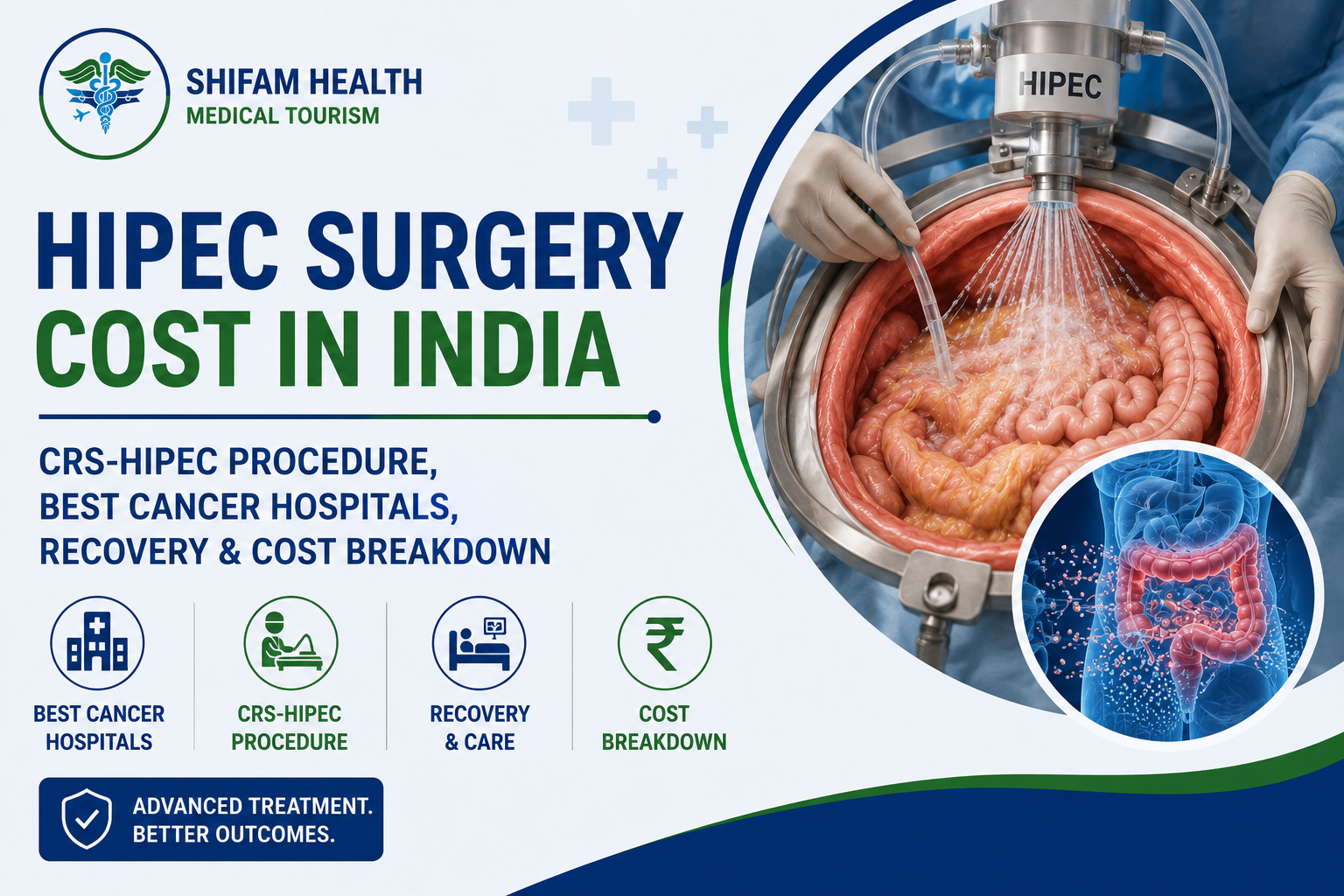
HIPEC surgery cost in India typically ranges from USD 8,000 to 18,000 for a complete international-patient package — covering cytoreductive surgery (CRS), the heated chemotherapy perfusion itself, ICU care, an 8–14 day hospital stay, and follow-up. Domestic pricing quoted to Indian residents is usually lower (roughly ₹3–12 lakh, or about $3,600–$14,400), since international packages are structured differently to include coordination, translation, and after-care support.
Published sources disagree meaningfully on this number — some quote as low as $2,700, others as high as $15,600 for the procedure alone, before ICU and stay costs. This isn’t inconsistency for its own sake: HIPEC pricing genuinely varies more than most surgeries because it depends heavily on your PCI (Peritoneal Cancer Index) score, how many organs need to be resected during CRS, which chemotherapy drug is used, and how long you need in the ICU afterward. Treat any number you see online — including this one — as a starting reference, and get a case-specific estimate after your surgical oncologist reviews your actual scans and pathology.
Planning HIPEC Surgery?
| Currency | CRS + HIPEC (Complete Package) |
|---|---|
| USD | $8,000 – $18,000 |
| GBP | £6,400 – £14,400 |
| EUR | €7,400 – €16,700 |
| AED | AED 29,400 – 66,100 |
| SAR | SAR 30,000 – 67,500 |
| BDT | ৳9,60,000 – ৳21,60,000 |
| Currency | CRS + HIPEC (Complete Package) |
|---|---|
| USD | $8,000 – $18,000 |
| GBP | £6,400 – £14,400 |
| EUR | €7,400 – €16,700 |
| AED | AED 29,400 – 66,100 |
| SAR | SAR 30,000 – 67,500 |
| BDT | ৳9,60,000 – ৳21,60,000 |
This is not medical advice, and no cost estimate should be treated as final until a surgical oncologist has reviewed your imaging, pathology, and overall fitness for surgery.
Table of Contents
ToggleWhat Is HIPEC Surgery?
HIPEC (Hyperthermic Intraperitoneal Chemotherapy) is a two-part cancer treatment used when cancer has spread across the lining of the abdominal cavity (the peritoneum) rather than to a single distant organ. It’s performed in two steps, in the same operation:
- Cytoreductive Surgery (CRS) — the surgeon physically removes all visible tumor deposits from the abdominal cavity, which can mean removing parts of the bowel, ovaries, spleen, or other affected tissue.
- HIPEC — immediately after CRS, a heated chemotherapy solution is circulated through the abdominal cavity for roughly 60–90 minutes to destroy microscopic cancer cells that surgery alone can’t remove.
The key difference from standard IV chemotherapy: instead of the drug traveling through your entire bloodstream, it’s delivered directly and at a much higher concentration to the exact area affected — while the heat itself also has a direct cancer-cell-damaging effect and improves how deeply the drug penetrates tissue. This localized delivery is why HIPEC can sometimes achieve outcomes that systemic chemotherapy alone can’t, in the right patients.
Which Cancers Can Be Treated With HIPEC?
HIPEC is used for cancers that have spread specifically to the peritoneal surface (peritoneal metastasis), not for cancers that have spread widely to distant organs like the liver, lungs, or bone. The most common candidates:
| Cancer Type | How Commonly Treated With HIPEC |
|---|---|
| Pseudomyxoma peritonei | Primary treatment in most cases. |
| Peritoneal mesothelioma | Primary treatment for eligible patients. |
| Appendiceal cancer with peritoneal spread | Commonly used. |
| Colorectal cancer with limited peritoneal metastasis | Used selectively in specific patients. |
| Ovarian cancer with peritoneal involvement | Increasingly used with standard treatment. |
| Gastric cancer with peritoneal spread | Used selectively; outcomes depend on disease extent. |
Not every patient with one of these cancers is a HIPEC candidate — eligibility depends heavily on how much disease is present and where
Who Is a Candidate for HIPEC?
Your surgical oncology team will assess several factors before recommending HIPEC:
- PCI (Peritoneal Cancer Index) — a scoring system (0–39) that measures how extensively the peritoneal surface is affected. Lower scores generally mean a more favorable candidate.
- Resectability — whether the surgical team believes all visible tumor can realistically be removed (the goal is “CC-0,” meaning no visible residual disease).
- Performance status — your general fitness and ability to tolerate a long, physically demanding surgery (often 6–14 hours).
- Organ function — kidney, liver, and cardiac/pulmonary function all need to be adequate to handle both major surgery and heated chemotherapy.
- Absence of significant disease outside the abdomen — HIPEC is generally not offered if cancer has spread widely to distant organs, since it wouldn’t address disease outside the peritoneal cavity.
If you don’t meet these criteria, that’s not a dead end — it usually means your oncologist will discuss alternative approaches (systemic chemotherapy, PIPAC, or a combination) that may be more appropriate for your specific situation. This guide cannot tell you whether you’re a candidate — only a surgical oncologist reviewing your actual imaging and pathology can.
HIPEC Surgery Cost in India — Detailed Breakdown
| Component | What It Covers |
|---|---|
| Initial consultation & workup | Surgical oncology consultation, blood tests, and tumor markers. |
| Imaging | PET-CT, CT scan, or MRI as required. |
| Diagnostic laparoscopy (if performed) | Assesses peritoneal disease before CRS + HIPEC. |
| Cytoreductive surgery | Surgeon’s fee, OT charges, tumor removal, and organ resections if needed. |
| HIPEC chemotherapy perfusion | Perfusion system and chemotherapy drugs (Mitomycin C, Oxaliplatin, or others). |
| Anesthesia | For the complete 6–14 hour procedure. |
| ICU stay | Usually 24–72 hours after surgery. |
| Hospital stay | Typically 8–14 days. |
| Medicines & consumables | Pain control, IV medications, and nutrition support if needed. |
| Histopathology | Laboratory analysis of removed tissue. |
| Follow-up | Wound review, scan assessment, and oncology consultation. |
CRS alone (without HIPEC, in cases where HIPEC isn’t indicated) generally costs less than the combined procedure, since it avoids the chemotherapy perfusion component. Repeat HIPEC, occasionally considered in select recurrence cases, is priced similarly to the original procedure and is a decision made only after multidisciplinary tumor board review.
What Actually Drives the Cost Up or Down
- PCI score and disease extent — a higher PCI generally means longer surgery, more organs resected, and a longer ICU stay
- Number of organ resections required during CRS
- Chemotherapy drug selected — some agents (like Oxaliplatin) cost more than others
- Length of ICU stay — complications or a more extensive procedure can extend this significantly
- Hospital category — government/trust hospitals are typically the most affordable but may have longer waiting periods; premium private cancer centers with dedicated HIPEC programs cost more but often have more perfusion-machine experience and faster scheduling
- Total hospital stay — 8 days vs. 14 days makes a real difference to the final bill
Step-by-Step: What Happens During CRS + HIPEC
- Pre-op evaluation — imaging, blood work, cardiac and pulmonary fitness assessment, tumor board discussion
- General anesthesia is administered
- Cytoreductive surgery — the surgeon systematically removes all visible tumor deposits, which may involve resecting sections of bowel, the omentum, or other affected structures; this phase alone can take several hours
- Catheter placement — two catheters are placed in the abdominal cavity, one for inflow and one for outflow of the chemotherapy solution
- Heated chemotherapy perfusion — a heated (typically ~42°C) chemotherapy solution is circulated through the abdominal cavity for 60–90 minutes
- Washout and closure — the chemotherapy solution is drained, the abdomen is rinsed, and incisions are closed
- ICU recovery — close monitoring for at least 24–72 hours, given the length and intensity of the combined procedure
- Ward recovery — gradual return to oral nutrition, mobility, and monitoring before discharge
The full combined procedure commonly takes 6–14 hours, depending on how much disease needs to be addressed during the cytoreductive phase.
HIPEC vs. Standard IV Chemotherapy
| Factor | HIPEC | Standard IV Chemotherapy |
|---|---|---|
| Delivery | Directly into the abdominal cavity. | Delivered systemically through the bloodstream. |
| Drug Concentration | Much higher at the tumor site. | Lower due to body-wide distribution. |
| Whole-Body Side Effects | Generally reduced. | More pronounced from systemic exposure. |
| Major Surgery Required | Yes, always combined with CRS. | No. |
| Typical Setting | One-time procedure with CRS. | Repeated treatment cycles over weeks or months. |
| Primary Use | Peritoneal surface cancers. | Broad range of cancer types and stages. |
HIPEC isn’t a replacement for systemic chemotherapy in most treatment plans — many patients receive standard chemotherapy before and/or after CRS+HIPEC as part of a combined strategy decided by a multidisciplinary tumor board.
HIPEC vs. PIPAC
PIPAC (Pressurized Intraperitoneal Aerosol Chemotherapy) is a related but distinctly different technique that’s frequently confused with HIPEC:
| Factor | HIPEC | PIPAC |
|---|---|---|
| Combined with Major Surgery | Yes, always with CRS. | No. Performed laparoscopically. |
| Chemotherapy Delivery | Heated liquid circulated in the abdomen. | Pressurized aerosol (mist). |
| Typical Use | Curative intent for resectable disease. | Usually palliative or for unresectable disease. |
| Recovery Time | Longer due to major surgery. | Much shorter. |
| Repeatability | Rarely repeated. | Repeated every 4–6 weeks if needed. |
| Relative Cost | Higher as a one-time major procedure. | Lower per session but requires multiple sessions. |
If your disease is too extensive for complete surgical removal, your oncologist may discuss PIPAC as an alternative or complementary option rather than HIPEC — this is a case-specific decision, not a matter of one being universally “better.”
Diagnosis and Pre-Surgery Workup
Before HIPEC is recommended, expect a thorough diagnostic pathway: detailed history and physical exam, CT scan and/or MRI, PET-CT to assess disease extent, tumor marker blood tests, and often a diagnostic laparoscopy to directly visualize and score the peritoneal disease (calculating the PCI) before committing to full surgery. Colonoscopy or upper endoscopy may be added depending on the suspected primary cancer site. Cardiac and pulmonary fitness evaluation is standard, given how demanding the combined procedure is on the body.
Recovery After HIPEC
| Stage | What to Expect |
|---|---|
| ICU (24–72+ hours) | Close monitoring of vital signs, kidney function, and fluid balance. |
| Hospital Stay (8–14 days) | Gradual walking, wound care, and return to oral nutrition. |
| Week 1–2 | Fatigue is common. Activity increases gradually with regular follow-up. |
| Month 1 | Energy levels and appetite continue to improve. |
| Month 3 | Follow-up scans assess recovery and guide further treatment. |
| Month 6 | Routine surveillance imaging as advised by the oncology team. |
Nutrition support (sometimes via feeding tube or IV in the initial days) is common if extensive bowel resection was part of the surgery. Return to full normal activity varies significantly by how extensive the CRS portion was — this is genuinely individual, and your surgical team is the only reliable source for your specific timeline.
Risks and Possible Complications
CRS+HIPEC is major surgery combined with regional chemotherapy, and it carries meaningful risks that should be discussed openly with your surgical team: bleeding, infection, anastomotic leak (if bowel was resected and rejoined), prolonged ileus (bowel not resuming normal function), blood clots, organ injury during the extensive dissection required for CRS, and side effects from the chemotherapy itself (kidney stress, blood count suppression, nausea). Recovery is genuinely demanding — this is one of the more intensive procedures in surgical oncology, and it should be approached with realistic expectations, not treated as a routine day surgery. A reputable surgical oncologist will walk you through your individual risk profile in detail rather than minimizing it.
India vs. Other Medical Tourism Destinations
| Destination | Approx. CRS + HIPEC Cost (USD) | Typical Wait Time |
|---|---|---|
| India | $8,000 – $18,000 | 1–3 weeks |
| USA | $60,000 – $150,000+ | Weeks (insurance dependent) |
| UK (Private) | $45,000 – $90,000 | Weeks to months |
| UAE | $30,000 – $55,000 | 1–3 weeks |
| Turkey | $15,000 – $28,000 | 1–2 weeks |
| Thailand | $18,000 – $32,000 | 1–3 weeks |
India’s cost advantage for HIPEC is unusually large compared to other procedures, largely because HIPEC in the West is billed at highly specialized cancer-center rates with limited price competition, while India has multiple experienced surgical oncology programs competing on both quality and cost. That gap is a genuine reason patients travel — but PCI complexity, drug selection, and length of stay still matter far more to your final number than which country you choose.
Choosing the Right Hospital
For a procedure this complex, hospital selection should weigh:
- Actual HIPEC case volume and a dedicated peritoneal surface malignancy program — not just general oncology capability
- Multidisciplinary tumor board — your case should be reviewed by surgical oncology, medical oncology, and radiology together, not decided by a single surgeon in isolation
- ICU capability — given the intensity of recovery, this isn’t optional
- In-house pathology for intraoperative and post-operative tissue analysis
- Accreditation (NABH/JCI) as a baseline quality signal, not a substitute for asking about actual HIPEC experience
- International patient department — coordinated visa support, transparent written estimates before you commit to travel
Best Cancer Hospitals for HIPEC Surgery in India
India is home to several leading cancer hospitals offering advanced CRS-HIPEC (Cytoreductive Surgery with Hyperthermic Intraperitoneal Chemotherapy) performed by experienced surgical oncology teams. Hospitals such as Medanta – The Medicity, Apollo Hospitals, Max Super Speciality Hospital, Fortis Memorial Research Institute, HCG Cancer Centre, and Tata Memorial Hospital provide comprehensive cancer care with modern operation theatres, advanced intensive care units, multidisciplinary tumor boards, and personalized rehabilitation. These centers follow international treatment protocols and are well-equipped to care for both Indian and overseas patients requiring complex peritoneal cancer surgery.
Frequently Asked Questions
How much does HIPEC surgery cost in India?
Complete international-patient packages typically range $8,000–$18,000, though published sources vary widely ($2,700–$15,600+) depending on what’s included. Get a case-specific quote after your reports are reviewed.
What is CRS-HIPEC?
Cytoreductive surgery (CRS) is the surgical removal of visible tumors from the abdominal cavity; HIPEC is the heated chemotherapy perfusion performed immediately after, in the same procedure, to target microscopic remaining cancer cells.
Is HIPEC painful?
As with any major abdominal surgery, there’s significant post-operative pain, managed with pain control protocols during the hospital stay. Recovery is more demanding than most standard surgeries given the procedure’s length and complexity.
Can international patients undergo HIPEC in India?
Yes — several Indian cancer centers have dedicated international patient programs and experienced HIPEC surgical teams.
How long should I plan to stay in India for HIPEC?
Typically 3–4 weeks total, accounting for pre-op workup, the 8–14 day hospital stay, and a recovery period before flying is medically appropriate — confirm exact timing with your surgical team.
Is HIPEC better than standard chemotherapy?
Neither is universally “better” — they serve different purposes and are often used together as part of one treatment plan. HIPEC is specifically for peritoneal surface disease; it doesn’t replace systemic chemotherapy in most cases.
Does HIPEC cure cancer?
Outcomes vary significantly by cancer type, PCI score, and how completely the tumor was removed during CRS. No responsible source can promise a cure — discuss realistic expectations for your specific case with your oncology team.
What cancers qualify for HIPEC?
Most commonly pseudomyxoma peritonei, peritoneal mesothelioma, appendiceal cancer, and selectively colorectal, ovarian, and gastric cancers with peritoneal spread.
What is a PCI score?
The Peritoneal Cancer Index — a 0–39 scoring system used to quantify how extensively cancer has spread across the peritoneal surface, used to help determine surgical candidacy.
People Also Ask
Who is eligible for HIPEC?
Patients with peritoneal metastasis from specific cancers (colorectal, ovarian, gastric, appendiceal, mesothelioma, pseudomyxoma peritonei) who have limited, potentially fully-resectable disease and adequate overall fitness. Eligibility is determined by a surgical oncology team, not by this guide.
How long is recovery after HIPEC?
Hospital stay is typically 8–14 days; full recovery of energy and normal activity often takes several weeks to a few months, depending on how extensive the surgery was
Can HIPEC be repeated?
Yes, in selected cases of cancer recurrence. The decision is made by a multidisciplinary tumor board based on your overall health and disease extent.
Is HIPEC available laparoscopically in India?
Yes, some specialized centers offer laparoscopic HIPEC for carefully selected patients, although open CRS with HIPEC remains the standard for advanced disease.
What should I eat after HIPEC surgery?
Your diet is introduced gradually under medical supervision, starting with liquids or tube feeding before progressing to solid foods.
What is the difference between HIPEC and PIPAC?
HIPEC is performed after cytoreductive surgery during a single operation, while PIPAC is a minimally invasive treatment that can be repeated when surgery is not possible.
Will insurance cover HIPEC treatment in India?
Coverage depends on your insurance provider and policy. Always confirm overseas treatment benefits before traveling.
What if I’m not a candidate for HIPEC?
Your oncology team may recommend alternatives such as systemic chemotherapy, targeted therapy, immunotherapy, or PIPAC, depending on your condition.
How many organs may be removed during CRS?
The number depends on how far the cancer has spread. Some patients require only limited tissue removal, while others may need bowel, spleen, or other organ resections.
Is HIPEC surgery safe?
HIPEC is a major procedure with potential risks, but experienced surgical oncology centers use specialized teams and ICU support to maximize patient safety.
How can I get a personalized HIPEC treatment cost estimate?
Share your CT scans, pathology reports, and medical records with Shifam Health. Our team will arrange a specialist review and provide a personalized treatment plan and cost estimate before you travel
How Shifam Health Supports Your HIPEC Journey
Shifam Health connects international patients with experienced surgical oncology teams for CRS+HIPEC, coordinates multidisciplinary tumor board review of your reports before you travel, and provides a transparent, case-specific cost estimate rather than a generic package price. Our team also handles medical visa documentation, airport pickup, accommodation, interpreter support, and post-treatment follow-up coordination.
If you already have imaging or pathology reports, our team can arrange a specialist review and realistic treatment plan — including an honest assessment of whether HIPEC is likely to be recommended for your specific case — before you commit to travel.
Get Your Free HIPEC Treatment Plan & Personalized Cost Estimate Today
Connect with India’s leading surgical oncology experts for a customized CRS-HIPEC treatment plan, transparent pricing, and end-to-end support for international patients.




Popular Posts From Last Week
- October 23, 2026
- shifamhealth
A fluttering chest, a sudden racing heartbeat or a skipped beat can be frightening, and it is hard…
- October 19, 2026
- shifamhealth
Coronary artery disease is one of the most common and serious heart conditions, yet it can develop quietly…
- October 22, 2026
- shifamhealth
A remote medical second opinion from India allows patients living in the USA, UK and other countries to…
- October 21, 2026
- shifamhealth
When you receive treatment estimates from two hospitals in India, do not compare only the final amounts. To…
- October 22, 2026
- shifamhealth
An itemized hospital quote in India should clearly explain the expected cost of treatment by separating major charges,…