


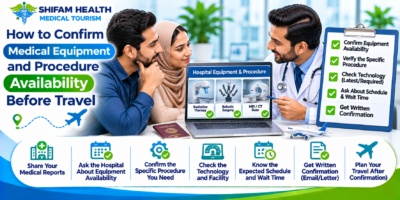
How to Confirm Medical Equipment and Procedure Availability Before Travel
Filters & Insights
Written By :
Medically Reviewed By :

Shifam Health Medical Team
Shifam Health - Medical Reviews Department
10+ Years Of Experience
Learn how to confirm hospital equipment, procedure, and specialist availability in India before booking medical travel.
📅
Last updated: November 21, 2026

Planning medical treatment in another country involves more than choosing a hospital and booking an appointment. Patients also need to confirm whether the hospital has the equipment, technology, specialists, and facilities required for their proposed procedure.
This is particularly important for international patients traveling to India for complex surgery, cancer treatment, cardiac procedures, organ transplantation, or advanced diagnostic services. A hospital may offer a particular specialty but may not provide every procedure or technology at every location. Some services may also depend on equipment availability, specialist schedules, clinical suitability, or referral arrangements.
Before booking flights or accommodation, ask the hospital to confirm the specific procedure and equipment you need. Request written information wherever possible, and make sure the confirmation relates to the exact hospital location where you will receive treatment.
This guide explains how to confirm medical equipment and procedure availability in Indian hospitals, which questions to ask, what documents to prepare, and how to avoid common planning mistakes.
Table of Contents
ToggleWhy You Should Confirm Equipment and Procedure Availability Before Traveling
Hospitals may offer a wide range of medical specialties, but the availability of a particular procedure or technology can vary between facilities.
For example, a hospital may provide cardiac surgery but not offer every specialized cardiac procedure at the same location. Similarly, a cancer center may provide radiation therapy but may not have every type of radiation technology available.
Confirming availability in advance can help you:
- Avoid traveling to a facility that cannot provide the required procedure.
- Understand whether the hospital has the necessary diagnostic and treatment equipment.
- Check whether the relevant specialist is available.
- Find out whether additional tests are required before treatment.
- Understand whether a procedure is performed at the same hospital or through a referral arrangement.
- Plan the expected treatment schedule and length of stay.
- Request a more accurate treatment estimate.
Equipment availability alone does not establish that a procedure is clinically suitable. The treating specialist must review the patient’s medical records and determine the appropriate treatment approach.
Step-by-Step: How to Confirm Medical Equipment and Procedure Availability
Identify the Exact Procedure You Need
Before contacting a hospital, identify the procedure or treatment recommended by your current doctor. Avoid using only broad descriptions such as “heart treatment,” “cancer surgery,” or “advanced scan.”
Instead, provide the specific procedure name whenever possible.
Examples include:
- Robotic-assisted surgery
- Minimally invasive spine surgery
- Coronary angioplasty
- Bone marrow transplantation
- Proton beam therapy
- MRI or PET-CT imaging
- Joint replacement surgery
- Endoscopic procedures
If you are unsure about the exact medical terminology, share the recommendation or medical report from your doctor. The hospital’s clinical team can review the records and clarify which procedure or technology may be relevant.
For patients who need an initial assessment before traveling, pre-travel telemedicine and diagnostic coordination may help organize preliminary communication with the hospital.
Contact the Correct Hospital Department
Contact the hospital’s international patient department, appointment desk, or relevant specialty department. Explain that you are an international patient considering treatment and want to verify the availability of a specific procedure and the equipment required.
Ask the hospital to connect you with the department responsible for the treatment.
Depending on the procedure, this may include:
- Cardiology or cardiac surgery
- Neurosurgery or neurology
- Medical, surgical, or radiation oncology
- Orthopedics
- Urology
- Gastroenterology
- Interventional radiology
- Diagnostic imaging
Do not rely only on a general hospital enquiry response. For specialized procedures, request confirmation from the relevant clinical department or its authorized representative.
You can begin your research through the Shifam Health hospital directory and then contact the specific facility directly.
Confirm Whether the Hospital Performs the Procedure
Ask the hospital whether the exact procedure is currently performed at the facility you are considering.
Useful questions include:
- Does this hospital currently perform the procedure I have been advised to undergo?
- Is the procedure performed at this exact hospital location?
- Is it available for international patients?
- Which department handles the procedure?
- Does the hospital have a specialist who performs it?
- Is the procedure performed regularly or only in selected cases?
- Does the hospital require additional tests before confirming eligibility?
If the procedure is not available at the selected facility, ask whether the hospital can refer patients to another center. Confirm the location and arrangements before making travel plans.
Verify the Required Medical Equipment and Technology
The next step is to confirm whether the equipment required for your proposed procedure is available.
For example, patients considering cancer treatment may need to ask about radiation therapy systems, imaging equipment, or surgical technology. Patients planning cardiac treatment may need information about catheterization laboratories, cardiac imaging, or interventional facilities.
Ask:
- Does the hospital have the equipment required for my proposed procedure?
- Is the equipment available at the hospital location where I will receive treatment?
- Is the equipment currently operational and available for clinical use?
- Does the procedure require any additional equipment or supporting facilities?
- Is the equipment operated by trained and qualified staff?
- Does the hospital need to schedule the procedure in advance?
You can also ask whether the equipment is owned and operated by the hospital or accessed through an external service provider. This distinction may affect scheduling and coordination.
For advanced cancer treatment, the guide to choosing a proton therapy center in India provides additional points to consider when evaluating a specialized treatment facility.
Check the Availability of the Specialist and Supporting Team
A hospital may have the required technology but still need to schedule the procedure according to specialist availability.
Ask whether the relevant doctor is currently practicing at the facility and whether the doctor personally performs the procedure you are considering.
You should also confirm whether supporting specialists and clinical teams are available when required.
Depending on the treatment, these may include:
- Anesthesiologists
- Radiologists
- Pathologists
- Critical care specialists
- Surgical assistants
- Specialized nursing teams
- Rehabilitation professionals
Ask whether the specialist is available during your proposed treatment period and whether an appointment or consultation can be arranged before arrival.
Confirm Whether Additional Tests Are Required
Some procedures require diagnostic investigations before the treating team can confirm eligibility or finalize a treatment plan.
These may include:
- MRI or CT scans
- PET-CT imaging
- Echocardiography
- Angiography
- Blood investigations
- Biopsy and pathology review
- Pulmonary function tests
- Cardiac fitness assessments
Ask the hospital whether it can review your existing reports or whether additional investigations are likely to be required after arrival.
Do not repeat expensive tests unnecessarily without discussing their relevance with the treating specialist. The hospital’s clinical team should determine which reports are acceptable and whether further investigations are needed.
Request Written Confirmation Before Booking Travel
After receiving verbal information, request a written response through an official hospital email address or patient coordination channel.
The confirmation should ideally include:
- The name of the hospital and exact location
- The proposed procedure or service
- The relevant department
- The availability of required equipment, where confirmed
- The specialist or team responsible for assessment
- Any preliminary tests required
- The expected consultation or treatment scheduling process
- Any conditions that may affect final confirmation
Remember that a written statement about service availability is not the same as a confirmed treatment appointment. The hospital may still need to review medical records, conduct an examination, or complete investigations before approving the procedure.
Questions to Ask About Different Types of Medical Equipment
The equipment you need to verify depends on your medical condition and proposed treatment. Use the following examples as a starting point rather than assuming that every patient requires all the listed facilities.
| Treatment area | Equipment or facility to confirm | Questions to ask |
|---|---|---|
| Cancer treatment | Linear accelerator, brachytherapy facilities, proton therapy where relevant | Is the required radiation technology available at this location? |
| Cardiology | Cardiac catheterization laboratory, echocardiography, cardiac imaging | Are the required diagnostic or interventional services available? |
| Neurosurgery | Operating microscope, neuronavigation, intraoperative monitoring where relevant | Does the hospital have the technology needed for the proposed operation? |
| Orthopedics | Joint replacement systems, surgical instruments, imaging facilities | Can the hospital perform the recommended replacement or reconstruction procedure? |
| Urology | Endoscopy systems, laser equipment, robotic surgery where relevant | Is the required procedure and technology available for my case? |
| Diagnostic imaging | MRI, CT, PET-CT, ultrasound | Is the required scan available, and can it be scheduled before treatment? |
| Gastroenterology | Endoscopy, colonoscopy, ERCP facilities | Does the hospital perform the required diagnostic or therapeutic procedure? |
The equipment listed is not a recommendation for a particular treatment. The treating specialist should determine which technology is appropriate for each patient’s condition.
Documents to Prepare Before Contacting the Hospital
Hospitals can provide more relevant answers when they receive clear medical information. Before sending an enquiry, organize the documents related to your diagnosis and proposed treatment.
Medical Records
Prepare:
- Recent consultation notes
- Diagnosis or referral letter
- Previous treatment summaries
- Operation reports, if applicable
- Discharge summaries
- Relevant blood test results
- Current medication list
- Known allergies
- Previous imaging reports
Diagnostic Images and Reports
If your treatment depends on imaging, share the relevant reports and images where possible.
These may include:
- MRI scans
- CT scans
- PET-CT scans
- X-rays
- Ultrasound reports
- Angiography images
- Biopsy and pathology reports
Ask the hospital how it prefers to receive imaging files. Some facilities may accept secure digital uploads, while others may request a specific file format or imaging disc.
Procedure and Equipment Details
If your current doctor has recommended a specific technology or procedure, include that information in your enquiry.
For example, if you have been advised to undergo robotic-assisted surgery, mention the procedure name and the reason your doctor recommended that approach. Do not assume that the same technology will be appropriate after the Indian specialist reviews your records.
How to Compare Hospitals Before Choosing One
When comparing hospitals, do not focus only on whether a hospital advertises a particular machine or advanced technology. Check whether the complete service required for your treatment is available.
Consider these factors:
| Comparison factor | What to verify |
|---|---|
| Procedure availability | Whether the exact procedure is performed at the selected facility |
| Equipment | Whether the required technology is available and operational |
| Specialist availability | Whether the relevant specialist is available for assessment and treatment |
| Supporting departments | Whether necessary diagnostic, anesthesia, intensive care, and other services are available |
| Scheduling | Whether the procedure can be scheduled within your expected travel period |
| Clinical suitability | Whether the treating specialist considers the procedure appropriate |
| Additional costs | Whether equipment, consumables, diagnostic tests, or external services affect the estimate |
| Accreditation | Whether the exact facility has current accreditation and what its scope covers |
You can review the hospital profiles of Apollo Hospitals, Fortis Healthcare, Max Healthcare, and Medanta – The Medicity as starting points for comparing facilities. Confirm the specific procedure, equipment, and specialist availability directly with the relevant hospital.
How to Verify Hospital Credentials and Equipment Claims
Hospitals may describe their services using terms such as advanced technology, robotic surgery, specialized imaging, or internationally accredited facilities. Patients should ask for specific details instead of relying only on promotional descriptions.
Verify the Hospital’s Accreditation
Ask for the hospital’s current accreditation status and confirm that it applies to the exact facility where treatment is planned.
Accreditation can provide information about a hospital’s quality systems and standards, but it does not independently confirm that a particular machine is available or that a specific procedure can be performed on your preferred date.
You can use the JCI-accredited hospitals in India guide as a starting point for understanding this accreditation category. Verify the current status directly with the accrediting organization.
Ask for Equipment-Specific Information
For specialized technology, ask the hospital for the equipment name, department, and intended clinical use.
For example, if a hospital says it offers robotic surgery, ask which robotic platform is available and which procedures are performed using it. If a hospital offers advanced radiation therapy, ask which treatment systems are available and whether the recommended treatment can be provided at that location.
The World Health Organization (WHO) explains the role of medical devices in healthcare delivery and the importance of appropriate selection, regulation, and management. Its medical devices guidance can help patients understand why equipment availability involves more than simply having a machine on-site.
In India, medical devices are regulated under the applicable framework overseen by the Central Drugs Standard Control Organization (CDSCO). Patients can consult the CDSCO official website for information about medical device regulation.
Check Whether the Equipment Is Actually Available for Your Treatment
A hospital may own a particular machine, but it may not be available for every patient or procedure at all times.
Ask whether:
- The equipment is operational.
- The required accessories and consumables are available.
- The equipment is used for the specific procedure you need.
- Trained staff are available to operate it.
- The procedure can be scheduled during your proposed stay.
- Maintenance or other scheduling issues may affect availability.
For certain specialized treatments, you may also ask whether the hospital follows relevant technical and safety requirements. For example, radiation facilities may operate under national regulatory requirements. The Atomic Energy Regulatory Board (AERB) provides information about radiation safety and regulatory oversight in India.
Common Mistakes to Avoid Before Traveling
Assuming Every Branch Offers the Same Services
A hospital group may operate multiple facilities in different cities. However, equipment and procedures available at one location may not be available at another.
Always confirm the exact hospital address and department where treatment will take place.
Confusing a Hospital’s Specialty With Procedure Availability
A hospital may have a cardiology or oncology department without offering every specialized procedure in that field.
Ask about the exact treatment rather than relying on a broad specialty listing.
Assuming That Equipment Availability Means Clinical Suitability
A machine or technology may be available, but it may not be appropriate for your medical condition.
The treating specialist must review your reports and determine the most suitable treatment approach.
Relying Only on Old Website Information
Hospital websites, brochures, and third-party listings may not reflect current equipment availability or specialist schedules.
Contact the hospital directly and request updated confirmation.
Not Asking About Additional Costs
Some procedures involve separate charges for equipment, consumables, implants, diagnostic tests, or external services.
Ask for a written estimate that explains what is included and what may be charged separately.
Booking Travel Before Receiving Confirmation
Avoid finalizing non-refundable flights or accommodation before the hospital has reviewed your medical records and clarified the likely treatment schedule.
A consultation may lead to additional tests or a change in the proposed treatment plan.
When Should You Contact the Hospital or a Specialist?
Contact the hospital as early as possible if your treatment requires specialized equipment, a specific procedure, or a particular specialist.
Early confirmation is especially important when:
- You are planning robotic or minimally invasive surgery.
- Your treatment requires specialized radiation technology.
- You need a complex cardiac or neurosurgical procedure.
- You are considering an organ or bone marrow transplant.
- Your treatment depends on advanced imaging or diagnostic facilities.
- You have a limited travel period and need coordinated appointments.
- Your current doctor has recommended a particular technology or procedure.
If the hospital needs additional medical information, provide the requested reports before making travel arrangements. For complex cases, ask whether the specialist can conduct an online consultation before your arrival.
How Shifam Health Can Help International Patients
International patients may need to contact several hospitals to confirm whether a procedure, specialist, or medical technology is available. Managing these enquiries while organizing medical records and travel arrangements can be difficult.
Shifam Health can assist with coordinating communication between international patients and hospitals in India. This may include:
- Sharing medical records with hospitals for clinical review.
- Coordinating requests for specialist opinions.
- Asking hospitals to clarify procedure and equipment availability.
- Requesting treatment plans and cost estimates.
- Helping organize online specialist consultations.
- Coordinating medical visa guidance and invitation-letter requests.
- Assisting with accommodation and airport pickup arrangements.
- Coordinating interpreter support where available.
The hospital’s clinical team remains responsible for confirming whether a procedure is available and medically appropriate. Shifam Health does not independently determine treatment suitability or guarantee equipment availability.
For a broader understanding of treatment planning and travel arrangements, read the complete guide to medical tourism in India.
If you are considering treatment in India, you can contact Shifam Health to discuss your requirements and request assistance coordinating hospital enquiries.
Frequently Asked Questions
How can I confirm whether a hospital in India performs a specific procedure?
Contact the hospital’s international patient department or relevant clinical department. Provide the procedure name and medical reports, and request written confirmation that the procedure is performed at the exact facility you are considering.
How do I check whether a hospital has the required medical equipment?
Ask the relevant department whether the equipment is available, operational, and used for your proposed procedure. Confirm that trained staff and supporting facilities are also available.
Can I confirm procedure availability before traveling to India?
Yes. You can send medical reports and diagnostic records to the hospital for preliminary review. The hospital may provide information about available services and arrange an online consultation before travel. Final treatment decisions may require an in-person assessment.
Does every branch of a hospital group offer the same equipment?
No. Equipment, specialists, and procedures can differ between locations. Always confirm the exact hospital branch where your treatment is planned.
Should I book flights after receiving a hospital estimate?
It is safer to wait until the hospital has reviewed your medical records and clarified the consultation and treatment schedule. A cost estimate alone does not guarantee that a procedure has been approved or scheduled.
What should I do if the required equipment is unavailable?
Ask whether the hospital can recommend another facility or arrange a referral. Confirm the alternative hospital’s location, specialist availability, procedure arrangements, and expected costs before making travel plans.
Conclusion
Confirming medical equipment and procedure availability before traveling is an important part of choosing a hospital in India. A hospital may have a well-known specialty or advertise advanced technology, but patients should still verify whether the exact procedure and required equipment are available at the specific facility where treatment is planned.
Start by identifying the recommended procedure and organizing your medical reports. Contact the relevant hospital department, ask about equipment and specialist availability, and clarify whether additional tests or consultations are required. Request written confirmation and a detailed estimate before making major travel commitments.
Remember that equipment availability does not automatically mean a procedure is suitable for every patient. The treating specialist must review the medical records and determine the appropriate treatment. Hospital schedules, equipment maintenance, and clinical findings may also affect the final plan.
If you are planning treatment in India, Shifam Health can help coordinate communication with hospitals, organize medical record sharing, and request information about treatment options and estimated costs. This can help you make more informed arrangements before traveling, while the hospital’s clinical team remains responsible for medical assessment and treatment decisions.




Popular Posts From Last Week
- November 21, 2026
- Razi Khan
A practical guide for international patients on confirming medical equipment, procedure availability, specialist schedules, and hospital facilities in…
- November 20, 2026
- Razi Khan
Understanding treatment risks and alternatives helps patients participate in informed discussions with their doctors. This guide explains how…
- November 19, 2026
- Razi Khan
When surgery is recommended, patients may want to understand whether medication, physiotherapy, injections or other non-surgical options are…
- November 19, 2026
- Razi Khan
Planning treatment abroad involves understanding what happens after the procedure, not just the hospital stay. This guide explains…
- November 19, 2026
- Shifam Health
After hospital discharge, some patients need help walking, using the bathroom, getting into vehicles or attending follow-up appointments….
- November 18, 2026
- Shifam Health
Learn how to organize a child’s medical records before travelling to India for treatment, including medical summaries, diagnostic…
- November 18, 2026
- Razi Khan
Learn how to prepare for a child’s hospital consultation abroad. This guide covers hospital checks, doctor credentials, medical…
- November 18, 2026
- Razi Khan
Planning medical travel for an older adult involves more than choosing a hospital. Learn how to assess travel…
- November 17, 2026
- Razi Khan
Learn how to support a patient with limited mobility during medical travel to India, including wheelchair assistance, accessible…
- November 17, 2026
- Razi Khan
Learn how international patients can manage time-zone differences when planning treatment in India, including specialist consultations, medical records,…
- November 16, 2026
- Shifam Health
Learn how to maintain a personal treatment timeline during medical travel, including consultations, diagnostic tests, treatment decisions, travel…
- November 17, 2026
- Razi Khan
Learn how international patients can confirm medical interpreter and translation support before treatment in India, including hospital arrangements,…