
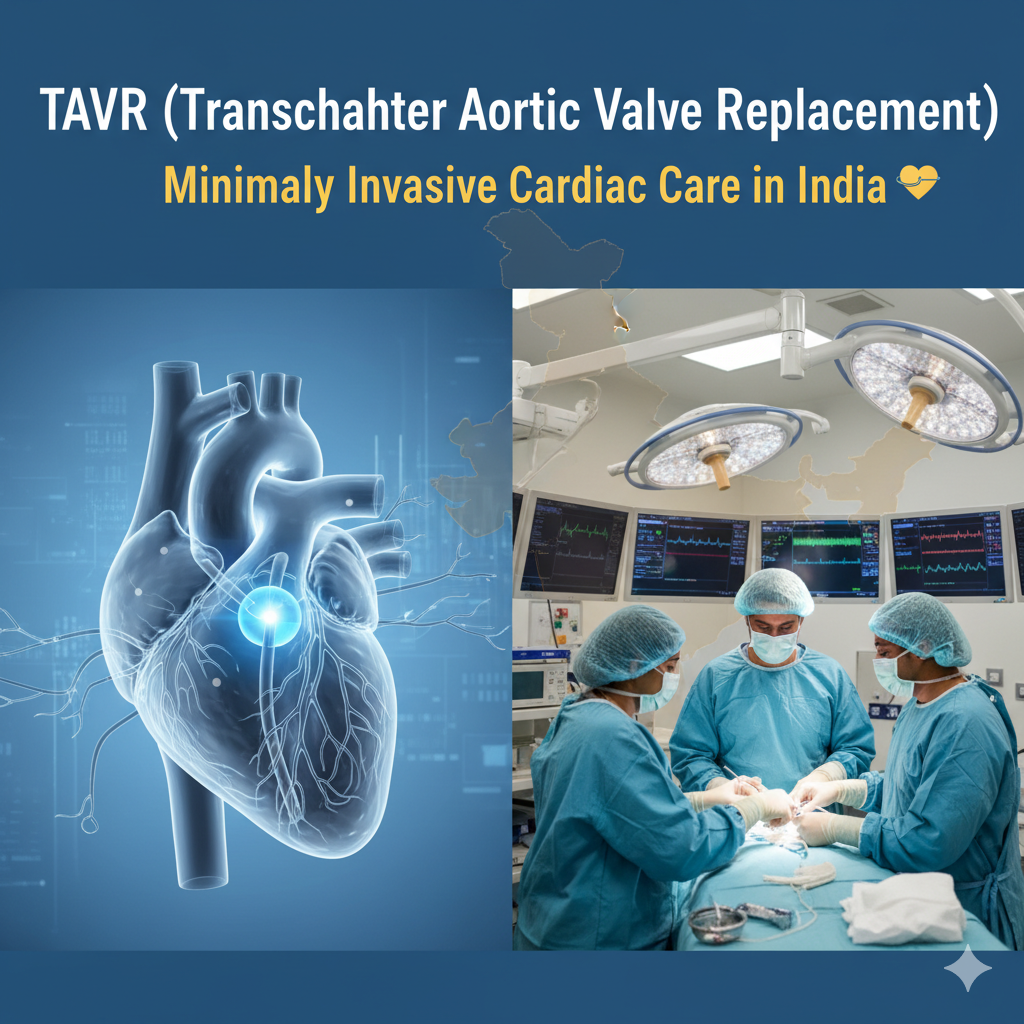
TAVR (Transcatheter Aortic Valve Replacement): Minimally Invasive Cardiac Care in India

Introduction: Revolutionizing Heart Valve Treatment
Heart valve problems, especially aortic stenosis, have traditionally required open-heart surgery with significant risks and long recovery times. However, medical science has made remarkable progress with TAVR (Transcatheter Aortic Valve Replacement). This groundbreaking procedure allows cardiologists to replace damaged heart valves without opening the chest. India has emerged as a global leader in adopting this next-generation technology, making advanced cardiac care accessible and affordable for patients worldwide.
TAVR represents one of the most significant advances in cardiology in recent decades. The procedure involves replacing the aortic valve through a small catheter inserted typically through the groin artery. Unlike traditional surgery that requires cutting through the breastbone, TAVR offers a minimally invasive approach that has transformed treatment for thousands of patients, particularly elderly individuals and those considered high-risk for conventional surgery.
Understanding TAVR: A New Approach to Heart Valve Disease
What is TAVR Procedure?
TAVR is a minimally invasive procedure that replaces a narrowed aortic valve that fails to open properly. The new valve is delivered through a catheter inserted in the leg or chest. It compresses the new valve into a catheter-based delivery system. Doctors guide the catheter through blood vessels to the heart. Once positioned perfectly, the new valve expands, pushing the old valve leaflets aside and taking over the valve’s function immediately.
The procedure typically takes 1-2 hours and is performed in a specialized hybrid operating room. Patients receive local anesthesia and sedation rather than general anesthesia in most cases. This approach significantly reduces risks associated with traditional open-heart surgery while providing equally effective results for eligible patients.
Who Needs TAVR?
TAVR primarily helps patients with severe aortic stenosis, a condition where the heart’s aortic valve narrows, restricting blood flow from the heart to the body. Common candidates include elderly patients over 75 years, individuals with multiple health conditions making open-heart surgery risky, people who have had previous heart surgeries, and patients with conditions like porcelain aorta or radiation damage to the chest. Additionally, TAVR is now increasingly used for younger patients and those at intermediate risk.
India’s Leadership in TAVR Technology
Advanced Cardiac Infrastructure
Indian hospitals performing TAVR procedures have invested in state-of-the-art technology matching global standards. These facilities feature hybrid cath labs that combine catheterization laboratory capabilities with operating room facilities. Advanced imaging systems including 3D echocardiography and CT scanning ensure precise valve sizing and placement. The country’s cardiac centers maintain comprehensive heart teams including interventional cardiologists, cardiac surgeons, radiologists, and anesthesiologists who collaborate on each case.
Growing Expertise and Volume
India’s TAVR program benefits from rapidly growing experience and high procedure volumes. Indian cardiologists have performed thousands of successful TAVR procedures with outcomes matching international standards. Many leading cardiac specialists have trained at prestigious international institutions and bring global expertise to patient care. The collaborative heart team approach ensures comprehensive evaluation and optimal treatment planning for each patient.
Also Read : CAR-T Cell Therapy in India: A New Hope for Cancer Patients
Cost Advantage: India vs Other Countries
Significant Cost Savings
TAVR procedure costs in India present one of the most compelling advantages for international patients:
- India: $10,000 – $15,000
- United States: $50,000 – $75,000
- United Kingdom: $45,000 – $65,000
- Singapore: $40,000 – $60,000
- Germany: $48,000 – $70,000
These prices represent all-inclusive packages covering the valve implant, hospital stay, diagnostic tests, and physician fees. Patients save 70-80% compared to Western countries while receiving the same quality valves and comparable medical expertise.
Value Beyond Cost
Beyond financial savings, India offers additional value through shorter waiting times, personalized care, and comprehensive support services. International patients typically receive treatment within 1-2 weeks of inquiry compared to several months in many Western countries. Hospitals provide dedicated international patient coordinators who assist with medical visas, travel arrangements, accommodation, and language interpretation services.
Also Read : Sports Injury and Arthroscopy Treatments in India: A Global Destination for Advanced Care
The TAVR Procedure Journey in India
Pre-Procedure Evaluation
The TAVR journey begins with comprehensive assessment including echocardiogram, CT angiography, heart catheterization, and blood tests. The heart team reviews all data to determine the optimal approach. Valve sizing is crucial and done through sophisticated 3D reconstruction of CT scans. Patients receive detailed education about the procedure, recovery expectations, and lifestyle modifications needed post-procedure.
Procedure Day Experience
On procedure day, patients receive mild sedation rather than general anesthesia. The team makes a small incision in the groin and inserts a catheter carrying the compressed valve. Using live X-ray guidance, specialists navigate the catheter to the heart and position the new valve within the existing aortic valve. The team then expands the new valve, which immediately begins functioning. The entire process takes 1-2 hours with minimal discomfort.
Recovery and Follow-up
Recovery after TAVR is significantly faster than traditional surgery. Most patients sit up the same evening and walk the next morning. Hospital stay typically lasts 2-4 days compared to 7-10 days for open-heart surgery. Patients return to normal activities within 1-2 weeks rather than 2-3 months. Regular follow-up includes echocardiograms to monitor valve function and medications to prevent blood clots.
Also Read : Digital Health Records and Your Privacy in India: Your Simple Guide to Rights and Safety
Success Rates and Clinical Outcomes
Proven Effectiveness
Indian cardiac centers report excellent TAVR outcomes that match global standards:
- Procedure Success Rate: 95-98%
- 30-Day Survival Rate: 97-99%
- Significant Symptom Improvement: 90-95% of patients
- Stroke Risk: 1-2%
- Valve Durability: 10+ years and continuing
These results demonstrate that India provides world-class TAVR care while maintaining exceptional safety standards and clinical outcomes.
Quality of Life Improvements
Patients experience dramatic improvements in symptoms and quality of life following TAVR. Breathlessness reduces significantly, exercise capacity improves, and fatigue diminishes. Most patients return to normal activities they had abandoned due to heart valve disease. The psychological benefit of avoiding open-heart surgery while receiving effective treatment significantly enhances patient satisfaction.
Also Read : Why India is Now the Global Leader in Pediatric Cardiac Surgery
Frequently Asked Questions
Q1: How long does a TAVR valve last?
A: Current data shows TAVR valves last 10+ years with ongoing studies showing longer durability.
Q2: What is the age limit for TAVR?
A: There’s no strict age limit; patients from 60-100+ have successfully undergone TAVR based on health status.
Q3: Can TAVR be done twice if needed?
A: Yes, valve-in-valve TAVR can be performed when the first TAVR valve wears out.
Q4: Is TAVR covered by insurance?
A: Most Indian hospitals help international patients with insurance claims and many procedures are covered.
Q5: How soon can I travel after TAVR?
A: Most patients can travel within 2-3 weeks after the procedure.
Q6: What makes India’s TAVR program special?
A: India offers world-class TAVR at 70% lower cost with excellent outcomes and minimal waiting times.
Why India Stands Out for TAVR
Rapid Technology Adoption
India has quickly embraced TAVR technology since its introduction, with over 100 centers now performing the procedure regularly. Indian cardiologists actively participate in global clinical trials and contribute to valve technology development. The country has early access to latest-generation valves and delivery systems. This rapid adoption ensures patients receive the most advanced treatment options available worldwide.
Comprehensive Cardiac Care Ecosystem
India’s strength in TAVR stems from its well-developed cardiac care ecosystem. The country has numerous JCI and NABH accredited hospitals specializing in cardiac care. Strong collaboration between interventional cardiologists and cardiac surgeons ensures optimal patient selection and management. Robust training programs ensure continuous skill development among healthcare professionals. Research initiatives contribute to improving techniques and outcomes.
Patient-Centered Approach
Indian hospitals prioritize patient experience and comfort throughout the TAVR journey. Multilingual staff and interpreters facilitate clear communication for international patients. Cultural sensitivity and personalized attention make patients feel comfortable and cared for. Comprehensive support services address all non-medical needs during the treatment stay. This holistic approach distinguishes India’s healthcare delivery and enhances patient satisfaction.
Conclusion: World-Class Heart Care at Accessible Prices
TAVR represents a paradigm shift in treating heart valve disease, offering patients a safe, effective alternative to open-heart surgery. India’s emergence as a global destination for TAVR demonstrates the country’s ability to provide cutting-edge medical technology at affordable prices. The combination of clinical excellence, technological sophistication, and remarkable cost-effectiveness makes India an ideal choice for international patients seeking advanced cardiac care.
The country’s cardiac centers have proven that high-quality healthcare need not be prohibitively expensive. With TAVR success rates matching international standards, significantly lower costs, minimal waiting times, and comprehensive patient support services, India has positioned itself as a leader in global cardiac care. For patients worldwide considering TAVR, India offers not just medical treatment but a complete healing experience that addresses clinical needs while providing exceptional value.
As TAVR technology continues to advance and applications expand, India stands ready to incorporate new developments while maintaining its commitment to making this life-changing procedure accessible to all who need it.
💛 Transform Your Heart Health with TAVR Surgery in India 💛
Experience world-class, minimally invasive cardiac care that blends precision, safety, and faster recovery with Shifam Health.
🫀✨ This advanced Transcatheter Aortic Valve Replacement (TAVR) procedure is performed by India’s leading cardiac experts in cutting-edge facilities. The combination of affordability, global standards, and compassionate care makes India a top destination for international patients. 🌍💉
✅ Restore your heart’s rhythm of life — choose expert TAVR surgery in India today!