


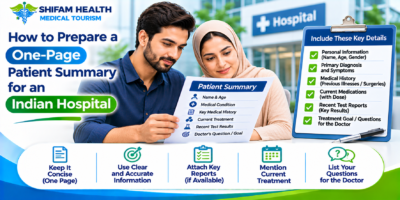
How to Prepare a One-Page Patient Summary for an Indian Hospital
Filters & Insights
Written By :
Medically Reviewed By :

Shifam Health Medical Team
Shifam Health - Medical Reviews Department
10+ Years Of Experience
Learn how to prepare a one-page patient summary for an Indian hospital, with a template and checklist for international patients.
📅
Last updated: November 22, 2026
When planning medical treatment in another country, patients often need to share their medical history with hospitals and specialists before traveling. However, medical records can include dozens of reports, prescriptions, scan results, and consultation notes. Reviewing all these documents at once may make it difficult to identify the most important information quickly.
A one-page patient summary provides a brief overview of the patient’s medical condition, previous treatment, current medicines, allergies, and reason for seeking care. It does not replace medical reports or a specialist’s assessment. Instead, it helps the receiving hospital understand the patient’s background and identify which records may be needed for further review.
For international patients considering treatment in India, preparing this summary before contacting hospitals can make communication more organized. It can also help family members explain the patient’s medical history more consistently.
This guide explains what to include, how to prepare the summary, which supporting documents to attach, and what to check before sharing it with an Indian hospital.
Table of Contents
ToggleWhat Is a One-Page Patient Summary?
A one-page patient summary is a concise document that brings together the most relevant information about a patient’s health. It gives a doctor or hospital team an initial overview without requiring them to search through every medical record immediately.
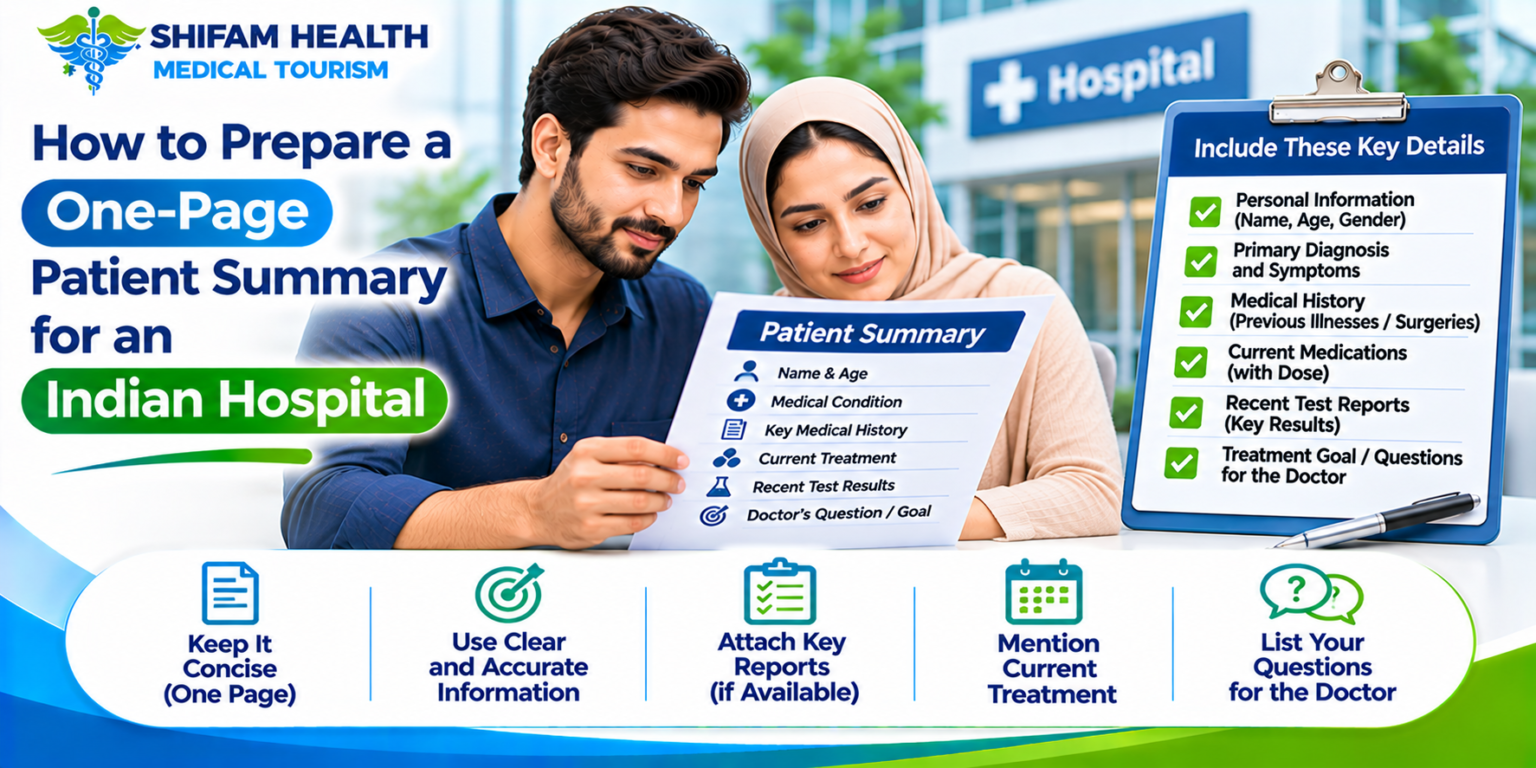
A useful summary generally includes:
- Patient identification and contact details.
- Main diagnosis or health concern.
- Current symptoms and when they started.
- Relevant medical history.
- Previous surgeries and treatments.
- Current medicines and known allergies.
- Important investigation findings.
- The reason for seeking treatment in India.
- Questions or concerns that the patient wants to discuss.
The summary should be factual, easy to read, and based on available medical records. If a diagnosis has not been confirmed, state that clearly rather than presenting a suspected condition as a confirmed diagnosis.
A patient summary is an organizational aid, not a medical diagnosis, treatment recommendation, or substitute for original reports. The treating specialist will decide what additional information and assessment are required.
If you are beginning to explore treatment abroad, our guide to how to get medical treatment abroad explains the initial planning process.
Why Should International Patients Prepare a One-Page Summary?
Preparing a short patient summary can make the first stage of communication with a hospital more straightforward.
It gives the hospital an initial overview
A specialist may receive several medical reports from a patient who is contacting the hospital from another country. A one-page summary helps identify the main medical concern, previous treatment, and important questions before reviewing the supporting records.
It helps organize medical information
Patients sometimes have reports from different hospitals, laboratories, and specialists. A summary creates a single reference document that brings the main details together.
It can make hospital communication clearer
When a patient contacts more than one hospital, a consistent summary can help ensure that the same basic information is shared each time. The patient should still provide any additional documents requested by each hospital.
It helps family members communicate accurately
An accompanying family member may be responsible for sharing reports or explaining the patient’s history. A written summary can help reduce the risk of forgetting important details.
It helps identify missing information
Preparing the summary may reveal missing dates, unclear medication details, incomplete treatment records, or reports that need to be obtained before a specialist review.
For a broader overview of choosing and evaluating hospitals, read how to prepare a checklist for choosing a hospital in India.
What Information Should a One-Page Patient Summary Include?
The summary should focus on information that helps the hospital understand why the patient is seeking medical care. Keep the layout simple and avoid adding every detail from the patient’s medical history.
Patient identification and contact details
Begin with basic information so the hospital can identify the patient and communicate with the appropriate person.
Include:
- Full name as written in the passport.
- Date of birth or age.
- Gender, if relevant to the medical assessment.
- Country of residence.
- Nationality, where relevant to administrative arrangements.
- Preferred contact number.
- Email address.
- Name and contact details of the accompanying family member, if applicable.
Use the patient’s correct details consistently across the summary and supporting documents. Avoid including unnecessary personal information, such as passport numbers, unless the hospital specifically requests it through an appropriate secure channel.
Main diagnosis or medical concern
Clearly explain why the patient is seeking medical attention.
Include:
- Confirmed diagnosis, if available.
- Suspected condition, if not yet confirmed.
- Date or approximate period when the condition was identified.
- Name of the doctor or hospital that made the diagnosis, if relevant.
- Main symptoms or concerns.
- Whether the condition has changed recently.
If the patient has not received a confirmed diagnosis, use wording such as “under investigation” or “suspected condition.” Do not interpret test results or make a diagnosis independently.
Current symptoms and relevant details
Provide a short description of the patient’s current symptoms.
For each important symptom, mention:
- When it started.
- Whether it is constant or intermittent.
- Whether it has improved, worsened, or remained unchanged.
- Any relevant observations documented by the treating doctor.
For example, a patient seeking evaluation for a persistent abdominal concern could write:
“Abdominal discomfort reported since approximately March 2026. Symptoms have continued intermittently. Previous ultrasound and blood test reports are attached.”
This is more useful than writing a vague statement such as “stomach problem.” However, only include details that accurately reflect the patient’s experience and available records.
Previous medical history
Mention medical conditions that may be relevant to the current concern or proposed treatment.
Examples include:
- Diabetes.
- High blood pressure.
- Heart disease.
- Kidney or liver conditions.
- Previous cancer diagnosis.
- Respiratory conditions.
- Neurological conditions.
- Previous major infections.
- Other significant chronic illnesses.
Do not list unrelated minor illnesses unless they may affect the specialist’s assessment or the planned treatment.
Previous surgeries and treatments
Summarize important procedures and treatments in chronological order.
Include:
- Name of the surgery or procedure.
- Approximate date.
- Hospital or location, if known.
- Relevant outcome or complications documented by the treating team.
- Previous chemotherapy, radiotherapy, dialysis, or other major treatment, where applicable.
For example:
“Appendectomy – 2022. No complications reported in the available discharge summary.”
For ongoing or complex treatment, attach the original records rather than trying to fit every detail into the summary.
Current medicines and known allergies
List the medicines the patient is currently taking, using the information on the prescription or medication packaging.
Where possible, include:
- Medicine name.
- Strength or dose.
- How often it is taken.
- Reason for taking it, if known.
- Any recently discontinued medicines that may be relevant.
Also mention known allergies, including the substance and the type of reaction if documented.
For example:
“Penicillin – reported allergic reaction: skin rash.”
If the patient is unsure about an allergy or medication detail, mark it as unconfirmed and ask the treating team rather than guessing.
Important investigations and findings
Mention the main tests and reports that support the patient’s medical history.
Examples include:
- Blood investigations.
- X-rays.
- Ultrasound.
- CT scans.
- MRI scans.
- PET-CT scans.
- Biopsy and pathology reports.
- Endoscopy reports.
- Cardiac investigations.
Include the test date and a brief description of the finding as written in the report. Do not independently interpret images or change the wording of a specialist’s findings.
The complete reports and original imaging files, where required, should be attached separately.
Reason for seeking treatment in India
Explain what the patient hopes to achieve by contacting the hospital.
For example:
- Seeking a specialist evaluation.
- Requesting a second medical opinion.
- Exploring treatment options.
- Reviewing whether surgery may be appropriate.
- Seeking further evaluation after previous treatment.
- Understanding the expected treatment process and estimated costs.
This section should describe the patient’s request, not state that a particular procedure is necessary.
Questions for the specialist
End the summary with a few important questions. These should reflect the patient’s actual concerns.
Examples include:
- What additional reports or investigations are required?
- Is an online consultation possible before travel?
- Which specialist or department should review the case?
- What treatment options may need to be discussed?
- What is the expected hospital stay if treatment is recommended?
- What further assessment may be required after arrival?
For help preparing questions for a consultation, the National Cancer Institute’s guidance on talking with your doctor offers useful communication advice for patients dealing with cancer. Its guidance is particularly relevant to cancer care, although the general practice of preparing questions can be useful in other medical discussions too.
Step-by-Step Process for Preparing a One-Page Patient Summary
Once you have collected the relevant information, follow these steps to create a clear and useful document.
Step 1: Collect the available medical records
Before writing the summary, gather the patient’s recent medical reports, prescriptions, discharge summaries, and previous treatment records.
Start with the documents most relevant to the current medical concern. If the patient has undergone treatment at multiple hospitals, arrange the records by date and identify which doctor or hospital prepared each report.
Do not delay urgent medical care while trying to complete a summary. Patients with severe or rapidly worsening symptoms should seek appropriate medical attention.
Step 2: Create a simple document
Use a standard word-processing document and keep the layout easy to read.
A practical format includes:
- A clear title: “Patient Medical Summary.”
- Patient details at the top.
- Short headings for each medical section.
- Bullet points instead of long paragraphs.
- Dates wherever relevant.
- A short section describing the purpose of the enquiry.
Use a readable font and avoid decorative formatting, unnecessary colors, or complicated tables.
Step 3: Write the information in chronological order
For previous diagnoses, procedures, and treatments, arrange the information from oldest to most recent.
A simple timeline helps the receiving specialist understand how the patient’s condition and treatment history have developed.
| Date or period | Medical event | Hospital or doctor |
|---|---|---|
| January 2024 | Initial diagnosis | Hospital A |
| March 2024 | Treatment started | Hospital A |
| September 2025 | Follow-up investigation | Hospital B |
| October 2026 | Latest consultation | Hospital B |
These are illustrative entries. Replace them with the patient’s actual medical history.
Step 4: Keep the wording factual and concise
Avoid long explanations, personal assumptions, or medical conclusions that are not supported by a doctor’s report.
Instead of writing:
“The previous treatment failed and the patient now needs surgery.”
Write:
“Symptoms have continued after the previous treatment. The patient would like a specialist review to understand the available options.”
The second version communicates the concern without making a treatment decision on behalf of the doctor.
Step 5: Check the summary against the original reports
Review names, dates, medicine details, diagnosis descriptions, and investigation findings.
Make sure that:
- The patient’s name is consistent.
- Dates are accurate.
- Current medicines are listed correctly.
- Allergies are not omitted.
- Previous treatments are described accurately.
- Unconfirmed diagnoses are clearly identified.
- No important medical information has been changed or exaggerated.
If a report is unclear, ask the doctor or hospital that issued it for clarification.
Step 6: Save the document as a PDF
Once the summary is complete, save it as a PDF to preserve its layout when sharing it with hospitals.
Use a clear file name, such as:
Patient_Summary_2026-11-18.pdf
Keep an editable copy in case the patient’s medical information changes. Update the PDF whenever important details are revised.
Step 7: Attach supporting medical reports separately
The one-page summary is an overview, not a replacement for the patient’s complete medical records.
Attach relevant supporting documents, such as:
- Recent consultation notes.
- Laboratory results.
- Imaging reports.
- Biopsy or pathology reports.
- Previous discharge summaries.
- Prescriptions.
- Relevant treatment records.
If the hospital requests original imaging files, ask about its preferred file format and secure submission method.
For additional guidance, read how to keep digital and printed copies of medical travel documents.
One-Page Patient Summary Template
The following template can be copied into a document and completed using the patient’s actual information. Keep the final version concise enough to fit on one page. If the medical history is extensive, use a separate timeline and supporting reports.
PATIENT MEDICAL SUMMARY
1. Patient Information
- Full name:
- Date of birth / Age:
- Gender, if relevant:
- Country of residence:
- Contact number:
- Email address:
- Accompanying family member, if applicable:
2. Main Medical Concern
- Confirmed diagnosis or suspected condition:
- Date of diagnosis or first symptoms:
- Main reason for seeking medical review:
3. Current Symptoms
- Main symptoms:
- When symptoms started:
- Recent changes, if any:
4. Relevant Medical History
- Existing medical conditions:
- Previous surgeries:
- Previous treatments:
- Significant complications, if documented:
5. Current Medicines and Allergies
- Current medicines, including dose where known:
- Known allergies and reported reactions:
6. Important Investigations
- Test or investigation:
- Date:
- Relevant finding as stated in the report:
7. Purpose of Contacting the Hospital
- Specialist evaluation / second opinion / treatment options / other:
8. Questions for the Specialist
- Which additional reports or tests are needed?
- Which specialist should review the case?
- What are the next steps for assessment?
Supporting documents attached: List the reports, prescriptions, imaging records, and discharge summaries included with the enquiry.
Date of preparation:
Prepared by: Patient / Family member / Authorized representative
The patient or authorized representative should review the summary before sharing it. If someone else prepares the document, the patient should confirm that the information is accurate wherever possible.
Common Mistakes to Avoid When Preparing a Patient Summary
A patient summary is useful only when the information is clear, accurate, and relevant. Avoid these common problems.
Including too much information
A summary that contains several pages of detailed medical history defeats its purpose. Include the most relevant information on the first page and attach additional records separately.
Leaving out important dates
Dates help specialists understand when symptoms started, when a diagnosis was made, and how previous treatment progressed. Include approximate dates if exact dates are unavailable, and label them as approximate.
Using unclear medical abbreviations
Different hospitals and specialists may interpret abbreviations differently. Use full medical terms wherever possible. If you use an abbreviation, write its full form the first time.
Presenting a suspected diagnosis as confirmed
Do not change a suspected condition into a confirmed diagnosis. Use the wording in the available medical records.
Forgetting current medicines and allergies
Current medicines and known allergies can be important when a specialist reviews the patient’s medical history. Check the latest prescriptions and mention any uncertainty.
Sending the summary without supporting records
The one-page document provides an overview, but the specialist may need original reports, investigation results, and imaging files. Attach the relevant records and ask whether anything else is required.
Sharing sensitive information carelessly
Medical summaries contain personal information. Send them only to the intended hospital or authorized recipient using an appropriate secure communication method. Avoid public links and unsecured file-sharing services.
For more information about maintaining personal health records, see MedlinePlus guidance on personal health records.
Questions to Ask Before Sending Your Patient Summary to an Indian Hospital
Before sharing the document, confirm how the hospital wants to receive medical information.
Useful questions include:
- Does the hospital accept a one-page patient summary for an initial review?
- Which medical reports should be attached?
- Are reports in languages other than English accepted?
- Are certified translations required for any documents?
- Does the hospital need original imaging files?
- Is there a secure email address or upload system for medical records?
- Can an online specialist consultation be arranged?
- Which department should receive the enquiry?
- Will the hospital request additional investigations before preparing a treatment plan?
- Can the hospital provide a preliminary treatment estimate after reviewing the records?
Requirements may differ between hospitals and specialties. Check the instructions of the specific hospital before sending documents.
You can explore the Shifam Health hospital directory and doctor directory to review available hospital and specialist information.
If you are comparing hospitals, also consider their relevant credentials, specialty services, and facilities. Our guide to JCI-accredited hospitals in India provides background on international hospital accreditation. Accreditation should be checked against the relevant hospital and its current status rather than assumed from a hospital group’s name.
When to Contact a Hospital or Specialist
Contact the hospital or relevant specialist if you are unsure what information to include or whether the available records are sufficient for an initial review.
You should seek clarification when:
- The diagnosis is uncertain or has changed.
- Important medical reports are missing.
- The patient has undergone recent surgery or treatment.
- There are new or worsening symptoms.
- The medication list is incomplete.
- A report contains unclear findings.
- The hospital requests additional tests or records.
- The patient needs to understand whether an online consultation is appropriate.
If the patient has a complex condition or wants another medical opinion, the appropriate specialist should review the complete medical records. For cancer-related cases, patients can explore the cancer second opinion service to understand the available coordination option.
Do not use a patient summary to decide whether a procedure is necessary or to change prescribed medicines. Those decisions should be discussed with qualified healthcare professionals.
How Shifam Health Can Help Coordinate the Initial Medical Enquiry
International patients may need to communicate with several hospitals and specialists before deciding where to seek treatment. Organizing the medical summary and supporting reports can make these discussions easier.
Shifam Health helps international patients coordinate medical travel arrangements in India. Depending on the patient’s requirements, assistance may include:
- Helping organize medical records for submission to a hospital.
- Coordinating communication with relevant hospitals and specialists.
- Assisting with requests for online consultations, where available.
- Requesting hospital treatment plans and estimated costs.
- Sharing information about available hospital options.
- Coordinating medical visa invitation-letter documentation where applicable.
- Assisting with accommodation and airport pickup arrangements.
- Coordinating interpreter support where available.
The hospital’s medical team remains responsible for reviewing the patient’s condition, requesting investigations, making diagnoses, and recommending treatment. A patient summary helps organize the information but does not replace a clinical assessment.
If you are considering treatment in India and need help understanding the initial coordination process, contact Shifam Health to discuss your requirements.
Frequently Asked Questions
What is the ideal length of a patient medical summary?
For an initial enquiry, aim for one page containing the most relevant medical and personal information. If the patient’s medical history is extensive, attach a separate timeline and supporting reports.
Should I prepare the patient summary before contacting an Indian hospital?
Yes, if possible. Preparing it in advance can make the initial enquiry more organized. However, do not delay urgent medical care while preparing documents.
Can a family member prepare the summary?
A family member can help organize the information, especially when the patient needs assistance. The patient or authorized representative should check the details for accuracy before sharing them.
Should I include all medical reports in the one-page summary?
No. Mention the important investigations and their dates, then attach the full reports separately. The specialist may request additional records or original imaging files.
Should the patient summary be translated into English?
Ask the receiving hospital whether it accepts documents in the original language or requires English translations. Translation requirements may differ by hospital and document type.
Does a one-page patient summary confirm that a hospital can provide treatment?
No. It is an initial information document. The hospital’s specialists must review the medical records and assess the patient before confirming a diagnosis or recommending treatment.
Final Thoughts
A one-page patient summary is a simple but useful tool for international patients contacting hospitals in India. It brings together the main medical details, previous treatments, current medicines, allergies, investigation findings, and reason for seeking care in a format that is easier to review.
Start by collecting the patient’s medical records and organizing the information by date. Write in clear language, distinguish confirmed diagnoses from suspected conditions, and check every detail against the original reports. Keep the summary brief and attach the relevant supporting documents separately.
Before sending it, confirm the hospital’s preferred method for receiving medical records and whether translations or original imaging files are required. Protect the patient’s personal information by sharing the document only with the intended recipient.
Most importantly, remember that the summary is a starting point for communication, not a substitute for a medical assessment. The treating specialist will determine whether further investigations, consultations, or treatment are appropriate. A well-prepared summary simply helps the patient and hospital begin that discussion with clearer information.



Popular Posts From Last Week
- November 22, 2026
- Razi Khan
Learn how to prepare a clear one-page patient summary before contacting an Indian hospital. This guide covers medical…
- November 20, 2026
- Razi Khan
Understanding treatment risks and alternatives helps patients participate in informed discussions with their doctors. This guide explains how…
- November 19, 2026
- Razi Khan
When surgery is recommended, patients may want to understand whether medication, physiotherapy, injections or other non-surgical options are…
- November 19, 2026
- Razi Khan
Planning treatment abroad involves understanding what happens after the procedure, not just the hospital stay. This guide explains…
- November 19, 2026
- Shifam Health
After hospital discharge, some patients need help walking, using the bathroom, getting into vehicles or attending follow-up appointments….
- November 18, 2026
- Shifam Health
Learn how to organize a child’s medical records before travelling to India for treatment, including medical summaries, diagnostic…
- November 18, 2026
- Razi Khan
Learn how to prepare for a child’s hospital consultation abroad. This guide covers hospital checks, doctor credentials, medical…
- November 18, 2026
- Razi Khan
Planning medical travel for an older adult involves more than choosing a hospital. Learn how to assess travel…
- November 17, 2026
- Razi Khan
Learn how to support a patient with limited mobility during medical travel to India, including wheelchair assistance, accessible…
- November 17, 2026
- Razi Khan
Learn how international patients can manage time-zone differences when planning treatment in India, including specialist consultations, medical records,…
- November 16, 2026
- Shifam Health
Learn how to maintain a personal treatment timeline during medical travel, including consultations, diagnostic tests, treatment decisions, travel…
- November 17, 2026
- Razi Khan
Learn how international patients can confirm medical interpreter and translation support before treatment in India, including hospital arrangements,…