



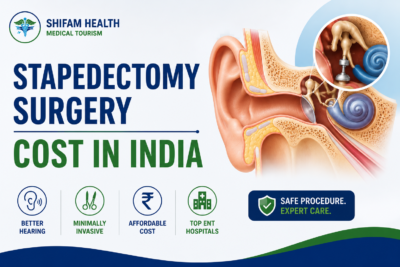
Stapedectomy Surgery Cost in India
Filters & Insights
Stapedectomy cost in India ranges from $900–$3,500 for international patients, versus $3,500–$9,000+ in the US & UK. Full cost breakdown, hospital selection guide, recovery timeline, & FAQs

Stapedectomy surgery in India typically costs $900 to $3,500 (roughly ₹75,000 to ₹2,90,000) for international patients, depending on the hospital, city, prosthesis type, and whether the package includes diagnostics, hospital stay, and follow-up care. This is 50–80% less than the $3,500–$9,000+ typically charged in the US, UK, or Australia for the same procedure, with comparable surgical outcomes at India’s NABH- and JCI-accredited ENT centers.
| Comparison | India (International Patient) | USA | UK |
|---|---|---|---|
| Typical Cost Range | $900–$3,500 | $3,500–$9,000+ | $5,000–$9,000 |
| Domestic / Local Pricing | ₹20,000–₹2,50,000 (~$250–$3,000) | Insurance-based | NHS covered; private £3,000–£7,000 |
| Typical Hospital Stay | Day-care to 1 night | Day-care | Day-care to 1 night |
| Reported Success Rate | ~90–95% hearing improvement | ~90% | ~90% |
These figures are drawn from published hospital price listings and medical-tourism facilitator quotes current as of 2025–2026. Actual quotes vary by patient and should always be confirmed directly with the treating hospital before booking travel.
Table of Contents
ToggleWhat Is Stapedectomy Surgery?
A stapedectomy is a microsurgical procedure that removes the stapes, the smallest bone in the human body, located deep in your middle ear and replaces it with a tiny prosthesis, usually made of titanium or Teflon. The goal is simple: restore the path that sound vibrations travel from your eardrum to your inner ear, so you can hear normally again without relying on a hearing aid.
The stapes is one of three connected bones (the malleus, incus, and stapes) that pass sound vibrations along like a relay. When the stapes becomes fixed in place and stops vibrating, sound gets stuck at that last handoff point. A stapedectomy bypasses the frozen bone entirely by replacing it with a working substitute.
Most ENT surgeons today actually perform a more precise variant called a stapedotomy. It a small hole is drilled into the footplate of the stapes rather than removing the whole structure but “stapedectomy” remains the term patients and search engines use for both, and we’ll use it that way throughout this guide, clarifying the distinction where it matters for your decision.
What Is Otosclerosis, and Why Does It Cause Hearing Loss?
Otosclerosis is the condition that makes stapedectomy necessary in the vast majority of cases. It’s a disorder in which abnormal, spongy bone grows around the stapes and gradually locks it in place. Once the bone can no longer vibrate, sound conduction from the eardrum to the inner ear weakens, a pattern known as conductive hearing loss.
Otosclerosis tends to run in families, often shows up between the ages of 20 and 40, and progresses slowly over years. It’s more common in women, and pregnancy can sometimes accelerate its progression. Left untreated, hearing loss usually worsens gradually rather than happening all at once, though the rate varies considerably from person to person.
Common early signs include:
- Difficulty hearing low-pitched or whispered sounds
- Hearing loss that starts in one ear before affecting both
- A sense that your own voice sounds unusually loud to you (this is a genuinely distinctive symptom of otosclerosis)
- Tinnitus (ringing or buzzing in the ear)
- Occasional dizziness or balance issues
If several of these apply to you and a family member has had similar hearing problems, it’s worth getting a hearing evaluation rather than assuming it’s simply age-related hearing loss, which has a different underlying mechanism and different treatment options.
Who Actually Needs This Surgery?
Stapedectomy is recommended for patients with confirmed conductive hearing loss caused by a fixed stapes bone most commonly from otosclerosis, though congenital stapes malformation is another, less common cause.
You may be a good candidate if:
- Audiometry confirms conductive hearing loss with a healthy inner ear (cochlea) function
- You have no active middle-ear infection
- You’re generally fit for a short procedure under local or general anesthesia
- Hearing aids haven’t provided adequate improvement, or you’d prefer a permanent surgical solution
Surgery is usually not recommended, or needs careful discussion first, if:
- You have an active ear infection at the time of evaluation
- Your only hearing ear has otosclerosis (surgeons are typically far more conservative here, since any surgical risk to your one functioning ear carries higher stakes)
- Your hearing loss is primarily sensorineural rather than conductive — a stapedectomy won’t fix inner ear or nerve-related hearing loss
- You have an unstable medical condition that makes even minor surgery risky
- You have very mild hearing loss that hearing aids already manage well and you’re not troubled by tinnitus or progression
A qualified otologist or neurotologist not a general ENT should confirm candidacy through audiometry and a physical exam before you commit to travel or surgery planning.
How Doctors Diagnose the Problem
Before recommending surgery, your ENT team will typically run a combination of hearing and imaging tests:
- Pure tone audiometry measures how well you hear sounds at different pitches and volumes, and is the primary test used to confirm conductive versus sensorineural hearing loss.
- Tympanometry checks how your eardrum moves in response to air pressure, helping rule out fluid buildup or eardrum problems that can mimic otosclerosis symptoms.
- Speech audiometry evaluates how clearly you can understand spoken words, not just detect sound.
- A CT scan of the temporal bone is sometimes ordered to rule out other causes of fixed ossicles and to give the surgeon a clearer anatomical picture before operating, particularly for revision cases.
- Microscopic examination of the ear canal and eardrum lets the surgeon rule out infection, perforation, or structural abnormalities that would need to be addressed before or during surgery.
If you’re planning to travel to India for treatment, most hospitals will ask you to send existing audiometry reports and imaging in advance so the surgical team can give you a realistic cost and treatment plan before you book flights.
Stapedectomy vs Stapedotomy vs Hearing Aids
Patients researching this procedure often get these three options mixed up. Here’s the honest breakdown.
| Comparison | Stapedectomy | Stapedotomy | Hearing Aids |
|---|---|---|---|
| What Happens | Entire stapes bone is removed and replaced with a prosthesis. | A small opening is made in the stapes footplate, and a prosthesis is inserted. | No surgery; sound is amplified with an external device. |
| Invasiveness | More invasive surgical option. | Less invasive and preferred by most surgeons. | Non-invasive. |
| Recovery | Similar recovery, with a slightly higher historical complication risk. | Usually faster recovery and lower risk of profound hearing loss. | No recovery period. |
| Permanence | Usually a one-time surgical solution. | Usually a one-time surgical solution. | Requires replacement every 4–6 years. |
| Cost Pattern | Comparable to stapedotomy. | Comparable to stapedectomy. | Lower upfront cost but ongoing replacement expenses. |
| Best For | Cases where stapedotomy is not technically feasible. | Most modern otosclerosis cases. | Patients who prefer to avoid surgery or are not surgical candidates. |
Studies referenced by hearing-health researchers generally find that the surgeon’s skill and experience influence outcomes more than which specific technique (stapedectomy vs. stapedotomy) is used — so when comparing hospitals, focus more on the surgeon’s case volume than on which exact procedure name is used in the quote.
Stapedectomy Surgery Cost in India: Full Breakdown
This is the section most patients are here for, so let’s be precise about what you’ll actually pay.
Domestic Indian pricing (what local patients pay)
Indian patients paying out-of-pocket at major private hospitals typically see quoted prices between ₹20,000 and ₹2,50,000 (roughly $250–$3,000), with an average around ₹80,000–₹1,10,000 ($950–$1,300). This is the “walk-in” domestic rate you’ll see advertised on Indian hospital-comparison platforms.
What international patients actually pay
If you’re traveling from abroad, expect your quoted package to run somewhat higher than the domestic advertised rate — typically $900 to $3,500 all-inclusive. This isn’t hospitals overcharging foreign patients; it reflects what’s actually bundled into an international package that a domestic walk-in price usually doesn’t include:
| Cost Component | What It Typically Covers |
|---|---|
| Surgeon’s Fee | The otologist or neurotologist’s professional fee for the procedure. |
| Operating Theatre & Anaesthesia | Operating room time, anaesthesiologist’s fee, and monitoring equipment. |
| Hospital Stay | Usually day-care, with an overnight stay in selected cases. |
| Pre-operative Diagnostics | Audiometry, tympanometry, and CT scan if required. |
| Prosthesis | Titanium or Teflon piston; material choice can affect the total cost. |
| Post-operative Medication | Ear drops, antibiotics, pain relief, and supportive medicines. |
| Follow-up Consultations | Typically 1–2 visits before returning home. |
| International Patient Coordination | Interpreter support, appointment scheduling, and sometimes airport transfers. |
A realistic estimate: budget $1,500–$2,500 for a straightforward, single-ear, first-time stapedectomy at a reputable private hospital, with costs trending toward the upper end if you choose a laser-assisted technique, a premium room category, or a hospital in a metro city like Delhi, Mumbai, or Bengaluru.
Revision surgery (a repeat procedure on an ear that’s already been operated on) generally costs more — often ₹80,000–₹1,50,000 domestically, or a comparable premium on international packages — because it’s technically more demanding and carries a somewhat lower success rate than a first-time procedure.
A note on quoted prices you’ll see online. You will find advertisements quoting stapedectomy “from $900” or even lower. Treat these as starting prices for the simplest possible case at the lowest room category, not as a reliable estimate of your total cost. Always request an itemized quote based on your actual audiometry results and preferred hospital before making travel plans.
What Actually Drives the Price Up or Down
- Surgical technique. Laser-assisted stapedotomy generally costs somewhat more than traditional microsurgical techniques, but often comes with faster recovery and fewer complications — many surgeons consider it worth the difference.
- Prosthesis material. Titanium pistons typically cost more than Teflon ones but are prized for precision and lower risk of migration.
- First-time vs. revision surgery. Revision cases take longer, are more technically demanding, and cost more.
- Hospital tier and accreditation. NABH- or JCI-accredited hospitals in metro cities generally charge more than smaller regional centers, reflecting infrastructure and surgeon experience.
- Room category. General ward vs. semi-private vs. private room can shift your total bill by a meaningful margin even though the surgical fee itself doesn’t change.
- Surgeon’s experience. A highly experienced otologist or neurotologist with a strong track record typically charges a premium — and for a procedure this delicate, that’s often a reasonable trade-off.
- Diagnostics required. If you arrive without prior audiometry or imaging, expect additional testing costs before surgery can even be scheduled.
- City. Tier-1 cities (Delhi NCR, Mumbai, Bengaluru, Chennai, Hyderabad) tend to price 15–30% higher than tier-2 cities for the same procedure, largely due to real estate and staffing costs rather than surgical quality differences.
India vs USA, UK, and Other Countries
| Country | Typical Cost (Self-Pay / Private) | What That Covers |
|---|---|---|
| India | $900–$3,500 | Comprehensive package including surgery, diagnostics, hospital stay, and follow-up. |
| USA | $3,500–$9,000+ (Mean study estimate: ~$3,500) | Usually covers surgery only; hospital, facility, and anaesthesia fees are often billed separately. |
| UK (Private) | $5,000–$9,000 | Private treatment package; the NHS covers eligible patients but may involve waiting lists. |
| UAE / Gulf | Comparable to or above UK private pricing | Package pricing with the advantage of shorter travel for Gulf-region patients. |
| Turkey | $2,500–$4,500 | All-inclusive medical tourism packages often include hotel accommodation and airport transfers. |
The gap between India and Western countries is real and consistent across nearly every published source, generally in the range of 50–80% savings. The most important thing to understand is why: it isn’t that Indian surgeons are less experienced — many were trained internationally and operate at hospitals holding the same JCI and NABH accreditation standards recognized globally — it’s that the overall cost structure of Indian healthcare (staffing, facility overhead, insurance-driven billing complexity) is fundamentally lower.
That said, cost should never be the only factor in your decision. A stapedectomy is a delicate microsurgical procedure on one of the smallest bones in the body; surgeon experience and hospital quality matter more than shaving off another few hundred dollars.
How to Choose the Right Hospital and Surgeon
Ask these questions before booking:
- Is the surgeon specifically an otologist or neurotologist, not a general ENT doing occasional ear surgery? Case volume in this specific procedure matters.
- What accreditation does the hospital hold? NABH and JCI are the two accreditations worth checking for.
- What’s included in the quoted price? Get a written, itemized breakdown covering surgeon’s fee, OT charges, anaesthesia, hospital stay, prosthesis, and follow-up — not just a headline number.
- What prosthesis material will be used, and why does the surgeon recommend it for your case?
- What’s the hospital’s revision rate for this procedure, if they’re willing to share it? (Be cautious of any hospital that claims a 100% or near-100% success rate — no honest surgical practice does.)
- Is remote follow-up available after you return home, via video consultation, in case you have questions during recovery?
- Do they support international patients directly — medical visa invitation letters, interpreter access, and coordinated appointment scheduling — or will you be navigating the hospital system alone?
Your Treatment Journey, Step by Step
- Initial consultation (remote or in-person)
Share your audiometry reports and medical history; the surgical team gives you a preliminary assessment and cost estimate.
- Travel planning
If surgery is confirmed as appropriate, you’ll typically need a medical visa, which requires an invitation letter from the treating hospital.
- In-country evaluation
On arrival, expect a hearing test, physical ear exam, and possibly a CT scan before the final surgical plan is confirmed.
- Pre-operative preparation
Bloodwork and anesthesia fitness checks, typically completed within a day or two of arrival
- Surgery
Performed under local or general anesthesia, usually taking 60–90 minutes for a single ear.
- Recovery room and same-day or next-day discharge
Most patients go home the same day or after one overnight stay.
- Early follow-up
A check-up within the first week to examine healing and remove any ear packing.
- Travel-home clearance
Your surgeon will confirm you’re fit to fly, typically after the first post-op review, though most surgeons recommend avoiding air travel for at least 1–2 weeks if possible
- Remote follow-up
Video consultations over the following weeks to track hearing improvement and address any concerns.
Recovery Timeline: When Will You Actually Hear Better?
Be realistic here — hearing improvement is not instant.
- Day of surgery to first week: Some ear fullness, mild dizziness, and packing inside the ear canal are normal. Hearing may actually seem worse immediately after surgery due to swelling and packing this is expected, not a sign something went wrong.
- Around 1 week: Ear packing is usually removed; many patients begin noticing early improvement.
- 2–4 weeks: Continue avoiding heavy nose-blowing, straining, and loud noise exposure while the middle ear heals.
- Up to 3–4 months: Hearing typically continues to improve gradually during this period as swelling fully resolves and the prosthesis settles.
- Flying: Most surgeons advise waiting at least 1–2 weeks before air travel, and some recommend longer depending on your specific recovery — confirm this directly with your surgeon rather than assuming a fixed timeline.
Activity guidance during recovery generally includes: avoiding swimming and getting water in the ear for several weeks, avoiding sudden pressure changes (flying, scuba diving, mountain driving) until cleared, and steering clear of loud noise exposure.
Risks and Complications: An Honest Look
No reputable source should tell you this surgery is risk-free, and we won’t either. Reported complication rates vary across studies, but the general pattern looks like this:
- Persistent or worsened hearing loss. In a small percentage of cases, hearing doesn’t improve as hoped, or in rare instances, worsens.
- Sensorineural hearing loss. A rare but serious complication where the inner ear itself is affected, potentially causing permanent hearing loss in that ear. This is the risk surgeons discuss most carefully with patients beforehand.
- Vertigo and dizziness. Common in the days immediately following surgery; usually temporary.
- Tinnitus. May persist or occasionally worsen after surgery, even when hearing itself improves.
- Taste disturbance. The chorda tympani nerve, which affects taste sensation, runs through the middle ear and can be temporarily or occasionally permanently affected.
- Facial nerve injury. Very rare, but a recognized risk given the facial nerve’s proximity to the surgical site.
- Need for revision surgery. A small subset of patients require a repeat procedure if the prosthesis shifts or the initial result doesn’t hold; published success rates for revision surgery are meaningfully lower than for first-time procedures.
This is not medical advice, and every patient’s individual risk profile differs based on their anatomy, the extent of otosclerosis, and whether it’s a first-time or revision procedure. A thorough, honest conversation with your specific surgeon not a generic online estimate — is the only reliable way to understand your personal risk.
Life After Stapedectomy
Most patients who undergo a successful stapedectomy no longer need a hearing aid in the operated ear and report a meaningful, lasting improvement in day-to-day hearing and speech clarity. That said, ongoing hearing monitoring is worth building into your routine:
- Periodic follow-up audiometry, even years later, helps catch any gradual changes early.
- Otosclerosis can sometimes progress in the other ear even after successful surgery on the first — this is why many surgeons wait around six months before considering surgery on the second ear, and why long-term monitoring of both ears matters.
- Continue avoiding unnecessary loud noise exposure and following any long-term precautions your surgeon recommends.
Frequently Asked Questions
Is stapedectomy cost in India really cheaper than in the US or UK?
Yes — generally by 50–80%, based on published cost comparisons. This reflects India’s lower overall healthcare cost structure, not lower surgical quality at accredited hospitals.
Does the price include the hospital stay?
Most quoted international-patient packages include day-care or one-night hospital stay, but always confirm this explicitly, since some domestic advertised prices only cover the surgical fee.
How long does the surgery itself take?
Typically 60–90 minutes for a single ear, performed under local or general anesthesia
Is stapedectomy painful?
Most patients report mild to moderate discomfort rather than severe pain, generally manageable with prescribed pain medication.
When will my hearing actually improve?
Initial improvement is often noticeable within the first week or two once ear packing is removed, but full improvement typically develops gradually over up to 3–4 months.
Can both ears be treated at the same time?
No. Stapedectomy is performed on one ear at a time, with the second ear usually treated about 6 months later if needed.
What happens if the surgery doesn’t work?
A small percentage of patients require revision surgery, which is more technically demanding and carries a somewhat lower success rate than a first-time procedure.
Can hearing aids be an alternative to surgery?
Yes, hearing aids are a valid non-surgical alternative, particularly for patients who aren’t good surgical candidates or prefer to avoid surgery, though they involve ongoing costs and don’t address the underlying otosclerosis
What should I avoid during recovery?
Water in the ear, forceful nose-blowing, heavy straining, loud noise exposure, and air travel or scuba diving until your surgeon clears you.
A Note Before You Decide
This guide is intended to help you understand realistic costs and what to expect — it is not a substitute for a personalized medical evaluation. Otosclerosis presentations vary, and only a qualified otologist reviewing your actual audiometry results can tell you whether stapedectomy is right for you, which technique fits your case, and what your realistic surgical risk looks like.
If you’d like a personalized cost estimate based on your own hearing test results, or want help connecting with an experienced otologist in India, Shifam Health’s team can review your reports and walk you through your options — no pressure, no obligation.
Recent Posts


Quick Inquiry Form
Popular Posts From Last Week
- July 13, 2026
- shifamhealth
Stapedectomy surgery in India typically costs $900 to $3,500 (roughly ₹75,000 to ₹2,90,000) for international patients, depending on…
- July 9, 2026
- shifamhealth
When the small intestine can no longer absorb enough nutrients to sustain life, the standard fallback is intravenous…
- July 8, 2026
- shifamhealth
If a scan just showed a swollen kidney and the word “UPJ obstruction,” you’re probably trying to answer…
- July 10, 2026
- shifamhealth
Kidney stones can cause severe pain, blood in the urine, recurrent infections, and even kidney damage if left…
- July 8, 2026
- Areen Fatima
Piles (hemorrhoid) surgery in India costs $500–$900 for conventional open hemorrhoidectomy, $700–$1,200 for stapled hemorrhoidopexy, and $900–$1,800 for…
- July 9, 2026
- Areen Fatima
If you or a family member has been told you need adrenal gland surgery, the first questions are…
- July 8, 2026
- shifamhealth
Can You Get Breast Reconstruction After Mastectomy in India? Yes. Breast reconstruction after mastectomy is a routine part…
- July 8, 2026
- shifamhealth
Quick Summary How Much Does Breast Reduction Surgery Cost in India? Breast reduction surgery in India costs roughly…
- July 9, 2026
- shifamhealth
Scar revision surgery can meaningfully improve but not completely erase the appearance and function of most scars. In…
- July 7, 2026
- shifamhealth
It usually starts with something small. A newborn’s skin looks a little more yellow than the nurses expected…
- July 7, 2026
- shifamhealth
Most parents don’t hear the words “cerebral palsy” during a single, calm conversation. It usually arrives in pieces…
- July 10, 2026
- shifamhealth
Recovery is one of the biggest concerns for anyone considering weight loss surgery. Questions like “How long will…