



Carpal Tunnel Syndrome: Symptoms, Causes, Diagnosis & Treatment
Filters & Insights
Carpal tunnel syndrome causes hand numbness and tingling from median nerve compression. Learn the real causes, when splinting works, and when surgery is needed.

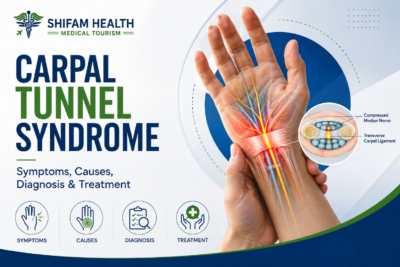
Carpal tunnel syndrome (CTS) is compression of the median nerve as it passes through the carpal tunnel — a narrow passage on the palm side of the wrist formed by small wrist bones and a ligament (the transverse carpal ligament, or flexor retinaculum). When pressure inside this tunnel increases, the median nerve doesn’t work normally, producing numbness, tingling, and sometimes weakness in specific parts of the hand.
Carpal tunnel syndrome is not the same thing as generic wrist pain. Wrist pain alone without the specific numbness and tingling pattern described below does not establish a CTS diagnosis, and treating every wrist symptom as CTS is a genuine, common misunderstanding.
The carpal tunnel contains the median nerve alongside several flexor tendons that bend the fingers. When the space inside becomes tighter from swelling, structural changes, or other contributing factors — pressure rises, and the median nerve, being the most pressure-sensitive structure in that space, is affected first, producing the characteristic symptoms.
Why specific fingers are affected and not others: the median nerve supplies sensation to the thumb, index finger, middle finger, and part of the ring finger but not the little finger, which is supplied by a different nerve (the ulnar nerve). This is genuinely one of the most useful clues in distinguishing CTS from other conditions: if numbness clearly and consistently involves the little finger, that points away from classic carpal tunnel syndrome and toward a different explanation.
Table of Contents
ToggleWhat Causes Carpal Tunnel Syndrome?
CTS results from increased pressure within the carpal tunnel, and this can come from multiple contributing factors at once rather than one single cause — anatomical, hormonal, metabolic, inflammatory, and mechanical factors can all play a role.
| Factor | How It Relates to CTS |
|---|---|
| Pregnancy | Fluid retention and hormonal changes can increase tissue swelling within the tunnel |
| Diabetes | Associated with increased CTS risk and can also independently cause peripheral neuropathy, complicating diagnosis |
| Hypothyroidism | Associated with tissue changes that can contribute to nerve compression |
| Obesity | An established risk factor |
| Rheumatoid Arthritis and Other Inflammatory Conditions | Inflammation around the tendons within the tunnel can increase pressure |
| Previous Wrist Fracture or Trauma | Can alter the anatomy of the tunnel |
| Structural/Anatomical Variation | Some individuals have naturally less space within the tunnel |
| Fluid Retention from Other Causes | Including some kidney conditions and dialysis, where an association has been described |
| Menopause/Age-Related Factors | Associated with increased risk in some studies |
| Family History | Some evidence supports a genetic or familial predisposition |
| Repetitive Hand/Wrist Activity, Wrist Positioning, Vibration Exposure | Associated with CTS in some occupational contexts, discussed further below |
On typing, computer use, and repetitive work specifically: this deserves direct, honest treatment, because it’s one of the most searched — and most oversimplified — questions about CTS. The relationship between typing/computer use and CTS is genuinely more complicated than a simple cause-and-effect claim.
Research on this specific question has produced mixed results, and typing and general computer/mouse use are not established as a strong, independent cause of CTS the way factors like pregnancy, diabetes, or direct wrist trauma are. Some occupational exposures — particularly forceful, repetitive gripping combined with vibration, as seen in certain manual and industrial work — have stronger evidence of association than routine office computer use.
This is an area where association and causation are frequently confused in popular health content, and it’s worth being precise rather than repeating an oversimplified claim.
Symptoms and Which Fingers Are Affected
CTS classically causes numbness, tingling, or a “pins and needles” sensation in the thumb, index, middle, and part of the ring finger — not the little finger — often worse at night, and can progress to weakness, reduced grip, and difficulty with fine motor tasks if compression continues.
Early symptoms:
- Intermittent numbness or tingling in the affected fingers
- A “pins and needles” or electric-shock-like sensation
- Symptoms that come and go, often related to hand position or activity
- Symptoms that may wake you at night
Moderate symptoms:
- More frequent or persistent numbness and tingling
- Burning sensations
- Reduced grip strength
- Difficulty with fine motor tasks — buttoning clothes, opening jars, handling small objects
- Occasionally dropping objects
- Pain that may radiate up toward the forearm
Advanced/severe symptoms:
- Persistent (rather than intermittent) numbness
- Noticeable hand weakness
- Wasting (visible shrinking) of the thenar muscle — the muscle at the base of the thumb
- Reduced fine motor control affecting daily tasks
Persistent numbness, ongoing weakness, or visible muscle wasting are meaningful findings — they suggest more advanced nerve dysfunction and generally warrant prompt evaluation rather than continued watchful waiting, discussed further in the “when to see a doctor” section below.
Why Is Carpal Tunnel Worse at Night?
Many people with CTS notice symptoms are most bothersome at night or upon waking, commonly attributed to wrist position during sleep — many people naturally sleep with wrists flexed, and prolonged flexion is understood to increase pressure within the carpal tunnel.
- Sustained wrist flexion during sleep is the most commonly cited contributing factor, though the exact mechanism combining position, reduced movement, and possible fluid shifts overnight isn’t perfectly understood in every patient
- Patients often describe waking with numbness or tingling and instinctively shaking or moving the hand for relief — a genuinely common and recognizable pattern
- This nighttime pattern is one reason night splinting specifically (discussed below) is a commonly recommended first-line conservative treatment — it directly targets the sleep-position mechanism
What Conditions Can Mimic Carpal Tunnel Syndrome?
Several other conditions can cause hand numbness, tingling, or pain that can be mistaken for CTS — distinguishing between them matters because the underlying treatment is genuinely different for each.
| Condition | Main Nerve/Structure | Typical Symptoms | Key Distinguishing Clue |
|---|---|---|---|
| Carpal Tunnel Syndrome | Median nerve, at the wrist | Numbness/tingling in thumb, index, middle, part of ring finger; little finger spared | Symptom pattern spares the little finger; often worse at night |
| Cervical Radiculopathy | Cervical (neck) nerve root | Neck pain, symptoms radiating down the arm, may involve the whole hand or a different finger pattern | Neck pain or restricted neck movement often accompanies it; symptom distribution follows a nerve root pattern, not the median nerve specifically |
| Ulnar Neuropathy | Ulnar nerve, often at the elbow | Numbness in the little finger and part of the ring finger | The opposite finger pattern from CTS — little finger involved, thumb/index typically spared |
| Peripheral Polyneuropathy | Multiple peripheral nerves, often symmetric | Numbness typically affecting both hands and/or feet, often symmetric and “glove and stocking” in distribution | Bilateral, symmetric, and often involves the feet too, not just one wrist’s nerve distribution |
| De Quervain Tenosynovitis | Tendons at the base of the thumb | Pain, not primarily numbness, near the thumb side of the wrist | Pain with thumb/wrist movement, not a numbness/tingling sensory pattern |
| Wrist Arthritis | Wrist joint | Joint pain, stiffness, swelling | Joint-related pain and stiffness rather than a nerve-distribution numbness pattern |
A genuinely important point: CTS can coexist with these other conditions — having diabetes-related peripheral neuropathy doesn’t rule out also having carpal tunnel syndrome, and cervical spine problems can occur alongside CTS rather than instead of it. This is exactly why the diagnostic process (discussed below) matters more than symptom-matching against a list.
Carpal Tunnel and Pregnancy
CTS symptoms commonly increase during pregnancy, largely attributed to fluid retention and hormonal changes that increase tissue volume within the carpal tunnel — symptoms often improve after delivery, though this isn’t guaranteed for every individual.
- Pregnancy-related fluid retention and physiological changes can meaningfully increase pressure within the carpal tunnel
- Symptoms often appear or worsen in later pregnancy and can affect either or both hands
- Conservative treatment is generally the preferred approach during pregnancy — splinting and activity modification are commonly used, since they avoid systemic medication exposure
- Medication decisions during pregnancy should always be guided by your treating clinician, weighing the specific situation rather than following general information
- Symptoms commonly improve after delivery as fluid retention resolves, but this isn’t guaranteed for every patient — some women have persistent symptoms requiring ongoing evaluation postpartum, and it would be inaccurate to promise universal resolution
If symptoms are significantly affecting function or sleep during pregnancy, this is worth discussing with your obstetric and/or hand specialist team rather than assuming it will simply pass.
Carpal Tunnel and Diabetes
Diabetes increases the risk of CTS and can also independently cause diabetic peripheral neuropathy — a separate nerve condition with overlapping symptoms which genuinely complicates diagnosis, since a diabetic patient’s hand numbness could reflect CTS, diabetic neuropathy, or both together.
- Diabetes is an established risk factor for CTS, and diabetic patients may also have generalized diabetic peripheral neuropathy affecting nerve function more broadly, not just at the wrist
- This overlap means symptoms in a diabetic patient are not automatically attributable to CTS alone — a careful evaluation (sometimes including nerve conduction testing) may be needed to sort out how much of the symptom picture is coming from each source
- Good glycemic (blood sugar) management supports overall nerve health, but it should not be assumed that glucose control alone will reverse an established mechanical compression of the median nerve at the wrist — these are related but distinct problems, and diabetic patients with genuine, significant CTS may still need the same conservative or surgical treatment as anyone else, alongside their diabetes management
When Should You See a Doctor?
Evaluation is generally worthwhile when symptoms:
- Persist rather than resolving on their own
- Recur frequently
- Interfere with sleep
- Affect work, driving, or daily tasks
- Involve weakness or dropping objects
- Affect fine motor function
- Are progressively worsening
- Involve persistent (not just intermittent) numbness
Progressive weakness or visible muscle wasting deserves prompt assessment rather than continued watchful waiting, since these findings suggest more advanced nerve dysfunction where earlier evaluation and treatment may matter more for outcomes.
Red flags warranting more urgent assessment
While uncomplicated CTS itself is not a medical emergency, certain symptoms suggest something different may be happening and deserve prompt attention:
- Sudden-onset weakness (rather than gradual)
- Sudden, widespread numbness
- Facial weakness or speech difficulty (these suggest a completely different, more urgent problem like stroke and need emergency evaluation, not routine hand clinic scheduling)
- Severe neck-related neurological symptoms
- Rapidly progressive neurological deficits
- Major trauma to the hand or wrist
- Severe swelling or visible deformity
- Signs of infection (fever, spreading redness, warmth)
These aren’t meant to cause alarm about typical CTS — they’re included because a small number of hand/wrist or neurological symptoms reflect something requiring faster attention than a routine appointment, and it’s worth knowing the difference.
How Is Carpal Tunnel Syndrome Diagnosed?
Diagnosis is based on a combination of your symptom history, physical examination, and when appropriate nerve conduction testing. No single bedside test is a perfect standalone diagnostic tool for CTS.
History — your clinician will ask about symptom distribution, timing (including nighttime pattern), specific triggers, how much function is affected, and whether symptoms are progressing.
Physical examination commonly includes:
- Phalen’s test — holding the wrists in flexion to see if it reproduces symptoms
- Tinel’s sign — tapping over the carpal tunnel to see if it reproduces tingling
- Compression/Durkan’s test — direct pressure over the tunnel
- Sensory examination of the affected fingers
- Strength testing, particularly of the thenar muscles at the base of the thumb
It needs to be said plainly: no single one of these provocative tests should be treated as a perfect, standalone diagnostic test. Each has real limitations in sensitivity and specificity, and a positive or negative result on any one test doesn’t definitively confirm or rule out CTS by itself — this is why diagnosis relies on the combination of history, exam, and, when needed, further testing, rather than any single maneuver.
Do You Need EMG or Nerve Conduction Studies?
Nerve conduction studies (NCS) and electromyography (EMG) measure how well the median nerve is conducting electrical signals and can help confirm the diagnosis, assess severity, and rule out other nerve problems but not every patient with likely CTS needs this testing, and it’s particularly useful when the diagnosis is uncertain or before surgery is being considered.
- Nerve conduction studies measure the speed and strength of electrical signals traveling along the median nerve, which can be reduced or delayed when the nerve is compressed
- EMG assesses the electrical activity of muscles, which can help detect more advanced nerve dysfunction affecting muscle function
- These tests can help confirm the diagnosis, assess severity, and distinguish CTS from other nerve conditions (like cervical radiculopathy or peripheral neuropathy) when the clinical picture isn’t entirely clear
- Results require clinical interpretation they’re not simply “positive” or “negative” in isolation from your symptoms and exam findings
- A normal test does not necessarily eliminate every possibility of CTS, particularly in milder or earlier cases — this is a genuine limitation of the test that’s worth understanding
- Testing is often particularly useful before surgery, or when the diagnosis remains uncertain after history and examination
Not every patient needs EMG/NCS — for a patient with a very classic symptom pattern and clear exam findings, some clinicians proceed toward conservative treatment or even surgery without electrodiagnostic confirmation, while others use it more routinely. This varies by clinical judgment and context.
Can Ultrasound or MRI Diagnose It?
Ultrasound can assess the median nerve’s cross-sectional area and structural appearance at the wrist, and can sometimes be used dynamically during wrist movement. It’s increasingly used as a complementary or, in some settings, alternative tool to electrodiagnostic testing. Advantages include being non-invasive and relatively quick; limitations include being operator-dependent — results can vary based on who’s performing and interpreting the scan. Ultrasound is not established as universally superior to nerve conduction testing — the two provide somewhat different information and are sometimes used together rather than as strict alternatives.
MRI is not automatically required for routine CTS diagnosis. It becomes relevant in specific situations — an atypical presentation, suspicion of a mass or structural lesion within the tunnel, unusual anatomy, or genuine diagnostic uncertainty after other evaluation. For the large majority of straightforward CTS cases, MRI adds cost and time without changing management.
Treatment: Building the Decision Pathway
Treatment depends on symptom severity, duration, functional impact, nerve testing results (where obtained), underlying conditions, and whether there’s evidence of nerve damage not a fixed protocol applied identically to everyone.
A general (not universal) decision pathway:
- Mild, intermittent symptoms → conservative treatment is often appropriate as a first approach
- Persistent or function-limiting symptoms → reassessment and more targeted treatment, potentially including nerve testing
- Severe compression, weakness, muscle wasting, or failure of an appropriate trial of conservative treatment → surgical evaluation becomes appropriate
Not every CTS patient needs surgery — this is worth stating clearly, since it’s a common assumption. Many patients, particularly with mild or intermittent symptoms, respond well to conservative measures.
Wrist Splinting and Activity Modification
Night wrist splinting is a commonly recommended first-line conservative treatment, aiming to hold the wrist in a neutral position (avoiding the flexed position that tends to worsen symptoms overnight, discussed above).
- Splinting is generally most useful for mild to moderate symptoms, particularly those prominently affecting sleep
- Excessively tight splints can be counterproductive, causing their own discomfort or restricting circulation — proper fit matters
- A reasonable trial period is generally used to judge whether splinting is helping, though rigid universal timelines aren’t strongly evidence-supported for every patient — this is worth discussing with your clinician
- Symptom recurrence after stopping splint use doesn’t necessarily mean the treatment “failed” — splinting manages symptoms during use; it doesn’t necessarily permanently alter the underlying anatomy in every case, so some recurrence after stopping isn’t unexpected or a sign that nothing worked
Activity modification includes reducing activities that clearly trigger symptoms, avoiding prolonged extreme wrist flexion, ergonomic workstation adjustments, taking regular breaks, and neutral wrist positioning during repetitive tasks. It’s important to be honest here: ergonomic changes help manage symptoms and reduce aggravating factors, but they don’t “cure” carpal tunnel syndrome in the sense of reversing established nerve compression — this is symptom management and risk reduction, not a guaranteed treatment of the underlying problem.
Hand Therapy and Exercises
Tendon-gliding and nerve-gliding exercises, along with general stretching and, where appropriate, strengthening, are often included in conservative CTS management, typically guided by an occupational or hand therapist.
Being realistic about the evidence: these exercises may help with symptoms and hand function for some patients, but they should not be presented as a guaranteed method of eliminating established mechanical nerve compression. They’re a reasonable, low-risk component of a conservative treatment plan, not a substitute for appropriate escalation if symptoms are severe or progressing.
Corticosteroid Injections
Corticosteroid injections into the carpal tunnel can reduce inflammation and provide meaningful symptom relief for some patients, but the effect is often temporary, and injections do not permanently correct the underlying structural narrowing of the tunnel.
- Injections may be considered for patients with bothersome symptoms, sometimes as a way to gain relief while deciding on longer-term management, or to help delay surgery in appropriate candidates
- Benefit is often more pronounced in the short term, with symptoms sometimes recurring over subsequent months
- Potential complications exist, though they’re generally uncommon with proper technique worth discussing directly with your clinician rather than assumed to be risk-free
The core honest point: an injection may meaningfully reduce inflammation and symptoms, but it does not necessarily permanently correct the underlying physical narrowing of the carpal tunnel space — this is why recurrence after an initially effective injection is a recognized, not unusual, pattern.
Oral medications — NSAIDs and other analgesics — may help with pain but do not directly decompress the median nerve; they manage symptoms rather than treating the underlying mechanical problem. Any medication decisions, including around dosing, should be made with your clinician rather than based on general information.
Other Treatments — An Honest Evidence Review
Being direct about commonly marketed or discussed alternative approaches:
| Treatment | Evidence Status |
|---|---|
| Therapeutic Ultrasound (as a treatment, not diagnostic tool) | Limited/mixed evidence for meaningful symptom improvement |
| Laser Therapy | Limited evidence |
| Acupuncture | Mixed evidence; may help some patients with symptoms, not established as correcting underlying compression |
| Chiropractic Manipulation | Limited evidence specifically for CTS |
| Vitamin B6 Supplementation | Insufficient evidence to support as a reliable CTS treatment |
| Magnetic Devices | Insufficient/no credible evidence |
| PRP (Platelet-Rich Plasma) / Regenerative Injections | Experimental for CTS; evidence remains limited and this should not be presented as an established treatment |
A specific and important safety warning: do not treat high-dose vitamin B6 as a casual, harmless CTS remedy. Excessive vitamin B6 intake can itself cause peripheral neuropathy — meaning it could potentially worsen or add to the very symptoms someone might be trying to treat. This is a genuine, documented risk, not a theoretical caution.
None of these alternative approaches should be promoted simply because they’re commercially popular or widely marketed — evidence quality, not popularity, is what should guide treatment decisions.
When Is Surgery Actually Needed?
Surgery becomes an appropriate consideration when there is:
- Persistent symptoms despite an appropriate trial of conservative treatment
- Significant functional impairment affecting daily life or work
- Evidence of severe nerve compression (often supported by nerve conduction findings, where obtained)
- Persistent sensory loss (rather than intermittent symptoms)
- Weakness
- Thenar muscle wasting
- Clinical circumstances where delaying decompression could risk further, potentially irreversible, nerve damage
Surgery is not always the best option for everyone, and it’s not accurate to say it is — timing and appropriateness are genuinely individualized based on your specific severity, findings, and how conservative treatment has gone. At the same time, when there’s evidence of significant, ongoing nerve dysfunction, delaying appropriate surgical evaluation carries its own real risk, discussed further below.
Carpal Tunnel Release Surgery
The goal of carpal tunnel release is to reduce pressure on the median nerve by releasing (cutting) the transverse carpal ligament, creating more space within the tunnel.
| Feature | Open Release | Endoscopic Release |
|---|---|---|
| Incision | Typically a single incision in the palm | One or two smaller incisions |
| Approach | Direct visualization of the ligament | Uses a small camera (endoscope) to visualize and release the ligament |
| Nerve Decompression | Same underlying goal — releasing the transverse carpal ligament | Same underlying goal |
| Recovery Considerations | Often associated with somewhat more initial incision-site discomfort given the larger incision | Sometimes associated with less immediate postoperative discomfort and a smaller scar, though findings vary across studies |
| Potential Advantages | Wide, direct visualization of the anatomy; widely available and well-established | Smaller incision(s), potentially quicker return to some activities in some studies |
| Potential Limitations | Larger incision, potentially more scar sensitivity | Requires specific equipment and surgeon training/experience; visualization is more limited than open direct view |
| Complications | Similar overall complication categories to endoscopic (see below) | Similar overall complication categories to open |
Neither technique is universally superior — both are established, effective approaches for decompressing the median nerve, and the right choice for a given patient often depends on surgeon expertise and experience with a particular technique, specific anatomy, and patient preference regarding incision size and expected early recovery, rather than one approach being objectively “better” in all situations.
On newer minimally invasive and ultrasound-guided techniques: some centers now offer ultrasound-guided or other minimally invasive release approaches. These represent a genuinely evolving area — some have accumulating supportive evidence, while others have more limited long-term data compared to established open and standard endoscopic techniques. Newer or more heavily marketed does not automatically mean better — it’s worth asking specifically about a surgeon’s experience and the evidence behind any less-established technique being offered, rather than assuming novelty equals superiority.
Risks and Complications
Being honest about this rather than presenting surgery as risk-free — potential complications, while generally uncommon, can include:
- Infection
- Bleeding or hematoma
- Scar tenderness
- “Pillar pain” — discomfort at the base of the palm near the incision, a recognized specific complication of this surgery
- Persistent or recurrent symptoms
- Incomplete release of the ligament
- Nerve or blood vessel injury
- Complex regional pain syndrome (uncommon but recognized)
- Stiffness
- Temporary weakness during the recovery period
Complications are uncommon, but the surgery is not risk-free — no legitimate source should describe any surgery, including this one, as guaranteed complication-free.
Recovery After Surgery
Recovery genuinely depends on several individual factors: how long the nerve was compressed before surgery, the severity of any nerve damage, your age, whether you have diabetes or other relevant conditions, your baseline nerve function, the type of work or activity you return to, the specific surgical technique used, and individual healing.
General recovery considerations (not a fixed timeline for every patient):
- Some pain and swelling in the immediate postoperative period
- Wound care during initial healing
- Gradual return of finger movement
- Gradual return of grip strength, which can take longer than wound healing itself
- Light activities are often resumed before heavier manual work
- Return to driving and full work duties depends on the specific job demands and how recovery is progressing
- Scar sensitivity, including pillar pain, can persist for some time before settling
- Nerve-related symptom improvement can be gradual, sometimes continuing to improve over months rather than resolving immediately
No fixed universal recovery timeline should be promised — your surgeon’s assessment of your specific case, procedure, and healing progress is what should guide expectations, not a generic number.
Can Nerve Damage Be Permanent?
This deserves a direct, realistic answer rather than false reassurance.
- Temporary nerve dysfunction from mild or shorter-duration compression often improves substantially, sometimes fully, once pressure is relieved
- Prolonged, more severe compression can cause actual axonal injury — physical damage to the nerve fibers themselves, not just temporary dysfunction
- In cases of longstanding, severe disease (particularly with persistent numbness, weakness, or visible thenar muscle wasting before treatment), decompression surgery can stop further damage from progressing, but recovery of an already chronically damaged nerve may be incomplete or slow, even after a technically successful surgery
This is genuinely why earlier evaluation and treatment matter for cases with clear evidence of significant, progressive nerve dysfunction — surgery reliably relieves the mechanical pressure causing ongoing damage, but it cannot always fully reverse damage that has already occurred by the time surgery happens. This is a realistic, medically responsible point that shouldn’t be softened.
Can It Come Back After Surgery?
Persistent or recurrent symptoms after carpal tunnel release can happen, and possible explanations include:
- Incomplete release of the ligament during the original surgery
- An underlying diagnosis that wasn’t actually (or wasn’t only) CTS
- Genuine recurrent compression, sometimes related to scar tissue formation
- A separate or coexisting neurological condition (like cervical radiculopathy or peripheral neuropathy) that wasn’t fully addressed by the wrist surgery, because it was never the primary cause
- Proximal (further up the arm) nerve pathology unrelated to the wrist itself
Persistent symptoms after surgery don’t automatically mean the surgery was performed incorrectly — several of the explanations above have nothing to do with surgical technique. If symptoms genuinely persist or recur, further evaluation — sometimes including repeat nerve conduction testing — helps determine the cause, and revision surgery may be considered in select cases where a clear, correctable explanation is identified, though it’s not automatically the answer for every case of persistent symptoms.
Myths vs. Facts
| Myth | Fact |
|---|---|
| “Every case of hand tingling is carpal tunnel syndrome.” | Several distinct neurological and musculoskeletal conditions can cause similar symptoms — an accurate diagnosis requires proper evaluation, not symptom-matching alone. |
| “Typing always causes CTS.” | The relationship between typing/computer use and CTS is more complicated than simple cause-and-effect, and evidence for this specific claim is genuinely mixed. |
| “Steroid injections permanently cure CTS.” | They can provide meaningful relief, often more pronounced short-term, but they don’t necessarily permanently correct the underlying structural narrowing, and recurrence is a recognized pattern. |
| “Surgery is necessary for everyone with CTS.” | Many patients, especially with mild or intermittent symptoms, respond well to conservative treatment and never need surgery. |
| “Carpal tunnel release is risk-free.” | Complications are uncommon but genuinely possible, including infection, incomplete release, and persistent symptoms. |
| “If the little finger is numb, it’s definitely CTS.” | The opposite is usually true — classic CTS spares the little finger; little-finger involvement points more toward ulnar nerve problems. |
Carpal Tunnel Treatment Cost in India
Domestic Indian pricing for carpal tunnel release surgery commonly ranges from roughly ₹40,000 to ₹1,20,000 (approximately $480–$1,450), while international-patient-facing packages are typically quoted considerably higher, often in the $3,000–$6,500 range once travel coordination and international patient services are factored in.
| Factor Affecting Cost | Notes |
|---|---|
| Surgical Technique | Endoscopic release is often somewhat more expensive than open release, given the specialized equipment involved |
| Anesthesia Type | Local/regional anesthesia is generally less costly than general anesthesia |
| Diagnostic Testing | Nerve conduction studies or imaging, if needed before surgery |
| Hospital Stay | Many carpal tunnel releases are outpatient (same-day) procedures; some centers or complex cases may involve a short stay |
| Unilateral vs. Bilateral Treatment | Treating both hands, whether simultaneously or staged, affects total cost |
| City and Hospital | Meaningful regional variation exists across India |
| Follow-up and Rehabilitation | Hand therapy sessions, if needed |
Treatment in India for International Patients
India offers relevant infrastructure for CTS evaluation and treatment, including orthopedic hand surgeons, peripheral nerve/hand surgery specialists, neurologists, electrodiagnostic (nerve conduction/EMG) testing, hand therapy services, and both open and endoscopic carpal tunnel release techniques at many accredited centers. Not every hospital offers every technique — minimally invasive or ultrasound-guided approaches specifically are more concentrated at centers with that particular expertise, so this is worth confirming directly rather than assumed.
International patient journey:
- Share your medical reports and any prior diagnostic testing
- Initial specialist review
- Confirmation of diagnosis
- Determination of severity
- Discussion of conservative vs. surgical treatment options
- Treatment cost estimate based on your specific case
- Medical travel and visa-related coordination support
- Airport pickup and accommodation coordination
- Hospital and specialist coordination on arrival
- Any needed diagnostic testing
- Treatment
- Recovery and hand therapy/rehabilitation
- Follow-up before you leave
- Return home with medical documentation
- Remote follow-up coordination where clinically appropriate
Shifam Health is a medical tourism facilitator, not a hospital, clinic, or surgical provider. They can assist with collecting medical records, coordinating specialist opinions, hospital coordination, treatment estimates, appointment scheduling, medical travel planning, visa-related coordination support, airport pickup, accommodation coordination, interpreter and local assistance where available, and follow-up coordination. Shifam Health does not diagnose CTS, perform surgery, or guarantee treatment outcomes, costs, or visa approval — those remain the responsibility of the treating medical team and relevant authorities.
If it would help, you’re welcome to share your medical reports with Shifam Health to help coordinate an appropriate specialist consultation and understand realistic next steps for treatment in India.
Questions to Ask Your Specialist
- How confident are you that I have carpal tunnel syndrome specifically, versus another condition?
- Could a different nerve condition, like cervical radiculopathy or ulnar neuropathy, explain my symptoms instead or as well?
- Do I need nerve conduction studies or EMG in my case?
- How severe is my nerve compression, based on my exam and any testing?
- Is there evidence of actual nerve damage, not just temporary dysfunction?
- Could I reasonably try splinting or other conservative treatment first?
- How long is a reasonable trial of conservative treatment before reassessing?
- Would a corticosteroid injection be appropriate for me?
- What specific findings would make you recommend surgery in my case?
- Which surgical technique (open or endoscopic) do you recommend for me, and why?
- What are the realistic risks specific to my situation?
- When could I reasonably expect to return to work and normal activities?
- Could my nerve damage be permanent, based on my current findings?
- What happens if symptoms persist after surgery?
- Do I need treatment for both hands, and if so, at the same time or staged?
Frequently Asked Questions
What is carpal tunnel syndrome?
Carpal tunnel syndrome (CTS) occurs when the median nerve is compressed at the wrist, causing numbness, tingling, and sometimes weakness in the hand.
What are the first symptoms?
Early symptoms usually include intermittent numbness or tingling in the thumb, index, middle, and part of the ring finger, often worse at night.
Which fingers are affected?
CTS typically affects the thumb, index, middle, and part of the ring finger. The little finger is usually unaffected because it is supplied by the ulnar nerve.
Can CTS cause forearm pain?
Yes. Pain or tingling may sometimes extend from the wrist into the forearm.
What causes carpal tunnel syndrome?
Risk factors include pregnancy, diabetes, hypothyroidism, obesity, inflammatory arthritis, previous wrist injury, and anatomical predisposition.
Does typing cause CTS?
The link between typing and CTS is not straightforward. Evidence that computer use alone directly causes CTS is mixed.
Can CTS go away without surgery?
Mild cases may improve with wrist splinting, activity modification, exercises, or treatment of an underlying condition. Persistent or severe compression may require surgery.
Can a wrist splint help?
Yes. A neutral-position wrist splint, particularly at night, can reduce symptoms in many people with mild-to-moderate CTS.
Are steroid injections effective?
Steroid injections can provide temporary symptom relief but may not permanently resolve the underlying nerve compression.
Is EMG or nerve conduction testing necessary?
Not always. These tests are useful when the diagnosis is uncertain, symptoms are severe, or surgery is being considered.
When is surgery needed?
Surgery may be recommended for severe nerve compression, muscle weakness or wasting, significant functional problems, or symptoms that do not improve with conservative treatment.
How much does carpal tunnel surgery cost in India?
Surgery commonly costs around ₹40,000–₹1,20,000 in India, while international-patient packages may range from $3,000–$6,500. The actual cost depends on the hospital, surgeon, technique, and individual case.
Final Takeaway
Carpal tunnel syndrome is common, but it shouldn’t be self-diagnosed from hand tingling alone — several other conditions can look similar, and getting the diagnosis right shapes everything that follows. Mild cases often respond well to conservative treatment like splinting and activity changes; more severe or progressive cases, particularly with weakness or muscle wasting, may need surgical release to prevent further, potentially permanent, nerve damage.
If you’re evaluating treatment, including treatment in India, sharing your symptom history and any existing test results with a specialist is the most useful first step toward an accurate diagnosis and a treatment plan suited to your specific situation.




Popular Posts From Last Week
- September 10, 2026
- shifamhealth
Medically reviewed content · Published 2026 · Last reviewed August 2026 Blount’s disease, also called tibia vara, is…
- September 13, 2026
- shifamhealth
Carpal tunnel syndrome (CTS) is compression of the median nerve as it passes through the carpal tunnel —…
- September 9, 2026
- shifamhealth
A cervical herniated disc occurs when the soft inner material of a disc in the neck pushes through…
- September 10, 2026
- shifamhealth
Chronic back pain is one of the most common reasons people seek medical care, and also one of…
- September 11, 2026
- shifamhealth
Myelopathy means dysfunction of the spinal cord itself — not a single disease, but a syndrome that can…
- September 9, 2026
- shifamhealth
Medically reviewed content · Published 2026 · Last reviewed September 2026 Disc degeneration seen on an MRI does…
- September 12, 2026
- shifamhealth
Medically reviewed content · Published 2026 · Last reviewed September 2026 Discitis is inflammation or infection involving an…
- September 12, 2026
- shifamhealth
A femoral hernia occurs when tissue often part of the bowel or fatty tissue — pushes through the…
- September 11, 2026
- shifamhealth
Kümmell’s disease refers to a delayed collapse of a vertebra — a nonunion or failure to heal properly…
- September 7, 2026
- shifamhealth
Ductal carcinoma in situ (DCIS) is a non-invasive breast condition in which abnormal cells are confined to the…
- September 8, 2026
- shifamhealth
Written by: Shifam Health Editorial Team — Neuro-Oncology Content Division Medically reviewed by: Shifam Health Clinical Advisory Panel…
- September 8, 2026
- shifamhealth
Medically reviewed content · Published 2026 · Last reviewed August 2026 Olfactory neuroblastoma also called esthesioneuroblastoma (ENB) —…