



Home > Blog > CyberKnife Radiosurgery for Brain Tumors in India: A Non-Invasive Revolution in Precision Treatment
CyberKnife Radiosurgery for Brain Tumors in India: A Non-Invasive Revolution in Precision Treatment
Filters & Insights
Written By :
Medically Reviewed By :

Dr. Kapil Jain
Neurosurgeon
MBBS, MS (General Surgery), MCh (Neurosurgery)
Explore CyberKnife treatment for brain tumors in India, including how it works, eligible conditions, treatment session, benefits & possible risks.
📅
Last updated: November 12, 2026
According to a 2026 systematic review published on CyberKnife radiosurgery for vestibular schwannomas, researchers analysed 15 studies involving 2,018 patients, evaluating tumour control and hearing preservation following treatment. These findings highlight the growing role of precision radiation techniques in managing selected brain tumours without conventional open surgery.
For patients in the UK, USA, Europe, the Middle East, Africa, Bangladesh and Central Asia, a brain tumour diagnosis can bring difficult questions about treatment, recovery and quality of life. Patients and families often want to know whether open brain surgery is necessary, whether treatment can be performed without an incision and how much advanced treatment may cost.
CyberKnife radiosurgery in India offers a non-invasive treatment option for selected brain tumours, including meningiomas, acoustic neuromas and certain brain metastases. Using advanced image guidance and highly focused radiation beams, it targets tumour tissue while limiting radiation exposure to surrounding healthy structures. Unlike conventional surgery, it does not require opening the skull, although it is not suitable for every tumour.
India offers specialised hospitals equipped with advanced radiosurgery technology. Shifam Health helps international patients with medical report reviews, specialist consultations, hospital coordination and treatment estimates, making it easier to explore suitable treatment options in India.
Table of Contents
ToggleWhat is CyberKnife Radiosurgery? Debunking the Myths
Despite its name, CyberKnife involves no blades or incisions. It is an advanced form of Stereotactic Radiosurgery (SRS), a non-surgical radiation therapy that delivers high-dose, pinpoint-accurate radiation to tumors with minimal exposure to surrounding healthy brain tissue.
Think of it as a highly sophisticated sniper rifle targeting the tumor, rather than a scattergun approach.
How Does the CyberKnife System Work?
The CyberKnife System’s precision is what sets it apart. Here’s how it achieves its remarkable accuracy:
- Advanced Imaging Guidance: The CyberKnife system uses image guidance and tracking technology to monitor the target’s position during treatment and help direct radiation accurately. Unlike traditional methods that rely on rigid head frames, CyberKnife uses the patient’s own skeletal structure for tracking, ensuring comfort and precision throughout the treatment.
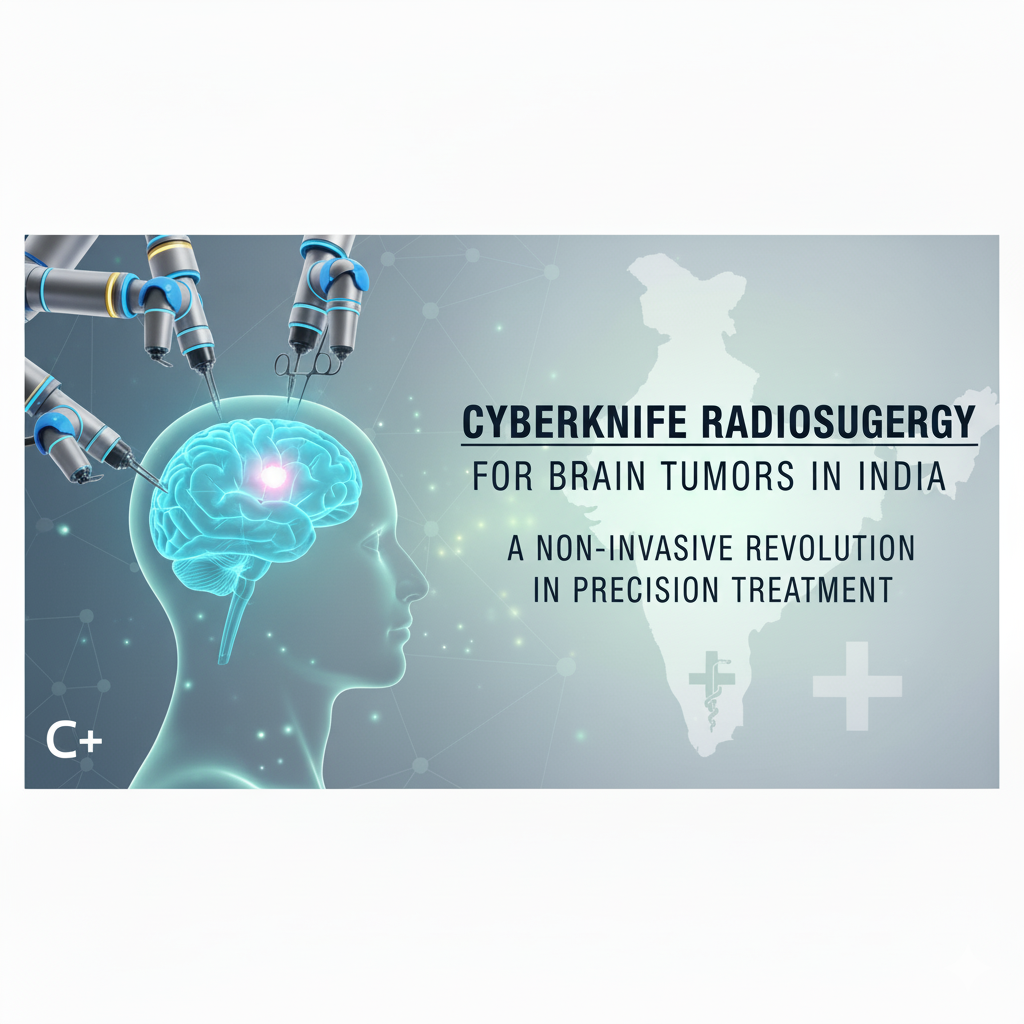
- Robotic Maneuverability: A compact linear accelerator (radiation source) is mounted on a flexible robotic arm. This arm can move and rotate around the patient’s head, delivering radiation from hundreds of unique angles. This mobility allows it to contour exactly to the shape of the tumor.
- Motion Tracking: The system uses tracking technology to account for relevant patient or target movement during treatment. The tracking method used depends on the treatment site and clinical requirements.
Key Benefits of Choosing CyberKnife for Brain Tumors
The advantages of this non-invasive approach are profound, both medically and for the patient’s quality of life.
- Non-Invasive & Painless: The treatment does not involve surgical incisions or the blood loss associated with an operation. However, radiation-related side effects and other treatment risks remain possible. Patients simply lie comfortably on the treatment table.
- Pinpoint Accuracy: CyberKnife uses highly precise radiation delivery to target the planned treatment area while limiting radiation exposure to surrounding healthy tissues. The achievable dose distribution and risks depend on tumour size, location and treatment planning.
- Shorter Treatment Recovery: CyberKnife is generally delivered as an outpatient treatment without surgical incisions or a conventional surgical recovery period. Many patients can resume normal activities relatively quickly, although fatigue and other side effects may occur.
- Outpatient Procedure: Treatments are typically performed on an outpatient basis, meaning no overnight hospital stay is required.
- Effective for Complex Tumors: CyberKnife can treat tumors that are considered inoperable due to their location near critical brain structures or in patients who are not suitable candidates for open surgery.
- Frameless Comfort: The elimination of the invasive metal head frame used in older radiosurgery systems makes the experience much more comfortable for patients.
Conditions Treated by CyberKnife in India
CyberKnife may be considered for selected intracranial conditions, depending on the diagnosis, tumour size, location and treatment objectives. These may include:
- Benign Brain Tumors: Acoustic neuromas, meningiomas, pituitary adenomas.
- Selected malignant brain tumours: Certain brain metastases and selected gliomas, depending on tumour characteristics and the radiation oncologist’s assessment.
- Trigeminal Neuralgia: A chronic pain condition affecting the facial nerve.
- Arteriovenous Malformations (AVMs): Tangled blood vessels in the brain.
The 2026 Advantage: Why India is a Leader in CyberKnife Radiosurgery
India’s rise as a premier destination for CyberKnife treatment is built on a powerful combination of factors that appeal directly to international patients.
1. Proliferation of Cutting-Edge Technology
Major hospital chains in metropolitan hubs like Delhi, Mumbai, Chennai, and Bangalore have invested heavily in the latest generation of CyberKnife systems. These centers are equipped with complementary technology, including high-field MRI and PET-CT scanners, for impeccable diagnosis and treatment planning.
2. World-Renowned Expertise
The neurosurgeons and radiation oncologists operating these systems in India are often fellowship-trained at top international institutions. Their high patient volume translates into deep, specialized experience in managing complex brain tumor cases, ensuring optimal treatment plans and outcomes.
Patients seeking a specialist opinion can also explore Dr. Maheep Singh Gour, whose clinical procedures include CyberKnife and stereotactic radiosurgery.
3. Unbeatable Cost-Effectiveness
This is one of the most significant draws. CyberKnife treatment costs in India may be lower than in several international destinations. The actual difference depends on the hospital, treatment plan, number of sessions, diagnostic requirements and the comparison country’s healthcare charges. This makes a life-saving, advanced procedure accessible to a much broader population without compromising on quality or safety.
4. Streamlined Medical Tourism Pathways
Hospitals catering to international patients have perfected a seamless journey:
- Quick Appointments: Minimal waiting times for consultation and treatment.
- Integrated Care: A dedicated team handles everything from visa assistance and airport transfers to accommodation and interpreter services.
- Comprehensive Packages: Transparent, all-inclusive pricing that covers diagnostics, the treatment itself, and initial follow-up consultations.
The Patient Journey: What to Expect
- Comprehensive Evaluation: Your medical records are reviewed, and advanced imaging is performed to determine if you are a suitable candidate.
- Treatment Planning: A multi-disciplinary team of neurosurgeons and radiation oncologists creates a custom 3D plan mapping the exact tumor coordinates and radiation dosage.
- Treatment Delivery: Typically, treatment is spread over 1 to 5 sessions (called fractions), each lasting 30-60 minutes. You lie still while the robotic arm moves around you as it’s a completely painless process.
- Follow-up: You will have periodic follow-up scans to monitor the tumor’s response, which typically shrinks over several months following treatment.
Is CyberKnife Radiosurgery Right for You?
An ideal candidate is typically someone with:
- A clearly defined brain tumor (benign or malignant) visible on MRI or CT scan.
- A tumor that is difficult to access with conventional surgery due to its location.
- A condition that requires a non-invasive approach due to overall health or personal preference.
- A metastatic brain tumor where controlling growth is the primary goal.
A consultation with a specialized team in India is the definitive way to determine your eligibility.
Is CyberKnife Suitable for Every Brain Tumor?
CyberKnife is not appropriate for every brain tumour. Suitability depends on tumour type, size, number, location, proximity to critical brain structures and previous treatments. Some patients may benefit more from conventional surgery, other forms of radiotherapy or a combination of treatments. A multidisciplinary team involving a neurosurgeon and radiation oncologist should review the MRI scans and medical history before recommending treatment.
Conclusion
The advent of CyberKnife Radiosurgery has fundamentally altered the prognosis and experience for countless brain tumor patients. It represents a triumph of technology and human ingenuity, offering a precise, effective, and gentle alternative to traditional surgery.
India’s commitment to this technology, combined with its clinical expertise and patient-centered, affordable care model, positions it as a global leader. For anyone facing a brain tumor diagnosis, CyberKnife in India represents a powerful, accessible, and hopeful path forward.
| Take the First Step It costs Nothing Share your medical reports with Shifam Health and receive a free, personalized assessment within 24 hours. No commitment. No pressure. Just honest information to help you make the right decision for you and your family. www.shifamhealth.com | contact@shifamhealth.com | WhatsApp: +91 81785 95807 24/7 Support Available | Free Consultation | No Hidden Charges |




Popular Posts From Last Week
- November 20, 2026
- Razi Khan
When doctors provide different diagnoses or treatment recommendations, organizing their opinions can help patients prepare for another specialist…
- November 18, 2026
- Razi Khan
Learn how to prepare for a child’s hospital consultation abroad. This guide covers hospital checks, doctor credentials, medical…
- November 18, 2026
- Razi Khan
Planning medical travel for an older adult involves more than choosing a hospital. Learn how to assess travel…
- November 17, 2026
- Razi Khan
Learn how to support a patient with limited mobility during medical travel to India, including wheelchair assistance, accessible…
- November 17, 2026
- Razi Khan
Learn how international patients can manage time-zone differences when planning treatment in India, including specialist consultations, medical records,…
- November 16, 2026
- Shifam Health
Learn how to maintain a personal treatment timeline during medical travel, including consultations, diagnostic tests, treatment decisions, travel…
- November 14, 2026
- Shifam Health
Learn how international patients can compare treatment options when time is limited, assess medical recommendations, understand risks and…
- November 14, 2026
- Razi Khan
Planning a hospital visit in India? This practical checklist helps international patients organize medical records, confirm hospital facilities,…
- November 14, 2026
- Razi Khan
Planning to fly to India for medical treatment? Learn what to confirm before booking flights, including hospital appointments,…
- November 17, 2026
- Razi Khan
Learn how international patients can confirm medical interpreter and translation support before treatment in India, including hospital arrangements,…
- November 16, 2026
- Shifam Health
Travelling abroad for medical treatment requires careful preparation of medical reports, prescriptions, scan images and travel paperwork. This…
- November 14, 2026
- Razi Khan
Medical appointments and treatment schedules can change. Learn how international patients can plan flexible travel dates for treatment…