



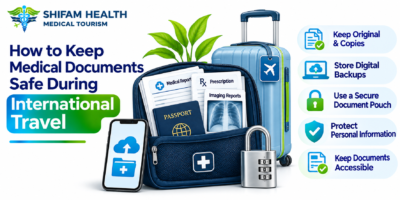
How to Keep Medical Documents Safe During International Travel
Filters & Insights
Written By :
Medically Reviewed By :

Shifam Health Medical Team
Shifam Health - Medical Reviews Department
10+ Years Of Experience
Learn how to protect medical records, prescriptions and travel documents when travelling internationally for treatment in India.
📅
Last updated: November 16, 2026

Travelling to another country for medical treatment involves more than booking flights and arranging accommodation. You may need to carry medical reports, prescriptions, scan images, identity documents, hospital correspondence and visa paperwork. Losing even one important document can create unnecessary delays during consultations, admission or treatment planning.
For international patients travelling to India, keeping these records organised and accessible is an important part of preparing for the journey. The good news is that a simple combination of secure digital copies, organised physical documents and careful travel habits can make the process much easier.
This guide explains how to protect your medical documents before departure, during your journey and after reaching India.
Table of Contents
ToggleWho Should Follow This Guide?
This guide is useful for:
- Patients travelling to India for planned surgery, cancer treatment, cardiac care, orthopaedic procedures or other specialist treatment.
- Patients who need to carry previous medical reports, diagnostic images or pathology records.
- People travelling with regular prescriptions or long-term medication.
- Family members and caregivers responsible for managing a patient’s paperwork.
- Patients who have received treatment recommendations from hospitals and need to carry supporting documents.
If you are still preparing your medical records, start with our guide on how to prepare a digital medical file for an overseas specialist.
Which Medical Documents Should You Keep Safe?
Before travelling, prepare a complete document folder. The exact documents depend on your condition and the treatment planned, but the following checklist is a useful starting point.
Medical records
- Recent medical reports and specialist consultation notes.
- Previous discharge summaries and hospital records.
- Blood test and other laboratory reports.
- X-rays, CT scans, MRI scans and ultrasound reports.
- Pathology reports and biopsy results, where relevant.
- Operation records and previous treatment summaries.
- Current prescriptions and medication details.
- Allergy information and relevant medical history.
- Vaccination records, if required by the treating hospital or destination authorities.
For patients carrying diagnostic images, remember that a written report and the actual scan images are not always interchangeable. Follow the hospital’s instructions about sharing DICOM files, CDs, DVDs or secure download links. Read our guide on how to share large MRI and CT files with an Indian hospital.
Patients undergoing cancer evaluation may also need pathology slides or tissue blocks for review. See how international patients can organise pathology slides for review in India.
Travel and hospital documents
Keep these separately from your medical records:
- Valid passport and relevant visa documents.
- Medical visa application or approval documents, where applicable.
- Hospital appointment confirmation.
- Hospital invitation letter, if issued.
- Written treatment plan or consultation summary.
- Flight tickets and travel itinerary.
- Accommodation confirmation.
- Travel insurance details, if applicable.
- Emergency contact information.
- Documents required for an accompanying attendant.
For guidance on the visa process, read our Indian medical visa guide and medical visa versus tourist visa for India.
Step-by-Step Process to Protect Your Medical Documents
Step 1: Create one master medical document folder
Start by collecting all relevant records in one place. Avoid keeping reports scattered across email accounts, messaging applications, phone galleries and different folders.
Create a simple folder structure:
- 01 – Identity and travel documents
- 02 – Medical history and discharge summaries
- 03 – Laboratory reports
- 04 – Imaging reports and scan files
- 05 – Prescriptions and medicines
- 06 – Hospital correspondence and treatment plan
- 07 – Insurance and payment documents
Use clear file names that make documents easy to identify. For example:
PatientName_MRI_Spine_September2026.pdf
PatientName_BloodReport_October2026.pdf
PatientName_DischargeSummary_HospitalName.pdf
Avoid vague names such as Report1.pdf, NewScan.pdf or FinalReportLatest.pdf.
Step 2: Keep both physical and digital copies
Do not depend entirely on paper documents or a single electronic device.
Prepare at least three accessible versions:
- Original documents: Carry originals when required by the hospital, embassy, airline or relevant authority.
- Printed copies: Keep photocopies of important reports, prescriptions, passport identification pages and hospital confirmations.
- Digital copies: Store scanned documents in a secure digital location that you can access during travel.
Keep the originals protected and use photocopies for routine sharing whenever originals are not specifically requested.
Step 3: Store digital copies securely
A phone or laptop can be lost, damaged or become inaccessible. Therefore, do not keep the only copy of your medical records on one device.
Consider using:
- A password-protected cloud storage account.
- An encrypted USB drive, where appropriate.
- A secure email account for important correspondence.
- A second trusted device with offline access to essential documents.
Use a strong, unique password and enable two-factor authentication where available. Avoid uploading sensitive medical records to unknown websites or sharing public links that anyone can open.
If you use cloud storage, check that the files are actually uploaded and can be opened before leaving home. Also keep essential records available offline in case airport or mobile internet access is unreliable.
For general information about personal health records, see MedlinePlus: Personal Health Records.
Step 4: Organise documents by importance
Not every document needs to be accessed with the same urgency.
Keep the following documents in a small, easily accessible travel folder:
- Passport identification page and visa.
- Hospital appointment confirmation.
- Latest medical summary.
- Current prescription and medication list.
- Emergency contact details.
- Any essential medical instructions from the treating doctor.
Keep older reports and supporting records in a separate organised folder. This makes it easier to find the most important information at airport checks, hospital registration or an emergency consultation.
Step 5: Protect documents during the flight
Keep essential medical paperwork in your cabin baggage rather than placing it in checked luggage.
This is particularly important for:
- Original medical reports.
- Prescriptions and medication details.
- Hospital admission or appointment letters.
- Passport and visa documents.
- Medical devices or supporting documents required during travel.
Use a waterproof document pouch or protective folder. Avoid leaving important paperwork unattended at airport counters, lounges, security areas or aircraft seats.
If you are carrying medication, medical equipment or temperature-sensitive products, check the airline’s rules before departure. Keep medicines in their original packaging where possible and carry relevant prescriptions or supporting letters. The CDC guide to travelling with medication provides useful preparation advice.
Step 6: Share documents with the hospital securely
Before travelling, confirm how the hospital wants to receive your medical records.
Some hospitals may accept PDF reports through email or a patient portal, while diagnostic images may require a separate upload method or physical media. Do not assume that a messaging application will preserve the original image quality or file format.
Ask the hospital:
- Which reports are required before the first consultation?
- Are original scan images needed?
- Should reports be submitted in PDF format?
- Is there a secure upload portal?
- Should pathology slides or tissue blocks be brought physically?
- Are translated reports required?
You can also read what happens during a virtual consultation with an Indian specialist and how to prepare for a video consultation about treatment in India.
Step 7: Keep an emergency copy accessible to your companion
If a family member or caregiver is travelling with the patient, they should know where the important documents are stored.
With the patient’s consent, provide the companion with access to essential information such as:
- Medical summary.
- Current medicines and dosages.
- Known allergies.
- Treating hospital contact details.
- Emergency contact numbers.
- Relevant insurance information.
Avoid sharing passwords unnecessarily. A secure, limited-access folder or a separate set of printed copies can be more appropriate.
For additional preparation advice, see what caregivers should prepare before travelling for treatment.
Step 8: Check your documents after arriving in India
Once you reach India, check that your passport, medical records, prescriptions and hospital documents are still with you.
Before attending the first appointment:
- Confirm that all required reports are available.
- Check that digital files open correctly.
- Keep originals ready if the hospital requests them.
- Make sure your companion knows where the documents are stored.
- Keep new consultation notes, test reports and prescriptions in the same organised system.
If the hospital issues additional reports during your stay, save digital copies and retain the originals carefully.
Documents and Questions to Prepare Before Departure
Use this checklist before leaving your home country.
Patient document checklist
- Valid passport and visa documents.
- Hospital appointment confirmation.
- Latest medical summary.
- Previous discharge summaries.
- Laboratory and diagnostic reports.
- MRI, CT, X-ray or other scan images, if required.
- Pathology reports, slides or tissue blocks, if requested.
- Current prescriptions and medication list.
- Allergy and medical history information.
- Written treatment plan or specialist opinion.
- Printed copies of essential documents.
- Secure digital backup.
- Emergency contact details.
Questions to ask the hospital
- Do you need original medical reports or are scanned copies sufficient?
- Should I carry the actual MRI or CT images?
- What is the preferred format for sharing medical records?
- Are pathology slides or tissue blocks required?
- Do any reports need to be translated?
- Should I bring previous prescriptions and medication packaging?
- Can I access my reports through a patient portal?
- Will I receive copies of all new reports and prescriptions during treatment?
If you have already received a treatment recommendation, it is useful to keep a copy of the written treatment plan requested before travelling to India. You can also review questions to ask before accepting a medical treatment package in India.
Common Mistakes and Practical Tips
Even well-prepared patients can face problems when documents are not organised properly. Avoid these common mistakes.
Mistake 1: Keeping all documents in checked baggage
Checked luggage can be delayed, misplaced or inaccessible during the journey. Keep essential medical and travel documents in your cabin baggage.
Mistake 2: Depending on one mobile phone
Your phone may run out of battery, become damaged or be lost. Maintain secure backups and printed copies of essential documents.
Mistake 3: Carrying only the written scan report
A radiology report explains the findings, but the treating specialist may also need to examine the actual images. Confirm the hospital’s requirements before departure.
Mistake 4: Sharing medical records through public links
Publicly accessible folders can expose sensitive personal information. Use secure sharing settings and provide access only to the intended hospital or authorised person.
Mistake 5: Forgetting older treatment records
Previous surgery reports, discharge summaries and medication history may help the specialist understand the patient’s medical background. Do not discard older records simply because you have recent reports.
Mistake 6: Not checking file quality
A blurred photograph or incomplete scan may be difficult to read. Scan documents clearly, check every page and confirm that files open properly.
Mistake 7: Not updating the document folder
Medical records change as new tests and consultations take place. Add new reports, prescriptions and discharge summaries as soon as they become available.
Practical tip: Prepare a one-page medical summary
Along with detailed reports, carry a short summary containing:
- Patient’s full name and date of birth.
- Main diagnosis or reason for consultation.
- Important previous treatments or surgeries.
- Current medicines and dosages.
- Known allergies.
- Major medical conditions.
- Emergency contact information.
This summary does not replace medical records or a doctor’s assessment. It simply helps the receiving medical team understand the patient’s background more quickly.
When Should You Contact the Hospital or a Specialist?
Contact the hospital before departure if:
- You are unsure whether the available reports are sufficient for consultation.
- The hospital has requested original scan images, pathology slides or tissue blocks.
- Your medical records are incomplete or difficult to read.
- You have received new test results after the initial treatment assessment.
- Your medication list has changed.
- You need clarification about documents for admission or a planned procedure.
- You are unsure whether a report needs translation or certification.
If your condition changes before travelling, inform the treating hospital or specialist. Do not assume that an earlier treatment plan remains suitable after a significant change in symptoms or medical status.
For patients who are still comparing treatment options, our guides on choosing between two treatment recommendations and confirming whether a hospital treats your specific condition may also be helpful.
How Shifam Health Can Help International Patients
Preparing for medical treatment abroad can involve several documents, appointments and travel arrangements. Shifam Health helps international patients coordinate these steps when exploring treatment in India.
Our coordination support may include:
- Helping patients organise and share available medical reports with the relevant hospital.
- Coordinating hospital and doctor consultation requests.
- Assisting with communication about additional reports or documents requested by the hospital.
- Coordinating medical visa invitation letter requests and providing general visa guidance.
- Helping arrange accommodation, airport pickup and other travel-related support.
- Coordinating translation and interpretation support where required.
- Supporting communication with the hospital during the patient’s treatment journey.
If you are planning treatment in India, you can contact Shifam Health to discuss your medical travel requirements. Our team can help you understand the coordination process and the documents that may be needed before your journey.
Frequently Asked Questions
Should I carry original medical reports when travelling to India?
Carry originals when available, especially if the hospital or relevant authority has requested them. Also keep printed and secure digital copies as backups.
Can I keep medical documents on my phone?
Yes, but do not rely on your phone alone. Keep secure backups and printed copies of essential documents in case your device is lost, damaged or inaccessible.
Should MRI and CT scan images be carried separately?
Ask the receiving hospital. It may need the actual scan images in addition to the written radiology report. Confirm the accepted format before travelling.
Is it safe to email medical reports to a hospital?
Use the hospital’s official email address or secure patient portal. Avoid public links and check that you are sending records to the correct recipient.
Should my companion carry copies of my medical records?
Yes, with the patient’s consent. A companion can keep copies of essential medical information and emergency contacts in case assistance is needed.
What should I do if I lose my medical documents during travel?
Contact the hospital or doctor who issued the records and request replacement copies. If your passport or visa documents are lost, contact the relevant embassy, consulate or local authorities as appropriate.
Conclusion
Keeping medical documents safe during international travel is a small but important part of planning treatment abroad. Organised physical records, secure digital backups and a clearly prepared medical summary can help reduce confusion during airport checks, hospital registration and specialist consultations.
Before travelling to India, confirm the hospital’s document requirements, keep essential records in your cabin baggage and make sure a trusted companion knows where important information is stored.
A well-organised medical file helps you arrive better prepared and allows the receiving medical team to review the information you have brought with you.



Popular Posts From Last Week
- November 12, 2026
- Areen Fatima
India has announced important Medical Visa changes for 2026, including one-year default validity with multiple entries for conventional…
- November 13, 2026
- Razi Khan
Acute flaccid myelitis (AFM) is a rare neurological condition that affects the spinal cord’s grey matter and can…
- November 14, 2026
- Razi Khan
Planning a hospital visit in India? This practical checklist helps international patients organize medical records, confirm hospital facilities,…
- November 13, 2026
- Razi Khan
Travelling to India for several weeks of medical treatment requires careful preparation. This practical packing guide covers medical…
- November 14, 2026
- Razi Khan
Planning to fly to India for medical treatment? Learn what to confirm before booking flights, including hospital appointments,…
- November 17, 2026
- Razi Khan
Learn how international patients can confirm medical interpreter and translation support before treatment in India, including hospital arrangements,…
- November 12, 2026
- Shifam Health
When a loved one is admitted to a hospital in India, families need clear and reliable information. This…
- November 12, 2026
- Shifam Health
Returning home after medical treatment in India is only one stage of the healthcare journey. International patients may…
- November 13, 2026
- Razi Khan
Before leaving an Indian hospital, international patients should collect the medical records needed for continued care at home….
- November 11, 2026
- Shifam Health
Returning home after treatment abroad does not mean your healthcare journey is over. Prescriptions, discharge summaries, laboratory reports…
- November 11, 2026
- Shifam Health
Returning home after treatment in India often means continuing care with a local doctor. A complete discharge summary…
- November 10, 2026
- Shifam Health
Returning home after treatment in India does not always mean recovery is complete. Many international patients need continued…