

How to Share an Indian Discharge Summary with Your Local Doctor
Filters & Insights
Written By :

Medically Reviewed By :

Shifam Health Medical Team
Shifam Health - Medical Reviews Department
Returning home after receiving treatment in India can bring relief, but it also marks the beginning of another important stage: continuing your healthcare with doctors in your own country.
Your local doctor may not have been involved in your treatment in India. To understand what happened during your hospital stay, they will need a clear account of your diagnosis, investigations, treatment, medicines and discharge instructions.
This is where your hospital discharge summary becomes particularly important.
A discharge summary is more than a document confirming that you left the hospital. It provides a clinical overview of your admission and helps another healthcare professional understand the care you received. However, simply forwarding the document may not always be enough. You may also need to share prescriptions, investigation reports, procedure notes and follow-up recommendations.
In this guide, we explain how international patients can share an Indian discharge summary with a local doctor, prepare supporting documents, communicate important details and avoid common mistakes during the handover.
Why Your Local Doctor Needs the Indian Discharge Summary
When you return home after treatment, your local doctor needs to understand your recent medical history before advising you about further care.
A discharge summary can help them review:
- The diagnosis recorded during your hospital admission.
- The reason for hospitalisation.
- Important clinical findings and investigations.
- Surgery, procedures or other treatment performed.
- Your condition at the time of discharge.
- Medicines prescribed for use after discharge.
- Recommended follow-up appointments.
- Pending investigations or further treatment instructions.
This information is especially important after major surgery, cancer treatment, cardiac procedures, organ transplantation, neurological treatment and other complex medical interventions.
Your local doctor may use the summary alongside your current symptoms, examination findings and new investigations to plan further care. The document does not automatically replace a fresh medical assessment.
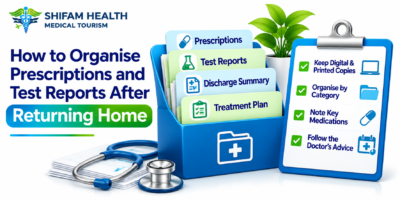
If you have recently returned from India, it is useful to organize the discharge summary with your other medical documents. Our guide on how to organize prescriptions and test reports after returning home explains how to maintain these records in one accessible system.
Step-by-Step Process to Share Your Discharge Summary
Step 1: Obtain the Complete Discharge Summary
Before leaving the Indian hospital, request a complete copy of your discharge summary.
Check that the document includes the following information, where applicable:
- Patient’s full name and hospital identification details.
- Date of admission and discharge.
- Primary diagnosis and relevant associated conditions.
- Important examination and investigation findings.
- Details of treatment, surgery or procedures performed.
- Condition at discharge.
- Medication instructions.
- Follow-up recommendations.
- Name and details of the treating consultant or department.
Check that every page is readable and that the document has not been cut off during scanning or printing.
If the hospital provides a digitally signed document or an official PDF, retain that version. Avoid relying only on a photograph of the first page.
For a broader checklist of records to collect before leaving the hospital, refer to what documents to request before discharge from an Indian hospital.
Step 2: Collect Supporting Medical Documents
Your discharge summary provides an overview, but your local doctor may need additional records to understand specific aspects of your treatment.
Prepare the documents relevant to your case:
Not every patient will need all these documents. Select records according to the treatment received and the information requested by your local doctor.
If you have multiple investigations, arrange them by date. You can also refer to how to prepare a digital medical file for an overseas specialist for a practical approach to organising medical records.
Step 3: Prepare a Short Medical Handover Note
Along with the discharge summary, prepare a short note explaining your treatment journey.
This is useful because a local doctor may not have time to review every document before your appointment.
Your handover note can include:
- Your diagnosis before travelling to India.
- The name of the hospital where you received treatment.
- The name or department of the treating specialist.
- The treatment or procedure performed.
- Admission and discharge dates.
- Your current symptoms, if any.
- Medicines you are currently taking.
- Follow-up appointments or investigations recommended.
- Any pending reports or unresolved questions.
Keep the information factual. Do not interpret medical findings or describe the outcome of treatment in your own words as a confirmed clinical conclusion.
For example, instead of writing that your condition has completely recovered, mention the discharge condition exactly as documented by the hospital and describe any symptoms you are currently experiencing.
Step 4: Ask Your Local Doctor How They Prefer to Receive the Documents
Different clinics and hospitals may have different systems for receiving medical records.
Before sending the documents, ask whether the doctor prefers:
- PDF attachments by email.
- Upload through a patient portal.
- A secure medical-record sharing platform.
- Printed copies during the appointment.
- A hospital-approved messaging or communication channel.
Avoid sending sensitive medical information through an unverified contact or public file-sharing link.
If you are sending several documents, use clear filenames such as:
PatientName_DischargeSummary_Date.pdfPatientName_FinalPrescription_Date.pdfPatientName_BloodReports_Date.pdfPatientName_ImagingReport_Date.pdfPatientName_OperationNotes_Date.pdf
This makes it easier for the receiving clinic to identify each document.
Step 5: Explain Why You Are Sharing the Summary
Do not send the discharge summary without explaining what you need from the local doctor.
For example, you may be requesting:
- A routine post-treatment review.
- Continuation of care after surgery.
- A medication review.
- Assessment of new symptoms.
- Review of follow-up investigations.
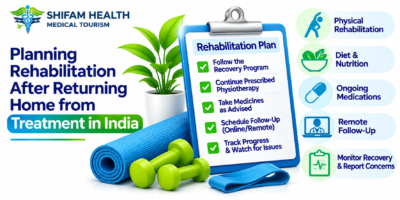
- Rehabilitation or physiotherapy planning.
- Coordination with the treating specialist in India.
Clearly state whether the appointment is routine or whether you have a new medical concern.
If you have severe or sudden symptoms, seek emergency medical attention rather than waiting for a routine document review.
Step 6: Arrange a Follow-Up Appointment
Once your doctor receives the records, arrange an appointment at the recommended time.
During the consultation, the doctor may review your discharge instructions, examine you, check your medicines and decide whether additional investigations or specialist referrals are needed.
Do not assume that a discharge summary alone provides enough information to continue every aspect of your treatment. Your local doctor may need original images, pathology material, additional reports or direct clarification from the Indian hospital.
If a remote specialist discussion is required, our article on what happens during a virtual consultation with an Indian specialist explains how such consultations generally work.
Step 7: Keep a Record of the Handover
After sharing your documents, maintain a record of:
- The date you sent the discharge summary.
- The name of the doctor or clinic receiving it.
- The documents shared.
- Whether receipt was confirmed.
- The date of your follow-up appointment.
- Any additional information requested.
Keep copies of new prescriptions, consultation notes and investigation reports received after returning home.
This helps maintain continuity between the treatment received in India and your ongoing care locally.
. What Questions Should You Ask Your Local Doctor?
A discharge summary may contain medical terminology or instructions that are unfamiliar to you. Prepare questions before your appointment so that important details are not missed.
Consider asking:
- Does the discharge summary provide enough information to continue my care?
- Do you need the original imaging files or additional investigation reports?
- Should I continue all the medicines prescribed at discharge?
- Are any medicines due for review or adjustment?
- When should I repeat the recommended tests?
- Do I need rehabilitation, physiotherapy or another specialist consultation?
- Should you communicate directly with the treating hospital in India?
- Which symptoms should prompt urgent medical attention?
- When should I schedule my next follow-up appointment?
- Are any pending reports or investigations still required?
Do not change medication doses or stop prescribed treatment based on your own interpretation of the discharge summary. Discuss any concerns with a qualified healthcare professional.
For additional guidance on reviewing medication records, read how to organize prescriptions and test reports after returning home.
. How to Handle Medical Terms and Language Differences
International patients may receive discharge summaries containing abbreviations, specialist terminology or medical terms that are unfamiliar to their local doctor.
Language differences can create additional difficulties, particularly when the patient and local doctor speak different languages.
Here are some practical steps:
- Request clarification from the Indian hospital if an important section is unclear.
- Do not translate medical terminology yourself if the meaning is uncertain.
- Retain the original document alongside any translated version.
- Use a qualified medical translator when an official translation is required.
- Ask the receiving doctor to clarify any terms they cannot interpret confidently.
A translated summary should not replace the original clinical document. Both versions may be useful during a consultation.
If you need help communicating with the hospital team in India, ask whether interpretation or translation support is available.
. Common Mistakes to Avoid When Sharing a Discharge Summary
Sending Only the First Page
Some discharge summaries contain several pages. Sending only the first page may leave out medication instructions, investigation findings or follow-up recommendations.
Always check that the complete document is attached.
Sharing an Unreadable Photograph
Blurry photographs, cropped pages and poorly scanned documents can make medical information difficult to interpret.
Use a clear PDF or scan whenever possible.
Forgetting the Final Prescription
The discharge summary may refer to medicines, but your local doctor may need the actual prescription with the dose, frequency and duration.
Send the latest prescription as a separate document.
Mixing Old and New Reports
If you have investigations from before and after treatment, label them clearly. The dates help your doctor understand how your results have changed.
Omitting the Procedure Details
For patients who have undergone surgery or a medical procedure, the discharge summary may not contain every technical detail. Your local doctor may need the operation note or procedure report as well.
Changing Medicines Without Medical Advice
Do not independently stop, restart or substitute medicines. The local doctor should review the complete medication history and consider your current clinical condition.
Sending Records to an Unverified Contact
Medical records contain sensitive personal information. Confirm the recipient’s identity and use an approved communication method.
. When Should You Contact the Indian Hospital or Treating Specialist?
Sometimes your local doctor may need clarification that cannot be obtained from the discharge summary alone.
Contact the Indian hospital or treating specialist if:
- The discharge summary is incomplete or a page is missing.
- You have not received the final prescription.
- A procedure or operation note is required.
- A test result is pending.
- Your local doctor needs clarification about the treatment performed.
- The medication instructions are unclear.
- You need the treating specialist to review new investigation results.
- You need to confirm the recommended follow-up schedule.
If you need to send additional investigation files, read how to share large MRI and CT files with an Indian hospital.
For patients whose treatment involved biopsy or tissue examination, how international patients can organise pathology slides for review in India may also be useful.
If you need to compare or clarify different treatment recommendations, our guide on how to choose between two treatment recommendations offers a structured approach to discussing the options with qualified specialists.
. How Shifam Health Can Help with Post-Treatment Coordination
For international patients, communication between an Indian hospital and a doctor in their home country may require additional coordination.
Shifam Health supports international patients with medical travel coordination and post-treatment communication. Depending on the patient’s requirements, assistance may include:
- Coordinating requests for discharge summaries and medical reports.
- Helping organise documents for communication with the treating hospital.
- Coordinating follow-up consultations with the relevant specialist, subject to availability.
- Supporting communication between patients and hospital teams.
- Assisting with language and interpretation requirements.
- Coordinating post-treatment follow-up communication.
Shifam Health does not replace the treating doctor or independently interpret medical reports. Clinical decisions, medication changes and further treatment recommendations remain the responsibility of qualified healthcare professionals.
If you need help obtaining documents or coordinating a follow-up discussion with the hospital in India, contact Shifam Health.
. Frequently Asked Questions
1. Is an Indian hospital discharge summary useful for a doctor in my home country?
If the clinic accepts medical records in advance, sending the document beforehand may give the doctor time to review it. Follow the clinic’s preferred submission process.
Not always. However, if your local doctor cannot understand the language of the document, ask whether a certified or medically accurate translation is required.
Depending on your treatment, include the final prescription, important test reports, imaging records, procedure notes and follow-up instructions.
You can request clarification from the treating hospital and ask whether the specialist or relevant department can communicate with your local doctor, subject to availability and the required consent.
Shifam Health can assist with coordinating communication, medical documents and follow-up consultations with the relevant hospital in India, depending on availability and the patient’s requirement.
Yes. It provides information about your diagnosis, hospitalisation, treatment and discharge instructions. Your local doctor may request additional records before deciding on further care.
Conclusion
Sharing your Indian hospital discharge summary with your local doctor is an important step in maintaining continuity of care after medical travel. A complete discharge summary, supporting investigation reports, updated prescription and short treatment history can help your local doctor understand the care you received.
Before sending the documents, check that they are complete, readable and shared through a secure channel. Ask questions whenever medication instructions or follow-up recommendations are unclear, and make sure your local doctor has the opportunity to request additional information from the treating hospital if necessary.
With organised records and clear communication, the transition from treatment in India to follow-up care at home can become more structured and manageable.
Need assistance coordinating your medical records or follow-up communication with an Indian hospital? Contact Shifam Health for support with your post-treatment coordination.


Popular Posts From Last Week
- November 11, 2026
- Shifam Health
- November 11, 2026
- Shifam Health
- November 10, 2026
- Shifam Health
- November 10, 2026
- Shifam Health
- November 10, 2026
- Shifam Health
- November 9, 2026
- Shifam Health
- November 7, 2026
- Shifam Health
- November 5, 2026
- Shifam Health
- November 9, 2026
- Shifam Health
- November 9, 2026
- Shifam Health
- November 6, 2026
- Shifam Health
- November 7, 2026
- Shifam Health