


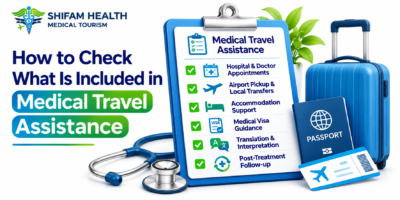
How to Check What Is Included in Medical Travel Assistance
Filters & Insights
Written By :
Medically Reviewed By :

Shifam Health Medical Team
Shifam Health - Medical Reviews Department
10+ Years Of Experience
Check medical travel assistance inclusions in India, including hospital coordination, transport, accommodation and aftercare.
📅
Last updated: November 9, 2026

When planning medical treatment in India from another country, patients often receive information about different services in one package or proposal. It may mention hospital coordination, doctor consultations, airport pickup, accommodation, medical visa assistance, translation and post-treatment support.
At first glance, the arrangement may appear comprehensive. However, one important question remains: What exactly is included, and what will you have to pay for separately?
This distinction matters because medical travel assistance can involve several independent services. Hospital charges, medical procedures, accommodation, local transport and coordination fees may be handled by different providers. If the inclusions are not clearly explained, patients may face unexpected expenses or misunderstand what support they will receive.
Before accepting any medical travel assistance arrangement, ask for a written breakdown of services, charges, exclusions and responsibilities.
This guide explains how to check what is included in medical travel assistance in India, what questions to ask and how international patients can avoid confusion before travelling.
Table of Contents
ToggleUnderstand What Medical Travel Assistance May Include
Medical travel assistance refers to the non-clinical coordination and practical support that may help international patients access treatment in another country.
The exact scope varies between organisations. Some may provide only hospital appointment coordination, while others may help organise several parts of the medical journey.
Common service areas include:
- Medical record collection and submission.
- Hospital and specialist appointment coordination.
- Requests for treatment estimates.
- Medical visa invitation letter coordination, where applicable.
- Airport pickup arrangements.
- Local transport coordination.
- Accommodation assistance.
- Translation and interpretation support.
- Medical escort coordination, where required.
- Discharge document coordination.
- Planned post-treatment follow-up communication.
Not every provider offers all these services. Some services may be included in a coordination fee, while others may be arranged separately and charged by an external provider.
It is also important to distinguish between medical travel assistance and clinical care. A facilitator may coordinate a consultation, but the hospital and treating doctors are responsible for medical assessment, treatment and clinical decisions.
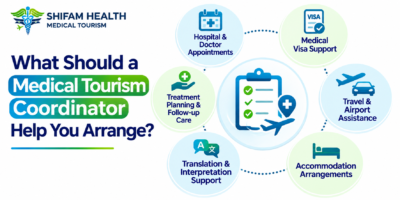
For a broader overview, read what a medical tourism coordinator should help you arrange.
Step-by-Step: How to Check What Is Included
Step 1: Request a Written Service Breakdown
Start by asking the medical travel support organisation for a written list of services included in its proposal.
Avoid relying only on a phone conversation or a general statement such as “complete medical travel assistance.”
The breakdown should explain:
- Which services are included.
- Which services are optional.
- Which services are charged separately.
- Which services are provided by external vendors.
- Which arrangements depend on hospital or provider availability.
- Whether any limits apply to the service.
For example, airport pickup may be included only for one arrival transfer, while additional hospital visits may be charged separately.
Similarly, interpretation may be available for selected appointments rather than throughout the patient’s entire stay.
Ask the provider to explain each item in plain language.
Step 2: Check What Hospital Coordination Includes
Hospital coordination is one of the most important parts of medical travel assistance.
Ask whether the provider will help with:
- Identifying hospitals that offer the relevant speciality.
- Submitting medical reports for review.
- Coordinating specialist consultation requests.
- Confirming appointment dates and timings.
- Communicating hospital responses.
- Requesting written treatment estimates.
- Helping obtain discharge documents.
Also clarify whether the hospital itself will provide the consultation and estimate.
A coordinator should not independently decide which treatment a patient needs. Medical recommendations must come from qualified specialists after reviewing the patient’s condition.
If you are comparing hospitals, read how to compare hospitals beyond the headline treatment price.
Step 3: Understand Whether Doctor Consultation Fees Are Included
Some medical travel proposals include consultation coordination but not the actual doctor’s consultation fee.
These are different things.
Ask:
- Is the appointment coordination free or paid?
- Is the doctor’s consultation fee included?
- Is an online consultation included?
- Is an in-person consultation included?
- Are repeat consultations charged separately?
- Does the fee change if another specialist is required?
- Will the hospital issue a consultation confirmation?
Do not assume that arranging an appointment means the consultation itself is included.
For more information, read what happens during a virtual consultation with an Indian specialist.
Step 4: Check the Treatment Estimate Separately
Hospital treatment costs should be clearly distinguished from medical travel coordination charges.
Ask whether the proposal includes a hospital-issued estimate or only an approximate cost communicated by the coordinator.
A written treatment estimate may specify:
- Hospital admission.
- Doctor or surgeon fees.
- Room category.
- Investigations.
- Operating theatre charges.
- Medicines and consumables.
- ICU charges, if applicable.
- Expected admission duration.
- Exclusions and possible additional expenses.
Also ask whether the estimate is provisional and how long it remains valid.
Treatment costs may change after clinical evaluation or if additional procedures, investigations or hospital days become necessary.
Read questions to ask before accepting a medical treatment package in India before agreeing to a package.
Step 5: Confirm What Medical Visa Assistance Covers
International patients may require a suitable visa and supporting hospital documentation before travelling to India.
A medical travel assistance provider may help coordinate:
- Hospital invitation letter requests.
- Appointment-related documentation.
- General information about medical visa procedures.
- Documents requested by the hospital.
- Information about an accompanying attendant’s documentation, where applicable.
However, assistance with documentation is not the same as visa approval.
Ask whether the provider’s service covers only hospital invitation letter coordination or also includes administrative guidance on the application process.
Check current requirements through the Government of India’s official visa portal.
You can also read the medical visa guide for India and the medical attendant visa guide.
Step 6: Confirm Airport Pickup and Local Transport Arrangements
Transport arrangements can involve different charges depending on the patient’s needs and the distance travelled.
Ask whether the assistance includes:
- One-way airport pickup.
- Return airport transfer.
- Hospital transfers.
- Accommodation-to-hospital transport.
- Transport for a companion.
- Accessible transport for patients with mobility difficulties.
- Additional waiting time or late-night charges.
Also confirm who will provide the vehicle and whether the transport provider is an external vendor.
If the patient requires clinical ambulance transport, this must be assessed and arranged through an appropriate medical transport provider. Ordinary airport pickup should not be presented as an ambulance service.
Our guide on how to arrange accessible transport for patients in India explains what to consider when mobility support is required.
Step 7: Check Accommodation Inclusions
Accommodation is another area where package descriptions can be unclear.
Ask:
- Is accommodation included or only recommended?
- Is the quoted price per night or for the full stay?
- Is the room suitable for the patient?
- Can a companion stay in the same room?
- Are meals included?
- Is there a lift or wheelchair accessibility?
- What are the cancellation and refund terms?
- Are taxes or additional charges included?
If accommodation is arranged through an external provider, ask for the property name, location and booking terms.
For more practical guidance, read affordable accommodation for medical tourists in India.
Step 8: Confirm Translation and Interpretation Support
Language assistance may be particularly important when patients need to communicate medical concerns or understand hospital instructions.
Ask:
- Which languages are available?
- Is interpretation included in the coordination fee?
- Is support available during doctor consultations?
- Is it available during admission and discharge?
- Is written translation included?
- Are additional hours charged separately?
- Will an interpreter be physically present or available remotely?
Do not assume that all communication will be translated simply because the provider mentions language support.
For important medical discussions, interpretation should be accurate and should help the patient communicate directly with the treating doctor.
Step 9: Check What Happens After Hospital Discharge
Some patients need support after leaving the hospital, particularly when they are travelling home soon after treatment.
Ask whether the provider can help coordinate:
- Discharge summary requests.
- Prescription and report collection.
- Planned follow-up consultation requests.
- Communication with the treating hospital.
- Translation of relevant documents, where available.
- Travel arrangements after discharge.
- Communication about the next stage of recovery.
Also confirm whether these services are included or charged separately.
Clinical rehabilitation, medical advice and emergency treatment remain the responsibility of qualified healthcare professionals.
Related guides:
- What to ask about complications and emergency contacts before discharge
- How to arrange remote follow-up consultations after medical travel
- Planning rehabilitation after returning home from treatment in India
Documents to Request Before Accepting Medical Travel Assistance
Before confirming an arrangement or making payment, ask for the relevant documents in writing.
Depending on the services being offered, these may include:
- Service proposal or agreement.
- Itemised list of included services.
- Separate list of exclusions.
- Coordination fee breakdown.
- Hospital treatment estimate.
- Consultation appointment confirmation, where available.
- Accommodation details and booking terms.
- Airport transfer details.
- Visa documentation requirements.
- Payment and refund policy.
- Contact details for the responsible coordinator.
- Post-treatment support description.
Keep copies of all written communication and payment receipts.
Questions to ask the medical travel assistance provider
- What exactly is included in the quoted amount?
- Which services are optional?
- Are hospital charges separate from coordination fees?
- Are doctor consultation fees included?
- Is airport pickup included?
- Is local hospital transport included?
- Is accommodation included or arranged separately?
- Are meals and companion accommodation covered?
- Is interpretation available throughout the hospital visit?
- Does medical visa assistance include invitation letter coordination?
- Is post-treatment follow-up coordination included?
- What happens if the treatment plan or travel dates change?
- Are there cancellation or refund charges?
- Will I receive invoices or receipts for payments?
Common Mistakes to Avoid
Assuming Everything Is Included in One Package
A proposal may use terms such as “complete assistance” without explaining the individual services.
Always ask for an itemised breakdown.
Confusing Hospital Charges with Coordination Fees
Hospital charges and medical travel assistance fees are not necessarily the same. Ask who receives each payment and what it covers.
Ignoring Exclusions
Some arrangements may exclude medicines, additional investigations, extended admission, meals, local transport or repeat consultations.
Read the exclusions carefully.
Accepting Verbal Promises
Important arrangements should be confirmed in writing. This is particularly important for accommodation, transport, consultation appointments and refunds.
Not Checking External Service Providers
If accommodation or transport is arranged through another company, ask who is responsible for the booking and what happens if the service is unavailable.
Assuming Visa Approval Is Part of the Package
A provider may coordinate supporting documents, but government authorities make visa decisions.
Not Clarifying Aftercare
Ask whether support ends at hospital discharge or includes planned communication after returning home.
When Should You Contact the Hospital or Another Service Provider Directly?
A medical travel coordinator can help organise communication, but patients should verify important information directly with the responsible provider.
Contact the hospital when you need to confirm:
- Whether the doctor has reviewed your reports.
- Whether the consultation is confirmed.
- Whether the treatment estimate is official.
- What hospital services are included.
- Whether the patient is suitable for a proposed procedure.
- Whether additional investigations are required.
- What follow-up care is medically recommended.
Contact the accommodation or transport provider when you need to verify:
- Booking confirmation.
- Vehicle type and pickup arrangements.
- Accessibility facilities.
- Cancellation terms.
- Additional charges.
For hospital and doctor verification, useful official resources include:
- National Medical Commission – Information about medical regulation and registration.
- National Accreditation Board for Hospitals and Healthcare Providers – Hospital accreditation information.
You may also read how to verify a doctor’s qualifications before medical travel and how to check hospital accreditation and quality information in India.
A Practical Medical Travel Assistance Inclusion Checklist
Use this checklist when reviewing a proposal from a medical travel support organisation.
| Service | What to confirm |
|---|---|
| Medical records | Collection, submission and document handling |
| Hospital coordination | Which hospitals and departments will be approached |
| Doctor consultation | Appointment coordination and consultation fee |
| Treatment estimate | Whether it is issued by the hospital |
| Visa assistance | Invitation letter coordination and guidance |
| Airport pickup | Arrival transfer, waiting time and additional charges |
| Local transport | Hospital transfers and accessible transport |
| Accommodation | Property, room type, duration and booking charges |
| Companion support | Whether companion arrangements are included |
| Interpretation | Languages, appointment coverage and extra charges |
| Hospital admission | Administrative coordination and communication |
| Discharge documents | Collection and organisation support |
| Follow-up | Planned remote consultation coordination |
| Service fees | Itemised charges and payment terms |
| Refunds | Cancellation and refund conditions |
A simple comparison between two providers can help identify differences.
| Comparison point | Provider A | Provider B |
|---|---|---|
| Written service breakdown | ||
| Coordination fee | ||
| Hospital charges separately identified | ||
| Airport pickup details | ||
| Accommodation arrangements | ||
| Interpretation support | ||
| Visa documentation assistance | ||
| Post-treatment coordination | ||
| Refund terms |
Do not select a provider based only on the number of services mentioned. Consider whether the arrangements are clearly defined, appropriate for the patient’s needs and supported by written terms.
How Shifam Health Helps Coordinate Medical Travel Assistance
Shifam Health is a medical travel coordination company based in Delhi, India. It supports international patients who are exploring treatment options in India and need assistance with hospital communication and practical travel arrangements.
Depending on the patient’s requirements, Shifam Health may help coordinate:
- Medical record collection and submission.
- Hospital and specialist appointment requests.
- Communication regarding hospital treatment estimates.
- Medical visa invitation letter coordination, where applicable.
- Airport pickup and local transport arrangements.
- Accommodation options.
- Medical escort coordination.
- Translation and interpretation support.
- Discharge document coordination.
- Planned post-treatment follow-up communication.
The exact scope of assistance depends on the patient’s requirements and the availability of the relevant hospital or external service provider. Services, charges and exclusions should be confirmed before arrangements are accepted.
Shifam Health acts as a facilitator and coordinator. It does not independently diagnose patients, prescribe treatment, provide hospital-based clinical care or guarantee medical outcomes. Clinical decisions remain with qualified healthcare professionals.
If you are planning treatment in India and want to understand the coordination process, contact Shifam Health.
Frequently Asked Questions
What is usually included in medical travel assistance in India?
It may include medical record coordination, hospital appointment requests, travel documentation assistance, airport pickup coordination, accommodation arrangements, interpretation and planned follow-up communication. The exact services vary by provider.
Are hospital treatment costs included in medical travel assistance fees?
Not necessarily. Hospital treatment charges, medical travel coordination fees and third-party service costs may be separate. Ask for an itemised written breakdown.
Should I receive a written list of inclusions and exclusions?
Yes. Request a written proposal that explains included services, optional services, exclusions, additional charges and refund conditions.
Does medical travel assistance include medical visa approval?
No. A provider may help coordinate hospital invitation documentation and provide general guidance, but visa decisions are made by the relevant government authorities.
Is accommodation automatically included?
No. Some providers coordinate accommodation separately, while others may include selected arrangements in a package. Confirm the property, duration, room type and total cost.
Can medical travel assistance continue after discharge?
Some providers help coordinate discharge documents and planned follow-up communication. Confirm the exact scope and remember that clinical aftercare must be managed by qualified healthcare professionals.
Conclusion
Medical travel assistance can make it easier for international patients to organise treatment in India, but only when the services and responsibilities are clearly explained.
Before accepting an arrangement, ask for a written breakdown of hospital coordination, consultation fees, travel documentation, airport pickup, accommodation, interpretation and post-treatment support. Check which charges are separate and understand the refund and cancellation terms.
Do not rely only on the phrase “complete medical assistance.” Understand exactly what the provider will arrange, who will deliver each service and what remains your responsibility.
A transparent arrangement helps patients and families plan their medical journey with fewer surprises and greater confidence.
Planning medical treatment in India? Shifam Health can help coordinate hospital communication, appointments, travel arrangements and planned post-treatment support. Contact our team to discuss the services you may require.


Popular Posts From Last Week
- November 3, 2026
- Shifam Health
Travelling to India with someone for medical treatment requires more than arranging flights and accommodation. Caregivers need to…
- November 3, 2026
- Shifam Health
Planning a hospital visit in India involves more than treatment and accommodation. International patients and their companions also…
- November 9, 2026
- Shifam Health
Medical travel assistance can include hospital coordination, appointment requests, visa documentation support, airport pickup, accommodation and planned follow-up…
- November 7, 2026
- Shifam Health
Planning treatment in another country involves hospital communication, medical records, appointments, travel documents and practical arrangements. A medical…
- November 5, 2026
- Shifam Health
Medical treatment abroad does not always follow the original schedule. Additional investigations, specialist consultations, hospital availability or recovery…
- November 5, 2026
- Shifam Health
Repeat investigations and additional specialist consultations can affect the total cost of medical treatment in India. Even when…
- November 9, 2026
- Shifam Health
Currency exchange can affect how much international patients spend on medical treatment in India, even when the hospital’s…
- November 6, 2026
- Shifam Health
Researching hospitals online is an important first step for international patients considering treatment in India. However, hospital websites,…
- November 7, 2026
- Shifam Health
Choosing a hospital in another country can feel complicated, especially when you are unfamiliar with its departments, doctors…
- November 4, 2026
- Shifam Health
When a patient travels to India for medical treatment, a close family member may need to remain in…
- November 6, 2026
- Shifam Health
A hospital treatment estimate may be a general package indication or a quotation prepared after reviewing a patient’s…
- November 4, 2026
- Shifam Health
When comparing hospitals in India for treatment, it is tempting to focus on the total amount mentioned in…