


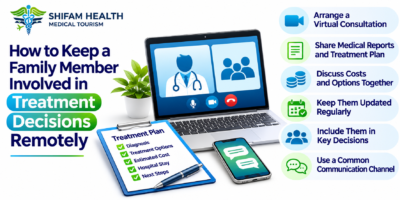
How to Keep a Family Member Involved in Treatment Decisions Remotely
Filters & Insights
Written By :
Medically Reviewed By :

Shifam Health Medical Team
Shifam Health - Medical Reviews Department
10+ Years Of Experience
Learn how to involve family remotely in treatment decisions in India while respecting patient consent, privacy and hospital policies.
📅
Last updated: November 6, 2026

When a patient travels to India for medical treatment, family members may not always be able to travel with them. A spouse, parent, adult child or another close relative may need to remain in their home country because of work, financial responsibilities, childcare or visa limitations.
Even when they are thousands of kilometres away, family members often play an important role in helping the patient understand medical information, consider treatment options and manage practical decisions.
However, keeping someone involved remotely requires more than regular phone calls. Medical information must be shared appropriately, the patient’s preferences must remain central, and communication with the hospital needs to be organised.
If you or a family member is planning treatment in India, this guide explains how to involve a trusted relative in treatment discussions, consultations and important decisions while respecting the patient’s privacy and independence.
Table of Contents
ToggleWhy Remote Family Involvement Matters
Medical treatment can involve unfamiliar terminology, several specialist consultations, investigations and important choices. A patient may find it difficult to remember every detail, especially when receiving complicated or unexpected information.
A trusted family member can provide practical and emotional support.
Helping the Patient Understand Medical Information
A relative can listen during consultations, take notes and help the patient review the doctor’s explanations later.
This can be particularly useful when the patient is discussing:
- A new diagnosis.
- Further investigations.
- Different treatment options.
- Possible benefits and risks.
- Expected recovery.
- Hospital admission and discharge.
- Follow-up arrangements.
Supporting Difficult Decisions
Some treatment decisions require careful consideration. The family member may help the patient organise questions and understand the information provided by the doctor.
However, family involvement should support the patient’s decision-making rather than replace it.
Coordinating Practical Arrangements
A relative living abroad may also help with:
- Reviewing treatment estimates.
- Arranging payments where appropriate.
- Coordinating travel changes.
- Organising accommodation.
- Managing communication with other relatives.
- Preparing for the patient’s return home.
Providing Emotional Support
Being away from familiar surroundings during treatment can be stressful. Regular conversations with family members can help patients feel connected and supported.
The most important point is that the patient should decide who is involved and what information may be shared.
Step-by-Step: How to Keep a Family Member Involved Remotely
Step 1: Ask the Patient Who They Want Involved
Start by speaking with the patient.
Ask whether they would like a family member to participate in consultations or receive updates about their treatment.
The patient may prefer to involve:
- Their spouse.
- An adult child.
- A parent.
- A sibling.
- Another trusted relative.
- A legally authorised representative, where applicable.
Do not assume that the closest relative automatically has permission to access medical information.
For an adult patient who has decision-making capacity, their preferences and consent should guide family involvement, subject to applicable law.
Step 2: Confirm the Hospital’s Consent and Communication Process
Before the first consultation, ask the hospital how it handles remote family participation.
Find out:
- Whether a family member can join a video consultation.
- Whether the patient must provide written consent.
- Whether the hospital accepts an email authorisation.
- Whether the family member can receive reports directly.
- Whether the doctor can discuss treatment options with the relative present.
- Whether there are restrictions on sharing medical information.
Hospitals may have specific procedures for verifying identity and recording patient consent.
The patient should ask the hospital which documents or forms are required. Do not assume that a WhatsApp message or informal family relationship is sufficient authorisation.
For general guidance on patient rights and informed consent, consult the National Medical Commission and ask the hospital about its own patient consent policy.
Step 3: Choose One Main Family Contact
If several relatives want updates, it is usually easier to nominate one primary family contact.
This person can:
- Join consultations when permitted.
- Maintain a record of important updates.
- Share agreed information with other relatives.
- Collect questions from the family.
- Help organise practical arrangements.
The patient should remain informed about what is being shared and with whom.
Having one main contact can reduce repeated calls and conflicting messages to the hospital.
Step 4: Arrange Remote Participation in Consultations
Ask the hospital or treating specialist whether the family member can join the consultation through a video call.
Before the appointment:
- Confirm the date and time in both countries.
- Check the time difference.
- Test the internet connection.
- Confirm that the patient has a suitable device.
- Ask whether the doctor permits another participant.
- Make sure the patient is comfortable discussing medical information in front of the relative.
If a video consultation is not possible, ask whether the hospital can arrange an alternative communication process, subject to the patient’s consent and hospital policy.
You can read what happens during a virtual consultation with an Indian specialist for more preparation guidance.
Step 5: Prepare Questions Before Every Consultation
A family member who cannot attend in person can still contribute by helping the patient prepare questions.
For example:
- What is the confirmed diagnosis?
- Are further investigations required?
- What treatment options are available?
- Why is one option being recommended?
- What are the expected benefits and risks?
- Are there alternative approaches?
- How long might treatment and recovery take?
- What expenses may not be included in the initial estimate?
- What follow-up care will be required?
Encourage the patient to ask the doctor directly if anything is unclear.
A useful reference is how to prepare for a video consultation about treatment in India.
Step 6: Maintain an Organised Medical Information Folder
A shared digital folder can help the patient and authorised family member access important documents.
Depending on the hospital’s rules and the patient’s consent, it may contain:
- Medical history.
- Diagnosis and consultation notes.
- Blood test reports.
- Imaging reports.
- MRI and CT scan files.
- Treatment recommendations.
- Hospital estimates.
- Prescriptions.
- Discharge summaries.
- Follow-up instructions.
Keep the folder organised by date and document type.
Avoid sending sensitive medical records through public or unsecured links. Use secure sharing methods and give access only to people authorised by the patient.
For help organising documents, see how to prepare a digital medical file for an overseas specialist and how to organise prescriptions and test reports after returning home.
Step 7: Keep a Written Record of Important Discussions
After each consultation, the patient or family member can prepare a short summary.
Record:
- Consultation date.
- Doctor’s name and speciality.
- Main medical findings.
- Tests recommended.
- Treatment options discussed.
- Questions that remain unanswered.
- Next appointment.
- Any instructions given by the hospital.
Where possible, use the doctor’s written notes and official hospital documents rather than relying only on memory.
If the patient and relative remember a discussion differently, ask the hospital to clarify the written treatment plan.
Step 8: Discuss Treatment Options Together Without Replacing the Doctor’s Advice
A family member may help the patient compare treatment options, but the medical recommendation should come from the treating specialist.
If the patient receives more than one recommendation, ask the doctors to explain the differences in terms the patient can understand.
Consider:
- The patient’s diagnosis and current condition.
- The purpose of each proposed treatment.
- Potential benefits and risks.
- Possible alternatives.
- Expected recovery.
- Follow-up requirements.
- Total estimated costs.
- Whether another specialist opinion is appropriate.
The final decision should reflect the patient’s informed preferences and the medical advice provided by the treating team.
You may find how to choose between two treatment recommendations and questions to ask before accepting a medical treatment package in India helpful.
Step 9: Agree on a Regular Communication Routine
Avoid relying on random updates throughout the day.
Agree on a simple communication routine that works across time zones.
For example:
- A short daily update from the patient, if they feel well enough.
- A family call after important consultations.
- An update when investigation results become available.
- A discussion before major treatment decisions.
- An update after discharge.
The patient should not feel pressured to make frequent calls while resting or recovering.
If the patient is admitted to hospital, ask the hospital who is authorised to provide updates and how frequently information can be shared.
Step 10: Plan How Important Decisions Will Be Handled
Before treatment begins, discuss how the family will approach major decisions.
Agree on:
- Who the patient wants involved.
- How the patient prefers to receive medical explanations.
- Whether the family member should join important consultations.
- How questions will be communicated to the doctor.
- How urgent updates will be shared.
- What happens if the patient cannot communicate.
If the patient may lose the ability to make or communicate decisions, ask the hospital in advance about its process for advance directives, legally authorised representatives and applicable consent requirements.
Do not assume that an overseas relative automatically has legal authority to make medical decisions in India.
Documents and Information to Prepare
Before the patient travels, organise the following information.
Patient Documents
- Passport and visa details.
- Medical history.
- Recent investigation reports.
- Previous treatment records.
- Current medication list.
- Known allergies.
- Hospital appointment confirmation.
- Treatment estimate, if available.
Family Contact Information
- Full name of the nominated family contact.
- Relationship to the patient.
- Country of residence.
- Phone number with country code.
- Email address.
- Preferred communication method.
- Time zone and suitable calling hours.
Consent and Authorisation
Ask the hospital whether it requires:
- Written patient consent.
- A hospital-specific authorisation form.
- Identification of the authorised family member.
- A separate consent for sharing medical reports.
- Any additional legal documentation.
The patient should understand what information will be shared, with whom and for what purpose.
Questions to Ask the Hospital
- Can my family member join consultations remotely?
- What consent is required?
- Can reports be shared with an authorised relative?
- Can the doctor explain treatment options during a joint call?
- Who should the family contact for appointment updates?
- What happens if an urgent decision is required?
- How will the hospital communicate with an overseas family member?
- Are there any restrictions on recording or sharing consultations?
Common Mistakes and Practical Tips
Assuming a Family Member Can Automatically Access Medical Records
Hospitals generally need to follow patient confidentiality and consent requirements. Make sure the patient has authorised the intended information sharing.
Allowing Too Many People to Contact the Hospital
Several relatives making separate requests can create confusion.
Choose one main contact and agree on how updates will be shared.
Relying Only on Verbal Updates
Important treatment decisions should be supported by written medical information wherever possible.
Ask for consultation notes, investigation reports and treatment recommendations through the hospital’s approved process.
Making Decisions Through Family Group Chats
Family discussions can be useful, but medical decisions should not be made based on forwarded messages or incomplete information.
Ask the treating doctor to explain the clinical options directly to the patient.
Ignoring Time Differences
A relative living in another country may not be available during Indian hospital hours.
Agree on suitable calling times and an alternative contact method.
Pressuring the Patient
Family members may be worried, but repeated calls and requests for updates can become tiring.
Respect the patient’s need for rest, privacy and independent decision-making.
Recording Consultations Without Permission
Do not record a consultation or share its contents without checking the hospital’s policy and obtaining the required consent from participants.
How to Handle Important or Urgent Treatment Updates
Sometimes a doctor may recommend an additional investigation, change the treatment plan or discuss an urgent medical concern.
In such situations, the patient should not delay necessary medical care simply because a relative is unavailable.
A practical approach is:
- Ask the doctor to explain the medical situation to the patient.
- Confirm whether the matter is urgent or whether there is time for further discussion.
- Ask the patient whether they want the authorised family member contacted.
- Request a joint call if it is medically and operationally possible.
- Ask for written information about the recommendation.
- Clarify any remaining questions with the treating team.
If the patient is unable to make or communicate a decision, the hospital should follow applicable law and its established procedures for emergency care, consent and authorised representation.
Family members should not independently change medication, cancel treatment or delay urgent care based on remote discussions.
For additional preparation, read what to ask about complications and emergency contacts before discharge.
How Shifam Health Can Support Remote Family Coordination
Shifam Health assists international patients who are planning treatment in India. When a patient wants a family member to remain involved from another country, communication and appointment coordination can be organized around the patient’s preferences and the hospital’s policies.
Depending on the case, Shifam Health may help with:
- Coordinating hospital and specialist appointment requests.
- Helping organise medical reports before consultations.
- Sharing appointment-related updates with authorised contacts, where permitted.
- Coordinating requests for virtual consultations.
- Helping patients obtain treatment estimates and written plans from hospitals.
- Supporting communication between the patient and hospital.
- Arranging translation and interpretation support where required.
- Coordinating practical travel and accommodation arrangements.
- Helping organise planned post-treatment follow-up communication.
Shifam Health does not make clinical decisions or independently interpret medical findings on behalf of the treating doctor. Access to medical information remains subject to the patient’s consent and hospital requirements.
If your family member is planning treatment in India and you want to understand how appointment and communication coordination can be arranged, contact Shifam Health.
Conclusion
A family member does not have to travel to India to remain meaningfully involved in a patient’s treatment journey. With the patient’s permission, remote consultations, organised medical records, written updates and regular communication can help relatives provide practical and emotional support from another country.
The most important things are to establish consent before sharing medical information, choose a clear communication process and keep the patient at the centre of every discussion.
Family involvement should make the treatment journey easier for the patient, not create additional pressure or replace professional medical advice.
Planning treatment in India while a family member remains abroad? Shifam Health can help coordinate hospital appointments, communication requests and practical arrangements so that the patient and authorised family contact can stay informed throughout the journey.
Frequently Asked Questions
Can a family member join a hospital consultation in India from another country?
Often, this may be possible through a video consultation, subject to the doctor’s availability, hospital policy and the patient’s consent.
Can a hospital share medical reports with an overseas relative?
The hospital may share information with a relative authorised by the patient, subject to its verification and confidentiality procedures.
Who makes the final treatment decision?
For an adult patient who has decision-making capacity, the patient generally makes their own informed treatment decisions. The doctor provides clinical advice and explains available options.
What if the family member cannot attend a consultation?
The patient can ask the hospital whether written consultation notes, an approved follow-up call or another communication arrangement is available.
Can Shifam Health coordinate communication with family members?
Shifam Health can assist with appointment and communication coordination where requested by the patient and permitted by the hospital. Medical information sharing remains subject to consent and hospital policy.
Should a family member make medical decisions for a patient who is abroad?
Not automatically. The patient’s consent, decision-making capacity and applicable legal requirements determine who may participate or act on their behalf.


Popular Posts From Last Week
- October 31, 2026
- shifamhealth
A practical guide for international patients planning treatment in India. Learn how to confirm ICU facilities, emergency response,…
- October 31, 2026
- shifamhealth
A practical guide for international patients planning treatment in India. Learn how to check whether a hospital treats…
- October 31, 2026
- shifamhealth
A practical guide for international patients explaining how to confirm a treating doctor’s availability, consultation dates, surgery schedules,…
- November 1, 2026
- shifamhealth
A practical guide for international patients planning treatment in India when more than one specialist is needed. Learn…
- November 2, 2026
- Shifam Health
A practical guide for international patients explaining how to organise existing medical reports, confirm additional test requirements, prepare…
- November 2, 2026
- Shifam Health
Planning medical treatment in another country involves more than choosing a hospital and booking a flight. International patients…
- November 2, 2026
- Shifam Health
If you are travelling to India for surgery, one of the most important questions to answer before booking…
- November 3, 2026
- Shifam Health
When a patient travels to India for medical treatment, having a companion can make the journey easier to…
- November 3, 2026
- Shifam Health
Travelling to India with someone for medical treatment requires more than arranging flights and accommodation. Caregivers need to…
- November 3, 2026
- Shifam Health
Planning a hospital visit in India involves more than treatment and accommodation. International patients and their companions also…
- November 6, 2026
- Shifam Health
Researching hospitals online is an important first step for international patients considering treatment in India. However, hospital websites,…
- November 4, 2026
- Shifam Health
When comparing hospitals in India for treatment, it is tempting to focus on the total amount mentioned in…