



How to Prepare for a Video Consultation About Treatment in India
Filters & Insights
Written By :
Medically Reviewed By :

Shifam Health Medical Team
Shifam Health - Medical Reviews Department
10+ Years Of Experience
Learn how to prepare for a video consultation about treatment in India, organize medical reports, verify hospital & ask the right questions.
📅
Last updated: October 28, 2026

A video consultation can help you speak with an Indian specialist, share your medical reports, understand possible treatment options, and decide what steps to take next all before travelling to India. For international patients, it can also be an opportunity to clarify hospital facilities, expected costs, recovery requirements, and travel arrangements.
However, a productive consultation requires more than joining a video call. You need to organise your medical records, prepare relevant questions, confirm the specialist’s credentials, and understand what the doctor can realistically assess remotely.
This guide explains how to prepare for a video consultation about treatment in India, what to ask the doctor, how to evaluate a hospital, and what to do after the appointment.
Table of Contents
ToggleWhat Is a Video Consultation for Medical Treatment in India?
A video consultation is a remote appointment during which a patient communicates with a doctor through a video-calling platform or a hospital’s telemedicine service.
Depending on the case, the specialist may review previous reports, ask about symptoms, discuss the patient’s medical history, explain possible treatment approaches, and recommend further investigations.
For international patients, this discussion may help determine whether travelling to India for an in-person assessment or treatment is worth considering.
A video consultation may help you:
- Understand your condition and the available treatment approaches.
- Obtain a specialist’s opinion on existing medical records.
- Identify additional tests or investigations that may be required.
- Discuss the suitability of a hospital and its relevant facilities.
- Understand the likely treatment pathway and provisional cost.
- Clarify the expected length of stay and follow-up requirements.
- Decide what information you need before making travel arrangements.
Important: A video consultation does not guarantee a final diagnosis, treatment recommendation, confirmed package price, or admission date. The doctor may need a physical examination, updated investigations, or an in-person assessment before making a final decision.
India’s Ministry of Health and Family Welfare provides a framework for telemedicine consultations. Read the official Telemedicine Practice Guidelines to understand the principles governing remote medical consultations.
Step-by-Step: How to Prepare for a Video Consultation
Step 1: Confirm the appointment details
Before the appointment, obtain confirmation of the date, time, duration, communication platform, and specialist’s details.
If you are joining from another country, confirm the time zone rather than relying on the time displayed on your device.
Ask the hospital or coordination team:
- What is the confirmed appointment time in my local time zone?
- Which application or link should I use?
- Will the specialist review my reports before the call?
- How long is the consultation expected to last?
- What should I do if the connection fails?
- Is an interpreter available if I need language support?
Keep the appointment confirmation and contact details accessible. If the appointment is important, test the video platform before the scheduled time.
Step 2: Organise your medical records
The quality of the information available to the doctor can affect how useful the consultation will be. Sending a large collection of unrelated documents may make it harder to identify the most important findings.
Prepare a digital medical file containing the records relevant to your condition.
Depending on your case, this may include:
- Recent medical reports and investigation results.
- Previous diagnoses and discharge summaries.
- CT scans, MRI scans, X-rays, ultrasound reports, or other imaging.
- Histopathology reports and pathology records, where applicable.
- Previous operation notes and treatment summaries.
- Current prescriptions and medication details.
- Allergy information and relevant medical history.
- Previous treatment records, including response to treatment.
- A list of your current symptoms and when they began.
Use clear filenames that include the document type and date, such as MRI_Brain_15_Oct_2026.pdf. Where possible, arrange documents chronologically and separate imaging files from written reports.
Do not assume that sending an imaging report means the doctor has received the original images. Ask whether the specialist needs the complete scan in DICOM format or can initially review the written report.
For more guidance, read How to Prepare a Digital Medical File for an Overseas Specialist and How to Share Large MRI and CT Files with an Indian Hospital.
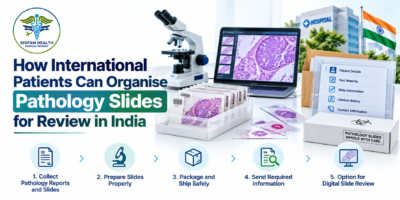
If your case involves cancer or another condition requiring tissue examination, you may also need to arrange the relevant pathology records or slides. See How International Patients Can Organise Pathology Slides for Review in India.
Step 3: Prepare a short medical history
You should be able to explain your condition without searching through multiple files during the call.
Write a brief summary covering:
- Your age and country of residence.
- Your main symptoms or medical concern.
- When the problem began and how it has changed.
- Any diagnosis already given by a doctor.
- Treatments, medicines, or procedures received so far.
- Any important allergies or other medical conditions.
- Your main objective for consulting the specialist.
For example, a patient seeking a second opinion for a knee replacement might explain when the pain began, how far they can walk, what treatment they have already tried, and whether recent X-rays or MRI scans are available.
This summary is not a substitute for medical records. It helps the specialist understand the main concern and identify which details need further discussion.
Step 4: Verify the specialist’s credentials
Before sharing sensitive medical information or making treatment decisions, confirm who will conduct the consultation.
Check the doctor’s full name, speciality, qualifications, registration details, and current hospital affiliation. For allopathic practitioners, you can consult the National Medical Commission’s Indian Medical Register. The registry notes that its data is being updated, so additional confirmation through the relevant State Medical Council or hospital may be necessary.
Also ask whether the doctor regularly manages conditions similar to yours and whether the consultation will be with the named specialist or another member of the clinical team.
A doctor’s registration and qualifications are important checks, but they do not by themselves establish that a particular treatment is suitable for your case.
Step 5: Research the hospital and its facilities
Choosing a hospital requires more than comparing its name or overall reputation. The relevant question is whether the hospital has the clinical team, equipment, facilities, and support services your treatment may require.
Consider the following:
- Relevant department: Does the hospital provide the speciality and treatment under consideration?
- Clinical team: Who would evaluate and treat you, and which team members would be involved?
- Required facilities: Are the necessary operating theatres, intensive care services, imaging facilities, laboratories, or specialised units available?
- Accreditation: Does the hospital have current accreditation relevant to its facility and services?
- Patient support: Can the hospital explain interpreter availability, international patient services, and follow-up arrangements?
- Practical arrangements: What is the likely admission process, and how long might you need to remain near the hospital?
You can check the NABH directory of accredited healthcare organisations. Verify the specific facility, accreditation status, and validity rather than relying solely on a logo or an old certificate displayed online.
Accreditation can be a useful quality indicator, but it does not guarantee a particular clinical outcome or mean that every treatment is available at that hospital.
For further guidance, see How to Get a Remote Medical Second Opinion from India.
Step 6: Prepare your questions in advance
Write your questions down before the consultation. Prioritise the concerns that will influence your decision about treatment.
For most patients, the questions fall into five categories:
About the diagnosis
- What do my current reports indicate?
- Is there any important information missing?
- Do I need additional tests or an in-person examination?
About treatment
- What treatment options may be appropriate for my condition?
- Why would you recommend one option over another?
- What are the important risks, limitations, and possible complications?
- What could happen if treatment is delayed?
About the hospital
- Which department and clinical team would manage my case?
- What facilities might be needed during treatment?
- Would my case require intensive care or specialised rehabilitation?
About costs and timing
- Can you provide a provisional treatment estimate?
- Which items are included and excluded from the estimate?
- What could cause the final cost to change?
- How much time might I need to spend in India?
About recovery and follow-up
- What recovery support might be required?
- When could I travel home, if treatment proceeds?
- What follow-up appointments or tests may be needed?
- Who should I contact if I have questions after returning home?
For additional guidance, read Questions to Ask Before Accepting a Medical Treatment Package in India.
Step 7: Test your device, internet, and surroundings
A technical problem can interrupt an important discussion. Complete these checks before the appointment:
- Use a smartphone, tablet, or computer with a working camera and microphone.
- Test your internet connection and the required application.
- Charge your device or keep it connected to power.
- Choose a quiet, well-lit, private room.
- Position the camera so your face is clearly visible.
- Keep your reports, medication list, and questions nearby.
- Use headphones if they improve sound quality and privacy.
- Ask a family member or interpreter to join if appropriate and agreed upon.
If you are joining from a different time zone, allow time to log in before the appointment begins.
The NHS provides a practical overview of how to prepare for a video consultation, including the equipment and environment needed for a remote appointment.
What Happens During the Video Consultation?
Although the exact process varies by hospital, speciality, and medical condition, a consultation commonly follows several stages.
Introduction and confirmation of details
The doctor or clinical team may confirm your identity, relevant medical details, and the purpose of the appointment. They may explain how the consultation will proceed and confirm consent where required.
Review of symptoms and medical history
The specialist will ask about your symptoms, previous diagnoses, current medicines, and treatments already received. They may ask follow-up questions about information in your reports.
Answer as accurately as possible. If you do not know a date, dosage, or medical term, say so rather than guessing.
Discussion of available reports
The doctor may review the reports you have provided and explain what they suggest. Depending on the condition, they may ask you to share a particular report or provide additional information.
The specialist may also identify missing records or recommend further investigations before reaching a conclusion.
Discussion of possible treatment options
If sufficient information is available, the specialist may discuss potential treatment approaches and their benefits, risks, and limitations.
For some patients, this may include discussing surgery, medication, further diagnostic testing, or conservative management. The appropriate approach depends on the individual clinical assessment.
Next steps
At the end of the consultation, clarify what should happen next. You may need to send additional records, arrange tests, attend an in-person appointment, or request a written treatment plan and provisional estimate.
India’s telemedicine guidelines emphasise that a registered medical practitioner must use professional judgement to determine whether remote consultation is appropriate or an in-person review is needed. Read the official guidelines on telemedicine practice in India for further details.
How to Ask About Hospital Treatment Facilities
If you are considering travelling to India, use the consultation to understand whether the hospital can support your likely treatment pathway.
Avoid asking only whether the hospital offers a particular procedure. Ask what the treatment process would involve for your individual case.
| Area | Questions to ask |
|---|---|
| Specialist team | Who will assess my case and perform the procedure, if required? |
| Investigations | Which tests must be completed before treatment? |
| Hospital facilities | What specialised facilities might my case require? |
| Admission | Is admission likely, and what determines the timing? |
| Recovery | What rehabilitation or follow-up might be necessary? |
| International patient support | Can I receive assistance with language and practical arrangements? |
| Treatment estimate | Can I receive an itemised estimate based on my reports? |
Where a procedure is being considered, ask whether the specialist’s initial recommendation is provisional and what further assessment is needed before confirming it.
For a detailed explanation of treatment estimates, read What Should an Itemised Hospital Quote Include? and How to Compare Two Hospital Treatment Estimates in India.
Common Mistakes to Avoid Before a Video Consultation
Sending incomplete or outdated reports
If important investigation results or treatment records are missing, the doctor may not have enough information to advise you meaningfully. Send the most relevant available records and ask whether anything else is required.
Providing unclear medical information
Avoid relying on broad descriptions such as “the pain is severe” without explaining when it occurs, how long it lasts, or how it affects daily activities. Specific details help the doctor understand your concerns.
Expecting a guaranteed diagnosis or final cost
A remote consultation may establish a preliminary direction, but the final diagnosis, treatment recommendation, and cost can depend on additional investigations, physical assessment, and the patient’s condition.
Focusing only on the hospital’s name
A hospital’s reputation alone does not establish whether its services match your needs. Check the relevant specialist, facilities, treatment pathway, and follow-up arrangements.
Forgetting to discuss risks and alternatives
Ask about reasonable alternatives, expected benefits, limitations, and important risks. You should understand the reasons behind a proposed treatment before deciding whether to proceed.
Making travel arrangements too early
Avoid purchasing non-refundable tickets or finalising a treatment date solely on the basis of an initial video discussion. First clarify the required investigations, the hospital’s confirmation process, visa requirements, and the expected treatment schedule.
Failing to confirm the next steps
Before ending the call, make sure you know what documents to send, whom to contact, and when you can expect the next update.
What to Do After the Video Consultation
Once the call ends, organise the information you received and confirm any outstanding points.
- Record the doctor’s recommendations. Note the suggested next steps, tests, and follow-up requirements.
- Request written clarification. If appropriate, ask the hospital for a written summary, treatment proposal, or provisional estimate.
- Confirm missing information. Send additional reports or answers requested by the specialist through the agreed secure channel.
- Review the estimate carefully. Check the proposed treatment, inclusions, exclusions, expected stay, and conditions that could change the cost.
- Clarify the timeline. Ask what must happen before an appointment, admission, or treatment date can be confirmed.
- Discuss travel planning only when appropriate. Confirm medical and logistical requirements before making final commitments.
- Keep follow-up contacts available. Know whom to contact if you need clarification or if your condition changes.
If you are comparing multiple treatment proposals, review how to compare hospital treatment estimates before making a decision.
Video Consultation Preparation Checklist
Use this checklist before your appointment.
- Appointment date, time, time zone, and video link confirmed.
- Specialist’s name, speciality, and hospital affiliation checked.
- Relevant medical reports organised and sent.
- Medication list, allergies, and medical history prepared.
- Main symptoms and treatment history summarised.
- Questions about diagnosis and treatment written down.
- Questions about hospital facilities and the clinical team prepared.
- Cost, recovery, and follow-up questions included.
- Camera, microphone, internet, and power checked.
- Private room and interpreter arrangements confirmed, if needed.
- Contact details available in case the call is interrupted.
Frequently Asked Questions
Can I consult an Indian specialist from my home country?
Yes, subject to hospital availability, applicable rules and acceptance of international patients.
What documents should I send before the consultation?
Share relevant medical reports, imaging, prescriptions, discharge summaries and previous treatment records as requested.
Will the doctor give me a final diagnosis during the video consultation?
Not always. Further tests, a physical examination or an in-person assessment may be necessary.
Can I receive a treatment cost estimate during the call?
You may receive a provisional estimate. Final costs depend on the treatment plan, investigations, hospital stay and additional care
How can I verify a doctor’s qualifications in India?
Check the doctor’s registration through the National Medical Commission’s Indian Medical Register or confirm details with the hospital.
How do I check whether a hospital is accredited?
Use the NABH healthcare organisation directory to check accreditation status.
Should I send my reports before the appointment?
Yes, if requested. Confirm the required file formats and secure transfer method with the hospital.
Can a family member join the video consultation?
Usually, subject to hospital policy and the patient’s consent. Inform the hospital beforehand.
What if my internet connection fails during the consultation?
Contact the hospital using the agreed backup method and ask whether the call can continue or needs rescheduling.
Should I book my flight after the first consultation?
Wait until the hospital clarifies the next steps, including further tests, treatment planning, visa requirements and travel suitability.
Plan Your Medical Consultation with Shifam Health
Preparing for treatment in another country can involve several decisions, from selecting the appropriate specialist to organising medical records and understanding the likely treatment pathway.
Shifam Health assists international patients with medical coordination in India, including specialist consultation arrangements, hospital communication, medical record sharing, treatment estimate clarification, and practical planning where required.
If you are considering treatment in India, start by organising your medical records and explaining your main concerns. The next steps will depend on your condition and the specialist’s assessment.
Request a Free Consultation with Shifam Health to discuss your medical coordination requirements.



Popular Posts From Last Week
- October 27, 2026
- Razi Khan
Imagine you have decided to seek a specialist’s opinion from another country. You have laboratory reports, prescriptions, scan…
- October 23, 2026
- shifamhealth
A fluttering chest, a sudden racing heartbeat or a skipped beat can be frightening, and it is hard…
- October 27, 2026
- Razi Khan
Receiving a medical treatment package from a hospital can feel like a major step forward. You have a…
- October 26, 2026
- Razi Khan
Learn how to send large MRI and CT files to an Indian hospital for specialist review. This guide…
- October 25, 2026
- shifamhealth
What is a ventricular septal defect? A ventricular septal defect (VSD) is an opening in the wall (septum)…
- October 28, 2026
- shifamhealth
Learn how to organise pathology slides for review in India, from requesting materials from the original laboratory to…
- October 28, 2026
- shifamhealth
Preparing for a virtual consultation with an Indian specialist? Learn what happens before, during and after the appointment,…
- October 28, 2026
- Areen Fatima
Learn how to prepare for a video consultation about treatment in India. Discover which medical reports to organise,…
- October 22, 2026
- shifamhealth
A remote medical second opinion from India allows patients living in the USA, UK and other countries to…
- October 22, 2026
- shifamhealth
An itemized hospital quote in India should clearly explain the expected cost of treatment by separating major charges,…