



What Should an Itemized Hospital Quote Include?
Filters & Insights
Written By :
Medically Reviewed By :

Shifam Health Medical Team
Shifam Health - Medical Reviews Department
10+ Years Of Experience
Learn what an itemized hospital quote in India should include from doctor fees & investigations to exclusions, additional charges & payment terms.
📅
Last updated: October 22, 2026

An itemized hospital quote in India should clearly explain the expected cost of treatment by separating major charges, identifying what is included and excluded, and stating the assumptions behind the estimate. Depending on the treatment, it may cover doctor fees, investigations, hospital admission, procedure or operation theatre charges, medicines, medical devices, room costs and follow-up care.
International patients should also check the proposed length of stay, additional charges, payment schedule, estimate validity and refund terms before making financial commitments. A quotation should help you understand what you are paying for not simply present one total without explaining how it was calculated.
The exact breakdown varies by hospital, procedure and the patient’s medical condition. An estimate prepared before admission may be provisional because further investigations or changes in clinical requirements can affect the final bill.
Table of Contents
ToggleWhat Is an Itemized Hospital Quote?
An itemized hospital quote is a written estimate that separates the anticipated costs of medical treatment into identifiable categories rather than presenting only a single total amount.
For example, a quotation for surgery might separately identify the surgeon’s fee, anaesthesia, operation theatre charges, room accommodation, investigations, medicines and any applicable implant or device costs.
An itemized quote helps patients and caregivers understand the proposed expenditure, compare estimates from different hospitals and identify charges that require clarification.
It is important to distinguish three documents:
- Hospital treatment estimate: An advance estimate of anticipated treatment costs, based on the information available at the time.
- Itemized hospital bill: A breakdown of charges actually incurred during the hospital stay or treatment.
- Payment receipt: Evidence that a specified payment has been received.
These documents serve different purposes. A quotation is not necessarily a guarantee of the final bill, and a payment receipt does not replace an itemized statement of services.
What Should an Itemized Hospital Quote Include?
A comprehensive quotation should identify the main cost categories relevant to the proposed treatment. Not every category applies to every patient, so the hospital should mark items as included, excluded, not applicable or dependent on clinical need.
1. Patient and hospital details
The quotation should identify the patient, the issuing hospital or healthcare provider and the proposed treatment.
Check for:
- Patient name or reference number.
- Hospital name and relevant department.
- Date the quotation was issued.
- Diagnosis or clinical indication, where appropriate.
- Proposed procedure, treatment or admission.
- Name of the treating specialist, if confirmed.
- Quotation reference number and contact details for clarification.
Check that the estimate refers to the correct patient and treatment plan. If it was prepared from preliminary medical records, ask the hospital to identify any outstanding assessments that could affect the proposed care.
2. Doctor and specialist fees
Professional fees may form a significant part of the total estimate. Depending on the treatment, they may include:
- Primary surgeon or treating specialist.
- Anaesthesiologist.
- Relevant consulting specialists.
- Preoperative assessment.
- Specified postoperative consultations.
Ask whether each fee is included in the total or charged separately. Confirm whether the amount covers the planned procedure only or also includes specified consultations before and after treatment.
If several specialists may be involved, ask which professional services are already included and which would be billed separately if required.
3. Hospital admission and room charges
The quotation should state the anticipated admission period and the room category used to calculate the estimate.
It may include:
- Room or bed charges.
- Nursing services.
- Routine inpatient services.
- Standard hospital accommodation.
- Other applicable admission-related charges.
Ask how many hospital days have been assumed and what happens financially if the patient needs to stay longer than expected.
Room categories can affect costs. Confirm whether the estimate is based on a general ward, shared room, private room or another accommodation category, as applicable.
4. Operation theatre and procedure charges
For surgery and other procedures, the estimate should clarify whether the relevant procedural charges are included.
Depending on the case, these may cover:
- Operation theatre usage.
- Routine procedural equipment.
- Standard procedure-related services.
- Recovery-room services, where applicable.
Ask whether the quotation assumes a particular procedure or duration and how additional procedures or changes to the planned intervention would affect the cost.
5. Diagnostic investigations and laboratory tests
Investigations may be required before treatment, during admission or after a procedure.
The quotation should clarify which anticipated tests are included. Depending on the clinical situation, these could include blood tests, imaging, cardiac assessment, pathology or other diagnostic services.
For each relevant investigation, ask whether the estimate covers the initial test only or also includes repeat testing if medically necessary.
Patients should also clarify whether tests performed by an external diagnostic provider are included in the hospital’s estimate.
6. Medicines, consumables and medical supplies
Ask whether the quotation includes the medicines and consumables expected during admission or whether these are charged according to actual use.
Relevant items may include:
- Routine medicines.
- Intravenous fluids and medications.
- Dressings and disposable supplies.
- Procedure-related consumables.
- Other clinically necessary medical supplies.
A quotation may include some items but exclude specialised medicines or additional supplies. Request clarification rather than assuming the category is fully covered.
7. Implants, prostheses and specialised devices
For procedures requiring an implant, prosthesis, stent or other specialised device, the estimate should identify whether the item is included and, where applicable, specify the proposed type or product.
Ask:
- Is the device included in the quoted total?
- Does the estimate identify a specific device or category?
- Could the price change if another device is clinically required?
- Are any related supplies or additional procedure charges excluded?
This category is particularly relevant to certain orthopaedic, cardiac and other device-dependent procedures. It is not applicable to every treatment.
8. Intensive care and higher-dependency services
Some treatments may require intensive care or a high-dependency unit. A preliminary quotation may not include these services if they are not expected under the initial plan.
The estimate should clarify whether any such stay is included, excluded or charged separately if clinically necessary.
Ask for the applicable charging basis and whether the hospital can provide an indicative rate for an additional day. The hospital may not be able to predict whether intensive care will be needed or how long it would last.
9. Rehabilitation and postoperative care
Depending on the procedure, recovery may involve physiotherapy, rehabilitation, wound care, follow-up consultations or additional investigations.
The quotation should state whether these services are included, for how long and under what conditions.
For example, a surgical estimate may cover the hospital admission but exclude outpatient physiotherapy after discharge. An international patient should clarify this before deciding how long to stay in India and how to organise care after returning home.
10. Taxes, administrative charges and other applicable fees
Ask whether the stated total includes all applicable taxes and administrative charges, where relevant.
If charges are excluded, request that they be identified separately. Do not assume that an estimate is tax-inclusive unless the document says so.
The hospital should also clarify any administrative fees that form part of the amount payable to it. Travel, accommodation and third-party services may be outside the hospital’s quotation altogether.
What Is Usually Excluded From a Hospital Treatment Quote?
A quotation may exclude costs that cannot be determined in advance or that fall outside the scope of the proposed treatment.
Potential exclusions include:
- Additional hospital days.
- Unexpected investigations or repeat tests.
- Additional medicines or consumables.
- Intensive care or high-dependency admission.
- Further procedures required after reassessment.
- Treatment of complications.
- Rehabilitation beyond the included period.
- Follow-up visits or investigations after discharge.
- Travel, accommodation, meals and local transport.
- Visa-related expenses and companion costs.
- Services provided by external providers.
These are examples, not a universal list. Some hospitals include certain items that others exclude.
Ask the hospital to provide a written exclusions section. For any item marked as excluded, request an explanation of whether it is likely to be relevant and how it would be charged if required.
How to Identify Potential Additional Charges
No pre-treatment estimate can anticipate every clinical development. However, a well-prepared quotation should make the main assumptions and uncertainties clear.
Review the following points carefully:
| Area | What to ask |
|---|---|
| Length of stay | How many days are included, and what is the charge for additional days? |
| Medicines | Are expected medicines included, or billed according to actual use? |
| Investigations | Are repeat tests or newly required investigations excluded? |
| Devices | Is the specified implant or device included in the total? |
| Complications | How are additional clinically necessary services charged? |
| Additional procedures | How will a change to the treatment plan be explained and documented? |
| ICU care | What is the charging basis if intensive care becomes necessary? |
| Follow-up | Which postoperative services are included, and which are separate? |
Ask the hospital how it communicates changes to the estimate and whether the patient or authorised representative will be informed before additional non-emergency charges are incurred, wherever reasonably practicable.
How Should the Total Cost Be Presented?
An itemized quote should make the estimated total easy to identify while preserving the detail needed to understand it.
Ideally, the document should show:
- Each applicable cost category and its estimated amount.
- Any subtotal for the main treatment or admission.
- Applicable taxes or additional fees, where relevant.
- Excluded items and costs dependent on clinical need.
- The estimated total and currency.
- Any advance payment required.
- The quotation’s validity period.
- Payment, cancellation and refund terms.
If the hospital provides a package price rather than a line-by-line breakdown, ask for a description of the services included in that package and a clear list of exclusions.
The objective is to understand the scope of the estimate. A package price may still be useful if its inclusions, limitations and assumptions are documented clearly.
How Can International Patients Compare Itemized Hospital Quotes in India?
If you have received quotations from two or more hospitals, compare them using the same checklist.
Step 1: Confirm that the estimates refer to comparable treatment
Check that the proposed procedures, treatment scope and clinical assumptions are sufficiently similar. If the recommendations differ, ask the relevant specialists to explain the reasons before comparing prices.
Step 2: Match each cost category
Compare professional fees, hospital stay, investigations, procedure charges, medicines, devices and follow-up services. Mark each item as included, excluded, not applicable or unclear.
Step 3: Review exclusions and uncertainties
Identify any costs that could be charged separately. Ask each hospital to clarify items that are missing or ambiguous.
Step 4: Confirm payment terms
Check the advance payment, quotation validity, accepted payment methods, cancellation terms and refund conditions.
Step 5: Calculate your broader travel budget
The hospital estimate may not cover flights, accommodation, local transport, visa-related expenses, companion costs or extended stays. Budget for these separately.
Step 6: Clarify the clinical differences
Do not assume that the cheapest quotation offers the same treatment or that the most expensive quotation represents better care. Discuss differences in clinical recommendations with qualified specialists.
Once the details have been clarified, request an updated written quotation from each hospital if necessary. Keep the documents and responses together so that you can review the financial and clinical information before deciding.
Additional Costs International Patients Should Budget For
For patients travelling to India from the USA, UK or another country, the hospital quotation is only one component of the overall budget.
Consider the following expenses separately:
- Return flights for the patient and accompanying person.
- Visa and related documentation expenses, where applicable.
- Accommodation before admission and after discharge.
- Local transport.
- Food and everyday living costs.
- Translation or interpretation services, if needed.
- Rehabilitation and medicines after discharge.
- Additional accommodation or travel changes if recovery takes longer than expected.
These costs depend on the patient’s location, treatment and length of stay. They should not be treated as standard hospital charges.
If you are exploring cancer treatment in India, for example, the hospital estimate should clarify the proposed investigations, treatment components and relevant exclusions. Travel and accommodation, however, may need to be budgeted separately. Patients should also confirm whether the estimate is provisional and whether further clinical assessment is required before a final treatment plan can be agreed.
Questions to Ask Before Accepting a Hospital Quote
Before making a payment, ask the hospital or authorised representative:
- Is this quotation provisional or final for the currently proposed treatment?
- What exactly is included in the stated total?
- Which items are excluded or charged according to actual use?
- What length of stay and room category have been assumed?
- Are all relevant professional fees and investigations included?
- Are implants, devices and specialised supplies included where required?
- What additional costs may arise if the patient needs further treatment?
- How long is the estimate valid?
- What advance payment is required?
- What are the cancellation and refund terms?
- Will an itemized final bill be provided?
- Who should be contacted if the treatment plan or estimate changes?
Request written answers to material questions. Keep copies of the quotation, updated estimates, payment receipts and correspondence.
How Shifam Health Can Help With Treatment Cost Estimates
International patients may receive quotations in different formats or find it difficult to understand what each hospital has included. Shifam Health supports international patients with hospital coordination, treatment-planning assistance and cost-estimate coordination.
Depending on the case and the hospitals involved, the coordination process may help patients organise medical records, request relevant estimates and clarify questions about the information provided by healthcare facilities.
The medical assessment and treatment recommendations remain the responsibility of qualified healthcare professionals. Each hospital determines its own proposed treatment, estimate, inclusions and payment terms. Patients should confirm the final scope and charges directly with the relevant provider.
To discuss your requirements, visit Shifam Health’s free consultation page or review its medical tourism services.
Conclusion
An itemized hospital quote should make the anticipated cost of treatment understandable. It should identify the relevant charges, explain what is included and excluded, state the assumptions behind the estimate and clarify the payment terms.
For international patients considering treatment in India, reviewing these details before paying an advance can help reduce uncertainty and support better financial planning. Compare quotations on a like-for-like basis, ask questions about unclear items and discuss differences in treatment recommendations with qualified specialists.
If you need help coordinating hospital estimates for treatment in India, contact Shifam Health through its free consultation page to discuss your requirements.
Frequently Asked Questions
What should an itemized hospital quote include?
It should identify the proposed treatment, estimated total, relevant professional fees, hospital stay, investigations, procedure charges, medicines, applicable devices, exclusions and payment terms. The categories included depend on the treatment and hospital.
Is a hospital estimate the same as the final bill?
No. An estimate predicts expected costs based on the information available before treatment. The final bill reflects the services and charges actually incurred.
Should a hospital quote include doctor fees?
The quotation should clarify whether the relevant professional fees are included or charged separately. Depending on the treatment, this may include the surgeon, anesthesiologist and other specialists.
Are medicines and investigations always included?
No. Some estimates include specified medicines and tests, while others charge certain items separately or according to actual use. Ask for a written breakdown.
What is the difference between a package price and an itemized quote?
A package price gives a combined amount for a defined set of services. An itemized quote separates cost categories. A package can still be transparent if its inclusions, exclusions and assumptions are clearly documented.
Does a hospital quote include accommodation and flights?
Usually, these should be confirmed separately rather than assumed to be part of the hospital estimate. International patients should clarify whether any travel or accommodation service is included in their specific arrangement.
What should international patients check before paying an advance?
Confirm the treatment scope, included services, exclusions, quotation validity, advance amount, payment method, cancellation conditions and refund policy. Obtain written confirmation before making financial commitments.
Can I request an itemized estimate from more than one hospital in India?
Yes, you can ask multiple hospitals for estimates based on the same medical records and proposed treatment requirements. The hospitals may need additional information before preparing comparable quotations.



Popular Posts From Last Week
- October 16, 2026
- shifamhealth
If a scan report has just told you that you have “spondylosis,” take a breath. It sounds alarming,…
- October 16, 2026
- shifamhealth
You are sitting quietly when your heart suddenly starts racing. It is not the pounding you feel after…
- October 19, 2026
- shifamhealth
Coronary artery disease is one of the most common and serious heart conditions, yet it can develop quietly…
- October 17, 2026
- shifamhealth
If your child has been told they have pulmonary stenosis, you may be anxious about the word “stenosis”…
- October 22, 2026
- shifamhealth
A remote medical second opinion from India allows patients living in the USA, UK and other countries to…
- October 21, 2026
- shifamhealth
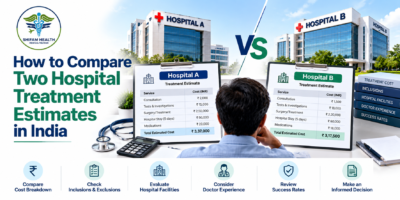
When you receive treatment estimates from two hospitals in India, do not compare only the final amounts. To…
- October 22, 2026
- shifamhealth
An itemized hospital quote in India should clearly explain the expected cost of treatment by separating major charges,…