


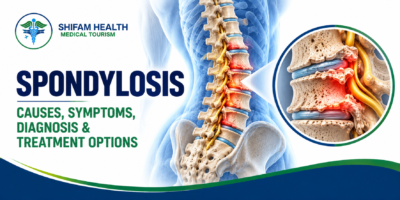
Spondylosis: Causes, Symptoms, Diagnosis & Treatment Options
Filters & Insights
Written By :
Medically Reviewed By :

Shifam Health Medical Team
Shifam Health - Medical Reviews Department
10+ Years Of Experience
Learn about spondylosis, including its causes, symptoms, diagnosis, and treatment options for managing spinal degeneration, pain, and nerve compression.
📅
Last updated: October 16, 2026

If a scan report has just told you that you have “spondylosis,” take a breath. It sounds alarming, but it is one of the most common findings in spine imaging, and many people who have it never feel a thing.
Spondylosis is the medical term for age-related wear in the spine: the discs between the vertebrae lose water and height, small bony growths called bone spurs (osteophytes) can form, and the small joints at the back of the spine can wear down. These changes can affect the neck (cervical), the middle back (thoracic) or the lower back (lumbar).
This guide explains what causes spondylosis, how symptoms differ by region, what your MRI report is really saying, which treatments help, when surgery is reasonable, and which symptoms need urgent attention.
Spondylosis is age-related degeneration of the spine’s discs and joints, often with bone spurs. It is common, may cause no symptoms, and can sometimes cause neck or back pain, stiffness, or nerve symptoms. Treatment depends on symptoms and examination findings, not on scan appearance alone, and is usually non-surgical first.
Table of Contents
ToggleWhat Is Spondylosis?
Spondylosis is a general term for degenerative (wear-related) changes in the spine. It typically involves the intervertebral discs, the facet joints and the edges of the vertebrae. It is common with age, does not automatically mean serious disease, and often causes no symptoms at all.
Your spine is a stack of bones (vertebrae) cushioned by discs and linked at the back by small paired facet joints. Together they let you bend and twist while protecting the spinal cord and nerves.
Over the years, several things can happen:
- Discs lose water and height. They become stiffer and thinner, which can narrow the gap between vertebrae.
- Bone spurs (osteophytes) form. The body sometimes lays down extra bone along stressed edges.
- Facet joints wear. The cartilage thins, joints can enlarge, and movement may feel stiffer.
- Ligaments can thicken. In some people this contributes to narrowing of the spinal canal.
Most of the time, this process is quiet. The important point is that what shows on a scan and what you feel are two different things. Some people with dramatic-looking scans have little pain, while others with mild findings have a lot.
Sometimes the changes narrow the space around a nerve root or the spinal cord. That is when symptoms such as arm or leg pain, numbness or weakness can appear, and it is the situation doctors watch for most carefully.
What Causes Spondylosis?
The main driver is ageing. Genetics, previous spinal injury, smoking and some physical demands may contribute, but no single cause explains every case, and the factors linked to degeneration are not necessarily the cause of any one person’s pain.
Natural ageing. Disc and joint wear is part of the normal ageing process. The NHS describes cervical spondylosis as a common, normal part of getting older, and many people with it have no symptoms.
Other factors associated with more degeneration or earlier degeneration:
| Factor | What we can reasonably say |
|---|---|
| Genetics and family history | Disc degeneration clusters in families. Spine shape and anatomy also vary |
| Previous spinal injury | A past fracture or significant injury may increase later wear at that level |
| Smoking | Associated with poorer disc health and slower healing |
| Heavy repetitive loading or certain occupations | Some association exists, but evidence is mixed and ordinary work does not “destroy” a spine |
| Excess body weight and low activity | Linked to more back symptoms; the link to the degeneration itself is less clear |
What does not cause it: Poor posture alone does not explain most spondylosis, and normal day-to-day activity does not inevitably damage your spine. Moving is generally good for spinal health.
What Are the Different Types of Spondylosis?
Spondylosis is named by the region of the spine involved: cervical (neck), thoracic (mid-back) or lumbar (lower back). It can affect more than one level, and the number of affected levels does not reliably predict how much pain or disability someone has.
| Region | Common symptoms | Key consideration |
|---|---|---|
| Cervical (neck) | Neck pain and stiffness, headaches from the neck, arm pain or tingling, sometimes hand clumsiness or balance changes | Nerve root irritation (radiculopathy) and spinal cord compression (myelopathy) are the important complications |
| Thoracic (mid-back) | Mid-back stiffness or aching; symptoms are less common | Pain here can have non-spine causes, so assessment matters |
| Lumbar (lower back) | Low back stiffness, pain on standing or bending, leg pain, leg heaviness when walking | Nerve root irritation (sciatica-type pain) or spinal stenosis |
| Multilevel | Depends on which levels are involved | More levels does not automatically mean worse symptoms |
Cervical Spondylosis
The neck is the most mobile part of the spine and the region where spondylosis is most discussed. It can cause neck pain and stiffness, which often comes and goes. When changes press on a nerve root or the spinal cord, symptoms can reach the arm, hand or even the legs and walking.
Thoracic Spondylosis
The mid-back is stiffer by design because of the rib cage, so degeneration here is less often troublesome. If you have mid-back or chest-area pain, do not assume spondylosis. Heart, lung and other conditions can cause similar pain and should be considered by a clinician.
Lumbar Spondylosis
Lower-back changes are very common. They can cause stiffness (often worse after sitting or on waking) and, in some people, leg symptoms from nerve irritation or from narrowing of the spinal canal (lumbar spinal stenosis).
Multilevel Spondylosis
Many people have changes at several levels. This sounds worse than it is. Symptoms are driven by whether a nerve or the spinal cord is being compressed, not by how many levels look worn.
What Are the Symptoms of Spondylosis?
Symptoms depend on where the changes are and whether nerves or the spinal cord are affected. Many people have no symptoms. When present, they commonly include neck or back pain, stiffness, reduced movement, and sometimes radiating pain, tingling, numbness or weakness.
Common symptoms
- Neck or lower-back pain, often dull and activity-related
- Stiffness, especially after rest or first thing in the morning
- Reduced range of motion
- Muscle tightness or tenderness
When nerves are involved
- Pain spreading into an arm, hand, buttock or leg
- Tingling or numbness in a pattern that follows a nerve
- Weakness in a hand, arm or leg
Lumbar stenosis pattern
- Leg pain, heaviness or tiredness when walking that eases when you sit or lean forward
When the cervical spinal cord is involved (needs prompt assessment)
- Clumsy hands, trouble with buttons or handwriting
- Unsteady walking or poor balance
- Weakness or stiffness in the legs
Not every symptom blamed on spondylosis is caused by it. Headaches, dizziness, shoulder pain and mid-back pain all have many possible causes, so a proper assessment matters.
Cervical Spondylosis, Radiculopathy and Myelopathy: What Is the Difference?
Cervical spondylosis is the degenerative change itself. Radiculopathy is a pinched or irritated nerve root causing arm symptoms. Myelopathy is compression of the spinal cord itself, which can cause hand clumsiness and walking problems and needs prompt medical assessment.
| Term | What it means | Typical features |
|---|---|---|
| Cervical spondylosis | Wear in the neck’s discs and joints | Neck pain, stiffness; may be symptom-free |
| Cervical radiculopathy | A nerve root is irritated or compressed | Pain, tingling, numbness or weakness in the arm or hand, often on one side |
| Cervical myelopathy | The spinal cord is compressed | Clumsy hands, balance and walking changes, limb weakness |
Why myelopathy matters
The spinal cord carries signals between the brain and the body. Prolonged compression can cause lasting damage. Early signs are easy to dismiss as “just getting older,” so new hand clumsiness or unsteadiness should never be put off. Many nerve-root problems settle without surgery. Myelopathy is different, and it is one of the main situations where timely specialist review is important.
When Should You Seek Urgent Medical Care?
Get emergency or same-day medical assessment for new loss of bladder or bowel control, numbness around the groin or saddle area, rapidly worsening weakness, new difficulty walking, or severe pain after significant trauma. Do not wait for an online consultation or plan travel first.
| Warning sign | Why it matters |
|---|---|
| New difficulty passing urine, or loss of bladder control | Possible severe nerve compression (including cauda equina syndrome) |
| New loss of bowel control | Same |
| Numbness in the groin or saddle area, especially with back and leg symptoms | Classic warning sign of cauda equina syndrome |
| Rapidly worsening weakness in an arm or leg | Possible progressive nerve or cord compression |
| New major difficulty walking, loss of balance or coordination | Possible spinal cord compression |
| New hand clumsiness with balance or walking changes | Possible cervical myelopathy |
| Severe spinal pain after a fall, accident or significant injury | Possible fracture |
| Back or neck pain with fever, or while seriously unwell | Possible spinal infection or other serious illness |
Urgent versus timely: The list above is for emergency or same-day care. Pain that lasts more than a few weeks, keeps coming back, or interferes with sleep and work deserves a timely appointment with a doctor, but it is not an emergency.
If you have any of the emergency signs, go to the nearest emergency department. Online consultations and international travel can wait.
How Is Spondylosis Diagnosed?
Diagnosis starts with your history and a physical examination. Imaging such as X-ray, MRI or CT is used when it is likely to change management, for example when nerve or spinal cord symptoms are present, when red flags appear, or when surgery is being considered.
Medical History and Physical Examination
A clinician will ask where the pain is, how long it has lasted, what makes it better or worse, whether you have numbness or weakness, and about past injuries and other health conditions. The examination usually checks neck or back movement, muscle strength, sensation, reflexes, walking and balance.
X-Ray
An X-ray shows bone: alignment, disc-space narrowing and bone spurs. It does not show discs, nerves or the spinal cord in detail.
MRI
MRI shows discs, nerve roots, the spinal canal and the spinal cord, which makes it the most useful scan when nerve or cord compression is suspected or surgery is being considered. It must always be read together with your symptoms and examination.
CT Scan
CT shows bone detail very well. It is used in selected cases, for example to look at bony anatomy for surgical planning or when MRI is not possible.
Nerve Tests
Nerve conduction studies and electromyography (EMG) can help when symptoms are unclear or a clinician needs to tell one cause of numbness or weakness from another.
| Test | What it shows best | When it is typically used |
|---|---|---|
| X-ray | Bone alignment, spurs, disc-space height | First look in some cases |
| MRI | Discs, nerves, spinal cord | Nerve/cord symptoms, red flags, surgical planning |
| CT | Fine bone detail | Selected cases, surgical planning |
| EMG / nerve conduction | Nerve function | Unclear or mixed neurological symptoms |
You do not need every test. Imaging is chosen according to symptoms, examination findings and whether the result will change what happens next. Routine scans for uncomplicated neck or back pain often add worry without adding answers.
What Does Spondylosis on an MRI Report Mean?
It means the scan shows age-related wear such as disc degeneration, bone spurs or facet joint changes. These findings are very common, including in people with no pain. Whether they explain your symptoms depends on your examination, and a scan alone never decides whether you need surgery.
Common phrases you may see, in plain language:
| Report term | Plain-language meaning |
|---|---|
| Disc degeneration / desiccation | The disc has lost water, which is part of ageing |
| Disc-space narrowing | Reduced disc height |
| Osteophytes | Bone spurs |
| Facet arthropathy | Wear in the small back joints |
| Disc bulge | The disc extends slightly beyond its normal edge; very common |
| Foraminal narrowing | Narrowing of the exit tunnel for a nerve root |
| Canal stenosis | Narrowing of the central space around the cord or nerves |
Research on people with no back pain consistently shows that disc degeneration and bulges become more common with age, and the majority of older adults have some. That is why the most abnormal-looking level is not necessarily the source of your pain, and why a specialist will match the scan to where and how you feel symptoms.
We cannot interpret your individual report here. Take it, and ideally the images themselves, to a spine specialist.
What Conditions Can Be Confused With Spondylosis?
Several spine conditions have similar names or symptoms: spondylitis, spondylolisthesis, spondylolysis, disc herniation, spinal stenosis, osteoporotic fracture and nonspecific mechanical pain. They can coexist with spondylosis but are not the same condition.
| Condition | What it is |
|---|---|
| Spondylosis | Age-related degenerative change |
| Spondylitis | Inflammation of the spine (for example, ankylosing spondylitis), usually inflammatory, not wear-and-tear |
| Spondylolisthesis | One vertebra slips forward over the one below |
| Spondylolysis | A defect or stress fracture in a small part of the vertebra (pars interarticularis) |
| Herniated (prolapsed) disc | Disc material pushes out and may irritate a nerve |
| Spinal stenosis | Narrowing of the spinal canal or nerve exits; may result from spondylosis |
| Osteoporotic vertebral fracture | A weakened vertebra collapses |
| Nonspecific mechanical pain | Pain with no single identifiable structural cause |
Non-spine problems such as shoulder disease, hip disease, nerve entrapments elsewhere, or heart and lung conditions can also mimic spine symptoms.
What Is the Best Treatment for Spondylosis?
There is no single best treatment. The right approach depends on your symptoms, the spinal region, whether nerves or the cord are affected, how much it limits your life, your general health and your goals. Most people improve without surgery. Treatment targets symptoms, not the scan appearance.
If a scan finding is not causing symptoms, it usually does not need treatment.
Education and Staying Active
Understanding that the findings are common and usually not dangerous reduces fear, and fear itself can amplify pain. Staying gently active generally works better than prolonged bed rest. You may need to temporarily adjust movements that clearly aggravate symptoms.
Physiotherapy and Exercise
A physiotherapist can design a programme matched to your symptoms. It may include strengthening, mobility and flexibility work, posture and movement coaching, and a gradual return to normal activities.
There is no universal routine. Exercises that suit a stiff lower back may be wrong for someone with cervical nerve compression, which is why individual guidance matters.
Pain Relief and Medication
Clinicians may use short courses of anti-inflammatory painkillers (NSAIDs), paracetamol, or other medicines selected for the type of pain, including nerve-related pain.
Take care and ask a doctor or pharmacist first if you have kidney disease, heart or blood-pressure disease, stomach ulcers or bleeding problems, take blood thinners, or are pregnant.
Painkillers ease symptoms. They do not reverse the degenerative changes, and long-term unsupervised use is not advisable.
Heat, Cold and Supportive Measures
Heat or cold can offer short-term comfort for some people. They are not cures. Soft collars are generally for short-term comfort only, as prolonged use can weaken neck muscles. Ask your clinician before using one.
Injections and Other Procedures
For persistent pain that has not responded to other care, some patients are considered for targeted injections, such as epidural steroid injections for nerve-root pain or joint-related blocks. These can provide temporary relief for some people, but they do not repair degeneration and are not right for everyone. Risks, although uncommon, include infection, bleeding, nerve irritation and, rarely, more serious complications. Ask what outcome the specialist expects and how long relief typically lasts.
Monitoring and Follow-Up
Return to your clinician if pain worsens, new numbness or weakness appears, or you are not improving as expected. Repeated scans without a change in symptoms are usually not helpful.
When Is Surgery Needed for Spondylosis?
Surgery is not the first treatment for uncomplicated spondylosis. It may be considered when significant nerve or spinal cord compression matches your symptoms and examination, when there is progressive neurological loss, or when disabling symptoms persist despite appropriate non-surgical care.
Situations where surgery may be considered
- Disabling symptoms that persist despite appropriate non-surgical treatment
- Significant nerve-root compression that matches your arm or leg symptoms
- Progressive weakness or other neurological decline
- Cervical myelopathy or other clinically significant spinal cord compression
- Selected cases of spinal stenosis or instability
Surgery is not recommended just because bone spurs are visible. The decision weighs your anatomy, neurological examination, expected benefits, risks, alternatives and overall health.
Cervical Spine Surgery
Procedures aim to relieve pressure on a nerve root or the spinal cord. Common approaches include removing a disc and fusing the level (ACDF), replacing a disc with an artificial one in selected patients, widening the canal from behind (laminoplasty or laminectomy, sometimes with fusion), or enlarging a nerve exit (foraminotomy). The choice depends on which structures are compressed and how many levels are involved.
For cervical myelopathy, guidelines generally favour surgery when it is moderate or severe, while mild cases may be managed with surgery or close monitoring depending on the individual.
Lumbar Spine Surgery
Surgery may be considered for carefully selected patients with disabling leg symptoms from nerve compression or stenosis that have not responded to non-surgical care, or with neurological complications. Decompression is the most common approach for stenosis. Surgery done only for back pain without nerve compression has a less certain track record, and a good surgeon will explain this honestly.
Decompression and Spinal Fusion
| Decompression | Fusion | |
|---|---|---|
| Goal | Create space and relieve pressure on nerves or the cord | Join vertebrae so they heal as one bone, adding stability |
| Examples | Laminectomy, laminoplasty, foraminotomy, discectomy | ACDF, lumbar interbody or posterolateral fusion |
| Typically considered when | Compression is the main problem | Instability, deformity, or decompression would otherwise destabilise the spine |
| Trade-offs | May not suit unstable segments | Longer recovery; adds stress to adjacent levels |
Not everyone needs a fusion. This is exactly a question to ask your surgeon: “Do I need decompression alone, or fusion as well, and why?”
Benefits, Risks and Realistic Expectations
Surgery can relieve nerve-related pain and prevent further neurological loss, but it cannot promise complete pain relief or restore a young spine. Risks include infection, bleeding, nerve or spinal cord injury, a tear in the covering of the spinal cord (dural tear), blood clots, anaesthesia complications, swallowing or voice problems after front-of-neck surgery, fusion not healing, persistent symptoms, wear at neighbouring levels, and sometimes further surgery.
We deliberately do not quote success percentages. Published figures vary widely by condition, procedure, surgeon and how “success” is defined, and a single number can mislead.
Can Spondylosis Be Cured or Reversed?
Age-related spinal degeneration generally cannot be reversed by exercise, medicines, supplements or posture correction. However, symptoms and function can improve substantially with the right management, and having degenerative changes does not mean you will inevitably become disabled.
Be cautious of anyone selling a “cure,” a supplement, a device or a “natural remedy” that claims to regrow discs or dissolve bone spurs. There is no reliable evidence for these claims.
What is realistic: reducing pain, improving movement and strength, protecting nerve function, and getting on with life.
Exercises and Daily Activities for People With Spondylosis
Staying active is generally helpful, and the safest approach is gradual, individualised and guided by symptoms. No single exercise, posture, pillow or mattress prevents or cures spondylosis. People with nerve compression or cord symptoms should get professional advice first.
General principles that apply to most people:
- Keep moving. Short, regular walks are usually safe and helpful. If lumbar stenosis limits walking, many people tolerate walking better with a slight forward lean, and a physiotherapist can help.
- Build gradually. Increase strength and mobility slowly rather than pushing through sharp pain.
- Break up long sitting. Change position every 30 to 45 minutes where possible.
- Adjust, don’t avoid. Modify movements that consistently provoke symptoms rather than stopping all activity.
- Lifting weights can be appropriate for many people, but technique and load matter. Ask about it if you have nerve symptoms.
- Get clearance first if you have arm or leg weakness, balance problems or suspected spinal cord compression.
How Can Spondylosis Be Managed Long Term?
Long-term management focuses on staying active, following an individualised rehabilitation plan, managing health conditions that affect recovery, understanding what medicines can and cannot do, and returning for review if symptoms change.
- Maintain regular physical activity that suits you
- Complete your physiotherapy plan, then continue the key exercises
- Manage weight, diabetes, smoking and other factors that affect recovery
- Use painkillers sparingly and as advised
- Report new numbness, weakness, balance changes or bladder and bowel changes promptly
- If you have had surgery, follow your surgeon’s rehabilitation and follow-up advice
No lifestyle change can promise to prevent all age-related spinal change, but these steps support long-term function.
Spondylosis Treatment in India for International Patients
International patients can seek spine evaluation in India by first sharing their medical records for a remote specialist opinion. A good process confirms that your symptoms match your scans, explains options and alternatives, and provides an itemized estimate before any travel decision.
India has many experienced spine and neurosurgery teams, and for patients facing high costs or long waits at home, it can be a reasonable option when surgery is truly indicated. It is only worth considering after a proper diagnosis, and never when emergency warning signs are present.
What to do before travelling
- Gather your records: radiology reports, the original MRI/CT image files (not only the reports), previous treatment notes, medication list, and any neurological test results.
- Request a remote specialist opinion based on those records.
- Ask whether your symptoms and scans point to the same problem. This is the most important question.
- Ask about alternatives, including non-surgical options and whether you could start those at home.
- Get an itemised estimate and clarify what it covers.
- Ask about travel fitness, hospital stay, rehabilitation and follow-up after you return home.
Understanding cost estimates
Published figures vary a great deal between sources, and prices quoted on hospital sites for local patients are often much lower than package prices quoted to international patients. The ranges below come from publicly available international-facing price pages and should be treated as starting points, not quotes.
| Procedure | Published range (USD) | Notes |
|---|---|---|
| Endoscopic spinal decompression | approx. $4,500 – $5,800 | Published by one international facilitator; suitability limited |
| Lumbar laminectomy (decompression) | approx. $3,200 – $5,500 | Single published source; varies by levels and hospital |
| ACDF, single level (neck) | approx. $5,000 – $8,000 | Published by several international facilitators |
| Decompression with stabilisation / fusion | varies widely; often higher than decompression alone | Depends on levels, implants and hospital |
What changes the final figure: number of levels, implant type, hospital category, room type, length of stay, investigations, rehabilitation, and complications. Always ask what is included: consultations, scans, hospital charges, implants, medicines, physiotherapy and follow-up. These ranges do not include flights, accommodation or visa costs.
How Shifam Health fits in
Shifam Health is a patient-coordination service, not a hospital and not a medical provider. It can help organize your records, arrange remote specialist opinions, shortlist hospital options, request and clarify itemized estimates, and support medical visa documentation, travel, accommodation and interpretation. Diagnosis and treatment decisions always rest with qualified doctors.
Questions to Ask Your Spine Specialist
Bring your reports, the original scan files, a list of your medicines and a short history of your symptoms. Then ask these questions to make sure your treatment plan matches your actual problem.
- Which spinal region and level is affected?
- Do my symptoms match what the scan shows?
- Is a nerve root or the spinal cord being compressed?
- Are there any neurological findings that concern you?
- Which non-surgical treatments are appropriate for me?
- Should I see a physiotherapist, and what should they focus on?
- Are injections likely to help my particular symptoms, and for how long?
- What findings would make surgery appropriate?
- What are the benefits, risks and alternatives of the procedure you suggest?
- What rehabilitation and follow-up will I need?
- If I have surgery abroad, who manages problems after I go home?
Myths vs. Facts
| Myth | Fact |
|---|---|
| Everyone with spondylosis has pain | Many people have it and feel nothing |
| Spondylosis always gets worse with age | Imaging changes tend to increase with age, but symptoms often stay stable or improve |
| An MRI alone decides your treatment | Treatment depends on symptoms and examination; scans support, not replace, clinical judgement |
| Exercise is always harmful | Appropriate, graded activity usually helps. Guidance matters if nerves or the cord are involved |
| Surgery is necessary whenever bone spurs are present | Most bone spurs never need surgery |
| Supplements or posture correction can reverse spondylosis | No reliable evidence that they reverse degeneration |
| Cervical spondylosis and cervical myelopathy are the same | Myelopathy is spinal cord compression, a specific and more serious complication |
| All neck or back pain in older adults is spondylosis | Other causes, including fractures, infection, tumours and non-spine problems, must be considered |
Frequently Asked Questions
What is spondylosis in simple terms?
Spondylosis is age-related wear of spinal discs and joints, sometimes causing bone spurs. It may not cause symptoms.
Is spondylosis a normal part of ageing?
Yes. Spinal changes become more common with age, but not everyone experiences pain or disability.
Is spondylosis serious?
Usually not, but nerve or spinal cord compression can cause weakness, numbness, or walking difficulties.
Can spondylosis occur without pain?
Yes. Many people have degenerative changes on scans without noticeable symptoms.
What causes cervical spondylosis?
Age-related wear is the main cause. Previous injuries, genetics, and smoking may also contribute.
What is the difference between cervical and lumbar spondylosis?
Cervical spondylosis affects the neck, while lumbar spondylosis affects the lower back. Both can cause nerve-related symptoms.
Can cervical spondylosis cause arm pain or numbness?
Yes. Nerve compression in the neck can cause pain, tingling, or numbness in an arm.
Can lumbar spondylosis cause sciatica?
Yes. It may irritate or compress nerves that cause pain radiating from the back or buttock into the leg.
Does spondylosis cause spinal stenosis?
It can. Bone spurs and other degenerative changes may narrow the spinal canal.
Can physiotherapy help?
Yes. Individualised exercises and physiotherapy can improve mobility, strength, and pain.
Is walking safe with spondylosis?
Usually, yes. Walking is often encouraged as tolerated, but worsening leg pain or heaviness should be discussed with a doctor.
When is surgery necessary?
Surgery may be considered for significant nerve or spinal cord compression, progressive neurological problems, or persistent disabling symptoms despite appropriate treatment.
Not sure what your scan means or whether surgery is really needed?
You do not have to work this out alone. If you would like help organising your reports, getting a specialist opinion, or understanding treatment options and estimates in India, Shifam Health’s patient-coordination team can help. We do not diagnose or treat, and there is no pressure to travel. Our role is to help you ask the right questions and compare your options clearly.
Contact Shifam Health on WhatsApp or through the free consultation form.

Popular Posts From Last Week
- October 15, 2026
- shifamhealth
Hearing that your baby or child has a heart defect can feel overwhelming. You may be trying to…
- October 13, 2026
- shifamhealth
A note before you read further: “Spondylitis” is not one disease. It is a word that gets applied…
- October 14, 2026
- shifamhealth
If a radiology report used the word “slippage,” it can sound alarming. In most people it is not…
- October 16, 2026
- shifamhealth
If a scan report has just told you that you have “spondylosis,” take a breath. It sounds alarming,…
- October 12, 2026
- shifamhealth
Normally, the lower end of the spinal cord floats freely inside the spinal canal and glides a little…
- October 12, 2026
- shifamhealth
The word “stenosis” can sound frightening, and a diagnosis of severe aortic stenosis often arrives with the words…
- October 15, 2026
- shifamhealth
Being told you have atrial fibrillation, or noticing your heart flutter and race for no reason, is unsettling….
- October 14, 2026
- shifamhealth
If your baby has been told they have a PDA, it can be hard to know whether it…
- October 14, 2026
- shifamhealth
If someone has a racing heartbeat with fainting, chest pain, severe breathlessness, confusion or collapse, call your local…
- October 13, 2026
- shifamhealth
If a newborn with suspected or known HLHS has blue or gray lips or skin, fast or difficult…
- October 12, 2026
- shifamhealth
Chiari malformation is a structural condition in which part of the cerebellum (the brain’s balance and coordination center)…
- October 13, 2026
- shifamhealth
What are congenital spinal cord malformations? Congenital spinal cord malformations are developmental conditions, present from birth, that affect…