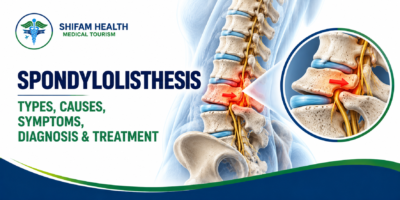
| II Most slips are grade I or II. Higher-grade slips are less common and are more often developmental in origin. What the grade does and does not tell you: - It describes alignment, not pain. Many people with a grade I or II slip have no symptoms, and some with a small slip have a lot.
- It does not predict, on its own, whether surgery is needed.
- Stability matters too, and it is judged on dynamic X-rays (flexion-extension films), not on the grade alone.
Causes and Risk Factors Degenerative slips come from wear over decades. Isthmic slips usually begin with repeated stress on the pars in growing years. Dysplastic slips come from how the bone developed. There is rarely a single “cause” and nothing you did wrong. Degenerative - Age-related disc and facet joint wear
- More common in women and in older adults
- Higher body weight is associated with higher risk
- Not caused by posture, a single lift, or sitting
Isthmic - Repetitive extension and rotation of the lower back in growing years
- Common in sports that load the lower back in extension, such as gymnastics, diving, football (lineman), weightlifting, and cricket fast bowling
- Genetic or developmental predisposition seems to play a part
- Spondylolysis has been reported in about 3% to 11.5% of the general population and in a much larger share of young athletes in published series, though figures vary between studies
Dysplastic - Present from birth, often with a family pattern
Other - Trauma, pathologic bone, and prior spinal surgery
A pars defect and a slip are common imaging findings, and many people live with them without ever needing treatment. Symptoms Many people with spondylolisthesis have no symptoms. When there are symptoms, the most common are low back pain and stiffness, sometimes with leg pain, numbness, or weakness, and sometimes walking limited by leg symptoms. Common symptoms - Low back pain, often worse with standing, extension, or activity, and eased by rest
- Stiffness or tight hamstrings (particularly in adolescents)
- Buttock or thigh pain
- Leg pain, tingling, or numbness following a nerve pattern (radiculopathy)
- Leg pain or heaviness with walking that eases when sitting or bending forward (neurogenic claudication, see our spinal stenosis guide)
- Fatigue or muscle spasm in the lower back
In children and adolescents - Back pain that comes with sport and eases with rest
- Tight hamstrings and sometimes an altered gait or posture
- A visible step or deepened curve in the lower back in more advanced cases
Less common, more serious - Progressive leg weakness, foot drop
- Numbness in the saddle area, new bladder or bowel changes (possible cauda equina syndrome, an emergency)
Symptoms do not track the amount of slippage reliably. The slip is only one part of the picture. Red Flags: When to Seek Urgent Care Back pain alone is rarely an emergency. These features need prompt assessment, and the first group needs same-day care. Same-day care - New urinary retention or loss of bladder control
- New loss of bowel control
- Numbness in the groin, genitals, or inner thighs (saddle area)
- Rapidly worsening leg weakness, particularly in both legs
Prompt assessment (days, not weeks) - Progressive or new leg weakness or foot drop
- Severe leg pain that is steadily getting worse
- Pain after significant trauma
- Back pain with fever, unexplained weight loss, a cancer history, or immune suppression (to look for other causes)
- In a child, a sudden change in gait or walking
These features are uncommon in people with spondylolisthesis. They are listed so that you know when not to wait. When to See a Doctor See a clinician if: - Back or leg symptoms last more than a few weeks or keep returning
- Pain affects sleep, work, or sport
- You notice numbness, weakness, or a limit to how far you can walk
- A child or adolescent has back pain with sport that does not settle with rest
- You have been told you have a slip and want to understand what it means
How Spondylolisthesis Is Diagnosed Diagnosis combines your history, an examination (including nerve testing), and imaging. The slip is seen on X-ray, but whether it is causing your symptoms, and whether it is unstable, are separate questions answered by the full picture. History and examination include the pattern of pain, walking tolerance, neurological examination (strength, sensation, reflexes), hamstring tightness, posture, gait, and, in younger patients, sport history. Imaging | Test | What it shows | Notes | | Standing X-ray (side view) | Amount of slip (grade), alignment, disc height, pars defects in some cases | Weight-bearing matters because slips can look different lying down | | Flexion-extension X-rays | Whether the segment moves abnormally (dynamic instability) | Helps judge stability and surgical planning | | MRI | Nerve and canal compression, disc, and soft tissues. In young patients, MRI can show active stress reaction in the pars before a fracture line appears | The key test for nerve compression | | CT | Fine bone detail, pars fracture lines, and bony healing | Used when bone detail matters; radiation is a consideration in children | | Bone scan / SPECT | Active stress in the pars in some centers | Used selectively in adolescents | | EMG/NCS | Electrical nerve and muscle function | Used when nerve findings and imaging do not clearly match | Imaging findings do not equal symptoms. A slip or a pars defect is common, including in people without pain. Your surgeon decides whether the finding explains what you feel. What Else Can Cause Similar Symptoms? | Condition | How it can look similar | | Lumbar spinal stenosis without a slip | Leg symptoms on walking; the two often coexist | | Disc herniation / sciatica | Leg pain along a nerve; different mechanism | | Facet joint or muscle pain | Localized back pain without a nerve pattern | | Hip joint disease | Buttock or groin pain | | Sacroiliac joint pain | Buttock pain | | Vascular claudication | Leg pain on walking, but not posture-related and with diminished pulses | | Peripheral neuropathy | Numbness in both feet or legs | | Infection or tumor | Persistent, often night, pain with systemic signs | Because spondylolisthesis frequently coexists with stenosis, disc disease, or arthritis, the treatment plan depends on which of these is driving your symptoms. Natural History: Does the Slip Get Worse? Often not. Many slips remain stable for years, and symptoms often settle with non-surgical care. Progression is hardest to predict, and different types behave differently. - Degenerative: typically progress slowly, if at all, in adults. Larger or more mobile slips are more likely to cause problems, but grade alone does not predict outcome
- Isthmic and dysplastic: the risk of progression is higher during rapid growth in childhood and adolescence, and higher-grade and dysplastic slips are more likely to progress
- Spondylolysis without a slip: healing of the pars can occur with rest and bracing in a young person with an active stress reaction, and healing may reduce the chance of a later slip, though this is not guaranteed
No reliable single percentage applies to everyone, so we have not quoted one. Treatment Overview Most people begin with non-surgical treatment. Surgery is for specific situations: persistent, disabling symptoms that have not improved with a reasonable trial of non-surgical care, nerve compromise, instability, or certain high-grade slips, especially in growing children. The right plan depends on: - The type of slip (degenerative, isthmic, dysplastic)
- Slip grade and stability
- Whether nerves are compressed
- Your age, activity, and overall health
- How much your symptoms limit your life
- Your preferences
Non-Surgical Treatment Activity adjustment, physiotherapy, and short-term pain relief are the usual starting point for adults. For adolescents with an active pars stress injury, treatment usually involves activity restriction, sometimes bracing, and rehabilitation. Adults with degenerative slips - Staying active within comfort rather than prolonged bed rest
- Physiotherapy: core and hip strengthening, flexibility, walking and posture training, adapted to your symptoms. Many people feel better with movements that avoid sustained extension, but there is no single exercise program that suits everyone
- Medication under clinician guidance (see below)
- Weight management where relevant
- Epidural steroid injections can relieve leg pain from nerve irritation or stenosis symptoms for a period in selected patients, but they do not correct the slip, and benefit is often temporary
- Education about what the imaging means and what to expect
Children and adolescents with spondylolysis or low-grade slips - Rest from the aggravating activity (often sport) for a period set by the treating clinician
- Bracing (often a lumbar orthosis) in some programs
- Physiotherapy to restore flexibility and strength, then a gradual return to sport
- A large series of adolescent athletes treated with this kind of conservative program reported high return-to-sport rates, and many pars defects healed on CT when treated early. It remains unclear whether the brace or the activity restriction itself contributes more, and there is no consensus on bracing, so practice varies between centers
- If symptoms persist despite a proper trial of conservative care, surgery can be considered
Medication categories This is for education only. It does not replace advice from your own doctor and gives no doses. | Category | Notes | | NSAIDs | Short-term pain and inflammation relief; stomach, kidney, and cardiovascular risks need review | | Acetaminophen / paracetamol | Simple pain relief; respect liver safety limits | | Muscle relaxants | Short-term use in selected patients; sedation | | Neuropathic pain agents | May be considered for nerve-related pain in selected patients; side effects and interactions need review | | Opioids | Generally avoided or used very selectively and briefly because of dependence and other risks | When Is Surgery Considered? When symptoms remain severe and disabling after a reasonable trial of non-surgical care, when there is significant nerve compression with weakness or progressive deficit, when the slip is clearly unstable, or, in growing children, when a slip is high-grade or progressing. Common reasons include: - Persistent leg pain or walking limitation despite appropriate non-surgical care
- Progressive neurological deficit (weakness, foot drop)
- Emergency features such as cauda equina syndrome
- Clear instability with disabling mechanical pain
- High-grade or progressing slips in children and adolescents
- Failure of conservative care for a symptomatic pars defect in a young patient
Not a reason on its own: the grade on an X-ray, or the phrase “slip” on a report. Asymptomatic high-grade slips in adults can sometimes be observed closely, while symptomatic high-grade slips in children are more often treated surgically because of the risk of progression. Even so, the best technique for high-grade slips remains debated. Surgical Options Surgery falls into three groups: decompression (freeing the nerves), fusion (joining the vertebrae so they cannot move), and, for selected young patients, direct repair of the pars. The choice depends on the type of slip, stability, nerve compression, and age. | Procedure | What it does | Typical use | | Decompression (laminectomy or laminotomy, open or minimally invasive) | Removes bone and ligament pressing on nerves | Degenerative slips with leg symptoms from stenosis, especially low-grade | | Decompression with fusion | Decompresses and stabilizes the slipped segment with screws, rods, and bone graft | Unstable slips, larger slips, deformity, or significant back pain from the mobile segment | | Interbody fusion techniques (e.g., TLIF, PLIF, ALIF, lateral/oblique approaches) | Place a spacer in the disc space as part of fusion, chosen by approach and anatomy | Selected fusion cases | | Direct pars repair | Repairs the defect without fusing the segment | Selected young patients with a pars defect, little or no slip, and a healthy disc | | Reduction and fusion for high-grade slips | Fusion, with or without partly realigning the slip | High-grade slips, particularly in children and adolescents; technique is debated | No technique is “best” for everyone. Technique choice depends on the slip, your anatomy, and the surgeon’s experience. Spondylolisthesis in Children and Adolescents Young patients are managed differently from adults because their spine is still growing. Many have spondylolysis or a low-grade isthmic slip and recover with activity restriction, rehabilitation, and sometimes bracing. Higher-grade or progressing slips are more likely to need surgery. - Early assessment matters, since an acute pars stress reaction may heal if treated promptly
- A series of conservative treatment in fine athletes reported successful outcomes in a large majority, with return to play after surgery commonly taking 6 to 12 months and collision sports generally restricted; return to sport after conservative care varies by sport and healing
- Symptomatic high-grade slips in children and adolescents are widely considered an indication for fusion because of the risk of progression, though the best surgical technique remains debated
- Parents and caregivers should expect regular follow-up, since slips can change during growth spurts
- Sport participation decisions should be made with the treating team rather than by a fixed rule
Complications and Risks of Surgery Risks depend on the procedure, your health, and your surgeon’s experience. They can include: - Infection and bleeding
- Dural tear (cerebrospinal fluid leak)
- Nerve injury
- Persistent or recurrent pain
- Failure of bones to fuse (pseudarthrosis), for fusion procedures
- Implant problems
- Adjacent segment degeneration over time
- Need for further surgery
- Anesthesia-related and blood clot risks
Complication rates vary by study and patient group. We have not quoted a single rate because it would not fit every case. Ask your surgeon for figures that match your procedure and health. Recovery Recovery depends on the procedure. Decompression alone usually allows earlier walking and a quicker return to daily activity than fusion, which needs bone to heal and has a longer recovery. General themes: - Walking is encouraged early, within your surgeon’s limits
- Physiotherapy supports strength, flexibility, and return to activity
- Driving, desk work, and heavier work return in stages
- Fusion usually involves longer restrictions on lifting and twisting while bone heals
- Sports return is individual, and in young patients depends on healing and the type of sport
- Follow-up imaging checks alignment, and for fusion, healing
No fixed timeline fits everyone. Your surgical team will guide you. Special Populations | Group | Considerations | | Older adults | Often have stenosis, osteoporosis, and other illness; bone quality affects screw fixation if fusion is considered; age alone should not rule surgery in or out | | Women after menopause | Degenerative slips are more common; bone health needs attention | | Athletes | Return-to-sport guidance depends on the type of slip, healing, and the sport’s demands | | Pregnancy | Back pain is common; evaluation and treatment need pregnancy-specific choices (imaging, medication); discuss with obstetric and spine teams | | People with prior spine surgery | Post-surgical instability needs individual assessment | | Higher body weight | Associated with degenerative slips and with surgical risk; weight management supports non-surgical care | Prevention and Risk Reduction You cannot guarantee that a slip will not happen, because age, genetics, and development play a large part. These steps support spine health and may help symptoms: - Regular exercise, including core and hip strengthening and flexibility
- Healthy body weight
- Stopping smoking
- For young athletes in high-risk sports: sensible training load, rest, and early attention to persistent back pain rather than playing through it
- Good bone health, particularly after menopause
Living With Spondylolisthesis: Work, Travel, Daily Life - Sitting and standing: change positions regularly rather than staying in one posture
- Lifting: use sound technique; avoid repeated heavy lifting if it clearly aggravates symptoms
- Sleep: choose a comfortable position; there is no single best one
- Driving and air travel: usually fine for stable, mild-to-moderate symptoms; take movement breaks
- Work: return depends on job demands and symptoms
- For international patients: long travel with severe leg symptoms, significant weakness, or uncontrolled pain should be discussed with your clinician before you travel
Spondylolisthesis Treatment in India for International Patients India has spine surgeons, neurosurgeons, imaging, and physiotherapy at many hospitals. The right center depends on your diagnosis and the procedure you need, and capabilities vary between hospitals. What the process generally looks like: - Share records, including X-rays (especially standing and flexion-extension films), MRI images (not just reports), CT if done, and prior treatment history
- Specialist review to clarify the type of slip, its stability, and whether nerves are compressed
- Decide whether non-surgical care, decompression, or fusion is being proposed, and why
- Confirm whether an in-person examination is needed before a plan can be finalized (usually yes before surgery)
- Receive a written cost estimate for the specific plan
- Arrange medical visa documentation and travel
- Consultation on arrival, any further tests, and treatment if recommended
- Rehabilitation and a clear follow-up plan with your home doctors
We are not claiming India is superior to care available elsewhere. We have not named hospitals or surgeons, and we do not state rankings, success rates, case volumes, accreditation, or technology availability for any center. Cost Spondylolisthesis treatment cost depends on the plan: investigations, whether care is non-surgical, a decompression, or a fusion with implants, the hospital and room category, length of stay, any complications, and rehabilitation. For related spine guides we reviewed international-patient-facing quotes for lumbar decompression of roughly $3,200 to $8,600, with fusion generally a separate and higher cost category. We did not verify a spondylolisthesis-specific price for this article. These are indicative planning figures from other sources, not a quote. The only reliable number is a written estimate from the treating hospital based on your reports. International Patient Safety Do not delay local care to arrange travel if you have new bladder or bowel changes, saddle numbness, rapidly worsening weakness, or severe uncontrolled pain. Treatment abroad is for stable, elective situations. Ask your treating doctor about travel timing, especially after surgery, when long flights may carry added risks. Questions to Ask Your Spine Specialist - What type of spondylolisthesis do I have (degenerative, isthmic, dysplastic, or other)?
- What grade is the slip, and is it stable on flexion-extension films?
- Is my slip actually causing my symptoms, or could stenosis, a disc problem, or something else explain them?
- Are any nerves compressed, and which ones?
- Is there any weakness or loss of sensation on my examination?
- Can this improve without surgery, and how long should I try?
- If surgery is suggested, is it decompression alone, or fusion? Why?
- What exact finding makes fusion necessary in my case?
- What are the realistic risks for me, given my age and health?
- What recovery and restrictions should I expect?
- What happens if the slip progresses or symptoms return?
- (For a child) How will growth affect the slip, and what monitoring is needed?
- How will my bone health affect surgical planning?
Second Opinion Consider one if: - Fusion is recommended and you want to understand why decompression alone is not enough
- Your symptoms and MRI do not seem to match
- A high-grade slip or complex surgery is proposed
- You have been told surgery is the only option without a trial of non-surgical care
- A child has been told surgery is needed
- You are considering travel for treatment
Bring: X-ray films (standing and flexion-extension), MRI images and reports, CT if done, a list of treatments tried, injection history, medicines, and any surgical recommendation already given. Myths vs. Facts | Myth | Fact | | “Spondylolisthesis always needs surgery.” | Most people are managed without surgery; surgery is for specific situations. | | “A bigger slip always means more pain.” | The grade on imaging does not reliably predict symptoms. | | “A slipped vertebra will keep slipping.” | Many slips stay stable for years; progression is more likely in growing children with higher-grade or dysplastic slips. | | “A slipped vertebra is the same as a slipped disc.” | They are different problems: one is a bone alignment change, the other is disc material displacement. | | “Spondylolysis and spondylolisthesis are the same.” | Spondylolysis is a pars defect or stress fracture; spondylolisthesis means the vertebra has slipped. A pars defect does not always lead to a slip. | | “If the X-ray shows a slip, that is what is causing my pain.” | Slips and pars defects are common, including in people without pain; your doctor judges whether the finding fits your symptoms. | | “Fusion is always the better operation.” | For low-grade degenerative slips with leg symptoms, large trials found decompression alone performed comparably; fusion suits particular situations and adds risks and recovery time. | | “Resting in bed is the best treatment.” | Prolonged bed rest tends to worsen conditioning; reasonable activity and physiotherapy are generally more helpful. | | “Exercise will make the slip worse.” | Appropriate, individualized exercise is a core treatment; your clinician or physiotherapist adjusts which movements to avoid. | | “Children with a pars fracture must give up sport forever.” | Many return to sport after healing and rehabilitation, though timing and sport type are individualized. | | “A brace permanently fixes the slip.” | Bracing aims to settle symptoms and support healing in some young patients; it does not realign a slip. | | “Spondylolisthesis only affects older people.” | The degenerative type is common in older adults, but isthmic and dysplastic types often begin in childhood or adolescence. | | “Minimally invasive surgery is always better.” | It describes the approach, not automatically a better outcome; suitability depends on your anatomy and the surgeon’s experience. | | “After fusion, the back problem is gone for good.” | Fusion can relieve symptoms, but adjacent-level wear and other problems can develop over time. | Shifam Health: A Note on How We Can Help Shifam Health is a healthcare coordination and international patient support service. It is not a hospital, treating doctor, or diagnostic authority, and it does not diagnose or treat spinal conditions. If you are an international patient weighing your options, Shifam Health can help you organize your records and imaging, arrange specialist opinions, communicate with hospitals, obtain written treatment estimates, and support medical visa documentation, travel, and local logistics. All medical decisions stay with your treating doctors. There is no obligation, and a second opinion on whether you need surgery at all is a reasonable place to start. FAQs What is spondylolisthesis? It occurs when one vertebra slips forward over the vertebra below it. It may or may not cause symptoms. Is spondylolisthesis serious? Severity depends on symptoms, spinal stability, nerve compression, and the risk of progression. What is the difference between spondylolysis and spondylolisthesis? Spondylolysis is a defect or fracture in the pars; spondylolisthesis involves vertebral slippage. What are the symptoms? Symptoms may include back pain, stiffness, leg pain, tingling, numbness, or weakness. Some people have no symptoms. What do Meyerding grades mean? They classify slippage from Grade I (up to 25%) to Grade V (complete displacement). Can it be treated without surgery? Often, yes. Physiotherapy, activity modification, appropriate medication, and selected injections may help manage symptoms. Will physiotherapy correct the slip? No, but it can improve strength, flexibility, pain, and daily function. When is surgery recommended? Surgery may be considered for persistent disabling symptoms despite conservative treatment, progressive weakness, or significant instability. What is the difference between decompression and fusion? Decompression relieves pressure on nerves. Fusion joins vertebrae to stabilize the spine when indicated. How long is recovery after surgery? Recovery depends on the procedure. Fusion generally requires more healing time than decompression alone. What does spondylolisthesis surgery cost in India? Costs vary by hospital, procedure, implants, and length of stay. Request an individualized written estimate. Popular Posts From Last Week Start typing to see posts you are looking for. |