


Tethered Spinal Cord Syndrome (2026): Causes, Symptoms, Diagnosis & Treatment
Filters & Insights
Written By :
Medically Reviewed By :

Shifam Health Medical Team
Shifam Health - Medical Reviews Department
10+ Years Of Experience
Tethered cord syndrome explained: causes, symptoms in children and adults, MRI findings, when surgery is needed, risks, re-tethering and urgent warning signs.
📅
Last updated: October 12, 2026

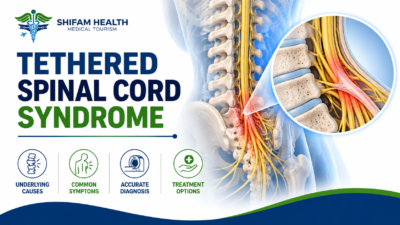
Normally, the lower end of the spinal cord floats freely inside the spinal canal and glides a little as the body bends and grows. In tethered spinal cord syndrome, something holds it in place, so the cord is stretched instead of moving freely.
That stretching can interfere with nerve function. Depending on the person, it may affect the legs, back, feet, bladder or bowels. In some people the condition shows up in infancy. In others it stays quiet for years and appears in adolescence or adulthood.
Causes, symptoms and treatment differ widely from one patient to the next, and not everyone whose scan shows a “tethered” or “low-lying” cord needs surgery. This guide explains the condition, how it is assessed, what untethering surgery involves, and which symptoms need urgent attention.
Tethered spinal cord syndrome is a neurological condition in which the spinal cord is abnormally attached or restricted, causing stretching that can affect the legs, back, bladder and bowels. It may be congenital or develop after spinal surgery or injury. Diagnosis relies on symptoms, examination and MRI, and treatment depends on whether symptoms are progressing.
Table of Contents
ToggleWhat Is Tethered Spinal Cord Syndrome?
Tethered spinal cord syndrome is a condition in which tissue attachments limit the spinal cord’s normal movement, placing it under abnormal tension. The tension can disturb nerve function. “Syndrome” means symptoms and examination findings are present, not just an unusual appearance on a scan.
The spinal cord runs from the brain down the spinal canal and ends in a tapered tip called the conus medullaris. From the conus, a thin fibrous strand called the filum terminale extends downward and anchors the cord loosely at the bottom. In most people, this arrangement allows the cord to move slightly with posture and growth.
“Tethering” means the cord is fixed more firmly than normal. This can happen because the filum is thick or tight, because fat or scar tissue is attached to the cord, or because of a developmental abnormality of the spine. As a child grows, the spine lengthens faster than a restricted cord can follow, so tension can build over time.
Two ideas matter here:
- Anatomical tethering is something seen on imaging or at surgery.
- Symptomatic tethered cord syndrome means that tension is actually causing neurological, orthopaedic or bladder and bowel problems.
The two are related, but they are not interchangeable. Some people have anatomical findings and no symptoms. Symptoms and examination findings matter as much as the scan.
What Causes Tethered Spinal Cord Syndrome?
Causes fall into two groups. Congenital tethering is present from development before birth, often linked to spinal dysraphism (incomplete closure or development of the spine). Acquired tethering develops later, most often from scar tissue after spinal surgery, but sometimes after injury or other spinal conditions.
| Congenital | Acquired | |
|---|---|---|
| When it starts | Before birth (symptoms may appear any time) | After surgery, injury or other spinal pathology |
| Typical causes | Tight or thickened filum, spinal lipomas, myelomeningocele, other spinal dysraphism | Scar tissue after spinal surgery (including repair of a congenital defect), trauma |
| Typical age at diagnosis | Infancy to adulthood | Any age after the triggering event |
Congenital Tethered Cord
Developmental abnormalities that may be involved include:
- Tight or thickened filum terminale: the anchoring strand is shorter, thicker or less elastic than normal.
- Lipomyelomeningocele and other spinal lipomas: fatty tissue that attaches to the cord, sometimes extending through a gap in the spine.
- Myelomeningocele: the most severe form of spina bifida, in which the cord and its coverings protrude through the back. Tethering after repair is a recognised concern.
- Occult (hidden) spinal dysraphism: forms of incomplete spinal development that are covered by skin and may be found only through skin signs or imaging.
- Diastematomyelia (split cord): the cord is divided by a bony or fibrous spur.
Having one of these abnormalities does not mean tethering will always cause symptoms.
Acquired Tethered Cord
Surgery on or near the spinal cord can leave scar tissue that binds the cord to surrounding structures. This is one reason that people who had a childhood spinal repair can develop new symptoms years later. Trauma and some other spinal conditions can do the same. Most people who have spinal surgery do not develop tethering.
Risk Factors and Associated Conditions
Spina bifida and related spinal dysraphism are the best-established associations. Some children with tethering also have other congenital conditions, such as VACTERL association, or orthopaedic problems like foot deformity or scoliosis. These are associations, not proven causes in every case.
What Are the Symptoms of Tethered Spinal Cord Syndrome?
Symptoms vary with age and the underlying cause. They may include back or leg pain, leg weakness, changes in walking, foot deformity, numbness, and bladder or bowel problems. Many of these are not specific to tethering, so symptoms must be interpreted alongside examination and imaging.
| Age Group | Possible Signs and Symptoms |
|---|---|
| Infants and young children | Skin marker over the lower spine, foot deformity, leg asymmetry, delayed or altered motor development, changes in gait once walking, delayed toilet training, bladder or bowel problems |
| Older children and adolescents | New or worsening back or leg pain, weakness, walking changes, progressive foot deformity or scoliosis, bladder changes, symptoms emerging during growth spurts |
| Adults | Low-back or leg pain, numbness or tingling, leg or foot weakness, gait disturbance, urinary urgency, retention or incontinence, bowel dysfunction, altered sensation in the perineal area |
Infants and Young Children
Doctors look for skin findings in the midline of the lower back, such as a dimple, a tuft of hair, a skin tag, a patch of discolouration or a fatty lump. Many such marks are harmless. A small shallow dimple low down near the tailbone is common and is usually not a problem. Features that raise concern (for example, a dimple that is large, high up, or accompanied by hair, a birthmark or other marks) should be assessed by a doctor.
Older Children and Adolescents
Symptoms may first appear or worsen as the child grows. Not every child with back pain or leg pain has a tethered cord. Most do not. The pattern, progression and examination findings are what prompt specialist assessment.
Adults
Some people are diagnosed only in adulthood, when sensory, motor, bladder or bowel problems appear. Adult symptoms overlap with many other conditions, including degenerative spine disease, disc problems and urological disorders, so appropriate clinical evaluation is essential.
When Is Tethered Spinal Cord Syndrome an Emergency?
Seek urgent or emergency assessment for inability to pass urine, new loss of bladder or bowel control, new numbness in the groin, genital or saddle area, rapidly worsening leg weakness, sudden major difficulty walking, or any rapid neurological decline. Do not wait for an online consultation or international travel.
| Warning Sign | Why It Matters |
|---|---|
| Unable to urinate, or acute urinary retention | May indicate serious neural compromise |
| New loss of bladder or bowel control | Same |
| New numbness around the groin, genitals or saddle area | Classic nerve warning sign |
| Rapidly worsening leg weakness | Possible rapid deterioration |
| Sudden major difficulty walking | Possible acute neurological change |
| Any rapid neurological deterioration | Needs prompt specialist assessment |
New bladder or bowel symptoms can have causes other than tethering, but they still need assessment. If any of these signs occur, go to the nearest emergency department. Getting local care first does not close the door to a later specialist opinion elsewhere.
How Is Tethered Spinal Cord Syndrome Diagnosed?
Diagnosis combines the patient’s history, a neurological examination and imaging, usually MRI of the spine. Tethered cord syndrome is a clinical diagnosis, so imaging must be interpreted together with symptoms, signs and sometimes bladder testing.
Medical History and Neurological Examination
The clinician reviews developmental history, any previous spinal surgery or repair, and the pattern and progression of symptoms. The examination typically checks strength, sensation, reflexes, walking, coordination, the feet and spine, the skin over the lower back, and bladder and bowel function. The overall pattern matters more than any single finding.
MRI of the Spine
MRI is the main imaging tool. It shows the position of the conus medullaris, the filum terminale, fatty masses or other abnormalities, features of spinal dysraphism and, after surgery, scar-related changes. In very young infants, an ultrasound of the spine may be used as an initial screening tool in some settings; this is a decision for the treating doctor.
MRI results need clinical context. The same finding can mean different things in different patients, and a normal or unclear MRI does not automatically close the question in every situation. Some specialists recognise patients with typical symptoms but few imaging features, and this area is debated.
Additional Investigations
Not every patient needs all of these:
| Test | Purpose |
|---|---|
| Urodynamic testing | Assesses how the bladder stores and empties urine |
| Kidney and urinary tract imaging | Checks for effects of bladder dysfunction when indicated |
| Additional imaging | Selected cases where MRI is unclear or surgery is planned |
| Orthopedic and rehabilitation assessment | Foot deformity, scoliosis, walking |
Differential Diagnosis
Similar symptoms can come from other neurological, spinal, orthopaedic or urological conditions. Care often involves neurosurgery, neurology, urology, paediatrics, orthopaedics and rehabilitation working together, depending on the patient.
What Is the Difference Between a Tethered Cord and a Low-Lying Spinal Cord?
A low-lying cord is an imaging finding: the conus medullaris ends lower than expected for the person’s age. A tethered cord syndrome is a clinical diagnosis. A low-lying cord does not automatically mean symptomatic tethering, and symptoms matter even when imaging is not clear-cut.
The position of the conus changes during early development, so what counts as “low” depends on age. After early infancy, the conus is generally found around the upper lumbar spine, and a position clearly below that range is commonly described as low-lying. Exact thresholds vary between sources and should be applied by a specialist rather than self-assessed from a report.
| Low-Lying Cord | Tethered Cord Syndrome | |
|---|---|---|
| What it is | An anatomical finding on imaging | A clinical syndrome |
| Needs symptoms? | No | Yes |
| Automatically needs surgery? | No | Not automatically, but surgery is considered if symptoms are progressing |
Does Every Patient With Tethered Cord Syndrome Need Surgery?
No. A tethered-looking MRI finding does not automatically require surgery. Decisions depend on symptoms, whether they are progressing, bladder and bowel involvement, the underlying anatomy, age and the balance of risks and benefits. Some patients are monitored; progressive symptoms usually prompt surgical discussion.
| Observation and Monitoring | Surgical Untethering | |
|---|---|---|
| Typically considered when | No symptoms or stable, mild findings | New, progressive or worsening symptoms or signs attributed to tethering |
| What it involves | Scheduled clinical review, examination and sometimes repeat imaging | An operation to release the tethering structure |
| Main trade-off | Risk that change is missed or delayed if follow-up lapses | Surgical risks, and benefit that varies by patient |
Patient-education material from the American Association of Neurological Surgeons (AANS) states that untethering is generally performed when clinical signs or symptoms of deterioration are seen. Reviews of the literature note that surgery’s benefit is debated in people with no symptoms and in those with normal imaging.
This article cannot tell you which path suits you. That decision belongs to a neurosurgeon who has examined the patient.
What Is Tethered Spinal Cord Surgery?
Tethered cord surgery, called untethering or detethering, releases the abnormal attachment so the spinal cord can move freely again and tension is reduced. The exact operation depends on the cause, any previous surgery and the individual’s anatomy.
Surgical Untethering
Under general anaesthesia, the surgeon opens the spinal canal at the relevant level, identifies the structure holding the cord, and releases it. For a tight filum, this may mean dividing the filum. Surgeons commonly use neurophysiological monitoring during the operation to help protect nerve function.
Surgery for Associated Spinal Abnormalities
Some patients have lipomas or other developmental abnormalities that make the operation more complex. Not every associated abnormality is removed, and the plan is individualised. After earlier surgery, scar tissue can make re-operation more delicate.
Pediatric Versus Adult Surgery
Age, cause, previous operations, symptoms and associated conditions all influence planning and after-care. Results are not identical in children and adults, and an adult with long-standing deficits may have different goals than a young child with early symptoms.
What Are the Risks and Possible Complications of Surgery?
Risks include cerebrospinal fluid (CSF) leak, wound infection, bleeding, nerve injury, new or worsened neurological symptoms, symptoms that persist, re-tethering and the need for further surgery, plus anaesthesia risks. The level of risk depends on the patient’s anatomy, cause and prior surgeries.
- CSF leak: fluid leaking from the covering of the cord, which may need extra treatment
- Wound infection or poor wound healing
- Bleeding
- Neurological injury, including new or worse weakness, numbness or bladder or bowel change
- Persistent symptoms despite a technically successful operation
- Re-tethering and possible repeat surgery
- Anaesthesia-related risks
We have deliberately not quoted complication percentages. Published figures vary by condition, centre and definition, and a single number can mislead. Ask your surgeon for figures that apply to your situation.
What Is Recovery Like After Untethering Surgery?
Recovery varies. It depends on age, how long symptoms were present, what was found at surgery and whether bladder or neurological function was affected beforehand. Expect hospital monitoring, wound care, a staged return to activity and follow-up, with rehabilitation if needed.
Typical elements include:
- Hospital monitoring and neurological checks after surgery
- Wound care and instructions on lying, sitting and activity
- Pain management
- Gradual return to normal activity as directed by the surgical team
- Rehabilitation or physiotherapy when indicated
- Neurosurgical, orthopaedic and (when bladder function is involved) urological follow-up
- Long-term watch for new or returning symptoms
We do not give fixed recovery timelines here, because they differ between patients and procedures. Ask your surgical team for a plan that fits your case.
Can Tethered Cord Symptoms Improve After Surgery?
Some symptoms may improve or stabilise, but results vary. Pain often responds best. Strength, sensation and bladder or bowel function are less predictable, and long-standing deficits may not fully reverse. For many patients, a key goal is preventing further deterioration.
A published review of the topic describes realistic surgical goals as relief of pain and stabilisation of neurological function, with improvement in function often seen but not guaranteed. The same review reports that early intervention is associated with better outcomes.
| Symptom Area | General Expectation |
|---|---|
| Pain | Often improves |
| Strength and sensation | May improve, stabilise or persist |
| Bladder and bowel function | Variable; may improve, stay the same or need ongoing management |
| Further deterioration | Preventing worsening is a central goal |
| Long-standing deficits | May not fully reverse |
Be wary of any source that promises complete recovery.
Can Tethered Cord Syndrome Return After Surgery?
Yes, re-tethering can occur, because scar tissue can form after surgery or the cord can become restricted again during growth. The risk varies with the underlying condition and operation. Regular follow-up matters, and repeat surgery needs careful specialist assessment.
The AANS patient information states that many children need only one untethering operation, while a minority need repeat surgery during growth; it cites a figure of 10–20% of children. Recurrence rates differ widely between published series and conditions, so treat any single number as a rough guide.
Return of symptoms such as new pain, weakness, walking changes or bladder changes should prompt reassessment, not a wait-and-see approach.
What Happens if Tethered Cord Syndrome Is Left Untreated?
The course varies. Some people stay stable for years. Others develop progressive neurological, orthopaedic or bladder and bowel problems, some of which may not be fully reversible. This is why ongoing monitoring and prompt assessment of change matter.
An imaging finding without symptoms does not mean deterioration is certain. Nor does it mean it is impossible. What matters is monitoring for meaningful change and avoiding delays when progressive deficits are suspected. No one can predict an individual’s course from an article.
Living With Tethered Spinal Cord Syndrome
Living well with tethering usually means following an individual monitoring plan, reporting new symptoms promptly, keeping records organised and attending follow-up. Activity restrictions should come from the treating team, not blanket rules.
- Follow the monitoring schedule your team recommends
- Report new or worsening symptoms promptly, especially bladder, bowel, walking or sensation changes
- Keep MRI images (the actual files), reports, operative notes and test results in one place
- Attend neurosurgical, orthopaedic or urological follow-up when advised
- Follow post-operative activity instructions
- Ask about rehabilitation or physiotherapy if function is affected
- For children, coordinate between parents, clinicians and school staff so that mobility, toileting needs or activity adjustments are understood
Tethered Spinal Cord Syndrome Treatment in India for International Patients
Families can seek a specialist opinion in India by first sharing records for remote review. A careful process confirms whether symptoms and imaging support the diagnosis, lays out options including monitoring, and gives an itemised estimate before any decision to travel. Emergency symptoms should be assessed locally first.
India has paediatric and adult neurosurgical teams that treat spinal dysraphism. Whether travel makes sense depends on the diagnosis, the patient’s stability and the quality of information available.
What to prepare
- MRI images in original format (DICOM files) plus radiology reports
- Previous surgical notes, including the operation that repaired any spinal defect
- Neurological, orthopaedic and urological assessments, including urodynamic results if available
- A timeline of symptoms, with dates of any change
- Medication and medical history
What to ask
- Do the symptoms and scans support symptomatic tethered cord syndrome?
- Is observation reasonable?
- What does the estimate include: consultations, investigations, surgery, anaesthesia, hospital stay, medicines, rehabilitation and follow-up?
- Is the patient fit to travel, and how long would a local stay be?
- Who handles follow-up and any complications after returning home?
Cost: what the published figures say
Public pricing information for this operation is sparse. One international facilitator publishes a range of about USD 14,000–23,000 for spinal cord detethering, described as including pre-operative evaluation, surgery and post-operative neurological care. We found no second independent source to compare it with. Treat it as a rough starting point only; costs depend on the cause, whether the case is a first operation or a repeat, hospital stay, intensive care needs and implants or monitoring.
How Shifam Health fits in
Shifam Health is a patient-coordination service, not a hospital and not a medical provider. It can help organise records and images, arrange remote specialist opinions, shortlist hospital options, request and clarify itemised estimates, and support visa, travel, accommodation and interpretation. Clinical decisions remain with qualified treating doctors.
Myths vs. Facts
| Myth | Fact |
|---|---|
| Every tethered cord on MRI needs surgery | Surgery is generally considered when symptoms or signs are progressing; some patients are monitored |
| A low-lying cord always means tethered cord syndrome | Low-lying cord is an imaging finding; the syndrome requires clinical features |
| Every child with a lower-back skin mark has a tethered cord | Many marks are harmless; some features warrant assessment |
| It only affects children | Adults can be diagnosed, including after childhood surgery |
| Surgery always restores normal bladder function | Bladder outcomes vary; some patients still need ongoing management |
| A normal MRI always makes further evaluation unnecessary | Rarely, specialists consider the diagnosis despite limited imaging findings; this is debated |
| Re-tethering never happens after surgery | It can, which is why follow-up matters |
| All patients have the same symptoms and outlook | Presentation and prognosis vary widely |
Frequently Asked Questions
What is tethered spinal cord syndrome?
A condition in which the spinal cord is abnormally attached, restricting movement and potentially causing stretching and nerve damage.
What causes tethered cord syndrome?
It may be congenital or develop later due to scar tissue after spinal surgery or injury.
Can adults develop tethered cord syndrome?
Yes. Congenital tethering may become symptomatic later, or tethering may develop after surgery.
What are the symptoms?
Symptoms may include back pain, leg weakness, numbness, walking difficulties, foot deformities, and bladder or bowel problems.
Can it affect bladder and bowel control?
Yes. Urinary urgency, retention, incontinence, and bowel dysfunction may occur and require medical assessment.
Does a fatty filum always require surgery?
No. Treatment depends on symptoms, examination findings, and specialist assessment.
How is tethered cord syndrome diagnosed?
Diagnosis combines medical history, neurological examination, and usually MRI. Bladder testing may also be needed.
Does every patient need surgery?
No. Some patients require monitoring, while surgery may be considered for progressive symptoms or neurological deterioration.
What is untethering surgery?
An operation that releases the abnormal attachment to reduce tension on the spinal cord.
Can symptoms improve after surgery?
Pain and function may improve or stabilize, but longstanding nerve damage may not fully reverse.
Can tethered cord syndrome return after surgery?
Yes. Re-tethering can occur due to scar tissue, particularly during growth, so follow-up is important.
What symptoms require emergency care?
New urinary retention, loss of bladder or bowel control, saddle-area numbness, or rapidly worsening leg weakness require immediate medical assessment.

Popular Posts From Last Week
- October 12, 2026
- shifamhealth
Normally, the lower end of the spinal cord floats freely inside the spinal canal and glides a little…