


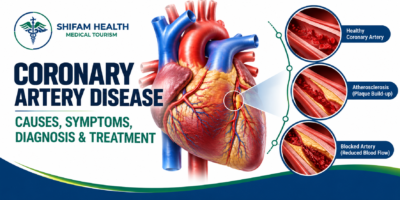
Coronary Artery Disease: Causes, Symptoms, Diagnosis & Treatment
Filters & Insights
Written By :
Medically Reviewed By :

Shifam Health Medical Team
Shifam Health - Medical Reviews Department
10+ Years Of Experience
Learn about coronary artery disease including its causes, symptoms, diagnosis & treatment options for managing narrowed or blocked heart arteries.
📅
Last updated: October 19, 2026

- Coronary artery disease (CAD) is a build-up of plaque in the arteries that supply the heart muscle, which can narrow them and reduce blood flow.
- It can be silent for years, then cause angina (chest discomfort), breathlessness, or a heart attack.
- Stable CAD and a heart attack are different situations. A suspected heart attack is an emergency.
- Diagnosis uses your history, blood tests, an ECG and imaging or stress tests; angiography is used selectively.
- Treatment combines lifestyle change, medicines, and, for selected patients, stenting (PCI) or bypass surgery (CABG). Neither procedure cures the underlying disease.
Coronary artery disease is one of the most common and serious heart conditions, yet it can develop quietly over many years. This guide explains how it forms, what the warning signs are, how doctors diagnose it, and how medicines, stents and bypass surgery are chosen. It is written for patients and families, including those considering a second opinion or care in India. It is general education and cannot diagnose you.
What is coronary artery disease? Coronary artery disease occurs when fatty plaque builds up inside the coronary arteries, the vessels that supply blood to the heart muscle. The plaque can narrow an artery or rupture and form a clot, reducing blood flow. This may cause angina, a heart attack or other complications, though it can also be silent.
Table of Contents
ToggleWhat Is Coronary Artery Disease?
Coronary artery disease means the arteries that feed the heart have become narrowed or blocked by plaque, so the heart muscle may not always get enough oxygen-rich blood. The process, called atherosclerosis, usually develops slowly over years.
The heart is a muscle that works constantly, so it needs its own blood supply through the left and right coronary arteries and their branches. In atherosclerosis, cholesterol, inflammatory cells and other material gather in the artery wall and form plaque. As plaque grows, it can:
- Narrow the artery, limiting blood flow when the heart works harder, which may cause angina.
- Rupture or erode, triggering a blood clot that can suddenly block the artery and cause a heart attack.
CAD may exist without any symptoms. Doctors also distinguish chronic coronary disease (long-term, often with predictable symptoms and a relatively stable course) from acute coronary syndrome (a sudden reduction in blood flow, including unstable angina and heart attack), which needs emergency care.
What Causes Coronary Artery Disease?
In most people, CAD is caused by atherosclerosis. It starts when the inner lining of the artery (the endothelium) is damaged or does not work properly, often through factors like high LDL cholesterol, high blood pressure, smoking and high blood sugar. Cholesterol-carrying particles then enter the wall, trigger inflammation and form plaque.
Over time, plaque can grow, harden with calcium or become unstable. If its surface breaks, platelets and clotting factors gather and a clot may form, which can abruptly block blood flow.
Not all reduced blood flow to the heart is due to a large blockage. Other causes of myocardial ischaemia (reduced oxygen supply to the heart muscle) include coronary artery spasm (vasospastic angina) and disease of the very small heart vessels (coronary microvascular dysfunction). These are less common but are an important reason why some people have angina or a heart attack without a large blockage on angiography.
Risk Factors for Coronary Artery Disease
Risk is cumulative: several modest risk factors can add up, and people with few obvious risk factors can still develop CAD.
Modifiable risk factors
| Risk factor | Why it matters | Possible risk-reduction approach |
|---|---|---|
| High LDL cholesterol and other lipid abnormalities | LDL contributes to plaque formation | Diet, activity, and lipid-lowering medicines when indicated |
| High blood pressure | Strains and damages artery walls | Lifestyle changes, blood-pressure medicines |
| Diabetes | Speeds up atherosclerosis and affects small vessels | Glucose control, lifestyle, medicines, regular review |
| Smoking and tobacco exposure | Damages the lining of arteries and promotes clots | Stopping tobacco, with cessation support |
| Physical inactivity | Linked to higher blood pressure, weight and glucose | Regular activity as advised by your clinician |
| Unhealthy diet pattern, excess weight | Raise lipids, blood pressure and diabetes risk | Heart-healthy eating pattern, weight management |
| Chronic kidney disease | Associated with higher cardiovascular risk | Kidney care, blood pressure and lipid control |
| Poor sleep, chronic stress, depression | Associated with higher risk in some evidence | Sleep care, stress management, mental-health support |
Certain substance exposures, such as some recreational drugs, can also be harmful to the heart.
Non-modifiable or background risk factors
- Increasing age
- Family history of premature coronary disease
- Inherited lipid disorders, such as familial hypercholesterolaemia
- Genetic predisposition. Several studies suggest South Asian ancestry is associated with CAD at younger ages, and your clinician may take this into account in risk assessment. [Reviewer to confirm and cite the AHA scientific statement.]
Having risk factors does not mean you have CAD, and having none does not rule it out.
Symptoms of Coronary Artery Disease
CAD symptoms occur when the heart muscle does not get enough blood for its workload. Many people have no symptoms for years, and symptoms alone cannot confirm or exclude CAD.
Chest pain or angina
Angina is typically a pressure, tightness, squeezing or heaviness in the chest. In stable angina it often appears with exertion or emotional stress and eases with rest, but patterns vary. Symptoms cannot reliably tell a heart attack from a less serious cause without medical evaluation.
Shortness of breath
Breathlessness can come with reduced blood flow to the heart, but it is not specific to CAD and has many other causes.
Discomfort beyond the chest
The arms, shoulders, back, neck, jaw or upper abdomen may feel pain, pressure or discomfort.
Fatigue, nausea, sweating or dizziness
These can accompany chest discomfort or breathlessness, and sometimes occur on their own.
Symptoms in women, older adults and people with diabetes
Chest discomfort remains the most common symptom across peoples. However, some people, including women, older adults and people with diabetes, are more likely to have less typical symptoms such as unusual fatigue, breathlessness, nausea or discomfort outside the chest. Women do not always have different symptoms from men.
Can coronary artery disease have no symptoms?
Yes. Silent myocardial ischaemia and symptom-free CAD exist, and a heart attack can be the first sign. This is why risk assessment matters, especially if you have diabetes, a strong family history, or several risk factors. Not having symptoms does not mean your arteries are healthy.
Heart Attack Warning Signs: When to Seek Emergency Care
Call emergency services immediately if you suspect a heart attack. In India, 112 is the national emergency number; use your local emergency number elsewhere.
Warning signs include:
- Chest pressure, squeezing, heaviness or discomfort lasting more than a few minutes, or that goes away and returns
- Pain or discomfort spreading to the arm, back, neck, jaw or upper abdomen
- Shortness of breath
- Cold sweat, nausea or light-headedness
- Sudden collapse or severe weakness
A heart attack can happen without dramatic chest pain. Do not wait to see whether symptoms disappear, and do not drive yourself if emergency help is available. Follow the emergency operator’s instructions, including any advice about medicines such as aspirin, since it is not right for everyone.
Types, Presentations and Severity of Coronary Artery Disease
Severity is about more than the percentage of narrowing seen on a scan. Doctors consider how many arteries are affected and where, how symptoms affect daily life, whether there is evidence of ischaemia, how well the heart muscle pumps, whether an acute coronary syndrome is present, and your overall health.
The main clinical presentations are:
- Chronic coronary disease with stable angina: symptoms are relatively predictable.
- Acute coronary syndrome (ACS): includes unstable angina and heart attack (myocardial infarction), either STEMI (a complete blockage, with a characteristic ECG pattern) or NSTEMI. These need urgent assessment.
- Vasospastic angina and coronary microvascular dysfunction: angina caused by artery spasm or small-vessel disease.
| Clinical presentation | General meaning | Typical clinical priority |
|---|---|---|
| Asymptomatic or incidentally detected disease | Plaque may be present without clear symptoms | Individualised risk assessment and prevention |
| Chronic stable symptoms | Symptoms are relatively predictable | Clinical evaluation and appropriate medical treatment or testing |
| Worsening or new symptoms | May indicate an unstable condition | Urgent medical assessment |
| Suspected acute coronary syndrome | Possible heart attack or unstable angina | Emergency evaluation |
This table is an educational overview, not a diagnostic classification. Symptoms alone cannot tell stable disease from unstable angina or a heart attack.
How Is Coronary Artery Disease Diagnosed?
Diagnosis depends on your symptoms, how stable you are, your risk profile and the findings of your examination. In a suspected heart attack, tests are done rapidly in an emergency setting. In a stable situation, doctors choose tests step by step, and not everyone needs every test.
| Test | What it helps assess | Important limitations or considerations |
|---|---|---|
| History and physical examination | Symptoms, risk factors, family history, blood pressure, pulse, signs of heart failure | Cannot confirm or exclude CAD on its own |
| Blood tests: lipids, glucose/HbA1c, kidney function | Risk factors and contributing conditions | Show risk, not whether arteries are narrowed |
| High-sensitivity cardiac troponin | Heart-muscle injury in suspected acute coronary syndrome | Interpreted with symptoms, ECG and timing; repeat measurements are often needed |
| ECG | Signs of ischaemia, past injury or acute heart attack | A normal ECG does not rule out CAD or an acute coronary syndrome |
| Echocardiogram | Heart pumping function, wall motion, valves | Does not directly show coronary plaque |
| Exercise or pharmacological stress test | Whether the heart develops ischaemia under stress | Choice depends on risk, ability to exercise, baseline ECG; can miss or over-call disease |
| Coronary CT angiography | Coronary anatomy and plaque in selected patients | Depends on heart rhythm, kidney function, contrast use; may need further tests |
| Invasive coronary angiography | Direct view of coronary arteries; guides PCI or CABG | Invasive with procedural risks; not needed for every patient |
| FFR and similar physiology tests | Whether a narrowing meaningfully limits blood flow | Used in selected patients, often during angiography |
A few points worth knowing:
- Troponin is mainly relevant when a heart attack is suspected. It is read together with symptoms, ECG changes and sometimes repeat blood tests.
- Stress tests show how the heart behaves under extra workload, either with exercise or with a medicine that mimics it.
- Coronary CT angiography and invasive angiography both look at the arteries, but angiography is a catheter procedure and is usually reserved for patients who need it for diagnosis or to guide treatment.
- No single test is best for everyone, and the cheapest or most advanced is not always the right one.
Treatment of Coronary Artery Disease
Treatment has three aims: reduce the risk of heart attack and cardiovascular death, relieve symptoms, and improve quality of life. The right plan depends on disease severity, symptoms, anatomy, other illnesses and your preferences.
| Treatment | Main purpose | When it may be considered | Key considerations |
|---|---|---|---|
| Lifestyle changes and cardiac rehabilitation | Slow disease, lower risk, improve fitness | For almost everyone with CAD or at risk | Needs sustained effort; exercise only after clinical assessment |
| Lipid-lowering medicines | Lower LDL cholesterol and reduce events | Most people with established CAD | Choice and monitoring are individual |
| Antiplatelet medicines | Reduce clot formation | Established CAD, after heart attack or stent, when indicated | Raise bleeding risk; not for everyone |
| Anti-angina medicines | Relieve symptoms | When symptoms occur | Do not all reduce heart attack risk |
| PCI (angioplasty and stenting) | Open a narrowed artery | Acute coronary syndromes; some patients with persistent symptoms despite medicines | Needs antiplatelet medicines afterwards; does not cure atherosclerosis |
| CABG (bypass surgery) | Route blood around blocked segments | Selected multivessel or left main disease, some with diabetes or reduced heart function | Major surgery; recovery takes time; does not remove underlying risk |
Lifestyle changes and cardiac rehabilitation
- Stop smoking and avoid tobacco exposure, with cessation support if needed.
- Eat a heart-healthy pattern, rich in vegetables, fruit, whole grains, legumes and fish, and low in processed foods, trans fats and excess salt and sugar.
- Be physically active, at a level advised by your clinician. Do not start strenuous exercise if symptoms are new, worsening or unexplained.
- Manage blood pressure, diabetes and cholesterol, and weight where relevant.
- Look after sleep and stress.
- Cardiac rehabilitation is a supervised programme of exercise, education and support, recommended after a heart attack or certain procedures.
Medicines for coronary artery disease
Medicines fall into groups with different jobs. Your clinician chooses them based on your condition, other illnesses, side effects and what you already take. This article does not give doses.
- Statins and other LDL-lowering medicines (such as ezetimibe, PCSK9-targeting medicines or bempedoic acid in selected patients) lower cholesterol and reduce heart attacks.
- Antiplatelet medicines, such as aspirin or a P2Y12 inhibitor, reduce clotting. They are used when indicated and increase bleeding risk, so not everyone should take aspirin.
- Beta-blockers slow the heart and reduce its workload and are used in selected patients, for example after a heart attack or with certain symptoms or heart weakness.
- Calcium channel blockers and nitrates help relieve angina symptoms.
- ACE inhibitors or ARBs are used in selected patients, such as those with high blood pressure, diabetes, kidney disease or heart weakness.
Important safety points: do not stop prescribed cardiac medicines without speaking to your clinician (especially after a stent), tell every doctor and dentist what you take, and distinguish medicines that lower long-term risk from those that mainly relieve symptoms.
Coronary angioplasty and stenting (PCI)
In percutaneous coronary intervention (PCI), a catheter is passed through an artery in the wrist or groin to the narrowed coronary artery. A small balloon widens it, and a stent (a tiny mesh tube) is usually left to hold it open.
PCI is most clearly beneficial in acute coronary syndromes, particularly a heart attack, where opening the artery quickly saves heart muscle. In stable CAD, trials such as ISCHEMIA suggest that PCI is not automatically better than good medical treatment for preventing heart attack or death in many patients. It can relieve angina when symptoms persist despite medicines.
After a stent, antiplatelet medicines are essential for the period your cardiologist prescribes. Risks include bleeding, vessel injury, kidney strain from contrast, stent re-narrowing or clotting, and rarely emergency surgery. PCI treats a narrowing; it does not cure the disease in the other arteries.
Coronary artery bypass grafting (CABG)
In CABG, a surgeon uses a blood vessel from elsewhere in the body (often an artery from the chest wall, a leg vein, or an arm artery) to create a detour around a blocked segment of a coronary artery.
Factors that may favour CABG include certain patterns of multivessel disease, significant left main coronary artery disease, diabetes in relevant situations, reduced heart function and anatomy that is difficult to stent. It is a major operation with its own risks, such as bleeding, infection, stroke, rhythm problems and a longer recovery. CABG is not always better than stenting, and not everyone with multiple blockages needs surgery.
Treatment during a heart attack
Emergency treatment depends on the type of acute coronary syndrome and may include urgent angiography, primary PCI to open the blocked artery, antithrombotic medicines and other measures, directed by an emergency and cardiac team. It is time-sensitive, and an article cannot replace emergency care.
When a heart team opinion helps
In complex cases where both PCI and CABG are possible, a heart team (an interventional cardiologist, a cardiac surgeon and often a non-invasive cardiologist) reviews your anatomy, risks and preferences together. You can ask for this, particularly before elective surgery.
Angioplasty and Stenting vs Bypass Surgery
PCI and CABG are not interchangeable. The choice depends on coronary anatomy, symptoms, other illnesses and shared decision-making. For a fuller comparison, see our guide to [stent vs bypass surgery].
| Feature | Angioplasty and stenting (PCI) | Bypass surgery (CABG) |
|---|---|---|
| How it works | Catheter, balloon and stent open the artery from inside | Graft vessels route blood around blocked segments |
| Typical considerations | Heart attacks; selected single- or limited-vessel disease; patients who prefer a less invasive option | Selected complex multivessel or left main disease; some people with diabetes or reduced heart function |
| Recovery and hospital stay | Usually shorter; individual | Longer; individual, with a sternum or leg wound to heal |
| Potential complications | Bleeding, vessel injury, stent clotting or re-narrowing, kidney strain | Bleeding, infection, stroke, rhythm problems, longer recovery |
| Long-term medicines and follow-up | Antiplatelet therapy as prescribed, plus lifelong risk-factor control | Antiplatelet therapy and risk-factor control, plus graft follow-up |
| What influences the choice | Anatomy, symptoms, diabetes, heart function, surgical risk, preference | The same factors, and a heart team assessment |
Neither procedure removes the underlying tendency to develop atherosclerosis.
Can Coronary Artery Disease Be Prevented or Reversed?
CAD often cannot be fully reversed, but it can often be slowed, and in some people plaque burden can shrink modestly with strong risk-factor control, particularly effective LDL-lowering treatment. You should not assume that established plaque will disappear.
Some important distinctions:
- Feeling better does not prove plaque has gone.
- A stent treats a narrowing but does not cure disease in the rest of the arteries.
- Bypass surgery reroutes blood flow but does not remove cardiovascular risk.
- Long-term risk-factor control and prescribed treatment remain important.
Evidence-based ways to reduce risk and slow progression:
- Avoid tobacco and seek help to quit.
- Keep blood pressure and blood sugar in the range advised.
- Follow a heart-healthy eating pattern and stay active as advised.
- Manage LDL cholesterol according to your overall risk and take medicines consistently.
- Attend follow-up visits, and discuss family history and inherited cholesterol disorders with a clinician.
Lifestyle change alone is not enough for every person with established CAD. Beware of claims that a supplement or diet can remove arterial plaque or replace indicated treatment.
Possible Complications of Coronary Artery Disease
Complications can include heart attack, heart failure, rhythm disturbances (see our guide to [cardiac arrhythmias — link to be verified]), cardiogenic shock in severe acute cases, sudden cardiac death, and reduced exercise capacity that affects daily life. The likelihood varies, and timely assessment and evidence-based treatment can lower risk.
Coronary Artery Disease Treatment in India
Selected tertiary hospitals in India offer cardiology, interventional cardiology, cardiac surgery and cardiac rehabilitation, serving both Indian and international patients. Availability and suitability vary between hospitals and between patients, so the plan should be based on your own records, symptoms, test results and stability.
When comparing options, it helps to ask about:
- The experience of the cardiologist and interventional cardiologist, particularly with complex disease
- Whether cardiac surgery is available on site if CABG might be needed
- Emergency and intensive care capacity, and access to a catheterisation laboratory and diagnostic imaging
- How complex coronary disease is managed, and whether a heart team reviews difficult cases
- Rehabilitation and long-term follow-up arrangements
- Clear, written communication about alternatives, risks and expected recovery
No hospital can ethically promise a result. We do not rank hospitals here, and a lower price is not proof that a plan is right for you.
What does treatment cost in India?
Cost depends on consultations and tests (including coronary CT angiography or invasive angiography), whether PCI or CABG is recommended, the number and type of stents, hospital and intensive-care needs, length of stay and complications, medicines, rehabilitation and follow-up, and, for international patients, travel, accommodation and attendant costs.
Published domestic figures for angioplasty with stenting are usually quoted at roughly INR 1.5 lakh to INR 4 lakh or more, depending on the hospital, city and stent type (SBI General, page updated May 2026), and one insurer’s indicative average is about INR 3 lakh. These are indicative domestic prices, not quotes. International patients are often quoted more than domestic list prices, and complex disease, multiple stents, emergencies and complications change the total. We found no reliable published figure for bypass surgery, so we do not quote one.
Ask for an itemised written estimate after specialist review. If you may be having a heart attack, seek emergency care at once; do not delay it to compare prices.
How International Patients Can Arrange Cardiac Treatment in India
A safe approach starts with your records and a specialist opinion, not with a flight. A patient with possible acute coronary syndrome should go to the nearest emergency department and not begin routine international travel planning.
- Gather records: medical history, medicines, ECGs, blood results, imaging reports and any angiography records or discs.
- Get a specialist review from an appropriately qualified cardiologist.
- Clarify the plan: the diagnosis, urgency, recommended treatment, alternatives and expected follow-up.
- Request a written treatment plan and itemised estimate.
- Confirm capability: ask whether the hospital can manage your specific condition, including surgery if needed.
- Check visa rules through official Indian government sources and the Indian mission in your country.
- Plan travel only after the treating team confirms you are fit to travel.
- Plan continuity: medicines, discharge documents, rehabilitation, and follow-up after you go home.
How Shifam Health fits in. Shifam Health is an India-based healthcare coordination organisation, not a hospital, and it does not diagnose or treat CAD. It can help collect records, request specialist opinions, shortlist hospitals, coordinate treatment plans and written estimates, and support medical visa documentation, travel, accommodation, interpretation and hospital logistics. It cannot guarantee outcomes, appointments, visa approval, treatment suitability or savings. Clinical decisions belong to your treating team.
Frequently Asked Questions
What is coronary artery disease?
Coronary artery disease (CAD) occurs when plaque builds up in the arteries supplying blood to the heart, reducing blood flow.
What causes coronary artery disease?
Atherosclerosis is the main cause. Risk factors include high cholesterol, high blood pressure, smoking, diabetes, and obesity.
What are the early symptoms of blocked heart arteries?
Symptoms may include chest pressure, breathlessness, and unusual fatigue during activity. Some people have no symptoms.
Can coronary artery disease occur without chest pain?
Yes. Some people experience breathlessness, nausea, or fatigue instead of typical chest pain, while others have no noticeable symptoms
What is the difference between coronary artery disease and a heart attack?
CAD is a long-term condition affecting the coronary arteries. A heart attack occurs when blood flow to part of the heart muscle is severely reduced or blocked, causing damage.
How is coronary artery disease diagnosed?
Tests may include an ECG, blood tests, echocardiography, stress testing, coronary CT angiography, or invasive angiography.
Can coronary artery disease be treated with medication alone?
Yes. Many patients with stable CAD can manage it with medication and lifestyle changes. Others may need a procedure.
When is angioplasty or bypass surgery recommended?
Angioplasty may help restore blood flow in selected cases, while bypass surgery may be recommended for certain complex or extensive blockages. The choice depends on individual assessment.
Can coronary artery disease be reversed?
It cannot always be reversed, but lifestyle changes and appropriate treatment can slow progression and sometimes reduce plaque.
Can someone live a long life with coronary artery disease?
Many people live for years with proper treatment, risk-factor management, and regular medical follow-up.
How much does coronary artery disease treatment cost in India?
Costs vary by treatment, hospital, stents, and length of stay. Request an individualized, itemized estimate.
Talk to Shifam Health
If you are considering cardiac care in India and would like help coordinating specialist opinions, treatment plans, cost estimates and travel logistics, Shifam Health can support you. We are not an emergency service, and you should never contact us before seeking urgent medical care.
- Website: https://shifamhealth.com/
- Free consultation: https://shifamhealth.com/free-consultation/
- Phone/WhatsApp: +91 81785 95807
- Email: contact@shifamhealth.com

Popular Posts From Last Week
- October 15, 2026
- shifamhealth
Hearing that your baby or child has a heart defect can feel overwhelming. You may be trying to…
- October 13, 2026
- shifamhealth
A note before you read further: “Spondylitis” is not one disease. It is a word that gets applied…
- October 14, 2026
- shifamhealth
If a radiology report used the word “slippage,” it can sound alarming. In most people it is not…
- October 16, 2026
- shifamhealth
If a scan report has just told you that you have “spondylosis,” take a breath. It sounds alarming,…
- October 15, 2026
- shifamhealth
Being told you have atrial fibrillation, or noticing your heart flutter and race for no reason, is unsettling….
- October 16, 2026
- shifamhealth
You are sitting quietly when your heart suddenly starts racing. It is not the pounding you feel after…
- October 19, 2026
- shifamhealth
Coronary artery disease is one of the most common and serious heart conditions, yet it can develop quietly…
- October 14, 2026
- shifamhealth
If your baby has been told they have a PDA, it can be hard to know whether it…
- October 17, 2026
- shifamhealth
If your child has been told they have pulmonary stenosis, you may be anxious about the word “stenosis”…
- October 14, 2026
- shifamhealth
If someone has a racing heartbeat with fainting, chest pain, severe breathlessness, confusion or collapse, call your local…
- October 13, 2026
- shifamhealth
If a newborn with suspected or known HLHS has blue or gray lips or skin, fast or difficult…
- October 12, 2026
- shifamhealth
Chiari malformation is a structural condition in which part of the cerebellum (the brain’s balance and coordination center)…