

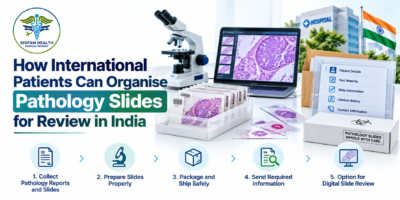


If you are considering treatment in India after receiving a biopsy or cancer diagnosis in your home country, the hospital may ask you to arrange a pathology slide review before confirming the next steps.
You may already have a pathology report explaining the findings. However, the Indian specialist might also need the original glass slides, tissue blocks or additional laboratory information to review the diagnosis. These materials are not interchangeable, and sending the wrong item can delay the review.
The practical challenge is that pathology materials are usually held by the laboratory that examined the original specimen. You may need to request their release, complete an authorisation form, obtain the receiving hospital’s instructions and arrange secure international delivery.
Organizing pathology slides for review in India starts with confirming exactly what the receiving pathologist needs not simply asking for every specimen and sending it by courier.
This is especially important when the review may influence decisions about cancer treatment, surgery or further diagnostic testing. The receiving specialist may need to compare the original findings with clinical records, imaging and previous pathology reports before advising on the next step.
In this guide, you will learn how to request pathology materials, understand the difference between slides and tissue blocks, prepare supporting documents, arrange international shipping and confirm that the Indian hospital has received everything required.
What Is a Pathology Slide Review?
A pathology slide review is an examination of previously prepared tissue or cell samples by a pathologist, often at a different laboratory or hospital, to assess the original findings or answer a specific diagnostic question.
Pathology plays an important role in diagnosing many conditions. In cancer care, for example, the examination may help establish the tumour type and relevant microscopic features. Depending on the case, additional laboratory tests may also be needed.
A review by another pathologist can help clarify a diagnosis, assess whether the original interpretation is supported by the material available or determine whether additional testing is appropriate. It does not automatically mean that the original report was incorrect.
The reviewing pathologist may agree with the original findings, provide a revised interpretation, request more material or recommend additional tests. The outcome depends on the case and the information available.
Why might an Indian hospital request a pathology review?
A hospital may request a review when:
- A patient is seeking a second opinion before treatment.
- The treating team needs to confirm or clarify the original diagnosis.
- The pathology findings must be considered alongside imaging and clinical history.
- Additional tests may be needed to guide treatment decisions.
- The patient has received reports from more than one laboratory.
- A specialist team needs to examine the original material before recommending a treatment plan.
Not every patient needs a formal review, and not every review requires physical slides. Ask the receiving hospital whether a review is necessary in your case and what materials it requires.
Understand the Difference Between Pathology Reports, Slides and Tissue Blocks

Before contacting the original laboratory, make sure you understand what you have and what you may need to request.
| Material | What it is | Why it may be needed |
|---|---|---|
| Pathology report | The written interpretation of the specimen | Gives the reviewing team the original findings and diagnosis |
| Glass slides | Thin sections of tissue or cells prepared for microscopic examination | Allow the pathologist to examine the material directly |
| Paraffin-embedded tissue block | A block of preserved tissue from which sections can be prepared | May be needed for additional sections, stains or other tests |
| Unstained slides | Prepared tissue sections without the requested diagnostic stain | May be used for specific additional tests when requested |
| Immunohistochemistry (IHC) results | Findings from tests using antibodies to identify particular markers in tissue | May help characterise certain tumours or other conditions |
| Molecular or genetic test reports | Results from selected tests performed on the specimen | May provide information relevant to diagnosis or treatment decisions |
| Previous consultation reports | Interpretations from earlier pathology reviews | Help the reviewing team understand what has already been assessed |
The precise materials required depend on the diagnosis, the original specimen and the purpose of the review.
Do not request tissue blocks or unstained slides unless the receiving hospital says they are needed. These materials may be limited, and some testing can consume tissue. The original laboratory and receiving pathologist should coordinate any request for additional material.
For more background on organising your supporting medical documents, see our guide on preparing a digital medical file for an overseas specialist.
Step One: Confirm Whether the Indian Hospital Needs a Pathology Review
Before asking the original laboratory to release any material, contact the hospital or specialist in India.
Explain why you are seeking treatment or a second opinion, identify the diagnosis mentioned in your report and ask whether the pathology material must be reviewed before the next clinical decision.
The receiving team may need to know:
- The type of biopsy or specimen.
- The date the specimen was collected.
- The name of the original laboratory or hospital.
- The diagnosis in the original pathology report.
- Whether additional tests have already been performed.
- Whether the original slides, tissue blocks or both are required.
- Whether digital pathology images are acceptable for the intended review.
Do not assume that a digital photograph of a slide is sufficient. Some pathology services accept digital whole-slide images, while others require physical glass slides or additional material. Acceptance depends on the receiving service and the purpose of the consultation.
Questions to ask the receiving hospital
Before arranging collection or shipping, ask:
- Is a formal pathology review required for my case?
- Which department or pathologist will receive the materials?
- Do you require glass slides, tissue blocks, unstained slides or only the report initially?
- Is there a pathology consultation request form?
- Does the original laboratory need to send the material directly?
- What clinical records and previous reports must accompany the slides?
- What address and recipient details should appear on the package?
- Are there specific courier, packaging or international shipping requirements?
- What is the process for tracking receipt and returning the original materials?
- Will additional testing or charges be discussed before it is performed?
Write down the answers. They will help you make a precise request to the original laboratory and avoid unnecessary transfers.
Step Two: Request the Pathology Materials From the Original Laboratory
Pathology slides and tissue blocks are commonly retained by the laboratory or hospital that performed the original examination. You may need to contact its pathology department, medical records team or patient services office.
Explain that you are seeking a specialist review at a hospital in India and ask about the procedure for releasing or transferring the materials.
The original provider may ask you to complete an authorisation form, submit identification or provide a request from the receiving hospital or treating clinician. Requirements vary by institution and country.
Information to include in your request
Provide the details needed to identify the correct case, such as:
- Patient’s full name as recorded by the original laboratory.
- Date of birth or another requested patient identifier.
- Date of the biopsy or procedure.
- Original pathology report number or accession number, if available.
- Type and location of the specimen, as recorded in the report.
- Name of the original hospital or laboratory.
- Name of the receiving Indian hospital or pathology department.
- A copy of the receiving hospital’s request, if required.
- Your signed authorisation or other required consent documentation.
The accession number is particularly useful because it helps the laboratory identify the specific pathology case. It may appear on the original report, specimen documentation or laboratory paperwork.
Do not guess the number or substitute an unrelated hospital identification number. If you cannot find it, ask the original laboratory how to identify the case.
Can I collect the slides myself?
That depends on the original laboratory’s policy and the receiving hospital’s requirements. Some institutions may release materials to an authorised patient or representative, while others prefer to send them directly to the receiving pathology service.
Ask the original laboratory which process it follows. If direct laboratory-to-laboratory transfer is available, it may simplify documentation and tracking.
Step Three: Prepare the Supporting Documents

Sending slides without the relevant medical context can make the review more difficult. The pathologist may need the original report, clinical history and information about previous testing to understand the question being asked.
Prepare a document folder containing the records requested by the receiving hospital.
Essential documents to discuss with the hospital
1. Original pathology report
Include the complete report, not just the page containing the diagnosis. Make sure any additional pages, comments or supplementary findings are included.
2. Pathology consultation request
If the receiving hospital provides a form, complete it according to its instructions. Check that patient details, the original case number and the clinical question are accurate.
3. Relevant medical summary
Prepare a concise summary of the patient’s diagnosis, symptoms, previous treatment and reason for seeking the review. Avoid adding a diagnosis that has not been confirmed by a qualified clinician.
4. Previous pathology opinions
If another laboratory has already reviewed the material, include the relevant report and explain which questions remain unresolved.
5. Relevant imaging reports
For some conditions, the pathologist or specialist may need imaging information to interpret the findings in context. Ask whether radiology reports or the original MRI, CT or other images should accompany the submission.
6. Relevant laboratory and treatment records
Include previous tests, treatment details or other records when the receiving team requests them. The requirements depend on the clinical question.
7. Authorisation and patient identification documents
Provide the documents required by the original and receiving institutions, using their approved submission process.
Prepare a simple document index
An index helps the receiving team identify the contents of the submission.
| Document | Date or reference | Included? |
|---|---|---|
| Original pathology report | As shown on report | Yes / No |
| Pathology consultation form | Current form version | Yes / No |
| Medical summary | Date prepared | Yes / No |
| Previous pathology review | Report date, if applicable | Yes / No |
| Relevant imaging report | Examination date | Yes / No |
| Authorisation documents | As required | Yes / No |
Only include documents relevant to the case and requested by the hospital. Protect the patient’s privacy when sharing them.
Step Four: Organize the Slides and Tissue Blocks Correctly

Pathology materials are delicate and must be handled according to the original laboratory’s and receiving institution’s instructions.
Glass slides can crack or break if they move around inside a package. Tissue blocks may also require particular handling, depending on the material, climate and duration of transit.
Do not remove slides from their holders, scrape material from them, relabel them yourself or attempt to prepare new sections at home.
How to prepare glass slides for shipping
Follow the instructions supplied by the pathology laboratory and receiving hospital. Their requirements take priority over general packing advice.
In general, the process may involve:
- Confirming which slides have been requested.
- Keeping each slide in its appropriate protective holder.
- Ensuring the holder is closed securely according to the laboratory’s instructions.
- Using protective outer packaging to reduce the risk of impact and movement.
- Placing the slides in a sturdy shipping package with the required documents.
- Ensuring the package is addressed to the correct pathology department and named recipient.
The University of California, San Francisco (UCSF) pathology service provides an example of institutional packing instructions: it advises placing slides in a slide container, securing the lid and using protective wrapping for shipment. Its instructions also specify how tissue blocks should be packaged. These instructions illustrate why patients should obtain recipient-specific guidance rather than improvising their own packaging. Read UCSF’s instructions for sending slides and blocks.
What about tissue blocks?
Do not package tissue blocks in the same way as glass slides without checking the instructions.
The correct packaging and transport conditions depend on the type of material and the receiving laboratory’s requirements. Ask both laboratories whether any temperature control, protective container or special handling is necessary.
Do not refrigerate, freeze or add a cooling pack to pathology materials unless the responsible laboratory instructs you to do so.
Should I send all the slides and blocks?
No not unless the receiving pathology service specifically asks for them.
The receiving pathologist may request selected slides or a representative block first, then ask for additional material if needed. Sending everything without instruction may increase costs and create avoidable handling and tracking work.
The University of Maryland School of Medicine’s pathology consultation instructions, for example, recommend sending relevant slides and explain that additional blocks can be requested if necessary. This is an example of one institution’s workflow, not a universal rule for every hospital. Read its consultation instructions.
Step Five: Arrange International Shipping to India

Once the receiving hospital has confirmed the materials, packaging and destination, arrange the transfer.
International shipments containing medical materials may require documentation or special handling. The applicable requirements depend on the nature of the contents, the origin and destination countries, and the courier’s policies.
Do not assume that a pathology slide package can be sent as an ordinary parcel without checking.
Before booking the courier
Confirm the following with the receiving hospital and courier:
- The exact recipient name and pathology department.
- The complete delivery address and contact number.
- Whether the courier accepts the materials for international shipment.
- What the courier requires the sender to declare.
- Whether any customs paperwork or authorisation is necessary.
- The packaging requirements and acceptable shipping method.
- Whether a tracking number will be provided.
- Who will be responsible for any customs questions or delivery delays.
Describe the contents accurately on the courier’s paperwork. Do not mislabel medical materials as unrelated merchandise to avoid questions or restrictions.
If the courier or customs authority requests additional information, contact the relevant institution rather than guessing.
Should I use express shipping?
Ask the receiving hospital when it needs the material and choose a suitable tracked service based on its instructions, the courier’s capabilities and the expected delivery time.
A faster service may reduce transit time, but it does not guarantee that the materials will clear customs immediately or be reviewed as soon as they arrive.
Allow time for the original laboratory to prepare the case, for shipping and delivery, and for the receiving pathology team to register and review the material.
Keep a complete shipping record
Save the following:
- Courier receipt.
- Tracking number.
- Date the package was sent.
- List of the materials and documents enclosed.
- Recipient’s name and department.
- Relevant email or written confirmation from the hospital.
This information is useful if the package is delayed, delivered to the wrong department or reported as incomplete.
Step Six: Protect the Materials and Patient Information
Pathology slides and blocks may be difficult or impossible to replace in exactly the same form. Treat them as important medical materials, not ordinary documents.
Protect the physical material
- Follow the original laboratory’s release and packaging instructions.
- Use suitable protective holders and packaging.
- Avoid unnecessary handling.
- Keep slides and blocks in their designated containers.
- Do not write directly on the diagnostic area or alter existing labels.
- Do not send irreplaceable materials without confirming the receiving hospital’s requirements.
Protect personal information
Pathology reports and accompanying forms may contain names, dates of birth, patient numbers and sensitive clinical information.
Verify the receiving institution and share records only through appropriate channels. If you are arranging the transfer for another person, ensure that you have the necessary permission or authorisation.
Keep copies of the paperwork, but store them securely. Do not post identifiable pathology reports or specimen labels publicly.
Ask about return of the original materials
Before shipping, ask whether the receiving hospital returns the slides or tissue blocks after the review, which party arranges the return and whether additional charges apply.
Do not assume that every item will automatically be returned. Confirm the policy in writing, especially if the original material is limited or may be needed for future testing.
What Happens After the Pathology Slides Reach the Indian Hospital?
Delivery is only one stage of the process. The pathology department may need to register the case, check the paperwork, confirm that the materials are suitable for review and assign the case to an appropriate pathologist.
The review may be straightforward, or the pathologist may need additional records, more slides, tissue blocks or further testing.
What should you confirm after delivery?
Contact the designated recipient to check:
- The package has arrived at the correct department.
- The patient’s identity and pathology case details have been matched correctly.
- The expected slides and blocks have been received.
- The original pathology report and consultation form are available.
- Any missing documents or materials have been identified.
- The next step and likely communication process have been explained.
Do not assume that a courier’s delivery confirmation means the pathology department has completed registration or begun the review.
How long does a pathology review take?
There is no single turnaround time that applies to every case or hospital.
Timing depends on the receiving service, the complexity of the diagnosis, the completeness of the material, the need for additional tests and the laboratory’s workload.
Ask the receiving hospital for its current expected timeline. If further testing is required, ask whether that will affect the schedule and whether additional approval or payment is needed.
Avoid making treatment or travel arrangements based on an unconfirmed review date.
Common Mistakes to Avoid
| Mistake | Why it matters | What to do instead |
|---|---|---|
| Sending slides before confirming the recipient | The package may reach the wrong department or be rejected | Obtain the exact destination and instructions first |
| Sending only the pathology report when slides are required | The reviewing pathologist may not have the original material | Confirm whether slides, blocks or both are needed |
| Sending every available tissue block | Some material may be unnecessary or limited | Send only what the receiving pathologist requests |
| Omitting the original report | The reviewing team may lack important context | Include the complete report and any relevant supplementary reports |
| Forgetting the case accession number | The laboratory may have difficulty identifying the correct case | Copy the identifier exactly from the original report |
| Packing glass slides loosely | Slides may break during transit | Use the designated holders and protective packaging |
| Using an unapproved courier or incorrect declaration | Delivery may be delayed or refused | Check courier acceptance and documentation requirements |
| Assuming the materials will automatically be returned | The return process may differ between institutions | Confirm return arrangements and costs in advance |
| Making travel plans based on an assumed turnaround time | The review may require extra testing or materials | Ask the hospital for its current expected timeline |
| Treating the pathology review as a complete treatment decision | Treatment planning may require clinical assessment and other investigations | Discuss the findings with the treating specialist |
Questions to Ask Before Sending Pathology Slides to India
Use this checklist when contacting the receiving hospital and the original laboratory.
- Is a pathology slide review required for my case?
- Which pathology department will receive the materials?
- Do I need to send glass slides, tissue blocks, unstained slides or only the report initially?
- Has the receiving hospital provided a consultation form or written request?
- Does the original laboratory require my authorisation?
- Is the pathology accession number included?
- Have I included the complete original report?
- Are previous pathology reviews or relevant imaging reports needed?
- Have the laboratories confirmed the correct packaging?
- Have I checked the courier’s acceptance and documentation requirements?
- Do I have the correct address and named recipient?
- Is the shipment trackable?
- Have I confirmed who arranges the return of the original materials?
- Do I know whom to contact after delivery?
If you do not know the answer to one of these questions, clarify it before sending the package. A short confirmation can help prevent avoidable delays and reduce the risk of losing track of important material.
When Should You Contact the Hospital or Specialist?
Contact the receiving pathology department before arranging shipment if:
- You are unsure whether a review is necessary.
- The hospital has not specified which materials it needs.
- You have only a pathology report and no slides.
- The original laboratory has requested a form or authorisation you do not understand.
- The report contains several specimen or accession numbers.
- You have received conflicting instructions about packaging or shipping.
- The courier requests documents you have not been given.
- The receiving hospital says that some materials are missing or unsuitable.
- You need to know whether additional tests will be performed or charged separately.
If the patient has a serious or rapidly changing medical condition, do not wait for an administrative process to finish before seeking appropriate medical care. Contact the treating clinician to discuss whether any decisions need to be made while the pathology review is being arranged.
A pathology review is one part of the clinical assessment. The treating team may also need the patient’s symptoms, examination findings, imaging and other test results before making treatment recommendations.
How Shifam Health Can Help International Patients Coordinate a Pathology Review in India
For international patients, arranging a pathology review can involve several organisations: the original laboratory, the receiving hospital, the pathology department and the courier. You may also need to coordinate the transfer with a specialist consultation and the rest of your medical records.
Shifam Health supports international patients with hospital and doctor coordination and related treatment-planning arrangements in India. If you are considering a specialist review, you can discuss the information you have and ask about the coordination process for approaching the relevant hospital.
The receiving hospital and original laboratory should confirm the required pathology materials, release procedure, packaging instructions and shipping destination. Shifam Health’s coordination support does not replace the pathologist’s assessment or guarantee a particular diagnosis or treatment recommendation.
You can request a free consultation with Shifam Health to discuss your requirements and the next steps for exploring treatment in India.
Frequently Asked Questions
Why would an Indian hospital ask for my pathology slides?
Specialists may review original tissue samples to confirm a diagnosis, obtain a second opinion or guide treatment planning.
Is the pathology report enough, or do I need to send the slides?
The report may support an initial review, but formal pathology assessment may require original slides or digital images.
What is the difference between pathology slides and tissue blocks?
Slides contain prepared tissue sections for microscopic examination. Tissue blocks preserve samples that can be used to prepare additional sections or perform further tests.
Can I request pathology slides from my original laboratory?
Usually, you can contact the laboratory to ask about its release process, required authorization and transfer arrangements.
Should I send all my pathology slides and tissue blocks?
No. Send only the materials requested by the receiving pathologist. The original and receiving laboratories may coordinate the selection.
How should I pack pathology slides for international shipping?
Follow the laboratories’ instructions. Slides need protective packaging to prevent breakage, while tissue blocks may require different handling.
Can pathology slides be reviewed digitally?
Some hospitals accept digital whole-slide images, while others require physical slides or tissue blocks. Confirm acceptance beforehand.
How long does an overseas pathology review take in India?
Timing depends on case complexity, material availability and additional testing. Ask the receiving pathology department for its estimated turnaround time.
Will the Indian hospital return my pathology slides?
Return policies vary. Confirm shipping arrangements, responsibilities and any charges before sending the materials.
What should I do if my pathology slides are missing?
Contact the original laboratory with your pathology report number and specimen details. Ask whether the material is available and inform the receiving specialist if it cannot be found.
Conclusion
Organising pathology slides for review in India requires more than arranging a courier. First, confirm the receiving pathologist’s requirements. Then request the correct materials from the original laboratory, prepare the supporting reports, follow the specified packaging instructions and use a suitable tracked shipping method.
Keep a record of the accession number, documents sent, courier details and delivery confirmation. Ask about the expected review timeline and the return of original materials before shipping.
For international patients, careful preparation can make the transfer process easier to manage and help the receiving team identify the material needed for review. The pathology findings should then be considered alongside the patient’s medical history, imaging and clinical assessment by the treating healthcare team.
If you need assistance coordinating a specialist consultation in India, contact Shifam Health for a free consultation.