

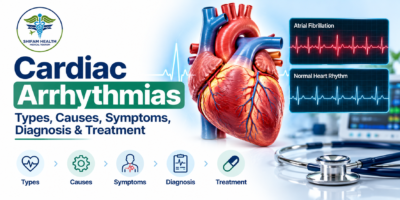
Cardiac Arrhythmias (2026): Types, Causes, Symptoms, Diagnosis & Treatment
Filters & Insights
Written By :
Medically Reviewed By :

Shifam Health Medical Team
Shifam Health - Medical Reviews Department
10+ Years Of Experience
Learn about cardiac arrhythmias, including types, causes, symptoms, diagnosis, and treatment options for abnormal heart rhythms.
📅
Last updated: October 23, 2026

- A cardiac arrhythmia is an abnormal heart rate or rhythm: too fast, too slow or irregular.
- Some arrhythmias are harmless. Others can cause stroke, fainting, heart failure or cardiac arrest. What matters is the specific rhythm and the person’s health.
- Diagnosis relies on an ECG and, when symptoms come and go, longer monitoring.
- Treatment ranges from observation to medicines, cardioversion, catheter ablation, pacemakers or ICDs, chosen for the individual.
- Collapse, chest pain, severe breathlessness or stroke signs need emergency care immediately.
A fluttering chest, a sudden racing heartbeat or a skipped beat can be frightening, and it is hard to know whether it is nothing or something serious. This guide explains what cardiac arrhythmias are, the main types, what causes them, how doctors diagnose them, and what treatment options exist. It is general education for patients and families, including international patients considering a specialist opinion. It does not replace an assessment by a clinician.
What are cardiac arrhythmias? Cardiac arrhythmias are abnormalities in the heart’s rate or rhythm, meaning the heart beats too fast, too slowly or irregularly. Main groups include atrial arrhythmias, supraventricular and ventricular tachycardias, slow rhythms (bradycardia) and conduction blocks. How serious and how treatable they are depends on the specific rhythm and the patient’s health.
Table of Contents
ToggleWhat Is a Cardiac Arrhythmia?
A cardiac arrhythmia occurs when the heart’s electrical signals that trigger each heartbeat start in the wrong place, fire at the wrong speed or travel along an abnormal path. This makes the heartbeat irregular, too fast or too slow.
Each normal heartbeat begins with an electrical impulse from the sinus node in the upper right chamber. The signal spreads through the upper chambers (atria), passes through the atrioventricular (AV) node, then triggers the lower chambers (ventricles) to pump blood. Problems with where the impulse starts, or how it travels, produce an arrhythmia.
Some useful distinctions:
- Heart rate is how many times the heart beats per minute. Heart rhythm is the pattern and regularity of those beats.
- Tachycardia means a fast heart rate. Bradycardia means a slow one. An irregular rhythm means beats are unevenly timed.
- A fast heartbeat is not always a disease. Exercise, fear, fever, dehydration and caffeine all raise heart rate normally.
- Palpitations are a sensation: pounding, fluttering or skipped beats. A palpitation is a symptom, not a diagnosis. An arrhythmia is only confirmed when a rhythm recording shows it.
An irregular rhythm is not automatically dangerous, but it should be assessed when it causes symptoms, lasts, or occurs in someone with heart disease or other risk factors.
Types of Cardiac Arrhythmias
Arrhythmias are grouped by where they start (atria or ventricles) and by speed (fast or slow). The main types differ greatly in risk and treatment.
| Type | Where it starts | Typical feature |
|---|---|---|
| Atrial fibrillation (AF) | Atria | Irregular, often fast rhythm; clot and stroke risk |
| Atrial flutter | Atria | Organised, rapid atrial circuit; often regular |
| Supraventricular tachycardia (SVT) | Above the ventricles | Sudden-onset, sudden-stop fast rhythm |
| Ventricular tachycardia (VT) | Ventricles | Fast rhythm; can be life-threatening |
| Ventricular fibrillation (VF) | Ventricles | Chaotic rhythm causing cardiac arrest |
| Bradycardia | Sinus node or conduction system | Slow heart rate |
| Heart block | AV node or conduction system | Delayed or interrupted signals |
| Premature beats (PACs/PVCs) | Atria or ventricles | Extra or skipped beats |
Atrial fibrillation (AF)
In atrial fibrillation the atria fire in a disorganised way, so the heartbeat is typically irregular and often fast. The atria no longer contract effectively, and blood can pool and form clots. If a clot travels to the brain it can cause a stroke, which is why stroke prevention is central to AF care.
Stroke risk is not the same for everyone. Doctors estimate it with scores such as CHA2DS2-VASc (or the newer CHA2DS2-VA used in the 2024 European guideline), which consider factors like age, high blood pressure, diabetes, heart failure, prior stroke and vascular disease. Whether you need a blood-thinning medicine is an individual decision.
Atrial flutter
Atrial flutter is an organised but abnormal electrical circuit in the atria. It often produces a fast and more regular rhythm than AF, though it can look similar on symptoms. It can occur with AF, and it can carry clinically important risks, including a stroke risk that doctors assess in much the same way.
Supraventricular tachycardia (SVT)
SVT describes fast rhythms that start above the ventricles. Episodes often begin and end suddenly. SVT includes different mechanisms, such as AV node re-entry and accessory-pathway circuits, and treatment depends on which one is present. Many people with SVT have otherwise normal hearts, but the diagnosis should be confirmed by a rhythm recording.
Ventricular tachycardia (VT)
VT is a fast rhythm that starts in the ventricles. Brief episodes may cause little, but sustained VT can be life-threatening, particularly in people with underlying heart disease such as a prior heart attack or cardiomyopathy. It can cause dizziness, fainting or collapse and may need urgent treatment.
Ventricular fibrillation (VF)
In VF the ventricles quiver chaotically and cannot pump blood, which causes cardiac arrest.
Emergency: If someone collapses and is unresponsive and not breathing normally, call your local emergency number immediately, start chest compressions if you are able, and use an automated external defibrillator (AED) as soon as one is available. Follow the emergency operator’s instructions.
Bradycardia
Bradycardia is an unusually slow heart rate. It can be normal, for example in athletes or during sleep. It becomes a concern when the slow rate causes dizziness, fatigue, fainting or breathlessness, often because the sinus node or conduction system is not working properly.
Heart block and conduction disorders
In heart block, electrical signals between the upper and lower chambers are delayed or interrupted. Severity ranges from mild (often found incidentally) to complete block, where the ventricles may beat very slowly and fainting or collapse can occur. Management depends on the type of block and symptoms.
Premature atrial and ventricular contractions (PACs and PVCs)
Premature beats are early beats that can feel like a skipped or extra beat. They are common and often occur in people with healthy hearts. They deserve assessment if they are frequent, bothersome, or accompanied by other symptoms or known heart disease, because very frequent premature ventricular beats can occasionally weaken heart muscle.
Other rhythm disorders exist, including inherited electrical conditions such as long QT syndrome, but they are beyond the scope of this overview.
Causes and Risk Factors of Cardiac Arrhythmias
Arrhythmias can result from an underlying heart condition, a temporary trigger, an inherited electrical disorder, or a mix of these. In some people, no clear cause is found.
- Heart conditions: coronary artery disease and previous heart attack, heart failure and cardiomyopathy, heart valve disease, high blood pressure with structural heart changes, congenital heart disease
- Inherited electrical disorders that affect heart rhythm
- Medical conditions: thyroid disorders (especially an overactive thyroid), sleep apnoea, diabetes, kidney disease
- Body chemistry: low or high potassium, low magnesium and other electrolyte disturbances
- Acute illness: fever, infection, dehydration
- Substances: alcohol, nicotine, recreational drugs and stimulants; caffeine is a trigger for some individuals but is not a universal cause
- Medicines: some prescription and over-the-counter drugs, including certain decongestants and some antiarrhythmic drugs themselves, can affect rhythm
- Other factors: older age, family history, previous heart surgery or procedures
A risk factor does not mean you have or will develop an arrhythmia. Tell your doctor about every medicine and supplement you take, since some can interact with heart rhythm.
Symptoms of Cardiac Arrhythmias
Common symptoms are palpitations (fluttering, pounding or skipped beats), a rapid or unusually slow heartbeat, dizziness or light-headedness, unexplained fatigue, breathlessness, chest discomfort, and near-fainting or fainting. Some arrhythmias cause no symptoms and are found on a routine pulse check or ECG.
Symptoms alone cannot identify the rhythm. Anaemia, thyroid disease, anxiety, lung disease and many other conditions can feel similar, so a recording of the heart rhythm during symptoms is often the key to diagnosis.
Emergency warning signs
Call your local emergency number immediately for:
- Chest pain or pressure with a suspected abnormal rhythm
- Severe shortness of breath
- Fainting or collapse, especially during exertion or with palpitations
- Stroke signs: facial drooping, arm weakness, difficulty speaking, sudden confusion
- A sustained rapid or abnormal heartbeat with severe weakness, dizziness or signs of poor circulation
- Someone who is unresponsive and not breathing normally: start CPR if you can and use an AED
Do not wait for an appointment, a second opinion or international travel in an emergency.
Recurring palpitations, unexplained dizziness, reduced exercise tolerance, a newly detected irregular pulse, or a relevant family history of sudden death or inherited heart rhythm problems are reasons to arrange a routine cardiology assessment soon.
How Are Cardiac Arrhythmias Diagnosed?
Diagnosis combines your symptoms, medical history, examination and tests that record the heart’s rhythm. A single normal ECG does not rule out an arrhythmia that comes and goes.
| Test | What it does | When it is useful |
|---|---|---|
| History and examination | Reviews symptoms, triggers, medicines, family history; checks pulse and blood pressure | Always the first step |
| ECG (electrocardiogram) | Records electrical activity for a few seconds to minutes | Catches arrhythmias present during recording; shows block, prior damage |
| Holter monitor | Continuous recording, usually 24–48 hours or longer | Frequent or daily symptoms |
| Event monitor / patch / loop recorder | Records over weeks, or longer with an implanted device | Infrequent symptoms or unexplained fainting |
| Echocardiogram | Ultrasound of heart structure and function | Looks for valve disease, weak heart muscle and other contributors; does not diagnose every rhythm |
| Blood tests | Thyroid, electrolytes, blood count and others as indicated | Finds treatable triggers |
| Exercise stress test | ECG during exertion | Symptoms that occur with exercise |
| Electrophysiology (EP) study | Catheters map the heart’s electrical pathways | Identifies the mechanism of certain arrhythmias; often combined with ablation |
Not every patient needs every test.
Smartwatches and home devices. Wearables can flag a possible irregular pulse and prompt you to seek care, and a recorded trace may help your doctor. But an alert is not a diagnosis, and a normal reading does not guarantee your rhythm is normal. Take a record of any alert to your clinician instead of starting or stopping treatment on your own.
Treatment Options for Cardiac Arrhythmias
Treatment depends on the exact rhythm, how much it affects you, any underlying heart disease, your risk of stroke or sudden cardiac death, and your preferences. These goals are different: controlling symptoms, restoring or maintaining normal rhythm, reducing stroke risk, preventing sudden death, and treating the cause.
Observation and lifestyle measures
Some arrhythmias, such as occasional premature beats, need only monitoring and reassurance. Managing triggers and related conditions is part of care: moderating or avoiding alcohol, stopping smoking, maintaining a healthy weight, treating high blood pressure and sleep apnoea, regular activity as advised, and limiting stimulants if they provoke episodes. The 2023 ACC/AHA/ACCP/HRS atrial fibrillation guideline treats risk-factor and lifestyle modification as a pillar of AF management. Lifestyle changes support treatment but do not replace it when treatment is indicated.
Medicines
Three different groups of medicines have different jobs:
- Rate-control medicines slow the heartbeat, for example in AF.
- Rhythm-control (antiarrhythmic) medicines try to restore or maintain a normal rhythm.
- Anticoagulants (blood thinners) reduce the risk of clots and stroke in selected people with AF or other indications. They do not correct the rhythm.
Because a heartbeat that feels normal does not mean stroke risk has gone, never stop an anticoagulant without your doctor’s advice. Bleeding risk, kidney function, other medicines and monitoring needs all matter, and your clinician must review them. Doses are individual and are not covered here.
Electrical cardioversion
In cardioversion, a controlled electrical shock given under sedation resets the rhythm in selected patients, for example in AF or flutter. Blood-thinning planning before and after is important because of clot risk, and timing depends on the clinical situation.
Catheter ablation
In catheter ablation, a specialist threads thin catheters, usually through a vein in the groin, to the heart and uses heat or cold energy to treat the small area of tissue responsible for an abnormal circuit. It may be considered for selected SVTs, atrial flutter, AF and some ventricular arrhythmias. Current AF guidelines support ablation as a first-line option in selected patients with paroxysmal AF and as an option when drugs fail in others. Outcomes, risks and the chance of recurrence vary with the rhythm and the patient. Some people need a repeat procedure or continued medicine.
Pacemaker implantation
A pacemaker is a small device placed under the skin that senses the heartbeat and sends a pulse when the heart is too slow or pauses. It is used for selected people with symptomatic slow rhythms or significant conduction block. It does not treat fast rhythms and is not a universal treatment for arrhythmias.
Implantable cardioverter-defibrillator (ICD)
An ICD monitors rhythm continuously and can pace the heart or deliver a shock to stop a dangerous ventricular arrhythmia. It is used in selected patients at risk of life-threatening ventricular arrhythmia, for example some people who have survived cardiac arrest or who have certain kinds of heart disease. Many ICDs also include pacing functions.
Other options and treating the cause
For some AF patients who cannot take long-term anticoagulants, left atrial appendage closure may be considered by specialists. Where an arrhythmia is driven by an underlying cause, such as thyroid disease, electrolyte problems, ischaemic heart disease, sleep apnoea or valve disease, treating that cause may be the key step.
Pacemaker vs ICD vs Catheter Ablation: What Is the Difference?
These three treatments do different jobs and are not interchangeable. A specialist decides whether any of them suits you.
| Treatment | Main purpose | Situations where it may be considered |
|---|---|---|
| Pacemaker | Supports a heart rate that is too slow or has pauses | Symptomatic bradycardia, certain types of heart block |
| ICD | Detects and treats selected life-threatening ventricular rhythms with pacing or shocks | Survivors of cardiac arrest from a ventricular rhythm; selected high-risk heart conditions |
| Catheter ablation | Targets the tissue or circuit causing certain arrhythmias | Selected SVT, atrial flutter, AF, and some ventricular arrhythmias |
Can Cardiac Arrhythmias Be Cured?
The answer depends on the rhythm and its cause. Some arrhythmias settle once a temporary trigger such as an electrolyte problem or overactive thyroid is corrected. Some, such as certain SVTs, can often be treated very effectively with ablation. Others, including AF, are often managed rather than permanently cured, and can come back after treatment.
This is why follow-up matters even when you feel well. Do not stop medicines or anticoagulation because your heartbeat feels normal. Avoid any source promising a guaranteed permanent cure.
Potential Complications of Cardiac Arrhythmias
Complications depend on the rhythm, how long it lasts, underlying disease and individual risk. They may include stroke and clots (mainly in AF and flutter), fainting and related injuries, heart failure or worsening of existing heart failure, reduced blood pumping, and cardiac arrest or sudden death in specific high-risk ventricular arrhythmias. Most people with a given arrhythmia will not face all of these.
Living With a Cardiac Arrhythmia
- Follow your treatment and monitoring plan, and attend follow-up after medicine changes, ablation or device implantation.
- Keep a simple record of symptoms, timing and possible triggers.
- Treat wearable readings as supporting information, not a diagnosis.
- Review all medicines and supplements with your clinician.
- Manage blood pressure, diabetes, weight, sleep apnoea and alcohol use.
- Ask your doctor what activity is safe for you. Many people can stay active, but there is no universal exercise plan, and some conditions need restrictions.
- Know which symptoms need emergency care.
Cardiac Arrhythmia Treatment in India for International Patients
Patients from abroad can seek a specialist opinion or treatment for arrhythmias in India, usually with a cardiologist or a clinical cardiac electrophysiologist (a rhythm specialist), depending on the condition. A careful process starts with sending your records for review and ends with a written plan, not with booking a flight.
What to prepare for an electrophysiology consultation:
- Previous ECGs, Holter or event-monitor reports, and any wearable traces you were advised to keep
- Echocardiogram and other imaging reports
- Recent blood test results, especially thyroid and electrolytes
- Discharge summaries, details of any past procedures or devices (including device model if you have a pacemaker or ICD)
- A current list of medicines, including anticoagulants and supplements
- A short note of when symptoms occur, how long they last and what you were doing
What to ask for: a clear explanation of the diagnosed rhythm, why a medicine, ablation or device is or is not advised, the risks, expected recovery, ongoing monitoring needs, and a written, itemised estimate. Ask what follow-up you will need after returning home and who will manage urgent problems there.
Safety first. International travel is not appropriate for someone with an unstable or potentially life-threatening arrhythmia. Emergencies must be treated locally first. Plan travel only after the treating team confirms it is medically appropriate.
What affects the cost?
Costs depend on the type of arrhythmia and the evaluation needed, consultation and tests, medicines and monitoring, the type and complexity of ablation, the pacemaker or ICD model, hospital stay and anesthesia, and follow-up including long-term device checks. Prices published online vary widely. For example, public listings for pacemaker implantation in India range from roughly INR 1.65 lakh to INR 12 lakh depending on the device type (single-chamber, dual-chamber, CRT or ICD) and hospital. We do not publish a price for ablation or ICD, because available published figures are inconsistent. International patients are often quoted more than domestic list prices. Treat any range as indicative and ask for an individual, itemized estimate.
How Shifam Health fits in. Shifam Health is an India-based healthcare coordination service, not a hospital, cardiology practice or emergency service. It can help you organise records, seek appropriate specialist opinions, understand options, and arrange non-clinical parts of treatment planning such as estimates, travel and accommodation. Diagnosis and treatment decisions remain with qualified treating clinicians.
Frequently Asked Questions
What is the most common type of cardiac arrhythmia?
Atrial fibrillation is the most common sustained arrhythmia seen in clinical practice, particularly with increasing age. Premature atrial and ventricular beats are very common too, but are often harmless and not treated.
Are all cardiac arrhythmias dangerous?
No. Some, like occasional premature beats, are often benign. Others, like sustained ventricular tachycardia or ventricular fibrillation, can be life-threatening. Risk depends on the specific rhythm, symptoms and any underlying heart disease.
What does an irregular heartbeat feel like?
People describe fluttering, pounding, a racing or skipped beat, or a pause followed by a strong beat. Some feel dizzy or breathless, and some feel nothing. Sensation alone cannot confirm which rhythm it is.
Can caffeine cause an arrhythmia?
Caffeine triggers palpitations in some people, but it is not a universal cause. If you notice a clear link, reducing it is reasonable. If symptoms continue, get a proper assessment.
Can an ECG detect every arrhythmia?
No. A standard ECG records only a short period, so it can miss rhythms that come and go. Holter, event monitors or implanted loop recorders may be needed to capture intermittent episodes.
Can cardiac arrhythmias be cured permanently?
Some can, especially when a trigger is corrected or certain SVTs are treated with ablation. Others, such as AF, are often controlled rather than permanently cured and may recur. Follow-up remains important.
What is the difference between a pacemaker and an ICD?
A pacemaker treats slow heart rates by sending small pulses. An ICD detects dangerous fast ventricular rhythms and treats them with pacing or a shock, and often includes pacemaker functions. They have different purposes.
Can an arrhythmia cause a stroke?
Yes, mainly atrial fibrillation and atrial flutter, because clots can form in the atria. Stroke risk varies per person and is assessed with scores. Doctors may recommend anticoagulants to reduce it. Never stop them without medical advice.
Conclusion
Cardiac arrhythmias range from occasional premature beats to life-threatening rhythms. The key steps are to identify the specific rhythm, understand its cause and risks, and agree an individual treatment plan with a qualified specialist. Know the emergency signs, and do not stop prescribed medicines on your own.
If you are an international patient who wants help organizing records, seeking specialist opinions, or understanding treatment planning in India, Shifam Health can assist with coordination. We do not diagnose or treat, and we cannot promise outcomes, availability or a fixed cost. [Share your reports for a coordination review →]
If you have chest pain, collapse, severe breathlessness or stroke signs, call your local emergency number now.



Popular Posts From Last Week
- October 23, 2026
- shifamhealth
A fluttering chest, a sudden racing heartbeat or a skipped beat can be frightening, and it is hard…
- October 16, 2026
- shifamhealth
You are sitting quietly when your heart suddenly starts racing. It is not the pounding you feel after…
- October 19, 2026
- shifamhealth
Coronary artery disease is one of the most common and serious heart conditions, yet it can develop quietly…
- October 17, 2026
- shifamhealth
If your child has been told they have pulmonary stenosis, you may be anxious about the word “stenosis”…
- October 22, 2026
- shifamhealth
A remote medical second opinion from India allows patients living in the USA, UK and other countries to…
- October 21, 2026
- shifamhealth
When you receive treatment estimates from two hospitals in India, do not compare only the final amounts. To…
- October 22, 2026
- shifamhealth
An itemized hospital quote in India should clearly explain the expected cost of treatment by separating major charges,…