


How to Build a Realistic Timeline for Treatment in India
Filters & Insights
Written By :
Medically Reviewed By :

Shifam Health Medical Team
Shifam Health - Medical Reviews Department
10+ Years Of Experience
Plan treatment in India with a realistic timeline for consultations, visa, hospital stay, recovery and travel.
📅
Last updated: November 2, 2026

Planning medical treatment in another country involves more than choosing a hospital and booking a flight. International patients need time for medical record review, specialist consultations, investigations, treatment decisions, visa arrangements, hospital admission and recovery.
A well-planned medical treatment timeline in India for international patients helps reduce avoidable delays and makes the journey easier to manage. However, no two patients follow exactly the same schedule. A patient travelling for a consultation or a minor procedure may need a very different amount of time from someone undergoing major surgery, cancer treatment or organ transplantation.
The most practical approach is to prepare a flexible timeline with confirmed milestones, estimated dates and additional time for unexpected changes.
This guide explains how to plan each stage of treatment in India, what documents to prepare and which questions to ask before confirming travel.
Table of Contents
ToggleWhy You Need a Realistic Treatment Timeline
A medical trip usually involves several connected stages:
- Sharing medical records with the hospital.
- Receiving an initial specialist opinion.
- Completing additional investigations, if required.
- Confirming the proposed treatment and estimated costs.
- Arranging the appropriate visa and travel documents.
- Travelling to India and attending hospital appointments.
- Undergoing treatment and recovering.
- Obtaining discharge documents and follow-up instructions.
- Receiving medical clearance before returning home.
The time required depends on the patient’s diagnosis, medical condition, treatment complexity, hospital availability and response to treatment.
For example, a patient seeking a second opinion may not need an extended stay. A patient undergoing a complex operation may need additional days for preoperative assessment, hospital admission, postoperative monitoring and rehabilitation.
Before making travel arrangements, understand the difference between an estimated treatment schedule and a confirmed hospital schedule. An initial estimate is useful for planning, but the treating hospital must confirm the actual dates.
Step-by-Step Process to Build Your Treatment Timeline
Step 1: Collect and Organise Your Medical Records
Start by preparing a complete digital medical file before contacting hospitals in India.
Depending on your condition, this may include:
- Recent medical reports and diagnosis summaries.
- Blood test and laboratory reports.
- MRI, CT, PET-CT, ultrasound or X-ray reports.
- Pathology and biopsy reports, where relevant.
- Previous operation notes and discharge summaries.
- Current prescriptions and medication details.
- Information about allergies and existing medical conditions.
- Passport copy, when required for hospital registration or an invitation letter.
Organise the documents chronologically and use clear file names. If you have imaging scans, ask the hospital whether it needs the original DICOM files rather than only the written report.
You can refer to our guides on preparing a digital medical file for an overseas specialist, sharing large MRI and CT files with an Indian hospital and organising pathology slides for review in India.
A complete file helps the specialist understand your medical history and decide whether further information or investigations are necessary.
Step 2: Allow Time for Specialist Review
Once your records are ready, share them with the hospital or through your medical coordination team.
The specialist may:
- Review your diagnosis and previous treatment.
- Request additional reports or updated investigations.
- Recommend a virtual consultation.
- Suggest an in-person examination before confirming treatment.
- Provide a preliminary treatment recommendation and cost estimate.
Do not assume that the first opinion is a final treatment decision. The doctor may need to examine you physically or review additional test results after you arrive in India.
If you are arranging an online appointment, read what happens during a virtual consultation with an Indian specialist and how to prepare for a video consultation about treatment in India.
Ask the hospital how long its initial review may take and whether the proposed doctor is available around your expected travel dates.
Step 3: Request a Written Treatment Plan
Before booking flights, request a written treatment plan or preliminary estimate from the hospital.
Where possible, it should clarify:
- The proposed treatment or procedure.
- The specialist or department responsible for care.
- Investigations that may be required before treatment.
- Estimated hospital admission duration.
- Expected recovery and observation period.
- Whether additional procedures may be necessary.
- What is included and excluded from the estimate.
- Whether follow-up appointments are required before departure.
The plan should also identify what remains uncertain. For example, the doctor may confirm the final procedure only after reviewing updated imaging or conducting a physical examination.
Read how to request a written treatment plan before travelling to India and questions to ask before accepting a medical treatment package in India.
If you receive different recommendations, consider the clinical reasoning behind each one rather than comparing only the quoted prices. Our guide on choosing between two treatment recommendations explains the points worth discussing.
Step 4: Confirm Whether More Than One Specialist Is Needed
Some patients require opinions from multiple departments before treatment can proceed.
For example:
- A patient with cancer may need an assessment involving medical oncology, surgical oncology or radiation oncology.
- A patient with a complex heart condition may require cardiology and cardiac surgery input.
- A patient with a neurological condition may need neurology, neurosurgery and rehabilitation assessments.
- A patient being considered for an organ transplant may require several specialist evaluations.
The hospital should clarify whether these consultations can be arranged on the same day or whether they need separate appointments.
If multiple departments are involved, allow enough time for doctors to review each other’s findings and agree on the next steps. Read how to plan a medical trip when more than one specialist is needed.
Step 5: Confirm Investigations and Pre-Treatment Requirements
Some investigations may be completed before travel, while others may need to be repeated or performed in India.
Ask the hospital:
- Which existing reports are acceptable?
- Which tests must be completed after arrival?
- Are any investigations time-sensitive?
- Do tests require fasting or medication adjustments?
- Can tests and consultations be arranged on the same day?
- How long will the results take?
Do not arrange tests independently simply because they appear in a general medical checklist. The treating specialist should decide which investigations are necessary.
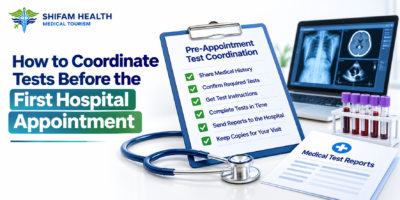
Our guide on coordinating tests before the first hospital appointment explains how to organise this stage.
Step 6: Start Visa and Travel Arrangements
Once you have a preliminary treatment plan and hospital confirmation, begin checking the applicable visa requirements.
For eligible patients, India provides a Medical Visa route. The exact requirements, validity, entry conditions and attendant arrangements depend on the applicant’s nationality and the applicable rules.
The Indian Ministry of Home Affairs provides information on Medical Visas and Medical Attendant Visas. You can also check the official Indian Visa Online portal for the application process and country-specific requirements.
Prepare the following, as applicable:
- Valid passport.
- Hospital invitation or appointment letter.
- Medical reports and diagnosis documents.
- Visa application and supporting documents.
- Attendant’s passport and visa documents, where relevant.
- Confirmed or proposed travel details.
- Accommodation and local transport arrangements.
Do not assume that every patient has identical visa requirements. Check the latest instructions from the relevant Indian embassy, consulate or official visa portal.
You can also read our guide to checking hospital accreditation and quality information in India before finalising your hospital choice.
Step 7: Plan Your Arrival and First Hospital Appointment
Your arrival date should allow enough time to reach the hospital, settle into your accommodation and attend the first appointment without unnecessary pressure.
Confirm:
- Airport pickup arrangements.
- Hospital location and appointment time.
- Accommodation distance from the hospital.
- Whether the patient needs a medical escort.
- Whether translation or interpretation support is required.
- Whether any reports or original documents must be carried.
If you are travelling with an attendant, confirm who will accompany you during consultations and help with communication or daily activities.
Avoid scheduling a hospital appointment immediately after a long international flight if the patient may be tired or medically unstable. Discuss the most appropriate arrival and appointment schedule with the hospital.
Step 8: Keep the Treatment and Recovery Period Flexible
The hospital may conduct examinations and investigations after your arrival. Based on the findings, the specialist may confirm, modify or postpone the proposed treatment.
Your timeline should account for:
- Initial hospital assessment.
- Additional investigations, if required.
- Final treatment decision and consent.
- Treatment or surgery.
- Hospital observation and recovery.
- Discharge assessment.
- Follow-up consultation and travel advice.
The duration of each stage varies considerably. A short outpatient procedure may require a different schedule from major surgery or a prolonged course of treatment.
Do not book your return flight based only on the estimated date of discharge. Ask the treating doctor when the patient may be fit to travel and whether any additional follow-up is needed.
The US Centers for Disease Control and Prevention explains that travel after medical treatment can involve additional risks, including blood clots and complications during recovery. Its Medical Tourism guidance is a useful reference.
Step 9: Arrange Follow-Up Before Returning Home
Before leaving India, ask the hospital for:
- Final diagnosis and discharge summary.
- Operation or procedure notes, if applicable.
- Copies of important investigations.
- Updated medication prescriptions.
- Wound care and recovery instructions, where relevant.
- Warning signs that require urgent medical attention.
- Follow-up schedule and contact details.
- Advice about travel fitness and any airline medical clearance.
Make sure you understand which follow-up appointments can be conducted online and which require an in-person examination.
The NHS guidance on recovery after surgery provides useful examples of discharge and recovery questions patients should discuss with their healthcare team.
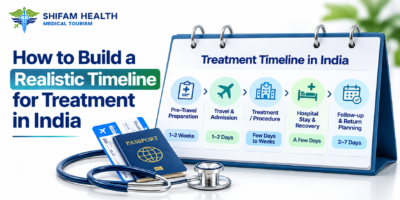
An Illustrative Treatment Travel Timeline
The following is a planning framework, not a medical recommendation or a guaranteed schedule. Actual timelines may be shorter or longer depending on the treatment and hospital’s assessment.
| Stage | Illustrative planning window | Main activity |
|---|---|---|
| Medical records | Before travel | Collect and share reports |
| Initial review | Before travel | Specialist assessment and consultation |
| Treatment planning | Before travel | Written plan and preliminary estimate |
| Visa and travel | Before travel | Visa application and travel arrangements |
| Arrival and assessment | After arrival | Hospital examination and required tests |
| Treatment | As advised | Procedure, surgery or treatment sessions |
| Recovery | As advised | Observation, rehabilitation or follow-up |
| Return planning | After medical clearance | Confirm fitness to fly and travel home |
Important: These are stages, not fixed durations. Do not interpret them as a promise that a particular treatment can be completed within a specific number of days.
Documents and Questions to Prepare
Keep one organised folder containing the following:
Medical documents
- Medical history and diagnosis summary.
- Recent investigations and imaging.
- Pathology reports, where relevant.
- Previous discharge summaries and operation notes.
- Current medication list and allergy information.
Travel and administrative documents
- Passport and relevant identity documents.
- Visa application documents.
- Hospital invitation or appointment letter.
- Attendant documents, where applicable.
- Travel and accommodation details.
Questions to ask the hospital
- Has the specialist reviewed all my medical records?
- Is an online consultation required before travel?
- Which tests must be completed after arrival?
- What is the estimated duration of treatment?
- How many days should I plan to stay in India?
- Is the proposed doctor available during my expected visit?
- What could cause the treatment schedule to change?
- How long might recovery take?
- When can I safely travel back home?
- What follow-up arrangements will be available after discharge?
You should also ask for clarification about the hospital’s estimate, including possible additional expenses. See how to compare hospitals beyond the headline treatment price.
Common Mistakes and Practical Planning Tips
Booking flights before receiving medical confirmation
Avoid committing to non-refundable travel arrangements before receiving a preliminary hospital assessment and understanding the likely treatment schedule.
Planning only for the procedure
The treatment date is only one part of the journey. Include investigations, preoperative assessment, hospital admission, recovery and follow-up.
Assuming the estimated stay is guaranteed
A hospital may provide an estimated admission or recovery period, but complications, additional investigations or changes in the treatment plan can affect it.
Ignoring the patient’s fitness to fly
Discharge from hospital does not automatically mean that a patient is ready for an international flight. The treating doctor should assess fitness to travel. Airlines may also require medical clearance or additional documentation.
The UK Civil Aviation Authority’s guidance on assessing fitness to fly explains why a passenger’s medical condition, medication and mobility may need to be considered.
Leaving no time for unexpected changes
Keep some flexibility in your accommodation and return travel arrangements. Discuss extension policies and possible additional costs before arrival.
Not arranging follow-up care
Before travelling, understand how you will communicate with the hospital after returning home and who will manage your ongoing care locally.
When Should You Contact a Hospital or Specialist?
Contact the hospital or relevant specialist as early as possible if:
- You have received a new diagnosis and need an initial opinion.
- Your current reports are incomplete or several months old.
- Your condition has changed since the last assessment.
- You need a written treatment plan before applying for a visa.
- More than one specialist may be involved.
- You have a fixed travel deadline or visa-related constraint.
- You need to understand the expected hospital stay and recovery period.
- You are unsure whether it is safe to travel.
If your condition is deteriorating or you are experiencing severe or urgent symptoms, seek immediate medical attention locally rather than waiting for an overseas consultation.
How Shifam Health Can Help You Plan Your Medical Trip
Planning treatment abroad can involve several organisations, documents and appointments. Shifam Health supports international patients by coordinating communication and practical arrangements with hospitals in India.
Depending on the patient’s requirements, our support may include:
- Collecting and organising medical records for hospital review.
- Coordinating specialist consultations and appointment requests.
- Helping obtain hospital treatment estimates and invitation letters.
- Providing guidance on Medical Visa documentation.
- Coordinating airport pickup and accommodation arrangements.
- Arranging medical escort and language interpretation support.
- Assisting with communication and post-treatment follow-up coordination.
The hospital and treating doctors remain responsible for clinical decisions, treatment recommendations, admission, discharge and fitness-to-fly assessments.
If you are considering medical treatment in India, share your diagnosis, available medical reports and preferred treatment details with Shifam Health. Our team can help coordinate the initial hospital review and guide you through the next planning steps.
Contact Shifam Health to discuss your treatment requirements and begin organising your medical journey to India.
Frequently Asked Questions
How early should I start planning treatment in India?
Start as soon as you have a diagnosis or medical reports to share. Early planning allows time for specialist review, additional investigations, visa documentation and travel arrangements.
Can I book my flight before receiving a treatment plan?
It is better to obtain an initial hospital assessment first. If you must reserve flights early, consider flexible or refundable options and avoid treating estimated dates as confirmed appointments.
How many days should I stay in India for treatment?
There is no universal duration. It depends on the diagnosis, procedure, hospital admission, recovery and follow-up requirements. Ask the treating hospital for an estimated stay and keep additional flexibility.
Can the hospital change my treatment schedule after arrival?
Yes. The specialist may modify the plan after physical examination, updated investigations or a review of your medical condition.
When can I return home after surgery?
Your treating doctor must assess your recovery and fitness to fly. The required waiting period varies by procedure, complications, mobility and other medical factors. Airline clearance may also be necessary.



Popular Posts From Last Week
- October 31, 2026
- shifamhealth
A practical guide for international patients planning treatment in India. Learn how to confirm ICU facilities, emergency response,…
- October 31, 2026
- shifamhealth
A practical guide for international patients planning treatment in India. Learn how to check whether a hospital treats…
- October 27, 2026
- Razi Khan
Imagine you have decided to seek a specialist’s opinion from another country. You have laboratory reports, prescriptions, scan…
- November 2, 2026
- Shifam Health
A practical guide for international patients explaining how to organise existing medical reports, confirm additional test requirements, prepare…
- October 28, 2026
- shifamhealth
Learn how to organise pathology slides for review in India, from requesting materials from the original laboratory to…
- October 28, 2026
- shifamhealth
Preparing for a virtual consultation with an Indian specialist? Learn what happens before, during and after the appointment,…
- October 30, 2026
- Razi Khan
Learn how international patients can compare hospitals in India beyond the headline treatment price. Discover how to assess…
- October 28, 2026
- Areen Fatima
Learn how to prepare for a video consultation about treatment in India. Discover which medical reports to organise,…
- October 29, 2026
- shifamhealth
Learn how international patients can request a written treatment plan before travelling to India. Discover which medical details…
- October 29, 2026
- shifamhealth
Learn how to compare two medical treatment recommendations before travelling to India. Understand how to assess clinical reasoning,…
- October 29, 2026
- shifamhealth
Learn what to do when your diagnosis is unclear and how an Indian specialist review may help. Discover…
- October 30, 2026
- shifamhealth
Learn how international patients can verify a doctor’s qualifications before travelling to India. Discover how to check medical…