


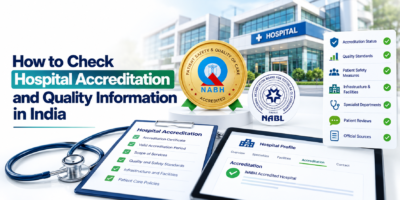
How to Check Hospital Accreditation and Quality Information in India
Filters & Insights
Written By :
Medically Reviewed By :

Shifam Health Medical Team
Shifam Health - Medical Reviews Department
10+ Years Of Experience
Learn how to check hospital accreditation in India, verify NABH status, assess hospital facilities & evaluate quality details before travel.
📅
Last updated: October 30, 2026

Choosing a hospital in another country requires more than comparing treatment costs, specialist profiles, or the appearance of a hospital’s website. International patients also need to understand whether a hospital follows recognised quality standards, what facilities it provides, and how to verify the information before travelling.
Hospital accreditation can be a useful starting point. It indicates that a healthcare organisation has undergone an external assessment against a defined set of standards. However, accreditation is not a guarantee of a successful treatment outcome, and it does not automatically establish that every department, procedure, or specialist is suitable for your case.
If you are considering treatment in India, this guide explains how to check hospital accreditation, understand the difference between accreditation and certification, evaluate hospital quality information, and prepare questions before making medical travel arrangements.
Table of Contents
ToggleWhat Is Hospital Accreditation?
Hospital accreditation is an external assessment process through which a healthcare organisation is evaluated against defined standards relating to quality, patient safety, and healthcare delivery.
In India, the National Accreditation Board for Hospitals and Healthcare Providers (NABH) operates accreditation and certification programmes for different types of healthcare organisations. NABH is a constituent board of the Quality Council of India.
Its hospital standards cover areas such as patient assessment, continuity of care, medication management, patient rights, infection control, quality improvement, facility safety, staffing, and medical information management. You can review the official NABH hospital accreditation programme for details.
Accreditation can help patients assess whether a hospital has established quality and safety systems. It is one part of a broader evaluation, alongside the hospital’s clinical services, relevant specialists, available facilities, and ability to meet an individual patient’s needs.
What accreditation can tell you
Depending on the programme and its scope, accreditation or certification can provide information about whether a healthcare organisation has been assessed against a defined set of standards.
It may help you understand whether the facility has established systems for:
- Patient assessment and continuity of care.
- Medication management and patient safety.
- Infection prevention and control.
- Patient rights, information, and consent.
- Staff responsibilities and organisational processes.
- Facility management and safety.
- Medical records and information management.
- Quality monitoring and improvement.
What accreditation cannot tell you on its own
Accreditation does not guarantee that a particular treatment will succeed or that complications will never occur.
It also does not establish that:
- Every doctor at the hospital has the right expertise for your condition.
- Every procedure is available at every branch or location.
- The hospital is the best option for your individual case.
- The quoted treatment cost includes every possible expense.
- Your admission or treatment date is confirmed.
- A specific clinical outcome can be guaranteed.
For international patients, the practical question is not simply whether a hospital has an accreditation mark. It is whether the relevant facility and clinical team can meet your specific medical requirements.
Understand Accreditation, Certification, and Empanelment
These terms can appear on hospital websites and official documents, but they do not necessarily mean the same thing.
Hospital accreditation
Accreditation involves an external assessment against the standards of the relevant accreditation programme. NABH’s hospital accreditation programme focuses on quality and patient safety systems across the healthcare organisation.
Entry-level certification
NABH also offers entry-level certification programmes. These provide a structured framework for healthcare organisations to develop quality and patient safety systems, with requirements that differ from those of the comprehensive hospital accreditation programme.
Entry-level certification should not automatically be described as equivalent to full hospital accreditation. Check the exact programme and status in the official record.
Read the NABH Entry-Level Certification Programme for the programme’s scope and requirements.
Empanelment
Empanelment generally refers to an organisation being accepted into a particular network or arrangement, such as an insurer’s or another programme’s network. It is not automatically equivalent to hospital accreditation.
When a hospital displays an accreditation or certification logo, confirm the exact designation and the organisation or programme that issued it.
The official NABH directory of accredited healthcare organisations includes organisations with accreditation, certification, or empanelment, including some under renewal. Because the directory itself notes that information may be incomplete or inconsistent during data migration, verify important details directly with NABH or the hospital when necessary.
Step-by-Step: How to Check Hospital Accreditation in India
Step 1: Identify the exact hospital facility
Start with the full name and address of the hospital where you expect to receive treatment.
Large hospital groups may operate multiple facilities in different cities or locations. A quality credential associated with one facility should not automatically be assumed to apply to every facility within the same group.
Record the following details:
- Hospital’s full official name.
- City and state.
- Street address or specific campus.
- Relevant department or speciality.
- Hospital website and official contact details.
If a hospital group operates several branches, verify the exact branch rather than searching only by the group’s name.
Step 2: Open the official NABH directory
Visit the NABH Find an Accredited Healthcare Organisation directory.
The directory provides search fields for information such as the organisation’s name, state, city, PIN code, and accreditation number. It also provides filters for selected specialities and healthcare services.
Use the search fields to locate the specific hospital you are considering.
Where possible, search using more than one identifying detail, such as the hospital’s full name and city. This helps reduce the risk of confusing similarly named facilities.
Step 3: Check the programme and current status
Once you find a possible match, review the available information carefully.
Check:
- Whether the organisation’s name matches the hospital you intend to visit.
- Whether the city and address correspond to the correct facility.
- Which accreditation, certification, or other programme is shown.
- Whether a certificate number or other identifying information is available.
- Whether the status indicates current accreditation, certification, renewal, or another category.
- Whether any validity or renewal information is displayed.
Do not treat every entry in a directory as proof of current full accreditation. The directory includes different types of recognition, so you need to distinguish between them.
If the information is unclear, ask the hospital for a copy of its current certificate and confirm the details with NABH where appropriate.
Step 4: Verify the certificate directly
If the hospital website displays an accreditation certificate or logo, compare it with the information available in the official directory.
Ask the hospital to confirm the programme name, certificate number, facility covered, and current validity.
A logo on a website, brochure, or social media post is not sufficient by itself to establish current status. The certificate should correspond to the actual healthcare organisation and the relevant programme.
If the hospital has recently changed its name, ownership, or location, ask whether the accreditation details have been updated accordingly.
Step 5: Contact NABH if information is inconsistent
The official directory notes that some information may be temporarily incomplete or inconsistent because of ongoing data migration.
Therefore, an unsuccessful search or a discrepancy should not automatically be treated as proof that the hospital is unaccredited.
If you cannot confirm a hospital’s status:
- Recheck the spelling and full name.
- Search using the city, PIN code, or accreditation number, where available.
- Ask the hospital for its current certificate and programme details.
- Contact NABH through its official website if clarification is still needed.
- Keep written confirmation for your records if the accreditation status materially affects your decision.
Step 6: Check whether the accreditation covers the facility you need
A hospital’s overall accreditation status is only one part of the assessment. Confirm that the relevant department and services are available at the facility where your treatment would take place.
For example, if you are considering a complex surgical procedure, ask whether the relevant surgical team, operating theatre, anaesthesia services, intensive care facilities, and required diagnostic services are available at that location.
Do not assume that the presence of a speciality on a hospital group’s website means that every branch provides the same service.
Step 7: Keep a record of what you verified
Save the official directory result, the certificate or confirmation received from the hospital, and the date on which you checked the information.
This is particularly useful when you are comparing several hospitals or discussing your options with family members and your current treating doctor.
Remember that accreditation and certification status can change. Recheck important details before making final treatment arrangements.
How to Evaluate Hospital Quality Beyond Accreditation
Accreditation is a useful indicator, but it should not be your only criterion. A hospital may meet defined organisational standards while still differing from another facility in its specialist expertise, services, treatment experience, or suitability for a particular patient.
Consider these additional factors before deciding.
Relevant clinical department
Confirm that the hospital provides the speciality and treatment you need.
Ask which department would manage your case, which specialists would be involved, and whether your condition requires input from more than one department.
Specialist qualifications and experience
Verify the qualifications and relevant registration details of the doctor who would assess or treat you.
Ask whether the specialist regularly manages conditions similar to yours and whether the proposed procedure falls within their current clinical practice.
Read How to Verify a Doctor’s Qualifications Before Medical Travel for a practical verification process.
Diagnostic and treatment facilities
Depending on your condition, you may need specialised imaging, laboratories, operating theatres, intensive care, rehabilitation, or other services.
Ask whether the necessary facilities are available at the relevant location and whether any investigations or procedures would need to be arranged elsewhere.
Infection prevention and patient safety
Ask how the hospital handles infection prevention, medication safety, patient identification, informed consent, and the reporting of safety concerns.
You may not be able to assess every internal process independently, but the hospital should be able to explain its policies and answer reasonable questions about the care pathway.
Patient rights and communication
Before treatment, understand how the hospital explains treatment options, obtains consent, provides medical records, and communicates changes in the treatment plan.
For international patients, also ask whether language support is available and how you can contact the clinical team if you need clarification.
Continuity of care
Ask how the hospital manages care before admission, during treatment, and after discharge.
For example, who will review your condition after a procedure? What follow-up may be needed? Who should you contact if a problem develops after you return home?
Written treatment and cost information
Request a written treatment proposal and an itemised estimate where appropriate. Confirm what is included, which services may cost extra, and what factors could change the final amount.
Accreditation does not establish that a treatment estimate is complete or that the proposed treatment is suitable for you.
Questions to Ask Before Choosing a Hospital
Use the following checklist when contacting the hospital or arranging a consultation.
| Topic | Questions to ask |
|---|---|
| Accreditation | What is the hospital’s current accreditation or certification status, and which programme applies? |
| Facility | Does the credential cover the exact campus where my treatment would take place? |
| Specialist | Which doctor or clinical team would assess my case? |
| Clinical services | Does the facility provide the treatment and relevant diagnostic services I may need? |
| Additional support | Are intensive care, rehabilitation, or other specialist services available if required? |
| Investigations | Which tests or assessments are needed before treatment can be confirmed? |
| Treatment plan | Can I receive the proposed clinical approach and next steps in writing? |
| Costs | Can the hospital provide an itemised estimate with inclusions and exclusions? |
| Admission | What determines the admission date and whether treatment can proceed? |
| Follow-up | What reviews or rehabilitation may be needed after discharge? |
| International patient support | Is language assistance available, and whom should I contact with questions? |
| Medical records | How can I obtain copies of reports, discharge summaries, and treatment documentation? |
The answers will help you evaluate the hospital’s suitability for your needs rather than relying solely on its accreditation status or marketing material.
Common Mistakes to Avoid
Assuming every NABH programme means full accreditation
Accreditation, entry-level certification, and empanelment are different categories. Check the exact programme shown in the official record before describing a hospital’s status.
Checking only the hospital group’s name
A credential may apply to a specific facility rather than every branch. Verify the exact location where you will receive care.
Relying only on a logo or certificate image
A displayed logo may be outdated or may refer to a different programme. Confirm the current status using the official directory and, if needed, direct verification.
Treating a missing search result as conclusive
Official directories may contain incomplete or inconsistent records. Recheck the identifying details and ask the hospital or NABH for clarification before drawing conclusions.
Assuming accreditation guarantees a successful outcome
Accreditation is not a guarantee of a particular medical result. Individual outcomes depend on the condition, treatment, patient factors, clinical decisions, and many other circumstances.
Ignoring the relevant specialist and department
A hospital’s general accreditation status does not establish that the specific specialist, treatment, or facility is suitable for your case. Verify those details separately.
Comparing prices without checking what is included
Two hospitals may quote different amounts because their estimates cover different services or assumptions. Request itemised estimates and compare the scope of care before making a decision.
Making travel commitments before the treatment pathway is clear
An accredited hospital may still need to review your reports, conduct an assessment, or confirm whether treatment is appropriate. Clarify the medical and logistical requirements before making non-refundable bookings.
How to Compare Two Hospitals
If you are deciding between two facilities, compare the information systematically rather than relying on a single factor.
| Comparison point | Hospital A | Hospital B |
|---|---|---|
| Exact facility and location | ||
| Accreditation or certification programme | ||
| Current status verified | ||
| Relevant speciality available | ||
| Doctor’s qualifications checked | ||
| Required diagnostic facilities | ||
| Relevant surgical or treatment services | ||
| Intensive care or specialist support, if needed | ||
| Written treatment proposal available | ||
| Itemised estimate available | ||
| Follow-up arrangements explained | ||
| Language and international patient support |
Fill the table using verified information. If a detail is unknown, ask the hospital rather than assuming that the service is available.
Once you have confirmed the relevant clinical services, you can compare the proposed treatment pathway, the specialist’s reasoning, the expected recovery, and the financial estimate.
For more guidance, read How to Choose Between Two Treatment Recommendations and How to Compare Two Hospital Treatment Estimates in India.
What to Do After Checking Accreditation
Once you have checked the hospital’s status, use the information as one part of your treatment-planning process.
- Confirm the facility. Make sure the accreditation or certification information matches the hospital where your care would take place.
- Verify the specialist. Check the doctor’s qualifications, registration details, and current affiliation.
- Share your medical records. Provide the relevant reports and investigation results through the hospital’s recommended channel.
- Arrange a specialist consultation. Ask whether a remote review is possible and what information is needed.
- Request a written treatment plan. Clarify the proposed approach, additional investigations, and next steps.
- Review the estimate. Check inclusions, exclusions, and possible additional charges.
- Confirm practical arrangements. Ask about admission, expected hospital stay, follow-up, and language support.
- Make travel decisions carefully. Do not treat accreditation or an initial consultation as confirmation that a procedure or admission is guaranteed.
If you are still at the information-gathering stage, read How to Prepare for a Video Consultation About Treatment in India and How to Request a Written Treatment Plan Before Travelling to India.
Frequently Asked Questions
How can I check hospital accreditation in India?
Use the NABH accredited healthcare organisation directory to search for the hospital and verify its status.
What is NABH accreditation?
NABH assesses healthcare organisations against defined standards for quality and patient safety.
Is NABH accreditation the same as entry-level certification?
No. They are separate programmes with different requirements. Check the hospital’s exact status.
Does hospital accreditation guarantee good treatment outcomes?
No. Outcomes depend on clinical expertise, facilities, treatment requirements and individual circumstances.
Can an accredited hospital lack a particular treatment?
Yes. Confirm that the specific facility offers your required speciality, procedure and clinical support.
What if a hospital does not appear in the NABH directory?
Check its name and location, then contact the hospital or NABH for clarification. A missing result alone does not prove it is unaccredited.
How can I verify whether accreditation is current?
Check the official directory and confirm the certificate number, facility covered and validity with NABH or the hospital.
Should I choose an accredited hospital over a non-accredited one?
Consider accreditation alongside specialist expertise, facilities, treatment options and follow-up arrangements.
How do I check whether a hospital has the facilities I need?
Contact the relevant department to confirm the availability of required diagnostic, surgical, intensive care or rehabilitation services.
Get Support With Hospital Selection in India
Checking hospital accreditation is a practical first step when considering treatment abroad. It helps you examine a facility’s recognised quality credentials, but it should be combined with checks on the relevant specialist, clinical services, treatment proposal, costs, and follow-up arrangements.
Shifam Health supports international patients with specialist consultation coordination, communication with Indian hospitals, medical record sharing, treatment estimate clarification, and practical planning for medical care in India.
If you are considering treatment in India, start by identifying your medical requirements and checking which hospital facilities and specialist expertise may be appropriate for your case.
Request a Free Consultation with Shifam Health to discuss your medical coordination requirements.



Popular Posts From Last Week
- October 27, 2026
- Razi Khan
Imagine you have decided to seek a specialist’s opinion from another country. You have laboratory reports, prescriptions, scan…
- October 27, 2026
- Razi Khan
Receiving a medical treatment package from a hospital can feel like a major step forward. You have a…
- October 26, 2026
- Razi Khan
Learn how to send large MRI and CT files to an Indian hospital for specialist review. This guide…
- October 25, 2026
- shifamhealth
What is a ventricular septal defect? A ventricular septal defect (VSD) is an opening in the wall (septum)…
- October 28, 2026
- shifamhealth
Learn how to organise pathology slides for review in India, from requesting materials from the original laboratory to…
- October 28, 2026
- shifamhealth
Preparing for a virtual consultation with an Indian specialist? Learn what happens before, during and after the appointment,…
- October 28, 2026
- Areen Fatima
Learn how to prepare for a video consultation about treatment in India. Discover which medical reports to organise,…
- October 29, 2026
- shifamhealth
Learn how international patients can request a written treatment plan before travelling to India. Discover which medical details…
- October 29, 2026
- shifamhealth
Learn how to compare two medical treatment recommendations before travelling to India. Understand how to assess clinical reasoning,…
- October 29, 2026
- shifamhealth
Learn what to do when your diagnosis is unclear and how an Indian specialist review may help. Discover…
- October 30, 2026
- shifamhealth
Learn how international patients can verify a doctor’s qualifications before travelling to India. Discover how to check medical…
- October 30, 2026
- shifamhealth
Learn how international patients can check hospital accreditation and quality information in India. Discover how to verify NABH…