


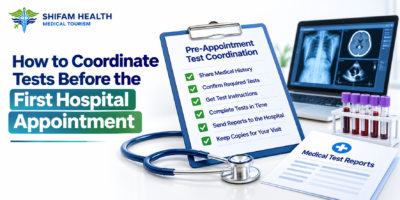
How to Coordinate Tests Before the First Hospital Appointment
Filters & Insights
Written By :
Medically Reviewed By :

Shifam Health Medical Team
Shifam Health - Medical Reviews Department
10+ Years Of Experience
Prepare for your first hospital appointment in India. Learn which medical tests to arrange and how to share existing reports.
📅
Last updated: November 2, 2026

Preparing for medical treatment in India often begins before the patient arrives at the hospital. International patients may already have blood reports, MRI scans, CT images, biopsy results, and other investigations from their home country. They may also be unsure whether they should complete additional tests before the first consultation.
The important thing is to coordinate these investigations properly.
Completing every possible test before meeting a specialist is not necessarily helpful. Some investigations may be unnecessary, outdated, or unsuitable for the patient’s actual condition. In other cases, the hospital may need a particular test, imaging format, or updated report before it can make a clinical assessment.
The best approach is to share existing medical records first, ask the receiving hospital what is required, and arrange additional investigations only when advised by the appropriate clinical team.
This guide explains how international patients can coordinate medical tests before their first hospital appointment in India.
Table of Contents
ToggleWhy Should You Coordinate Medical Tests Before the First Appointment?
Medical investigations help doctors understand a patient’s condition, assess its severity, and decide what further evaluation or treatment may be appropriate.
However, the tests required vary depending on the diagnosis and the patient’s medical history.
For example:
- A patient with a suspected heart condition may need an ECG, echocardiogram, or other cardiac investigations, depending on the clinical assessment.
- A patient seeking cancer treatment may need biopsy reports, pathology slides, imaging, or other investigations relevant to the suspected cancer.
- A patient with a neurological condition may need MRI or CT imaging, depending on the symptoms and diagnosis.
- Someone considering joint replacement surgery may need X-rays and other assessments of the affected joint.
- A patient with kidney or liver problems may need relevant blood tests, imaging, and previous treatment records.
These are examples, not standard test requirements for every patient with those conditions. The treating specialist should decide which investigations are necessary.
Coordinating tests before the appointment can help:
- Reduce unnecessary repeat investigations.
- Make existing reports available to the specialist.
- Identify missing clinical information.
- Organise appointments and diagnostic services.
- Avoid delays caused by incomplete records.
- Make the first consultation more productive.
Step-by-Step Process to Coordinate Medical Tests Before Your Appointment
Step 1: Prepare a list of investigations already completed
Before arranging new tests, identify what the patient has already undergone.
Create a simple record containing:
- Name of the investigation.
- Date it was performed.
- Name of the diagnostic centre or hospital.
- Main findings, if available.
- Whether the original report is available.
- Whether the original images or test files are available.
For example:
| Investigation | Date | Available records |
|---|---|---|
| Complete blood count | 15 October 2026 | Laboratory report |
| MRI brain | 18 October 2026 | Report and DICOM images |
| Echocardiogram | 20 October 2026 | Report and images, if available |
| Biopsy | 22 October 2026 | Histopathology report |
This is only an illustration. Include investigations relevant to the patient’s condition.
Organising the existing reports helps the hospital understand what information is already available and whether further testing may be required.
For a detailed guide, read How to Prepare a Digital Medical File for an Overseas Specialist.
Step 2: Share the medical records with the hospital before booking new tests
Send the available medical reports to the hospital’s international patient department or the relevant specialist team.
Ask whether the documents are sufficient for an initial review.
The hospital may:
- Accept the existing reports for the first consultation.
- Request additional documents.
- Ask for updated investigations.
- Recommend a virtual consultation.
- Explain that certain tests should be performed after the patient arrives in India.
Do not assume that every investigation needs to be repeated simply because it was performed at another hospital or in another country.
The treating specialist should determine whether an existing report is adequate for clinical decision-making.
If you are sending large imaging files, read How to Share Large MRI and CT Files with an Indian Hospital.
Step 3: Ask which tests are required before the first consultation
Once the hospital has received the records, request clarification about any additional investigations.
Ask these questions:
- Are the existing medical reports sufficient for the first consultation?
- Are any additional tests required before the appointment?
- Which investigations can wait until after the specialist reviews the patient?
- Are there specific diagnostic centres or testing formats the hospital recommends?
- How recent should the reports be for this particular assessment?
- Should the original imaging files or pathology materials be brought?
This step is important because some tests are needed for an initial assessment, while others may only be required after the doctor examines the patient.
Avoid arranging a large package of investigations without a clinical reason.
Step 4: Understand which tests may need special preparation
Different investigations have different preparation requirements.
Some blood tests may require fasting, while others do not. Certain imaging examinations may involve contrast material, and some procedures require specific preparation or medication instructions.
Before completing any test, ask the diagnostic centre or treating clinician about:
- Whether fasting is required.
- How long fasting should continue, if applicable.
- Whether water is permitted.
- Whether regular medication should be taken.
- Whether any medication needs special instructions.
- Whether previous allergies or medical conditions need to be disclosed.
- Whether pregnancy or the possibility of pregnancy should be reported before imaging.
- Whether additional preparation is required for contrast-enhanced imaging.
Important: Do not stop prescribed medication or fast unnecessarily. Follow the instructions provided for the particular investigation.
For general guidance, consult MedlinePlus: How to Prepare for a Lab Test.
Step 5: Check whether existing test reports are still suitable
An older report is not automatically invalid, and a recent report is not automatically sufficient.
Whether a test needs repeating depends on the patient’s condition, the type of investigation, changes in symptoms, and the specialist’s requirements.
For example:
- A patient whose symptoms have changed may need updated imaging.
- A patient undergoing treatment may require more recent laboratory results.
- A specialist reviewing a previous operation may need the original surgical records.
- A patient seeking a cancer opinion may need additional pathology review.
- A patient with a complex cardiac condition may need updated cardiac investigations, depending on the clinical situation.
Ask the hospital whether the existing reports can be used for the first consultation.
The decision to repeat a test should be made by the treating clinical team.
Step 6: Arrange specialist-requested investigations in the correct sequence
Some investigations depend on the findings of another test or the specialist’s initial assessment.
For this reason, it is not always practical to complete every test before the first appointment.
A possible sequence is:
- Share existing medical records.
- Arrange an initial specialist review.
- Receive recommendations for additional investigations.
- Complete the required tests.
- Share the new reports with the specialist.
- Arrange a follow-up consultation to discuss the findings.
This sequence may differ for urgent cases or conditions where the hospital specifically requests certain investigations before the first appointment.
If more than one specialist is involved, ask the hospital whether the departments can coordinate their test requirements. Read How to Plan a Medical Trip When More Than One Specialist Is Needed.
Step 7: Confirm where the tests will be performed
If additional investigations are required in India, confirm whether they can be completed at the proposed hospital or whether another diagnostic facility will be used.
Ask:
- Is the investigation available at the same hospital?
- Does the hospital require a particular imaging or laboratory format?
- Can the test be scheduled before the consultation?
- How long will the results take?
- Will the specialist receive the results directly?
- Will a separate appointment be required to discuss the findings?
If the patient is travelling for several investigations, try to coordinate appointments in a practical order.
However, do not schedule tests too closely together without confirming preparation requirements and result timelines.
Step 8: Keep copies of all reports and original test files
International patients should maintain their own organised medical records, even when the hospital receives the documents electronically.
Carry:
- Printed copies of important reports.
- Digital copies of laboratory results.
- Original MRI and CT imaging files, where available.
- Previous prescriptions.
- Medication details.
- Discharge summaries.
- Pathology reports and materials, if requested.
For imaging, ask whether the hospital requires DICOM files rather than only PDF reports or screenshots.
For pathology cases, confirm whether the hospital needs glass slides, paraffin blocks, digital slides, or only the written report for the initial assessment.
Read How International Patients Can Organise Pathology Slides for Review in India.
Step 9: Confirm the first appointment and test schedule
Once the hospital has reviewed the available records, confirm the appointment details.
Clarify:
- Consultation date and time.
- Doctor’s name and department.
- Hospital branch and location.
- Tests required before the appointment.
- Tests that can be completed after consultation.
- Expected report turnaround time.
- Whether a follow-up consultation is required.
If you are travelling internationally, allow sufficient time for investigations and the review of results.
Do not book a return flight immediately after the first consultation if additional testing or specialist assessment may be necessary.
Step 10: Ask for a written assessment and next-step plan
After the first consultation and any recommended investigations, ask the specialist to explain the next steps.
Depending on the case, the doctor may recommend:
- Further diagnostic investigations.
- A second specialist opinion.
- Medication or non-surgical treatment.
- Surgery or another intervention.
- Observation and follow-up.
- Additional evaluation before making a final decision.
If treatment is recommended, request a written plan explaining the proposed approach, expected hospital stay where possible, and estimated costs.
Read How to Request a Written Treatment Plan Before Travelling to India.
Common Medical Tests and Records Patients May Be Asked to Share
The investigations required depend on the medical condition. The following table provides examples of common records that hospitals may request during an initial review.
| Type of investigation | Examples | When it may be relevant |
|---|---|---|
| Blood tests | CBC, blood glucose, kidney function, liver function | General assessment and condition-specific evaluation |
| Cardiac investigations | ECG, echocardiogram, stress test | Certain heart-related conditions |
| Imaging | X-ray, MRI, CT, ultrasound | Assessment of organs, bones, joints, and other structures |
| Cancer investigations | Biopsy, histopathology, immunohistochemistry | Evaluation of suspected or confirmed cancer |
| Neurological investigations | MRI brain, CT brain, EEG | Selected neurological conditions |
| Kidney investigations | Kidney function tests, urine tests, ultrasound | Assessment of kidney-related conditions |
| Previous treatment records | Operation notes, discharge summaries, prescriptions | Understanding medical history and previous treatment |
These are examples only. Not every patient needs all the investigations shown.
Documents and Questions to Prepare Before Contacting the Hospital
Medical documents checklist
- Diagnosis or referral letter.
- Recent consultation notes.
- Existing laboratory reports.
- MRI, CT, X-ray, or ultrasound reports.
- Original imaging files, where available.
- Biopsy and histopathology reports, where applicable.
- Previous surgery records.
- Discharge summaries.
- Current medication list with dosages.
- Details of allergies and existing medical conditions.
- Previous treatment history.
- Passport copy, if requested for administrative processing.
Questions to ask the hospital
| Topic | Question |
|---|---|
| Existing records | Are the reports already submitted sufficient for the first consultation? |
| Additional tests | Which investigations are required before the appointment? |
| Timing | How recent should the reports be? |
| Preparation | Do any tests require fasting or other preparation? |
| Medication | Should the patient follow any special medication instructions? |
| Imaging | Are original DICOM files required? |
| Pathology | Are slides or blocks needed for review? |
| Location | Can the tests be completed at the same hospital? |
| Scheduling | Can tests and consultations be coordinated? |
| Results | How long will reports take to become available? |
| Follow-up | Will another consultation be needed after the tests? |
| Costs | What are the estimated charges for the recommended investigations? |
Common Mistakes International Patients Should Avoid
Mistake 1: Completing every test before receiving medical advice
More tests do not necessarily mean better preparation. Some investigations may be unnecessary or may need to be selected after a specialist evaluates the case.
Mistake 2: Repeating tests without checking existing reports
Send previous reports and ask whether they can be used. Avoid repeating investigations unless the clinical team recommends it.
Mistake 3: Assuming all blood tests require fasting
Preparation varies by test. Follow the specific instructions rather than fasting automatically.
Mistake 4: Stopping medication before an investigation
Never stop prescribed medicines unless the treating clinician specifically instructs you to do so.
Mistake 5: Sending only screenshots of imaging reports
The hospital may need the original DICOM files to review the images. Confirm the required format.
Mistake 6: Ignoring report dates
Provide the date of each investigation. The specialist can then decide whether the information is sufficiently recent.
Mistake 7: Booking tests without confirming the diagnostic requirements
Different hospitals and departments may have different requirements. Ask before arranging tests at an outside laboratory or diagnostic centre.
Mistake 8: Planning an unrealistic travel schedule
Allow time for investigations, report preparation, specialist review, and possible follow-up appointments.
When Should You Contact the Hospital or Specialist?
Contact the hospital before travelling if:
- The patient has several existing medical reports from different hospitals.
- You are unsure which tests are required.
- The patient has undergone recent surgery or treatment.
- The hospital has requested additional investigations.
- You need to arrange a biopsy or pathology review.
- Imaging files are too large to send by email.
- Several specialists need to review the case.
- You want to complete certain investigations before the first consultation.
If the patient has severe or worsening symptoms, seek urgent medical attention locally. Do not delay necessary medical care while waiting for an overseas hospital to review reports or recommend tests.
FAQs
Should I complete all medical tests before travelling to India?
No. Share existing reports first and ask the hospital which additional tests, if any, are necessary.
Can Indian hospitals accept reports from my home country?
Hospitals may review reports from overseas for an initial assessment. The treating specialist decides whether further testing or repeat investigations are needed.
How recent should medical test reports be?
There is no single validity period for every investigation. It depends on the test, diagnosis, changes in the patient’s condition, and the specialist’s requirements.
Should I fast before blood tests?
Only when instructed for the specific test. Follow the laboratory or doctor’s preparation instructions.
Do I need to carry original MRI and CT files?
Ask the hospital. It may require the original DICOM images in addition to the written report.
Can Shifam Health help coordinate tests?
Shifam Health can help organise medical records, communicate investigation requirements to hospital departments, and coordinate appointment-related arrangements. Clinical decisions about which tests are necessary remain with the treating doctors.
Prepare Your Medical Records Before Your First Appointment
Coordinating investigations before travelling to India can make the first hospital appointment more organised. However, the aim should not be to complete as many tests as possible. It should be to provide the specialist with relevant, accurate, and properly organised medical information.
Share existing reports, confirm additional requirements, follow test-specific preparation instructions, and allow enough time for results and follow-up discussions.
Shifam Health supports international patients with medical record organisation, hospital communication, specialist consultation coordination, and travel-related planning.
Request a Free Consultation With Shifam Health to discuss your medical requirements and the next steps for arranging your first hospital appointment in India.



Popular Posts From Last Week
- October 31, 2026
- shifamhealth
A practical guide for international patients planning treatment in India. Learn how to confirm ICU facilities, emergency response,…
- October 31, 2026
- shifamhealth
A practical guide for international patients planning treatment in India. Learn how to check whether a hospital treats…
- October 27, 2026
- Razi Khan
Imagine you have decided to seek a specialist’s opinion from another country. You have laboratory reports, prescriptions, scan…
- November 2, 2026
- Shifam Health
A practical guide for international patients explaining how to organise existing medical reports, confirm additional test requirements, prepare…
- October 28, 2026
- shifamhealth
Learn how to organise pathology slides for review in India, from requesting materials from the original laboratory to…
- October 28, 2026
- shifamhealth
Preparing for a virtual consultation with an Indian specialist? Learn what happens before, during and after the appointment,…
- October 30, 2026
- Razi Khan
Learn how international patients can compare hospitals in India beyond the headline treatment price. Discover how to assess…
- October 28, 2026
- Areen Fatima
Learn how to prepare for a video consultation about treatment in India. Discover which medical reports to organise,…
- October 29, 2026
- shifamhealth
Learn how international patients can request a written treatment plan before travelling to India. Discover which medical details…
- October 29, 2026
- shifamhealth
Learn how to compare two medical treatment recommendations before travelling to India. Understand how to assess clinical reasoning,…
- October 29, 2026
- shifamhealth
Learn what to do when your diagnosis is unclear and how an Indian specialist review may help. Discover…
- October 30, 2026
- shifamhealth
Learn how international patients can verify a doctor’s qualifications before travelling to India. Discover how to check medical…