


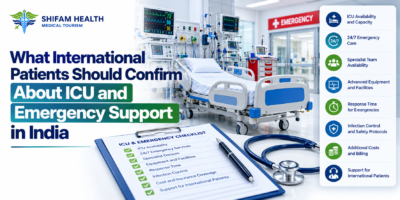
What International Patients Should Confirm About ICU and Emergency Support in India
Filters & Insights
Written By :
Medically Reviewed By :

Shifam Health Medical Team
Shifam Health - Medical Reviews Department
10+ Years Of Experience
Learn what international patients confirm about ICU facilities, emergency response, specialist availability, ambulance & hospital costs.
📅
Last updated: October 31, 2026

Choosing a hospital in India involves more than comparing treatment costs, doctors’ qualifications, or the technology available. For international patients, it is equally important to understand how the hospital would respond if a medical condition suddenly worsened before, during, or after treatment.
Intensive care unit (ICU) facilities and emergency services can be particularly important for patients undergoing major surgery, cancer treatment, cardiac procedures, organ transplantation, or other complex medical interventions. However, not every patient needs intensive care, and the level of support required depends on their diagnosis, general condition, and proposed treatment.
Before making travel arrangements, ask the hospital specific questions about its ICU facilities, emergency response arrangements, specialist availability, ambulance services, and potential additional costs.
This guide explains how to assess these services and what international patients should confirm before travelling to India for treatment.
Table of Contents
ToggleWhy ICU and Emergency Support Matter When Choosing a Hospital
An ICU provides close monitoring and specialised treatment for patients who are critically ill or need intensive support following a serious procedure. Depending on the hospital and its clinical services, this may include patients with severe cardiac conditions, breathing difficulties, major infections, complications after surgery, or other life-threatening problems.
Emergency departments assess and manage urgent medical conditions. They also determine whether a patient needs admission, specialist intervention, intensive care, transfer, or another appropriate level of treatment.
For an international patient, understanding these arrangements beforehand can help with planning, communication, budgeting, and travel decisions.
ICU and emergency services are not the same
Although they work closely together, these services have different roles.
- Emergency department: Assesses patients with urgent or potentially life-threatening symptoms and initiates appropriate emergency care.
- Intensive care unit: Provides close monitoring and advanced support for critically ill patients.
- High-dependency unit (HDU): Provides a higher level of observation and support than a standard ward, where available and clinically appropriate.
- Specialist services: Departments such as cardiology, cardiac surgery, neurology, neurosurgery, oncology, and respiratory medicine may be needed depending on the emergency.
A hospital may have an ICU but still require clarification about the specific services available for a patient’s condition. For example, a patient with a complex cardiac problem should ask about access to the relevant cardiac specialists and facilities rather than assuming that a general ICU covers every requirement.
The goal is not simply to find a hospital that advertises an ICU. It is to confirm whether the hospital can provide the level and type of care that the treating specialist considers necessary.
Step-by-Step Process to Check ICU and Emergency Support
Step 1: Ask whether the hospital manages your type of medical condition
Start with the proposed treatment and the patient’s current medical status.
A hospital suitable for a routine procedure may not necessarily be the most appropriate choice for a patient who has several serious medical conditions or a high risk of complications.
Ask the hospital:
- Does the hospital routinely manage patients with this diagnosis or clinical complexity?
- Is the relevant specialty available at this location?
- Is a specialist from the required department available around the clock when clinically necessary?
- Does the treating doctor anticipate that ICU care may be needed after the planned procedure?
- If complications occur, what level of care could be required?
The hospital should assess the patient’s medical records before giving case-specific guidance. Its response should reflect the diagnosis, proposed treatment, existing illnesses, medications, and current test results.
For guidance on comparing medical facilities, read How to Compare Hospitals Beyond the Headline Treatment Price.
Step 2: Confirm the relevant ICU facilities
Ask the hospital to clarify which critical-care facilities are available and relevant to the proposed treatment.
Depending on the patient’s needs, this may include:
- General medical and surgical ICU.
- Cardiac or cardiothoracic intensive care.
- Neurological or neurosurgical critical care.
- Paediatric intensive care, if the patient is a child.
- Respiratory support and mechanical ventilation.
- Continuous monitoring and access to emergency investigations.
- Renal support, such as dialysis, when clinically indicated and available.
Not every hospital offers every type of specialised ICU. Availability can also depend on the particular facility, clinical indication, staffing, and current capacity.
Ask whether the required service is available at the hospital where treatment will actually take place. If the hospital has multiple branches, confirm the exact location rather than relying on the capabilities of the hospital group as a whole.
Questions to ask:
- Does this hospital have the ICU facilities relevant to my condition?
- Is the required specialist critical-care team available at this location?
- Can ICU admission be arranged if the treating team considers it necessary?
- What happens if the relevant ICU is at capacity?
- Would the patient need to be transferred to another facility if a particular service is unavailable?
A hospital should not promise an ICU bed in advance unless it can clearly explain what has been reserved and under what conditions. ICU admission and bed availability may change with clinical demand.
Step 3: Understand how emergency response works
Before travelling, ask how the hospital manages a sudden deterioration in a patient’s condition.
The emergency department should have an established process for assessing urgent cases, prioritising care, and coordinating with relevant clinical teams. The National Accreditation Board for Hospitals & Healthcare Providers (NABH) has a dedicated certification programme for hospital emergency departments that addresses emergency-care processes and patient safety.
You can review the NABH Emergency Department Certification Programme to understand the purpose of this framework.
Ask the hospital:
- Is emergency care available at the proposed treatment location?
- Is the emergency department operational 24 hours a day?
- How are critically ill patients prioritised?
- How does the emergency team contact the relevant specialist?
- Are emergency investigations available on-site, or could some require referral elsewhere?
- What is the process for transferring a patient from the emergency department to the ICU or operating theatre when indicated?
Avoid relying only on statements such as “advanced emergency services available.” Ask for practical details relevant to the planned treatment.
Step 4: Confirm specialist and anaesthesia support
For major procedures, emergency and ICU facilities are only part of the picture. The availability of appropriately qualified clinicians is also important.
Depending on the procedure, the treating team may need input from an intensivist, anaesthesiologist, cardiologist, cardiac surgeon, neurologist, neurosurgeon, or another specialist.
Confirm:
- Who will lead the patient’s treatment?
- Who will provide anaesthesia, if required?
- Which team will supervise postoperative care?
- Who will assess the patient if a complication arises outside normal consultation hours?
- How are urgent decisions communicated to the treating consultant?
- If the primary consultant is unavailable, what is the hospital’s coverage arrangement?
For a planned operation, ask whether the treating team expects postoperative ICU monitoring and whether that expectation is reflected in the written treatment plan.
To check a doctor’s professional credentials, consult the relevant official records and read How to Verify a Doctor’s Qualifications Before Medical Travel.
Step 5: Check access to emergency diagnostics and blood services
An emergency may require investigations or support beyond a consultation and physical examination. Depending on the clinical situation, the treating team may need laboratory tests, imaging, blood products, or urgent procedural intervention.
Ask whether the hospital has access to the facilities relevant to the patient’s condition, such as:
- Laboratory testing and urgent blood investigations.
- CT, MRI, ultrasound, or other relevant imaging.
- Blood bank and transfusion services, where indicated.
- Operating theatres and emergency surgical services.
- Cardiac catheterisation or other specialised intervention facilities, when relevant.
- Dialysis and respiratory support, if required.
- Infection prevention and isolation arrangements where clinically appropriate.
The availability of a service does not mean that every test or procedure is immediately available in every situation. Confirm which services are on-site, which are available through another department, and which would require transfer.
Patients who have imaging records should also organise their existing reports and scans before travelling. The guide How to Share Large MRI and CT Files with an Indian Hospital explains how to prepare and send these files for review.
Step 6: Ask about ambulance and inter-hospital transfer arrangements
Some patients arrive in India with complex conditions, mobility limitations, or a need for medical assistance during transportation. Others may require an ambulance transfer between an airport, accommodation, hospital, or another medical facility.
Ask the hospital or relevant transport provider:
- Is an ambulance service available when medically required?
- Is the service operated by the hospital or an external provider?
- Can the ambulance provide the level of support required for the patient’s condition?
- Is trained medical personnel support available if needed?
- What equipment and monitoring are provided?
- How is an inter-hospital transfer arranged if a specialised service is unavailable?
- Who is responsible for coordinating the receiving facility?
Do not assume that every ambulance offers the same clinical support. A patient who needs continuous monitoring or advanced life support may require a different transport arrangement from a stable patient travelling for a routine appointment.
The treating doctor should advise on the appropriate transport method. Patients who may be medically unstable should not make independent travel arrangements without clinical guidance.
Step 7: Confirm ICU charges and emergency-related expenses
The advertised treatment package may not cover every service that becomes necessary during a hospital stay. ICU care, prolonged admission, additional investigations, emergency procedures, blood products, and ambulance transfers can affect the total cost.
Before accepting a quotation, ask the hospital to clarify:
- The daily ICU or HDU charge, if applicable.
- Whether the room, nursing, monitoring, and routine ICU services are included.
- Whether ventilator support or other advanced interventions are billed separately.
- Whether specialist visits and emergency consultations are included.
- Whether investigations, medicines, blood products, and procedures are included.
- What happens financially if the hospital stay is longer than expected.
- Whether the quotation includes an allowance for postoperative ICU care.
- How additional expenses are communicated to the patient or family.
Ask for a written estimate that distinguishes between included services, exclusions, and costs that cannot be predicted before treatment.
No hospital can accurately guarantee the final cost of every possible emergency in advance. The purpose of this discussion is to understand the billing structure and reduce avoidable surprises.
For a broader checklist, read Questions to Ask Before Accepting a Medical Treatment Package in India.
Documents and Questions to Prepare Before Contacting the Hospital
International patients can make the hospital’s initial review more useful by sending complete, organised medical information.
Medical documents to prepare
Gather the records relevant to the patient’s condition, including:
- Recent specialist consultation notes.
- Current diagnosis and proposed treatment, if already established.
- Relevant blood tests and other laboratory results.
- Imaging reports and the original images where available.
- ECG, echocardiography, angiography, biopsy, or pathology reports, where applicable.
- Previous operation notes and discharge summaries.
- Current medication list, including dosages.
- Known allergies and previous adverse reactions.
- Existing medical conditions that may affect anaesthesia, surgery, or recovery.
- Details of any recent hospital admission or emergency episode.
If the patient has a complex medical history, send the most relevant records rather than relying on a brief description of the diagnosis. Clearly label documents with the patient’s name, date, and type of investigation, and ensure that the files are readable.
For patients seeking an additional opinion, How International Patients Can Organise Pathology Slides for Review in India provides further preparation guidance where pathology review is relevant.
Questions to send in writing
Use the following checklist when communicating with the hospital or its international patient department.
| Topic | Question to ask |
|---|---|
| Clinical suitability | Can the treating team review the records and advise whether the hospital is appropriate for this case? |
| ICU capability | Does the hospital have the type of critical-care support relevant to the patient’s condition? |
| Emergency response | What emergency services are available at the treatment location, and how are urgent specialist reviews arranged? |
| Specialist coverage | Which clinical team would manage complications or deterioration? |
| Bed availability | Can ICU availability be confirmed closer to admission, and what happens if a bed is unavailable? |
| Diagnostic support | Which urgent investigations and procedures are available on-site? |
| Ambulance | What type of transport is appropriate, and what medical support can it provide? |
| Cost | Which ICU, emergency, and additional services are included in the estimate? |
| Communication | Who will update the patient or family if the treatment plan changes? |
| Transfer | What arrangements are available if care beyond the hospital’s capabilities becomes necessary? |
Keep the written responses with the treatment estimate and consultation notes. If a response is unclear, ask for clarification before paying a deposit or confirming travel.
How to Verify Hospital Accreditation and Quality Information
Hospital accreditation can help patients assess whether a healthcare organisation has undergone an external evaluation against defined standards. It should be considered alongside clinical suitability, specialist expertise, facilities, and the needs of the individual patient.
In India, the National Accreditation Board for Hospitals & Healthcare Providers offers hospital accreditation and a separate certification programme for emergency departments. These programmes have different scopes, so patients should check what status a particular facility holds rather than assuming that all its departments have separate certification.
You can use the following official resources:
- NABH Hospital Accreditation Programme — explains the broader hospital accreditation framework.
- NABH Emergency Department Certification Programme — provides information about the dedicated emergency department programme.
- NABH Healthcare Organisation Search — a starting point for checking hospital accreditation information.
When reviewing a hospital’s status, confirm the exact facility name, address, scope, and validity period where the information is available. A hospital group’s accreditation or a certificate held by one branch should not automatically be assumed to apply to another branch.
Accreditation is useful evidence of a quality framework, but it does not guarantee a particular treatment outcome, immediate ICU bed availability, or the availability of every specialist service at all times.
For more guidance, read How to Check Hospital Accreditation and Quality Information in India.
Common Mistakes International Patients Should Avoid
Mistake 1: Assuming every large hospital has every type of ICU
Hospitals differ in their clinical departments and critical-care capabilities. Confirm the facilities relevant to the diagnosis at the exact location where treatment is planned.
Mistake 2: Treating an ICU advertisement as confirmation of availability
A hospital may operate an ICU without having an appropriate bed available on the intended admission date. Ask how availability is checked and whether any reservation is possible for the planned admission.
Mistake 3: Ignoring the emergency plan because treatment is scheduled
Even when a procedure is planned, patients should understand how the hospital manages unexpected complications. This is especially relevant for people with significant existing illnesses or complex treatment needs.
Mistake 4: Comparing hospitals only by their ICU price
A low daily rate does not tell you whether the required specialist, monitoring, equipment, or support services are available. Compare the expected clinical needs and what each quotation actually includes.
Mistake 5: Assuming an ambulance is suitable for every patient
Transport requirements vary. A stable patient travelling to a scheduled appointment may need ordinary transport, while an unstable patient may require medically supervised transfer. Follow the treating team’s advice.
Mistake 6: Sending incomplete medical records
Missing medication details, outdated test results, or absent operation notes can make an initial review less useful. Send the most relevant available records and ask whether anything else is required.
Mistake 7: Not clarifying who will communicate with the family
For patients travelling internationally, communication is an important practical consideration. Ask who will provide updates, how urgent decisions will be explained, and what arrangements apply if the patient cannot communicate independently.
Mistake 8: Assuming a medical facilitator replaces the hospital’s clinical team
A medical travel facilitator can help organise records, communicate with hospital departments, and coordinate travel-related arrangements. Clinical decisions about emergency care, ICU admission, treatment, and medical fitness must remain with qualified healthcare professionals.
When Should You Contact the Hospital or a Specialist?
Contact the hospital’s international patient department or treating specialist before travel if:
- The patient has several existing medical conditions.
- The proposed treatment is major surgery or another complex intervention.
- The patient has recently required emergency care or hospital admission.
- The specialist has mentioned a possible need for ICU care.
- The patient requires oxygen, dialysis, mobility assistance, or other specialised support.
- The patient may need medically supervised transport.
- The planned treatment depends on a specialised ICU or emergency intervention facility.
- The quotation does not explain the potential cost of prolonged admission or critical care.
Send the available reports and request a case-specific review. Ask the hospital to explain any additional assessment or preparation required before travel.
What if the patient develops symptoms before travelling?
Do not delay urgent care while waiting for an international consultation or travel arrangements. Severe breathlessness, chest pain, loss of consciousness, signs of stroke, or another potentially life-threatening symptom requires immediate assessment by local emergency services.
The priority is stabilisation and appropriate local medical care. Travel to India should be considered only after qualified clinicians assess whether the patient is fit to travel and determine the necessary transport and medical support.
FAQs
How can I check whether a hospital in India has an ICU?
Check the hospital’s official website and contact its team to confirm ICU availability, capabilities and suitability for the patient’s condition.
Does every patient undergoing surgery need ICU admission?
No. ICU care depends on the procedure, the patient’s health and the treating team’s assessment.
Can international patients reserve an ICU bed before travelling?
Ask the hospital about advance arrangements. A reservation may not guarantee availability because ICU admission depends on clinical needs and bed capacity.
What happens if a patient’s condition worsens during treatment?
The hospital team may arrange emergency assessment, specialist care, ICU admission or transfer, depending on the patient’s needs and available facilities.
Are ICU charges included in treatment packages?
Not always. Confirm whether ICU care, medicines, respiratory support, investigations and extended stays are included or charged separately.
Is NABH accreditation enough to confirm hospital suitability?
No. Accreditation is one consideration. Verify the hospital’s specific ICU capabilities, emergency services and relevant specialist expertise.
Can Shifam Health help confirm ICU and emergency arrangements before travel?
Shifam Health can coordinate communication with hospitals and help clarify treatment-related arrangements. The hospital’s clinical team must confirm ICU availability, medical suitability and emergency-care capabilities.
Plan Your Medical Travel to India With Clear Information
Selecting a hospital involves looking beyond the treatment price and confirming whether the facility can address the patient’s clinical needs. ICU capability, emergency response, specialist coverage, diagnostic services, ambulance arrangements, and transparent cost information are all important considerations when planning complex treatment.
Before travelling, prepare the patient’s medical records, request a written treatment plan, clarify the relevant emergency arrangements, and confirm which services are available at the intended hospital location.
Shifam Health supports international patients with medical record coordination, hospital communication, consultation arrangements, and travel-related planning. Our team can help you prepare questions and organise the information needed for a more informed discussion with the hospital.
Request a Free Consultation With Shifam Health to discuss your medical travel requirements and the next steps for contacting a suitable hospital.



Popular Posts From Last Week
- October 31, 2026
- shifamhealth
A practical guide for international patients planning treatment in India. Learn how to confirm ICU facilities, emergency response,…
- October 27, 2026
- Razi Khan
Imagine you have decided to seek a specialist’s opinion from another country. You have laboratory reports, prescriptions, scan…
- October 27, 2026
- Razi Khan
Receiving a medical treatment package from a hospital can feel like a major step forward. You have a…
- October 26, 2026
- Razi Khan
Learn how to send large MRI and CT files to an Indian hospital for specialist review. This guide…
- October 28, 2026
- shifamhealth
Learn how to organise pathology slides for review in India, from requesting materials from the original laboratory to…
- October 28, 2026
- shifamhealth
Preparing for a virtual consultation with an Indian specialist? Learn what happens before, during and after the appointment,…
- October 30, 2026
- Razi Khan
Learn how international patients can compare hospitals in India beyond the headline treatment price. Discover how to assess…
- October 28, 2026
- Areen Fatima
Learn how to prepare for a video consultation about treatment in India. Discover which medical reports to organise,…
- October 29, 2026
- shifamhealth
Learn how international patients can request a written treatment plan before travelling to India. Discover which medical details…
- October 29, 2026
- shifamhealth
Learn how to compare two medical treatment recommendations before travelling to India. Understand how to assess clinical reasoning,…
- October 29, 2026
- shifamhealth
Learn what to do when your diagnosis is unclear and how an Indian specialist review may help. Discover…
- October 30, 2026
- shifamhealth
Learn how international patients can verify a doctor’s qualifications before travelling to India. Discover how to check medical…