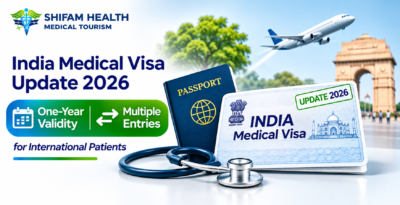




India has introduced important changes to its visa framework that are relevant to international patients travelling for medical treatment. The revised provisions provide for one-year default validity with multiple entries for Medical Visas covering conventional and AYUSH treatment. Corresponding visa categories are also available for medical attendants.
The government has also announced a 65–70% reduction in the number of fields in visa application forms, as part of a wider effort to simplify the process for foreign nationals visiting India.
For patients travelling for cancer treatment, organ transplantation, cardiac procedures, orthopaedic surgery or other specialist care, these changes may make it easier to plan consultations, staged procedures and follow-up visits.
However, patients should understand which visa category applies to their treatment, when the revised framework is being implemented and what conditions they must follow before booking their journey.
This guide explains India’s Medical Visa updates for 2026, the M-1, M-2, M-3 and M-4 categories, the Visitor Visa provisions and the practical steps international patients should take before travelling.
What Has Changed in India’s Medical Visa Rules in 2026?
The Ministry of Home Affairs announced a rationalisation of India’s visa regime on 11 November 2026. The broader changes aim to make the visa system simpler and easier to navigate for foreign nationals visiting India for healthcare, tourism, education, business and other purposes.
The announcement includes several changes relevant to international patients:
- One-year default validity: M-1 and M-3 Medical Visas, including their e-Visa variants, are to be granted with one-year validity as the default option.
- Multiple entries: The revised Medical Visa provisions allow multiple entries, which may help patients who need to return to India during their treatment journey.
- Medical attendant categories: M-2 and M-4 categories correspond to the conventional and AYUSH Medical Visa routes.
- Simplified application forms: The number of fields in visa application forms across the 23 visa sub-categories has been reduced by approximately 65–70%.
- Updated visa system: The Ministry of Home Affairs is updating its IT systems, with visas under the new rationalised framework expected to be issued by the end of 2026.
It is important to distinguish between the one-year e-Medical validity update communicated earlier in 2026 and the wider rationalisation announced in November. The Ministry of Home Affairs communication dated 31 July 2026 had already addressed the increase in e-Medical and e-Ayush visa validity to one year with multiple entries. The November announcement places these provisions within the wider revised visa framework.
Patients should check the latest instructions on the official Indian Visa Online portal before applying.
India’s New Medical Visa Categories Explained
The revised framework retains separate Medical Visa categories for conventional medical treatment and treatment under AYUSH systems.

The categories are:
| Visa category | Purpose |
|---|---|
| M-1 Medical Visa | Medical treatment other than treatment under AYUSH systems |
| M-2 Medical Attendant Visa | Attendants accompanying M-1 visa holders |
| M-3 Medical Visa | Treatment under AYUSH systems |
| M-4 Medical Attendant Visa | Attendants accompanying M-3 visa holders |
The corresponding e-Visa variants are also covered by the revised provisions.
M-1 Medical Visa for Conventional Treatment
The M-1 category is intended for foreign nationals travelling to India for medical treatment other than treatment under AYUSH systems.
This may be relevant to patients seeking assessment or treatment for conditions such as cancer, heart disease, kidney disorders, liver disease, neurological conditions and orthopaedic problems.
Patients should have relevant medical documentation and follow the requirements applicable to their nationality and application route.
M-2 Medical Attendant Visa
The M-2 category is intended for eligible attendants accompanying patients who hold an M-1 Medical Visa.
An attendant may be a family member or another eligible accompanying person, subject to the applicable visa requirements.
M-3 Medical Visa for AYUSH Treatment
The M-3 category covers foreign nationals travelling to India for treatment under AYUSH systems.
AYUSH refers to Ayurveda, Yoga and Naturopathy, Unani, Siddha and Homoeopathy. Applicants should ensure that their intended treatment and institution meet the requirements for the relevant visa category.
M-4 Medical Attendant Visa
The M-4 category is intended for eligible attendants accompanying M-3 visa holders.
Patients and attendants should confirm their respective application requirements rather than assuming that approval of the patient’s visa automatically grants permission to the accompanying person.
What Does One-Year Medical Visa Validity Mean for Patients?
One of the most important features of the revised framework is the default one-year validity with multiple entries for M-1 and M-3 Medical Visas.
This can be useful because medical treatment does not always take place during a single hospital visit. Some patients need several consultations, additional investigations, staged procedures or follow-up appointments.
For example, a patient travelling to India for cancer treatment may first attend a specialist consultation and undergo further investigations. The treatment team may then recommend a treatment schedule involving multiple visits or sessions.
Similarly, a patient being assessed for an organ transplant may need medical evaluation, further investigations and subsequent follow-up.
A multiple-entry visa may make these return visits more convenient during the visa’s validity, subject to its conditions.

However, one-year visa validity does not mean that every patient is automatically guaranteed a visa or permission to remain in India continuously for one year. Validity, permitted duration of stay and other conditions are separate matters. Patients must follow the conditions stated on their issued visa and applicable immigration rules.
Medical Attendant Visas for Family Members and Companions
Travelling abroad for medical treatment can be challenging, particularly for patients who need help with daily activities, communication or hospital arrangements.
The corresponding M-2 and M-4 categories provide designated visa routes for eligible attendants accompanying patients under the M-1 and M-3 categories.
Before applying, patients and attendants should confirm:
- Whether the proposed attendant meets the applicable eligibility requirements.
- Which attendant category corresponds to the patient’s Medical Visa.
- What passport and supporting documents are required.
- Whether separate applications are needed.
- Whether the attendant’s visa validity and stay conditions match the patient’s travel arrangements.
The attendant should not assume that the patient’s visa approval automatically covers their own travel.
Medical Visa Application Forms Have Been Simplified
The Ministry of Home Affairs has also announced a reduction of approximately 65–70% in the number of fields or columns in visa application forms across the 23 visa sub-categories.
The objective is to reduce the information applicants need to enter while retaining essential details required for visa processing.
For international patients, this may make the application process easier to complete. However, a shorter form does not remove the need to provide accurate information or supporting documents.
Depending on nationality, visa category and application route, patients may need to prepare:
- A valid passport.
- A recent photograph meeting the application specifications.
- Medical reports and relevant investigation results.
- Hospital appointment confirmation or medical invitation documentation, where required.
- Details of the proposed treatment.
- Information about the accompanying attendant, if applicable.
- Any additional documents requested by the relevant Indian Mission or visa authorities.
The exact checklist can vary. Applicants should follow the current official instructions rather than relying only on a general list.
Is the Visitor Visa Also Relevant for Medical Travel?
Yes. The revised framework has renamed the former Tourist Visa category as the Visitor Visa and introduced two sub-categories, V-1 and V-2.

The V-1 category covers certain short-term activities, including:
- Medical consultations.
- Wellness retreats.
- Short-duration medical treatment.
- Business meetings.
- Specified short courses and cultural activities.
The V-1 visa is provided for 30 days with multiple entries under the announced framework.
The V-2 category is intended for longer visits and may be granted with validity of one, five or ten years, as specified, subject to the applicable requirements.
Important distinction: A short medical consultation or short-duration treatment may fall under the Visitor Visa provisions. Patients travelling for intensive or indoor medical treatment should check the Medical Visa route and its requirements. The appropriate category depends on the actual purpose of travel, not simply on which visa offers a longer validity period.
Applicants should confirm the correct category with the official visa authorities before submitting their applications.
How Could the New Medical Visa Rules Help International Patients?
The changes may make medical travel planning more flexible for eligible patients, particularly those whose treatment requires more than one visit to India.
Greater flexibility for staged treatment
Some treatment plans involve several stages, such as initial assessment, investigations, surgery, additional treatment and follow-up. Multiple-entry validity may make repeat travel more convenient.
Easier planning for follow-up consultations
Patients may need to return to India for specialist reviews, monitoring or additional procedures. A multiple-entry visa can help reduce the need to make a fresh visa application for every visit during its validity, subject to the applicable conditions.
A designated visa route for attendants
The M-2 and M-4 categories provide corresponding routes for eligible attendants accompanying patients under the M-1 and M-3 categories.
Simpler application forms
The announced reduction in form fields may reduce the effort involved in completing an application. Applicants must still provide accurate details and any supporting information requested by the authorities.
Better coordination of medical travel arrangements
More predictable visa arrangements can help patients, hospitals and medical travel coordinators plan appointments, accommodation and travel schedules. However, visa approval and medical treatment decisions remain with the respective authorities and healthcare providers.
When Will the Revised Medical Visa Framework Be Implemented?
The Ministry of Home Affairs has stated that its IT systems are being updated to implement the rationalised visa framework.
According to the announcement dated 11 November 2026, visas under the new system are expected to be issued by the end of 2026.
This implementation timeline is important for applicants. Some provisions, including the earlier e-Medical and e-Ayush validity update, were communicated before the November announcement. Other changes form part of the wider system rationalisation.
Therefore, patients should not assume that every revised application feature is already available in every application channel.
Before applying, check:
- The current visa category and application form.
- Whether the revised provisions are active for the intended application route.
- The current validity and entry conditions.
- The latest document checklist.
- Instructions from the relevant Indian Embassy, High Commission or Consulate.
For the latest information, refer to the official Indian e-Visa portal.
Documents International Patients Should Prepare Before Applying
Although exact requirements vary according to nationality and visa category, organising documents in advance can make the application process easier.

| Document or information | What to check |
|---|---|
| Passport | Validity and correct personal details |
| Photograph | Compliance with current application specifications |
| Medical reports | Relevant test results, scans and previous treatment details |
| Hospital documentation | Appointment confirmation or invitation letter, where required |
| Treatment information | Purpose of travel and proposed medical assessment or treatment |
| Attendant details | Passport and supporting information for the accompanying person |
| Travel details | Proposed travel arrangements, if requested |
| Application information | Correct visa category and consistent personal details |
Patients should also keep digital and printed copies of important medical documents and hospital correspondence.
For a more detailed explanation of the application process, read Shifam Health’s guide on how to apply for an Indian Medical Visa online.
Patients travelling with a companion can also review the Indian Medical Attendant Visa requirements before beginning the application.
What Should Patients Confirm Before Booking Flights to India?
Visa arrangements are only one part of planning a medical trip. Patients should also confirm their hospital appointments and understand the expected treatment schedule.
Before booking flights, consider the following:
- Share available medical reports with the hospital for an initial review.
- Confirm the specialist consultation or hospital appointment.
- Request a written treatment plan or preliminary estimate, where available.
- Check the appropriate visa category and current visa conditions.
- Confirm the application requirements for accompanying attendants.
- Discuss the likely duration of stay with the hospital.
- Arrange accommodation according to the expected hospital schedule.
- Check whether follow-up visits may be required before planning the return journey.
Patients should avoid making non-refundable travel arrangements until the relevant visa and hospital arrangements have been confirmed.
Shifam Health has also published a practical guide on what to confirm before booking flights for medical treatment.
For patients who may need additional consultations or treatment stages, the guide on planning flexible travel dates around medical appointments may also be useful.
Planning Accommodation and Travel During Medical Treatment
Patients travelling for medical treatment may need to remain in India for longer than an ordinary tourist visit. The length of stay depends on the diagnosis, treatment plan, recovery and the treating doctor’s advice.
Before travelling, patients and companions should consider:
- Distance between accommodation and the hospital.
- Availability of suitable accommodation for the expected duration.
- Transport arrangements for hospital visits.
- Accessibility requirements for patients with limited mobility.
- Whether a family member or attendant will stay with the patient.
- Arrangements if the hospital schedule changes.
Patients can read Shifam Health’s guide to affordable accommodation for medical tourists in India for more information about planning their stay.
Those who need a longer stay than originally expected should also review the Indian Medical Visa extension process. An extension is not automatic and remains subject to the applicable rules and approval by the authorities.
How Shifam Health Helps International Patients Plan Treatment in India
Understanding visa rules is important, but patients also need to coordinate hospital communication, medical records, appointments and travel arrangements.
Shifam Health helps international patients with practical coordination when exploring treatment options in India.
Depending on the patient’s requirements, support may include:
- Organising medical records for review by relevant hospitals.
- Coordinating specialist consultations and hospital communication.
- Requesting written treatment plans and cost estimates.
- Providing general guidance on the medical visa application process.
- Coordinating hospital invitation documentation, where applicable.
- Helping arrange accommodation and airport pickup.
- Coordinating interpreter support where available.
- Communicating appointment and travel-related updates.
Shifam Health does not issue visas or determine visa eligibility. Visa decisions are made by the relevant Indian authorities. Diagnosis, treatment recommendations and clinical decisions remain the responsibility of the treating doctors and hospitals.
International patients who would like assistance with hospital coordination can contact Shifam Health to discuss sharing their medical records and exploring the next steps.
Frequently Asked Questions
Is India’s Medical Visa valid for one year in 2026?
The revised framework provides one-year default validity with multiple entries for M-1 and M-3 Medical Visas, including their e-Visa variants. Applicants should confirm the current implementation and individual visa conditions.
What are the M-1 and M-3 Medical Visa categories?
M-1 covers medical treatment other than AYUSH treatment. M-3 covers treatment under AYUSH systems.
Can a family member accompany a patient?
Eligible attendants can apply under M-2 for M-1 patients and M-4 for M-3 patients. The attendant must meet the applicable requirements and obtain the required approval.
Does a one-year visa allow a patient to stay in India continuously for one year?
Not necessarily. Visa validity and permitted duration of stay are different matters. Patients must follow the conditions specified on their issued visa.
Does the new policy cover e-Medical Visas?
Yes. The revised framework specifically includes the e-Visa variants of M-1 and M-3. Applicants should check the official portal for the current application process and conditions.
Can a patient use a Visitor Visa for medical treatment?
The V-1 Visitor Visa covers certain short-term activities, including medical consultations and short-duration medical treatment. Patients travelling for intensive or indoor medical treatment should check the Medical Visa requirements.
When will the revised visa system be fully implemented?
The Ministry of Home Affairs has stated that the IT systems are being updated and that visas under the new rationalised framework are expected to be issued by the end of 2026.
Where can international patients check the official visa requirements?
Applicants should consult the Indian Visa Online portal and the relevant Indian Embassy, High Commission or Consulate for current instructions.
Conclusion
India’s 2026 Medical Visa updates are an important development for international patients considering treatment in the country. The one-year default validity and multiple-entry provisions for conventional and AYUSH Medical Visas may make it easier for eligible patients to plan repeat consultations, staged procedures and follow-up visits.
The corresponding M-2 and M-4 categories also provide designated visa routes for eligible attendants accompanying patients. In addition, the reduction in application form fields is intended to make the process simpler for foreign nationals.
However, patients should not confuse visa validity with permission to remain in India continuously for one year. The correct category, permitted stay, documentation and other conditions depend on the individual visa and the applicable immigration rules. The wider rationalised system is also being implemented through updates to the government’s IT systems, so applicants should check the latest official instructions before applying.
For patients planning medical travel, visa preparation should go hand in hand with hospital coordination. Medical records should be reviewed, appointments confirmed, treatment estimates requested and accommodation and travel arrangements planned around the expected treatment schedule.
Shifam Health can help international patients coordinate these practical steps when exploring medical treatment in India. Patients and families can begin by sharing their available medical records and discussing the hospital review and travel arrangements they may need.
Official policy reference: Ministry of Home Affairs, Government of India, Rationalisation of India’s Visa Regime, announced on 11 November 2026. Applicants should always refer to the official Indian Visa Online portal and the relevant Indian Mission for the latest requirements.