


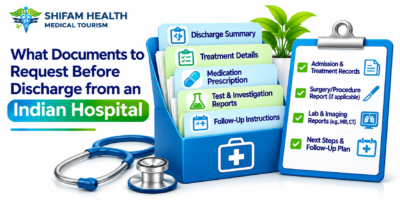
What Documents to Request Before Discharge from an Indian Hospital
Filters & Insights
Written By :
Medically Reviewed By :

Shifam Health Medical Team
Shifam Health - Medical Reviews Department
10+ Years Of Experience
Know which hospital discharge documents to collect in India, from medical reports to prescriptions and follow-up instructions.
📅
Last updated: November 13, 2026

When you are preparing to leave an Indian hospital after treatment, it is natural to focus on travelling home, arranging transport and getting back to your family. However, there is one important task you should complete before discharge: collecting all your medical records.
For international patients, hospital discharge documents are more than paperwork. They help your local doctor understand what treatment you received in India, which medicines you need to continue, what restrictions you should follow and whether further investigations or specialist reviews are required.
Imagine returning home after surgery and discovering that your local doctor needs the operation notes, but you only have a short discharge summary. Or perhaps you need to continue medication, but the prescription does not clearly explain the duration. These situations can create unnecessary delays and confusion.
That is why it is important to request the right documents before leaving the hospital.
This guide explains which hospital discharge documents international patients should collect in India, how to request them, what details to verify and how to organise the records for continued treatment at home.
Table of Contents
ToggleWho should use this guide?
This guide is intended for international patients and caregivers who are preparing to leave an Indian hospital after:
- Major or minor surgery.
- Cancer treatment or diagnostic procedures.
- Heart surgery or cardiac interventions.
- Joint replacement and orthopaedic procedures.
- Kidney, liver or other organ transplantation.
- Neurological or spine treatment.
- IVF and fertility-related procedures.
- Long-term medical evaluation or specialist treatment.
Even if your hospital stay is short, you should request the records relevant to your diagnosis and treatment.
The exact documents will depend on the procedure, the hospital’s documentation process and the patient’s clinical requirements. Not every patient needs every record mentioned in this guide.
Essential documents to request before hospital discharge
1. Final discharge summary
The discharge summary is one of the most important documents you should collect.
It provides an overview of the patient’s hospital admission, diagnosis, treatment and condition at discharge. Your local doctor may use it as the starting point for understanding the treatment received in India.
Check that it includes:
- Patient’s full name and hospital identification details.
- Admission and discharge dates.
- Primary diagnosis and relevant secondary diagnoses.
- Important medical history.
- Procedures or surgeries performed.
- Major investigations and findings.
- Treatment provided during admission.
- Condition at the time of discharge.
- Medication instructions.
- Follow-up recommendations.
Check the spelling of your name and other personal details before leaving. If you notice an error, ask the hospital’s medical records or discharge department how it can be corrected.
You should also ask for clarification if the diagnosis or procedure is described using medical terminology you do not understand.
2. Operation notes or procedure report
If the patient underwent surgery or another invasive procedure, request the operation notes or relevant procedure report, subject to the hospital’s record-release process.
This document provides more specific information about what was performed.
It may include:
- Name and date of the procedure.
- Treating surgeon and relevant clinical team.
- Preoperative and postoperative diagnosis.
- Procedure performed.
- Important operative findings.
- Devices or implants used, where applicable.
- Any complications documented.
- Relevant postoperative instructions.
For example, a patient who underwent joint replacement may need implant information for future orthopaedic reviews. A patient who underwent cardiac surgery may need the operative details for subsequent cardiology or cardiac surgery consultations.
If you are still comparing treatment providers before travelling, read our guide on how to compare hospitals beyond the headline treatment price. Understanding the hospital’s treatment arrangements is an important part of medical travel planning.
3. Final laboratory investigation reports
Ask for copies of relevant laboratory reports completed during the hospital stay.
Depending on the treatment, these may include:
- Complete blood count.
- Kidney function tests.
- Liver function tests.
- Blood glucose results.
- Electrolyte levels.
- Coagulation profile.
- Blood culture reports.
- Other condition-specific investigations.
You may not need every test report for future consultations. Ask the treating doctor which results are important for continued monitoring.
If a test is still pending when the patient is discharged, ask how and when the final report will be shared.
4. Imaging reports and original image files
If the patient underwent imaging during admission, request the corresponding reports and image files where available.
These may include:
- X-ray.
- Ultrasound.
- CT scan.
- MRI.
- PET-CT.
- Echocardiography.
- Angiography.
- Other specialised imaging.
Do not collect only the written report when the original images are available and may be required for future review.
For example, a patient who underwent spine surgery may need previous MRI images for comparison during a later consultation. A cancer patient may need earlier imaging to help the oncology team assess changes over time.
Our guide on how to share large MRI and CT files with an Indian hospital explains how medical imaging can be organised and transferred securely.
5. Histopathology and biopsy reports
For patients who have undergone a biopsy, tumour removal or another procedure involving tissue examination, request the relevant pathology documentation.
Depending on the case, this may include:
- Histopathology report.
- Biopsy report.
- Immunohistochemistry report.
- Molecular or genetic testing reports, where performed.
- Other specialised pathology findings.
In some cases, the treating team may recommend preserving or transferring pathology slides or tissue blocks for further review.
Ask the hospital whether the original material can be released, whether special handling is required and how it should be transported.
If you need additional guidance, read how international patients can organise pathology slides for review in India.
6. Medication prescription and treatment instructions
Before discharge, obtain a clear and updated medication prescription.
The prescription should identify:
- Medicine name.
- Strength and dosage.
- Frequency and timing.
- Route of administration.
- Duration, where specified.
- Special instructions.
- Relevant changes from the patient’s previous medicines.
Ask the doctor or pharmacist to explain which medicines have been started, stopped or modified during admission.
This is particularly important for patients taking blood thinners, cardiac medication, insulin, immunosuppressants or other medicines requiring regular monitoring.
If a prescribed medicine is not available in your home country, discuss the issue with your treating specialist and local doctor. Do not independently replace it with another medicine.
The NHS medicines information service provides general information about medicines, but your own prescription and clinical instructions should come from your healthcare professionals.
7. Implant, device and prosthesis details
Patients who receive an implant or medical device should ask for the relevant product information.
Examples include:
- Knee or hip replacement implants.
- Cardiac pacemakers.
- Artificial heart valves.
- Orthopaedic plates and screws.
- Stents.
- Neurostimulation devices.
- Other implanted medical devices.
Depending on the device and hospital records, request the implant identification card, device details, manufacturer information, model or serial number and relevant procedure documentation.
These details may be useful during future medical consultations, imaging assessments, device checks or emergency treatment.
Ask the treating specialist whether there are any device-specific precautions that you should communicate to healthcare providers in your home country.
8. Anesthesia records, where relevant
For patients who underwent surgery under general, regional or other forms of anaesthesia, ask whether an anaesthesia record or relevant anaesthesia summary can be provided.
This may be useful if the patient has a history of anaesthesia-related complications, allergies or other relevant medical concerns.
The treating team can advise whether a separate record is available and necessary for future care.
9. Blood transfusion and blood product records, where applicable
If the patient received blood or blood products during admission, ask whether relevant transfusion documentation is available.
This may include information about the transfusion, dates and any documented reactions.
Keep these records with the rest of the discharge documents, particularly if future treatment may involve surgery or further transfusions.
10. Physiotherapy and rehabilitation instructions
Patients recovering from orthopaedic, neurological, cardiac or other major procedures may need ongoing rehabilitation.
Request written instructions covering:
- Recommended exercises.
- Movement restrictions.
- Weight-bearing instructions, if relevant.
- Mobility assistance requirements.
- Physiotherapy frequency.
- Activity progression.
- When a rehabilitation review is recommended.
For example, a patient recovering from a joint replacement may need to continue physiotherapy after returning home. A patient recovering from a stroke may need a coordinated rehabilitation programme.
Do not begin exercises or increase activity beyond the level recommended by the treating team.
11. Follow-up appointment and aftercare plan
Before leaving, request a written follow-up schedule.
It should explain:
- When the next appointment is due.
- Whether the review can be conducted online.
- Which investigations are required.
- Whether the patient needs to visit a local specialist.
- Which symptoms require urgent medical attention.
- How to contact the relevant hospital department.
This is particularly important for international patients who may not be able to return to India immediately.
For more guidance, read how to plan follow-up care after returning home from India. You can also review our guide on telemedicine follow-up care in Indian medical tourism.
Step-by-step process for collecting hospital discharge documents
Collecting medical records can become confusing when several departments are involved. A simple process can make it easier.
Step 1: Ask the treating doctor what records you need
Before discharge, ask your doctor which documents are important for your diagnosis and future treatment.
The doctor may recommend additional records depending on the procedure, complications, investigation findings or ongoing treatment requirements.
Step 2: Contact the discharge or medical records department
Ask the hospital’s discharge desk or medical records department about the procedure for obtaining copies.
Some records may be provided during discharge, while others may require a separate request.
Confirm:
- Which documents are available immediately.
- Whether a written request is required.
- Whether identification or authorisation is needed.
- Whether copies are provided digitally or physically.
- Whether any administrative fee applies.
- How long additional records may take.
Step 3: Check the patient’s details
Before accepting the documents, verify:
- Full name.
- Hospital identification number.
- Date of birth, where recorded.
- Admission and discharge dates.
- Treating department.
- Report dates.
Errors in patient identification or dates can create confusion when records are shared with another hospital.
Step 4: Check whether all relevant reports are included
Compare the documents received against the doctor’s recommendations.
If a report is pending, ask when it will be available and how the hospital will share it.
Do not assume that every investigation performed during admission is automatically included in the discharge file.
Step 5: Request digital copies where possible
Digital records are useful for international patients because they can be shared with local doctors and specialists after returning home.
Ask whether the hospital can provide secure PDF copies or another suitable digital format.
For practical guidance, see how to prepare a digital medical file for an overseas specialist.
India’s Ayushman Bharat Digital Mission (ABDM) provides a national framework for digital health infrastructure. However, do not assume that every hospital record will automatically appear in a patient’s digital health account. Confirm directly how your particular hospital provides and shares records.
Step 6: Organise the documents before travelling
Create separate folders for:
- Discharge and clinical summaries.
- Surgery and procedure records.
- Laboratory investigations.
- Imaging reports and image files.
- Prescriptions and medication instructions.
- Pathology reports.
- Implant or device details.
- Follow-up and rehabilitation instructions.
Keep a backup of important digital files in a secure location.
The MedlinePlus guide to personal health records also explains why maintaining organized personal health information can help patients manage their care.
Documents checklist for international patients
Use this checklist before leaving an Indian hospital.
| Document | When It Is Particularly Important |
|---|---|
| Final Discharge Summary | All admitted patients. |
| Operation or Procedure Report | Patients who underwent surgery or procedures. |
| Laboratory Reports | Patients requiring continued monitoring. |
| Imaging Reports and Files | Patients who underwent diagnostic imaging. |
| Biopsy and Pathology Reports | Patients who underwent tissue examination. |
| Medication Prescription | Patients discharged with medicines. |
| Implant or Device Information | Patients who received an implant or device. |
| Anaesthesia Records | Where relevant to future care. |
| Transfusion Records | Patients who received blood products. |
| Physiotherapy Instructions | Patients requiring rehabilitation. |
| Follow-up Schedule | Patients requiring further reviews. |
| Pending Investigation Details | Patients awaiting final reports. |
| Hospital Contact Information | International patients needing clarification. |
Practical tip: Keep the original documents safely and carry accessible copies when attending future consultations. Share medical records only with authorised healthcare professionals.
Questions to ask before leaving the hospital
Before discharge, ask the hospital or treating specialist:
- Have all important reports been completed?
- Which investigation results are still pending?
- Can I receive digital copies of my medical records?
- Do I need the original imaging files?
- Can I obtain the operation notes or procedure report?
- Are implant or device details included in my discharge file?
- Which medicines should I continue after returning home?
- When should I schedule the next appointment?
- Can the next consultation take place online?
- Will my local doctor need any additional documents?
- How can I request missing reports after returning home?
- Who should I contact if I need clarification about the discharge instructions?
If you are still evaluating a hospital before treatment, our articles on how to verify a doctor’s qualifications before medical travel and how to check hospital accreditation and quality information in India can help you understand what information to review before making a decision.
You can also read how to confirm whether a hospital treats your specific condition and what international patients should confirm about ICU and emergency support.
Common mistakes to avoid
Leaving without the final discharge summary
Do not assume that a verbal explanation is enough. Collect the written discharge summary and check that it identifies the diagnosis, treatment and follow-up instructions.
Collecting reports without checking patient details
Always verify the name, dates and hospital identification details. Request corrections if you notice errors.
Forgetting original imaging files
A written imaging report may not replace the original images when a specialist needs to review or compare them.
Not asking about pending reports
Some pathology, culture or specialised investigation results may take additional time. Ask how these will be delivered after discharge.
Keeping prescriptions without understanding them
Make sure you understand the medication name, dosage, timing and duration. Ask the doctor or pharmacist to clarify anything that is unclear.
Assuming digital records are automatically shared
Hospitals may have different systems for releasing medical records. Confirm how you can obtain and share your documents.
Not arranging follow-up care
A discharge summary is only one part of the process. Confirm the next appointment and identify a suitable local healthcare provider before returning home.
When should you contact the hospital or specialist?
Contact the hospital’s medical records department if:
- A document promised during discharge has not been provided.
- You notice an error in your medical records.
- A report is missing.
- You need an additional copy of your discharge summary.
- You require imaging files or procedure documentation.
- You need clarification about the process for sharing records.
Contact the treating specialist if:
- You do not understand the medication instructions.
- You need clarification about activity restrictions.
- You have questions about rehabilitation.
- You need guidance about a pending investigation.
- You require clarification about the next follow-up appointment.
If you experience serious or rapidly worsening symptoms after discharge, seek urgent medical attention locally. Do not wait for routine correspondence or a remote appointment.
How Shifam Health can help international patients
For international patients, collecting documents is sometimes only the first step. They may also need help understanding which hospital department to contact, arranging a follow-up consultation or sharing medical reports with the treating team.
Shifam Health supports international patients with administrative and treatment-related coordination, including:
- Helping patients organise relevant medical records.
- Coordinating communication with hospitals and specialists.
- Assisting with follow-up consultation requests.
- Supporting the sharing of reports for specialist review.
- Helping patients understand the administrative next steps after discharge.
Our role is to support coordination and communication. Medical records, discharge decisions, prescriptions and clinical recommendations remain the responsibility of the treating hospital and qualified healthcare professionals.
If you are planning treatment in India or need assistance coordinating hospital communication, you can contact Shifam Health.
Frequently asked questions
What is the most important document to collect before hospital discharge?
The final discharge summary is essential because it records the diagnosis, treatment, condition at discharge, medication instructions and follow-up recommendations. However, additional reports may be needed depending on the procedure.
Can international patients request digital copies of hospital records in India?
You can ask the hospital whether digital copies are available and what request procedure applies. The format and delivery process may vary between hospitals.
Should I collect the operation notes after surgery?
Where available and relevant, operation notes or procedure reports can help future healthcare professionals understand what was performed. Ask the treating hospital how to obtain them.
Do I need original MRI and CT images?
It is advisable to request the original image files where available, especially if future specialist reviews or comparisons may be needed.
What should I do if a pathology report is pending?
Ask the hospital when the report is expected and how it will be shared. Confirm whether the treating specialist needs to review the result before any further treatment decisions.
Can my local doctor use medical records from an Indian hospital?
Yes. Your local doctor can review the documents as part of your ongoing care. They may request additional information or clarification from the Indian hospital.
Can Shifam Health help me obtain missing documents?
Shifam Health can assist with administrative coordination and communication with the relevant hospital. The hospital’s medical records department remains responsible for issuing official medical documents.
Conclusion
Before leaving an Indian hospital, take time to collect and organise your medical records. A complete discharge file can help your local doctor understand the treatment received, continue medication safely, arrange further investigations and plan appropriate follow-up care.
Start with the final discharge summary, then collect the relevant procedure reports, investigation results, prescriptions, imaging files, pathology records and aftercare instructions. Check the patient’s details, ask about pending reports and keep secure digital copies.
For international patients, these steps can make the transition from hospital care in India to continued treatment at home much more organized.


Popular Posts From Last Week
- November 12, 2026
- Shifam Health
Returning home after medical treatment in India is only one stage of the healthcare journey. International patients may…
- November 13, 2026
- Razi Khan
Before leaving an Indian hospital, international patients should collect the medical records needed for continued care at home….
- November 11, 2026
- Shifam Health
Returning home after treatment abroad does not mean your healthcare journey is over. Prescriptions, discharge summaries, laboratory reports…
- November 11, 2026
- Shifam Health
Returning home after treatment in India often means continuing care with a local doctor. A complete discharge summary…
- November 10, 2026
- Shifam Health
Returning home after treatment in India does not always mean recovery is complete. Many international patients need continued…
- November 10, 2026
- Shifam Health
Returning home after medical treatment in India does not always end the need for specialist communication. International patients…
- November 10, 2026
- Shifam Health
Hospital discharge is an important step, but international patients should understand what to do if a complication develops…
- November 9, 2026
- Shifam Health
Medical travel assistance can include hospital coordination, appointment requests, visa documentation support, airport pickup, accommodation and planned follow-up…
- November 7, 2026
- Shifam Health
Planning treatment in another country involves hospital communication, medical records, appointments, travel documents and practical arrangements. A medical…
- November 12, 2026
- Shifam Health
Choosing a medical travel support organisation is an important part of planning treatment in India. International patients should…
- November 9, 2026
- Shifam Health
Currency exchange can affect how much international patients spend on medical treatment in India, even when the hospital’s…
- November 9, 2026
- Shifam Health
Understanding a hospital treatment estimate is essential before travelling to India for medical care. A quoted amount may…