


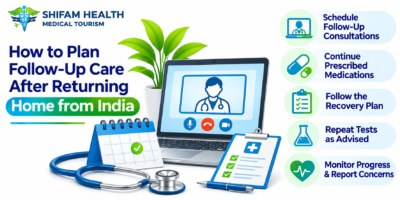
How to Plan Follow-Up Care After Returning Home from India
Filters & Insights
Written By :
Medically Reviewed By :

Shifam Health Medical Team
Shifam Health - Medical Reviews Department
10+ Years Of Experience
Plan follow-up care after treatment in India with practical tips on medical records, medicines, remote reviews and local doctors
📅
Last updated: November 12, 2026

Receiving treatment in another country can involve months of preparation, hospital consultations, travel arrangements and difficult decisions. But one important part of medical travel is sometimes overlooked: what happens after you return home?
For international patients, the end of a hospital stay in India does not necessarily mean the end of treatment. You may still need medication, wound checks, rehabilitation, repeat investigations, specialist reviews or long-term monitoring. Your local doctor may also need detailed information about the treatment performed in India.
A well-organised follow-up plan helps connect the hospital team in India with healthcare professionals in your home country. It also helps you understand which instructions to follow, when to attend reviews and whom to contact if something changes.
This guide explains how to plan follow-up care after returning home from India, what documents to collect before departure, how to arrange remote consultations and how to avoid common gaps in communication.
Table of Contents
ToggleWho should use this guide?
This guide is useful for international patients who have travelled to India for:
- Major or minor surgery
- Cancer diagnosis or treatment
- Cardiac procedures and heart surgery
- Orthopaedic procedures and joint replacement
- Organ transplantation
- Neurological treatment
- Fertility treatment
- Long-term medical management or specialist evaluation
It is also useful for family members and caregivers responsible for organising appointments, medicines and communication with doctors.
The follow-up requirements are different for every patient. Someone who has undergone a minor procedure may need only a scheduled review, while a patient recovering from major surgery or cancer treatment may need several months of monitoring.
The treating specialist should define the follow-up schedule before the patient leaves India. Do not assume that all patients can follow the same recovery timeline.
Why follow-up care should be planned before leaving India
One of the most practical steps is to discuss aftercare while you are still in contact with the treating hospital.
After returning home, arranging a medical review may take time. Your local healthcare provider may need the discharge summary, investigation reports, procedure details and medication list before deciding how to continue care.
Planning ahead helps you:
- Understand the next appointment date and whether it can be conducted online.
- Arrange a local doctor or specialist who can continue monitoring.
- Avoid interruptions in prescribed medication.
- Know which investigations need to be repeated and when.
- Understand activity restrictions and rehabilitation requirements.
- Identify symptoms that require urgent medical attention.
- Share relevant treatment information with your local healthcare team.
If you are still comparing treatment options in India, you can also read our guide on how to request a written treatment plan before travelling to India. A written plan can help clarify the expected treatment, hospital visits and possible next steps.
Step-by-step process for arranging follow-up care
Step 1: Ask the treating specialist for a written follow-up plan
Before discharge or departure, request a written aftercare plan from the treating hospital.
It should explain:
- The diagnosis and treatment performed.
- The patient’s condition at discharge.
- Medicines, doses and duration, including any changes.
- Wound-care or dressing instructions, if applicable.
- Physical activity and dietary restrictions, where relevant.
- Recommended rehabilitation or physiotherapy.
- Investigations required after discharge.
- The expected date or interval for the next review.
- Symptoms that require urgent medical attention.
- Contact details for the relevant hospital department.
Ask the doctor to clarify which instructions are temporary and which may continue for several months.
For example, a patient who has undergone joint replacement may need a structured rehabilitation programme. A patient treated for cancer may require a separate schedule for imaging, blood tests or oncology review.
Step 2: Collect all medical records before departure
Do not leave the hospital with only a discharge summary if other important records are available.
Request copies of the documents relevant to your treatment, such as:
- Final discharge summary.
- Diagnosis and clinical history.
- Operation notes or procedure report.
- Anaesthesia records, where relevant.
- Laboratory and blood investigation reports.
- Imaging reports and available image files.
- Histopathology or biopsy reports, if applicable.
- Implant details, device information or product labels, where relevant.
- Medication list and prescription.
- Follow-up recommendations and pending investigation details.
For a more organised handover, follow our guide on preparing a digital medical file for an overseas specialist.
If your treatment involved MRI or CT imaging, keep the original image files where available, not only the written reports. Our guide on sharing large MRI and CT files with an Indian hospital explains practical ways to organise and share imaging files.
Patients who have undergone a biopsy or cancer-related procedure should also ask how to obtain pathology reports and, where required, the original slides or blocks. See how international patients can organise pathology slides for review in India.
Step 3: Identify a doctor or healthcare provider in your home country
Before returning, identify who will oversee your ongoing care locally.
Depending on your condition, this could be:
- Your regular family doctor or general practitioner.
- A local surgeon.
- A cardiologist.
- An oncologist.
- An orthopaedic specialist.
- A neurologist.
- A physiotherapist or rehabilitation professional.
- Another specialist recommended by your treating doctor.
Share the Indian hospital’s discharge summary and treatment records with this provider. Ask whether they can continue the prescribed monitoring and whether they need any additional information from the Indian specialist.
If you do not have a local specialist, ask the treating hospital for guidance on the type of doctor you should consult. You can then arrange an appointment through your local healthcare system.
Important: A local doctor should review the treatment records and make clinical decisions within their professional role. Do not independently change medicines or treatment instructions based on general online information.
Step 4: Arrange the first follow-up appointment
Your treating specialist should recommend when the next review is due.
Ask whether the appointment should take place:
- In person at the Indian hospital.
- Through a video consultation with the Indian specialist.
- With a doctor in your home country.
- Through both local and remote specialist reviews.
A remote consultation can be useful for discussing recovery, reviewing reports and clarifying the next stage of care. However, it cannot replace a physical examination or urgent in-person assessment when one is medically necessary.
You can read more about what happens during a virtual consultation with an Indian specialist and how to prepare for a video consultation about treatment in India.
Before scheduling, confirm the time zone, appointment platform, consultation fee, payment method and how reports should be shared.
Step 5: Confirm the medication and prescription arrangements
Medication instructions should be clear before the patient travels home.
Ask the treating doctor or hospital pharmacist to explain:
- The name of every prescribed medicine.
- The correct dose and timing.
- Whether it should be taken with food.
- How long it should be continued.
- What to do if a dose is missed.
- Possible side effects that need medical attention.
- Whether any previous medicine has been stopped or changed.
- Whether the medicine is likely to be available in your home country.
If a medicine is unavailable locally, ask the treating specialist and your local doctor about an appropriate alternative. Do not substitute medicines yourself.
Patients taking blood thinners, immunosuppressants, insulin, cardiac medicines or other medicines requiring close monitoring should receive especially clear instructions.
Step 6: Understand the rehabilitation and recovery requirements
Some treatments require more than a follow-up appointment.
For example:
- Joint replacement may involve physiotherapy, mobility exercises and activity restrictions.
- Spine surgery may require specific movement precautions and rehabilitation.
- Stroke treatment may involve physiotherapy, occupational therapy or speech therapy.
- Cancer treatment may require regular oncology reviews and investigations.
- Cardiac procedures may involve medication monitoring and cardiac rehabilitation.
Ask the treating specialist whether rehabilitation should begin in India, continue after returning home or follow a staged plan.
The exact schedule depends on the procedure, the patient’s condition and the treating team’s recommendations. Do not begin strenuous exercise or discontinue mobility restrictions without medical approval.
Step 7: Keep communication open with the Indian hospital
Some patients need clarification after reaching home. They may have questions about a medicine, an investigation report or the next consultation.
Before departure, obtain the relevant department’s contact details and ask how international follow-up enquiries are handled.
Confirm:
- The appropriate email address or patient communication channel.
- Whether the doctor offers remote consultations.
- How to submit new reports.
- How appointment requests are processed.
- Whether there is a fee for follow-up consultations.
- What to do if a question is urgent.
For patients who need continued remote reviews, our article on telemedicine follow-up care in Indian medical tourism provides additional context.
Documents and information to prepare before returning home
Use this checklist before leaving India.
| Document or information | Why it matters |
|---|---|
| Discharge summary | Explains the treatment and condition at discharge |
| Diagnosis and treatment details | Helps the local doctor understand the medical history |
| Operation or procedure report | Records what was performed |
| Investigation reports | Supports future clinical reviews |
| Imaging files and reports | Allows comparison with future scans |
| Prescription and medication list | Helps maintain continuity of medicines |
| Implant or device information | Important for future device-related care |
| Pathology or biopsy report | May be needed for further treatment decisions |
| Follow-up schedule | Clarifies when reviews and tests are due |
| Emergency warning signs | Helps the patient recognise when to seek urgent care |
| Hospital contact information | Supports communication with the treating team |
| Local doctor’s appointment details | Helps establish care after returning home |
Keep both physical and digital copies. Store digital records securely and share them only through appropriate channels with authorised healthcare professionals.
If you have several reports from different departments, organise them by date and treatment stage. This makes it easier for a local doctor to understand the sequence of events.
Questions to ask the hospital before departure
Before leaving India, consider asking the treating team:
- What is the recommended date or interval for my next follow-up?
- Can the first follow-up consultation take place online?
- Which tests or scans will I need after returning home?
- When should these investigations be completed?
- Which medicines should I continue, and for how long?
- Have any of my previous medicines been stopped or changed?
- What physical activities should I avoid?
- Do I need physiotherapy or rehabilitation?
- Which symptoms should prompt an urgent medical review?
- Who should I contact if my local doctor needs clarification?
- Can I share new investigation reports with the Indian specialist?
- Will I need another in-person visit to India?
You may also find our guides on questions to ask an international patient coordinator in India and questions to ask before accepting a medical treatment package in India useful when organising the overall treatment journey.
Common mistakes to avoid when planning aftercare
Leaving without a complete discharge summary
A short discharge note may not contain every detail needed for ongoing care. Ask for the relevant procedure reports, investigation results and medication instructions as well.
Assuming the Indian hospital will automatically contact your local doctor
Do not assume that medical records will be transferred automatically. Ask how information can be shared and whether you need to arrange the communication yourself.
Missing follow-up appointments
Patients sometimes postpone reviews because they feel better. However, some conditions require monitoring even when symptoms improve. Follow the schedule recommended by the treating specialist.
Changing medication without medical advice
Do not stop, reduce or replace prescribed medicines without discussing the change with an appropriate healthcare professional.
Not arranging local care in advance
It can be difficult to find a suitable specialist at short notice. Where possible, arrange the first local appointment before returning home.
Depending entirely on video consultations
Remote reviews are useful, but some conditions require physical examination, laboratory testing, imaging or urgent in-person care.
Ignoring warning signs
Do not wait for a scheduled online appointment if you develop serious or rapidly worsening symptoms. Seek urgent local medical attention.
When should you contact a hospital or specialist?
Contact your treating hospital or specialist when:
- You need clarification about the discharge instructions.
- Your local doctor requires additional procedure details.
- You need to discuss a scheduled investigation or follow-up review.
- You have questions about the prescribed medication.
- A report or test result requires review by the treating team.
- Your recovery is not progressing as expected and you need clinical guidance.
However, do not rely on an email or routine teleconsultation for a medical emergency.
Seek urgent local medical attention if you experience severe breathing difficulty, chest pain, fainting, sudden weakness, uncontrolled bleeding, severe allergic reactions, new confusion or other serious or rapidly worsening symptoms. These are examples, not a complete list. Follow the emergency instructions provided by your treating team.
How Shifam Health can support follow-up coordination
Returning home after treatment in another country can involve several administrative and communication steps. Patients may need help arranging a remote appointment, sharing reports with the Indian hospital or understanding the next coordination step.
Shifam Health supports international patients with treatment-related coordination, including:
- Helping patients organise and share relevant medical records.
- Coordinating follow-up consultation requests with the concerned hospital or specialist.
- Assisting with the communication of reports and appointment-related information.
- Helping patients understand the administrative next steps after treatment.
- Supporting communication between patients, families and relevant hospital teams.
Shifam Health does not replace the treating doctor, provide independent clinical advice or make decisions about medication and recovery. Medical recommendations must come from qualified healthcare professionals.
If you are planning treatment in India or have already received treatment and need help coordinating a follow-up consultation, you can contact Shifam Health to discuss the coordination support required.
Frequently asked questions
Can I continue follow-up care with my local doctor after treatment in India?
Yes. You can arrange follow-up with a qualified healthcare professional in your home country. Share your discharge summary, procedure reports, prescriptions and investigation results so they can review your treatment history.
Can I consult my Indian doctor online after returning home?
Some hospitals and specialists offer remote consultations. Confirm availability, fees, appointment procedures and whether your medical concern can be assessed remotely.
What documents should I collect before leaving India?
Collect your discharge summary, procedure or operation report, prescriptions, investigation results, imaging files, pathology reports where relevant, device details if applicable and written follow-up instructions.
What if my local doctor needs clarification from the Indian hospital?
Ask your local doctor to identify the specific information required. You can then contact the relevant hospital department and request the appropriate records or specialist review.
Should I travel back to India for every follow-up appointment?
Not necessarily. Some reviews may be possible online or through your local doctor. Whether an in-person visit is required depends on your treatment, recovery and the treating specialist’s advice.
What should I do if I develop symptoms after returning home?
For serious or rapidly worsening symptoms, seek urgent medical care locally. Do not wait for an online appointment or an email response from the hospital in India.
Conclusion
Follow-up care is an important part of the medical travel journey. A successful treatment experience should include a clear plan for what happens after the patient returns home.
Before leaving India, collect your complete medical records, understand your medication instructions, confirm the next follow-up date and identify a suitable healthcare provider in your home country. Keep communication open with the treating hospital and make sure you know when to seek urgent medical attention.
With proper preparation, international patients can make the transition from hospital care in India to continued healthcare at home more organised and less stressful.
Planning treatment in India or need help coordinating a follow-up consultation? Contact Shifam Health for assistance with medical records, hospital communication and appointment coordination.

Popular Posts From Last Week
- November 12, 2026
- Shifam Health
Returning home after medical treatment in India is only one stage of the healthcare journey. International patients may…
- November 11, 2026
- Shifam Health
Returning home after treatment abroad does not mean your healthcare journey is over. Prescriptions, discharge summaries, laboratory reports…
- November 11, 2026
- Shifam Health
Returning home after treatment in India often means continuing care with a local doctor. A complete discharge summary…
- November 10, 2026
- Shifam Health
Returning home after treatment in India does not always mean recovery is complete. Many international patients need continued…
- November 10, 2026
- Shifam Health
Returning home after medical treatment in India does not always end the need for specialist communication. International patients…
- November 10, 2026
- Shifam Health
Hospital discharge is an important step, but international patients should understand what to do if a complication develops…
- November 9, 2026
- Shifam Health
Medical travel assistance can include hospital coordination, appointment requests, visa documentation support, airport pickup, accommodation and planned follow-up…
- November 7, 2026
- Shifam Health
Planning treatment in another country involves hospital communication, medical records, appointments, travel documents and practical arrangements. A medical…
- November 9, 2026
- Shifam Health
Currency exchange can affect how much international patients spend on medical treatment in India, even when the hospital’s…
- November 9, 2026
- Shifam Health
Understanding a hospital treatment estimate is essential before travelling to India for medical care. A quoted amount may…
- November 6, 2026
- Shifam Health
Researching hospitals online is an important first step for international patients considering treatment in India. However, hospital websites,…
- November 7, 2026
- Shifam Health
Choosing a hospital in another country can feel complicated, especially when you are unfamiliar with its departments, doctors…