


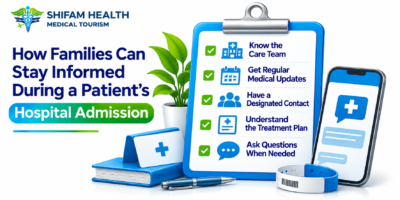
How Families Can Stay Informed During a Patient’s Hospital Admission
Filters & Insights
Written By :
Medically Reviewed By :

Shifam Health Medical Team
Shifam Health - Medical Reviews Department
10+ Years Of Experience
Learn how families can receive hospital updates, ask doctors questions and stay informed during treatment in India.
📅
Last updated: November 12, 2026

When a loved one is admitted to a hospital in another city or country, the family naturally wants to know what is happening. Is the patient comfortable? Has the doctor reviewed the reports? What tests have been completed? When will the next update be provided?
These questions become even more important when the patient has travelled to India for medical treatment and some family members are staying in their home country.
Hospital admission can involve consultations, investigations, treatment decisions, procedures and recovery. Without a clear communication arrangement, family members may receive incomplete information or become anxious while waiting for updates.
The best approach is to agree on a communication plan with the patient and hospital team from the beginning. This guide explains how families can stay informed, what questions to ask and how to coordinate updates while respecting patient privacy and hospital procedures.
Table of Contents
ToggleWho Should Follow This Guide?
This guide is useful for:
- Families accompanying patients travelling to India for treatment.
- Relatives monitoring a patient’s admission from another country.
- Caregivers supporting patients undergoing surgery or complex treatment.
- Families who need to coordinate communication between several relatives.
- Patients who want a trusted person to receive updates on their behalf.
Whether the admission is planned or unexpected, communication should be organised early. Families should understand who is responsible for providing updates, how information will be shared and what to do if they cannot reach the hospital.
How Families Can Stay Informed: A Step-by-Step Process
Step 1: Identify the main family contact person
Before admission, decide who will be the primary family contact.
If several relatives call different hospital departments independently, messages can become confusing. One designated person can collect questions, receive authorised updates and share information with other family members.
The primary contact should ideally:
- Know the patient’s medical background.
- Have the patient’s consent to receive relevant information.
- Be available during agreed communication hours.
- Maintain a record of important updates.
- Share information accurately with other relatives.
For patients travelling with a companion, it is useful to clarify the companion’s responsibilities in advance. Our guide on planning a medical trip when the patient needs a companion explains some of the practical arrangements families should consider.
Step 2: Understand the hospital’s communication process
Hospitals may have different procedures for sharing information with patients and their relatives.
Some updates may come from the treating consultant, while others may be communicated by nursing staff, patient relations teams or authorised hospital coordinators.
Ask the hospital:
- Who is the designated person for family communication?
- When are routine updates generally provided?
- Can updates be shared over the phone or through an approved digital channel?
- How can an overseas family member contact the hospital?
- Who should be contacted outside routine communication hours?
- What is the procedure for receiving information about an emergency?
Do not assume that every staff member can discuss the patient’s medical condition. Hospitals must follow their privacy policies and applicable legal requirements.
Step 3: Obtain the patient’s consent
Patient privacy is an important part of hospital communication.
A hospital may not be able to share medical information with relatives unless the patient has authorised it, subject to applicable law and emergency exceptions.
Before admission, the patient should clarify:
- Which family members may receive medical updates.
- Whether one person should receive all routine communication.
- Whether the hospital can communicate with relatives living abroad.
- Which contact numbers and email addresses should be used.
- Whether consent needs to be documented in a hospital form.
For patients who cannot communicate independently, ask the hospital how it identifies the appropriate legal representative or authorised contact.
The WHO Patient Safety Rights Charter provides a useful international reference on patient safety rights, including respect, information and involvement in care.
Step 4: Maintain a reliable communication schedule
Families often become anxious when they do not know when they will hear from the hospital.
Instead of calling repeatedly, ask whether the hospital can provide updates at an agreed time or after specific events.
For example, families may request updates:
- After the initial medical assessment.
- After important investigations are completed.
- When the treating consultant reviews the patient.
- Before a planned procedure, where appropriate.
- After a procedure or major treatment decision.
- When the doctor discusses the next stage of care.
- Before discharge.
This is a suggested communication structure, not a guarantee that every hospital will provide scheduled calls. The frequency and method of updates depend on hospital policy, clinical circumstances and staff availability.
If the patient’s condition changes significantly, the family should ask how urgent communication will be handled.
Step 5: Keep a written record of important updates
A simple update log can help families understand the sequence of events.
Record:
- Date and time of the update.
- Name or department of the person providing information.
- Current status as communicated by the hospital.
- Tests or procedures completed.
- Pending reports or consultations.
- Doctor’s recommendations.
- Questions requiring clarification.
- Expected next communication, if agreed.
Do not interpret medical terms or make assumptions based on incomplete information. If something is unclear, ask the hospital to explain it in simple language.
A written record is particularly useful when relatives are in different time zones or several family members are involved in decisions.
Step 6: Understand the difference between routine and urgent updates
Not every hospital update has the same level of importance.
Routine updates may concern test completion, ward arrangements, medication schedules or expected consultation timings.
Urgent updates may involve a sudden change in the patient’s condition, an emergency intervention or an important treatment decision.
Families should ask the hospital:
- Which number should be used for urgent communication?
- Who should be contacted if the primary contact is unavailable?
- How will the hospital reach an overseas family member?
- What happens if the patient needs an urgent decision?
- How should the family respond if it receives an unexpected call?
For patients admitted to intensive care, communication arrangements may differ from those for a general ward. Read our guide on what international patients should confirm about ICU and emergency support.
Step 7: Request explanations of medical decisions
Families may hear terms such as diagnosis, investigation, procedure, prognosis or treatment response without fully understanding what they mean.
It is reasonable to request a clear explanation from the treating doctor.
Useful questions include:
- What is the patient’s current diagnosis?
- What have the latest investigations shown?
- What is the purpose of the recommended treatment?
- Are there alternative treatment options?
- What are the important risks or possible complications?
- What decisions need to be made by the patient or family?
- What is the next planned step?
The treating doctor is responsible for clinical explanations and recommendations. A patient coordinator or administrative contact can help with communication arrangements but should not replace medical advice.
Step 8: Arrange communication for relatives living abroad
When relatives are outside India, differences in time zones, language and internet access can make communication difficult.
Before admission, confirm:
- The hospital’s official contact details.
- Whether international calls are accepted.
- Whether email or an approved messaging channel is available.
- The preferred language for communication.
- Whether a translator or interpreter can be arranged.
- Which family member will receive and share updates.
If the family needs language support, ask the hospital whether professional interpretation is available. Do not rely on informal translation for important medical decisions when accurate interpretation is needed.
For patients who need help coordinating communication and hospital arrangements, questions to ask an international patient coordinator in India can help clarify responsibilities.
Documents and Questions Families Should Prepare
A little preparation can make communication smoother during admission.
Important documents and information
Keep the following details accessible:
- Patient’s full name and date of birth.
- Hospital registration or admission number.
- Treating doctor’s name and department.
- Primary family contact’s name and phone number.
- Patient’s consent for sharing medical information, where required.
- Relevant medical history and previous discharge summaries.
- Current medication and allergy information.
- Emergency contact details.
- Insurance or payment information, if relevant.
- Passport and visa details, where needed for administrative coordination.
If the patient has travelled from another country, keep a copy of the original treatment assessment and relevant reports. Our guides on preparing a digital medical file for an overseas specialist and organising a medical trip when more than one specialist is needed can help families prepare medical information before admission.
Questions to ask during admission
| Area | Questions to Ask |
|---|---|
| Admission | Which department is managing the patient’s admission? |
| Communication | Who is the designated family contact? |
| Doctor Updates | When can the family expect the next routine update? |
| Investigations | Which tests are completed and which are pending? |
| Treatment | What is the current treatment plan? |
| Consent | Does the hospital have the patient’s communication consent on record? |
| Emergency | Whom should the family contact if the patient’s condition changes? |
| Discharge | How will the family be informed about discharge planning? |
Families can also prepare by reading questions to ask before accepting a medical treatment package in India.
Common Mistakes and Practical Tips
Mistake 1: Allowing too many people to contact the hospital
When several relatives call different departments, information may become inconsistent.
Practical tip: Select one primary contact and one backup contact. Share updates with the wider family through them.
Mistake 2: Assuming that silence means something is wrong
Hospitals may be busy with clinical responsibilities, and routine updates may not always happen at the exact expected time.
Practical tip: Agree on a reasonable communication arrangement. If an update is delayed, use the designated contact channel to ask for clarification.
Mistake 3: Relying only on informal messages
A short message may not explain a medical decision, its risks or the patient’s current condition.
Practical tip: Ask for an explanation from the treating doctor when a clinical decision needs to be understood. Request written instructions where appropriate.
Mistake 4: Sharing patient information without permission
Forwarding reports, photographs or medical updates to extended family members without consent can compromise privacy.
Practical tip: Confirm what the patient is comfortable sharing and with whom.
Mistake 5: Confusing administrative updates with medical advice
A coordinator or hospital administrative representative may communicate appointments, documents and logistics, but clinical decisions should come from qualified treating professionals.
Practical tip: Direct questions about diagnosis, medication, procedures and prognosis to the treating medical team.
Mistake 6: Not recording important decisions
Families may forget details when they receive several updates in a short period.
Practical tip: Maintain a dated communication log and write down questions before speaking with the doctor.
Mistake 7: Not preparing for discharge communication
Families sometimes focus only on admission and treatment, overlooking the instructions needed after discharge.
Practical tip: Ask about discharge summaries, medication instructions, follow-up appointments, warning signs and travel suitability before leaving the hospital.
For patients who need to plan their stay after treatment, read how long international patients should plan to stay in India after surgery.
When Should Families Contact the Hospital or Specialist?
Families should contact the hospital through its designated channel when:
- An agreed routine update has been missed and clarification is needed.
- They do not understand a medical recommendation.
- A report or investigation result needs explanation.
- The patient or authorised representative needs to discuss a treatment decision.
- There is uncertainty about consent or who can receive information.
- The family needs clarification about a planned procedure or discharge.
- A patient reports a new or worsening symptom.
If the patient experiences sudden deterioration or an emergency, the person physically with the patient should immediately alert hospital staff or use the hospital’s emergency procedure. Do not wait for a routine family update.
For families evaluating hospitals before admission, these resources may also help:
- How to check hospital accreditation and quality information in India
- How to compare hospitals beyond the headline treatment price
- How to verify a doctor’s qualifications before medical travel
- How to confirm whether a hospital treats your specific condition
How Shifam Health Can Support Families During Hospital Admission
For international patients, hospital admission may involve communication across different countries, time zones and languages. Families may also need help understanding whom to contact for appointments, reports and administrative arrangements.
Shifam Health supports international patients through coordination services such as:
- Coordinating communication with hospitals and relevant departments.
- Helping organise medical records and consultation requests.
- Assisting with appointment-related communication.
- Coordinating translation and interpretation support where required.
- Helping families understand administrative and travel-related requirements.
- Coordinating accommodation, airport pickup and other travel arrangements.
- Supporting follow-up communication and coordination after treatment.
Shifam Health does not replace the treating doctor or hospital team. Medical updates, diagnosis, treatment recommendations and clinical decisions must come from the responsible healthcare professionals.
If your family is planning treatment in India or needs help coordinating the patient’s hospital journey, contact Shifam Health to discuss the support required.
Frequently Asked Questions
Can a hospital share patient updates with family members?
Usually, the hospital will need the patient’s consent or another valid legal basis before sharing confidential medical information. Ask how consent should be documented.
Who should be the main contact during hospital admission?
Ideally, one authorized family member should act as the primary contact, with another person available as a backup.
Can relatives living abroad receive hospital updates?
This depends on hospital policy, patient consent and available communication channels. Confirm the process before admission.
How often should families receive updates?
There is no universal schedule. Ask the hospital when routine updates are generally available and how urgent changes are communicated.
Can a patient coordinator explain medical decisions?
A coordinator can help with communication and administrative arrangements, but clinical explanations and treatment decisions should come from the treating doctor.
What should families do if they cannot reach the hospital?
Use the hospital’s official contact or patient relations channel. For an immediate emergency, contact the hospital’s emergency team rather than waiting for a routine update.
Conclusion
Staying informed during a hospital admission is easier when families have a clear communication plan. Choosing one authorised contact, understanding hospital procedures, maintaining a written update log and preparing questions can reduce confusion and help relatives participate appropriately in the patient’s care.
For international patients receiving treatment in India, communication across countries may require additional planning. Agree on the process before admission, respect the patient’s privacy and direct clinical questions to the treating medical team.
Planning treatment in India for a family member? Contact Shifam Health for assistance with hospital coordination, consultation arrangements, communication support and travel-related planning for international patients.


Popular Posts From Last Week
- November 12, 2026
- Shifam Health
When a loved one is admitted to a hospital in India, families need clear and reliable information. This…
- November 12, 2026
- Shifam Health
Returning home after medical treatment in India is only one stage of the healthcare journey. International patients may…
- November 11, 2026
- Shifam Health
Returning home after treatment abroad does not mean your healthcare journey is over. Prescriptions, discharge summaries, laboratory reports…
- November 11, 2026
- Shifam Health
Returning home after treatment in India often means continuing care with a local doctor. A complete discharge summary…
- November 10, 2026
- Shifam Health
Returning home after treatment in India does not always mean recovery is complete. Many international patients need continued…
- November 10, 2026
- Shifam Health
Returning home after medical treatment in India does not always end the need for specialist communication. International patients…
- November 10, 2026
- Shifam Health
Hospital discharge is an important step, but international patients should understand what to do if a complication develops…
- November 9, 2026
- Shifam Health
Medical travel assistance can include hospital coordination, appointment requests, visa documentation support, airport pickup, accommodation and planned follow-up…
- November 7, 2026
- Shifam Health
Planning treatment in another country involves hospital communication, medical records, appointments, travel documents and practical arrangements. A medical…
- November 9, 2026
- Shifam Health
Currency exchange can affect how much international patients spend on medical treatment in India, even when the hospital’s…
- November 9, 2026
- Shifam Health
Understanding a hospital treatment estimate is essential before travelling to India for medical care. A quoted amount may…
- November 6, 2026
- Shifam Health
Researching hospitals online is an important first step for international patients considering treatment in India. However, hospital websites,…