


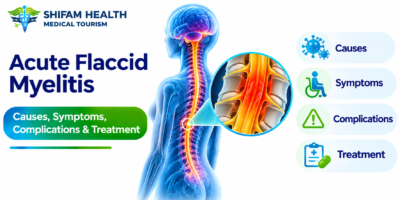
Acute Flaccid Myelitis (2026): Causes, Symptoms, Complications & Treatment
Filters & Insights
Written By :
Medically Reviewed By :

Shifam Health Medical Team
Shifam Health - Medical Reviews Department
10+ Years Of Experience
Learn about acute flaccid myelitis, including its causes, symptoms, complications, diagnosis and treatment options.
📅
Last updated: November 13, 2026

Acute flaccid myelitis (AFM) is a rare but serious neurological condition that damages the gray matter of the spinal cord, causing sudden weakness and loss of muscle tone in one or more limbs. It mostly affects children and often follows a viral illness. Sudden limb weakness needs emergency assessment because AFM can affect breathing. There is no proven cure, so care is supportive, followed by rehabilitation.
- Who: mostly children, but adults are affected too.
- Warning sign: weakness that appears within hours to days, often after a fever or respiratory illness.
- Biggest risk: weakness of the breathing and swallowing muscles.
- Treatment: hospital monitoring, breathing support when needed, then rehabilitation. No therapy is proven to reverse the spinal cord injury.
Table of Contents
ToggleWhen a Child Suddenly Can’t Lift an Arm
It often starts with something ordinary: a cold, a fever, a stomach bug. A few days later, a child stops using one arm, or a leg gives way. Parents wonder if it is a sprain, a trapped nerve or just tiredness. Within hours it can become clear that something is seriously wrong.
That is the typical story of acute flaccid myelitis (AFM). It is uncommon, and most children with a cold will never develop it. But because it can progress quickly, knowing the signs matters. This guide explains what AFM is, what is and isn’t known about its causes, how it is diagnosed, how treatment really works, and what recovery and rehabilitation can look like.
How Does AFM Affect the Nervous System?
Your brain sends movement commands down the spinal cord. Inside the cord, the butterfly-shaped core is called gray matter. It contains motor neurons, nerve cells that connect the spinal cord to muscles. When a motor neuron fires, its muscle contracts. Muscle tone is the natural, slight tension that keeps a muscle ready to work.
In AFM, motor neurons in the spinal cord gray matter are injured. Without their signal, the muscles they supply become weak and limp, a state called flaccid paralysis, and the stretch reflexes in those limbs fade or disappear. Sensation is often normal, so a child may feel a touch on a limb they cannot move.
Not every case of sudden flaccid weakness is AFM. The umbrella term is acute flaccid paralysis, which includes Guillain-Barre syndrome, transverse myelitis and polio. AFM is the subtype with spinal cord gray matter changes on MRI.
Causes of Acute Flaccid Myelitis
The cause is not identified in every patient, but viruses are the leading suspects. CDC lists these viral causes:
- Non-polio enteroviruses, notably EV-D68 and EV-A71
- Flaviviruses, such as West Nile virus and Japanese encephalitis virus
- Herpesviruses
- Adenoviruses
Many patients have a fever, cough or stomach illness one to two weeks earlier. EV-D68 circulation was linked to U.S. peaks in AFM in 2014, 2016 and 2018.
What is not proven:
- A virus linked to AFM does not mean it caused every individual case. Different pathogens may be involved, and sometimes none is found.
- Tests are often negative. In U.S. surveillance for 2020-2025, EV-D68 was detected in only one AFM patient, even though EV-D68 respiratory illness increased in 2022, 2024 and 2025. Samples are often collected after the early illness, when virus may be harder to find, and researchers are studying whether recent EV-D68 strains are less likely to harm nerves.
- AFM is not a typical “catching” illness. The viruses linked to it can spread, but AFM itself is an uncommon complication in the very few people who develop it.
Who Can Develop AFM? Risk Factors
AFM has mostly been reported in children. Across 2020-2025, roughly three-quarters or more of confirmed U.S. cases were under 18, with a median age around 7-12 years, and adults were affected too.
Beyond that, little is known. A recent illness is common but does not establish an AFM diagnosis, and individual susceptibility is not understood. AFM is rare: the U.S. recorded 17-48 confirmed cases a year in 2020-2025, compared with 120-238 in the peak years of 2014, 2016 and 2018. These are U.S. figures. Reporting differs by country, and AFM may be under-recognized elsewhere.
Symptoms of AFM
The most common symptoms:
- Sudden weakness of one or more arms or legs, often worse in the upper arm or thigh than in the hand or foot
- Loss of muscle tone and reflexes in the weak limb
Some patients also have:
- Neck, back or limb pain, sometimes before the weakness
- Facial droop or drooping eyelids, or difficulty moving the eyes
- Difficulty swallowing, slurred speech or a weak cry
- Trouble holding the head up, or constipation or bladder changes
- Rarely, numbness or tingling
Weakness typically develops over hours to a few days. Not every patient has fever, pain or facial weakness, and the pattern varies from one limb to all four. Young children may not say “weak”. They may simply refuse to use a limb.
Early Warning Signs: When to Seek Emergency Care
AFM can progress rapidly, so treat these as emergencies. Go to an emergency department or call emergency services for:
| Sign | Why It Matters |
|---|---|
| Sudden Weakness in an Arm or Leg | A typical AFM sign, but also seen in other urgent conditions. |
| Weakness That Is Getting Worse | Rapid progression is a red flag. |
| New Facial Weakness With Other Neurological Symptoms | May indicate brainstem nerve involvement. |
| Trouble Swallowing, Speaking or Managing Saliva | Risk of choking and aspiration. |
| Trouble Breathing, Weak Cough or Inability to Take a Full Breath | Possible breathing-muscle weakness. |
| Weakness With Unusual Drowsiness or Confusion | Requires immediate medical evaluation. |
Breathing-muscle weakness may not feel dramatic at first, which is why hospital monitoring is needed. CDC advises that patients under investigation for AFM be admitted to hospital immediately.
How Is Acute Flaccid Myelitis Diagnosed?
There is no single diagnostic test. Doctors piece together the examination, imaging and laboratory results, ideally with neurology and infectious disease specialists. Tests should be done as early as possible.
| Investigation | What It Looks For |
|---|---|
| Neurological Examination | Strength, tone, reflexes, cranial nerves, sensation, breathing and swallowing safety. |
| MRI of the Spinal Cord (and Often Brain) | Lesions involving the spinal cord gray matter. |
| Cerebrospinal Fluid (CSF) Analysis | Inflammation and findings suggesting other conditions. |
| Respiratory and Swallowing Assessment | Airway protection and breathing strength. |
| Virus Testing: Respiratory, Stool, CSF and Blood | Enterovirus, other pathogens and poliovirus. |
| Tests for Other Conditions | Guillain-Barré syndrome, transverse myelitis, compression, stroke and other conditions. |
Neurological examination. Doctors check strength in both the upper and lower parts of each limb, because weakness near the trunk is easy to miss. Sensation is often normal in AFM.
MRI. MRI is central. CDC’s surveillance definition requires a spinal lesion largely restricted to gray matter spanning one or more segments, though some white matter involvement can occur. Imaging alone does not confirm every case, and MRI findings can lag the symptoms.
CSF analysis. A lumbar puncture helps exclude other causes. Many patients with AFM have raised white cells in the fluid (44-72% of U.S. confirmed cases, depending on the year), but results vary and need interpretation.
Breathing and swallowing checks. Teams assess breathing strength, cough and swallowing safety, and look for blood pressure or temperature instability.
Virus tests. Respiratory, stool, CSF and blood samples may be sent. A negative result does not rule AFM out. Stool testing matters for another reason: AFM and paralytic polio look the same clinically and on MRI, so stool testing for poliovirus is recommended for suspected cases.
Excluding other conditions. CDC’s list of look-alikes includes Guillain-Barre syndrome, transverse myelitis, stroke (including spinal stroke), tumor, acute cord compression and even simple limb injury. Do not try to self-diagnose from a symptom list.
AFM vs Other Causes of Acute Weakness
| Feature | AFM | Guillain-Barré Syndrome | Transverse Myelitis | Cord Compression | Paralytic Polio |
|---|---|---|---|---|---|
| What Is Affected | Spinal cord gray matter (motor neurons). | Peripheral nerves. | Spinal cord, often white matter and sensory pathways. | Spinal cord compressed by tumour, abscess, trauma or bleeding. | Spinal cord gray matter. |
| Typical Weakness Pattern | Often asymmetric, affecting one or more limbs, with proximal weakness. | Often symmetric and may ascend. | Weakness below a spinal level. | Weakness below a level, often with back pain. | Often asymmetric. |
| Sensation | Often preserved. | Often altered. | Often reduced below a level. | Often reduced below a level. | Preserved. |
| Bladder/Bowel | Less common. | Can occur. | Common. | Common. | Possible. |
| Key Tests | MRI gray matter lesions; viral testing. | Nerve conduction studies; CSF protein. | MRI; CSF; antibody tests. | Urgent MRI. | Stool poliovirus testing. |
These are general patterns, not rules. The conditions overlap, and no single symptom reliably separates them. Only a clinical team can tell them apart.
Complications of AFM
Complications depend on how much of the spinal cord is affected and where. They are not inevitable, and severity varies widely:
- Persistent limb weakness or paralysis
- Respiratory muscle weakness and respiratory failure, sometimes requiring a ventilator
- Swallowing difficulty and aspiration risk
- Autonomic instability (blood pressure and temperature swings) in severe cases
- Muscle wasting and joint contractures if weak limbs are not positioned and moved
- Pain, reduced mobility and dependence on assistance
- Emotional distress and strain on the family
In the U.S. for 2020-2025, 98-100% of confirmed patients were hospitalized, 47-76% were admitted to intensive care depending on the year, and none of the confirmed patients died. Those figures describe a surveillance system with ready access to intensive care. Outcomes differ where it is not available.
How Is AFM Treated?
There is no universally proven, specific treatment for AFM, and no FDA-approved drug for it. Care aims to keep the patient safe and as well supported as possible, find and treat any alternative diagnosis, and begin rehabilitation early. Never treat suspected AFM at home.
Hospital Monitoring and Supportive Care
Patients are watched closely for worsening weakness, breathing trouble and swallowing problems. Care includes nutrition and hydration support, prevention of pressure sores and clots, pain control, and joint positioning. A team of neurologists, intensive care doctors, infectious disease specialists, respiratory therapists and rehabilitation staff usually works together.
Respiratory Support
Some patients need oxygen, and some need help to breathe. Oxygen alone does not fix weak breathing muscles, so respiratory support (non-invasive or invasive ventilation) is decided in hospital based on breathing strength, not on oxygen levels alone.
Medicines and Immunotherapy: What the Evidence Shows
Three treatments are used often, but none is proven:
| Treatment | What CDC Says | Practical Note |
|---|---|---|
| Corticosteroids | No indication to prefer or avoid them; no clear human evidence of benefit. Some animal and EV-A71 data raise concerns about possible harm during infection. | Sometimes used when other steroid-responsive conditions are suspected. |
| IVIG (Intravenous Immunoglobulin) | No clear human evidence of benefit; no evidence suggesting it is likely to be harmful. | Widely used in the hope of boosting immunity. |
| Plasma Exchange | No clear human evidence of benefit; carries procedure-related risks. | Used in some severe cases. |
Between 2020 and 2025, roughly 4 to 6 in 10 U.S. hospitalized confirmed patients received both steroids and IVIG, and about a quarter to two-thirds had plasma exchange, reflecting how common they are despite thin evidence. CDC’s guidance rests on case reports and case series, because there are no controlled trials. Decisions depend on the clinical picture, the possibility of another diagnosis, and specialist judgment. This article gives no doses and does not recommend any of these as a cure.
Antiviral and Other Drugs
CDC finds no indication to use currently available antivirals, fluoxetine or interferon for AFM, and no indication for other immunosuppressive drugs. Antibiotics do not treat viral AFM.
Managing Pain and Secondary Problems
Teams treat nerve pain, muscle stiffness, constipation and bladder problems, nutrition, skin protection and sleep, tailored to each patient.
Rehabilitation and Recovery After AFM
Rehabilitation often begins in the intensive care unit and continues for months or years. A plan is built around the pattern of weakness and changed over time:
- Physical therapy: keeps joints moving, builds strength where nerves still work, supports positioning, standing and walking.
- Occupational therapy: helps with feeding, dressing, play, writing and school tasks, and adaptive tools.
- Speech and swallowing therapy: when speaking or swallowing is affected.
- Respiratory rehabilitation: cough assistance, airway clearance and, when needed, long-term ventilation support.
- Equipment: braces, splints, walkers, wheelchairs and home adaptations.
- Psychological and family support, and school planning for children, including individualized support.
- Surgery in selected cases. For some children with lasting arm or leg weakness, surgeons have used nerve transfers, rerouting a working nerve to a weak muscle. Evidence comes from small case series, and results depend on careful selection and timing. It is not a first-line or universal option.
Therapy cannot promise to restore lost motor function. Its purpose is to make the most of what recovers, prevent avoidable stiffness and deformity, and help the child take part in life.
Prognosis: Can Patients Recover From AFM?
Recovery varies widely. It depends on how severe and widespread the spinal cord injury is, how weak the patient was at the start, whether breathing was involved, and the quality of rehabilitation. The best-studied numbers come from small groups, so treat them with caution:
- Colorado, 2014: of 8 children followed for a year, 6 had persistent motor or functional deficits and 2 recovered fully. Weakness was worst in proximal muscles, though all improved in distal muscles.
- Japan, EV-D68 cluster: a three-year follow-up found a high rate of persistent motor deficits, usually one or two limbs, though disability scores improved over time.
- Reviews: these describe substantial residual disability and long-term rehabilitation needs in many patients, with recovery of function in some.
So: many patients improve, many keep some weakness, a few recover almost fully, and some need long-term support such as mobility aids or breathing support. These studies are small, measure different outcomes and include children from specific outbreaks. They cannot predict one child’s outcome. Do not read them as “everyone is paralysed” or “everyone recovers”.
Long-Term Follow-Up and Living With AFM
Care continues after discharge. Typical follow-up includes:
- Neurology review and repeated strength and function assessments
- Rehabilitation reassessment as the child grows
- Monitoring of joints, spine and muscle length to prevent contractures
- Breathing and swallowing follow-up where relevant
- Equipment checks and home or school adaptations
- Emotional, educational and family support
Some patients need coordinated, multidisciplinary support over many years.
Can AFM Be Prevented?
There is no proven intervention that prevents AFM itself. General infection-prevention steps are sensible, but they are not AFM-specific:
- Wash hands often and avoid close contact with sick people
- Stay home when ill
- Protect against mosquito bites where mosquito-borne viruses such as West Nile or Japanese encephalitis are a concern
- Keep routine vaccinations up to date
On vaccines: polio vaccination protects against paralytic polio, which cannot be told apart from AFM by symptoms or MRI. That is why suspected cases are tested for poliovirus [4]. It does not prevent AFM caused by other viruses. No supplement or “immune booster” is proven to prevent AFM.
AFM Treatment and Rehabilitation in India for International Patients
India has large neurology, pediatric neurology, intensive care and rehabilitation services. Indian pediatric neurologists have noted that AFM is under-reported in India and is often initially labelled transverse myelitis, which makes specialist review worthwhile. India also runs nationwide surveillance for acute flaccid paralysis in children, so stool tests for poliovirus are standard in any suspected case.
First, safety. A patient with sudden or worsening weakness, trouble swallowing or breathing difficulty needs urgent local care. International travel is considered only once the treating team confirms the patient is stable enough, including for flying with any breathing support.
What good planning looks like:
- Collect records: neurological examination notes, MRI images and reports, CSF and laboratory results (including stool and respiratory virus tests), hospital summaries, breathing and swallowing assessments, and treatments given with dates.
- Arrange specialist review (neurology or pediatric neurology, with intensive care and rehabilitation input as needed), usually starting with a remote review of records.
- Ask for a written assessment of the diagnosis, whether other conditions have been excluded, current care needs, rehabilitation options and follow-up.
- Request an itemized estimate for hospital care and rehabilitation, with inclusions and exclusions clearly stated.
- Check what the center offers: neurocritical care or pediatric intensive care, MRI, respiratory support, physical, occupational and speech therapy, assistive equipment and long-term follow-up.
- Arrange travel, medical visa, accommodation and interpretation only when clinically appropriate. See our guide to medical visa options.
- Plan continuity of care for when you return home: a discharge summary, therapy plan and a local team for follow-up.
Where Shifam Health fits. Shifam Health is a patient-coordination service, not a hospital, emergency service or treating clinician. It does not diagnose or treat AFM. It can help you gather and organize records for specialist review, shortlist suitable centers, request estimates and handle non-clinical logistics. See questions to ask an international patient coordinator.
What Affects the Cost of AFM Treatment and Rehabilitation in India?
We could not find a reliable, current price specific to AFM, so we do not quote one. Costs depend on:
| Cost Factor | What Influences It |
|---|---|
| Acute Hospital Care | Ward or intensive care, length of stay. |
| Respiratory Support | Oxygen, non-invasive or invasive ventilation, duration. |
| Investigations | MRI, CSF, virology, nerve studies and repeat imaging. |
| Rehabilitation | Inpatient or outpatient care, weekly sessions and total duration. |
| Therapies | Physical, occupational, speech, swallowing and respiratory therapy. |
| Equipment | Braces, wheelchairs and home adaptations. |
| Surgery (Selected Cases) | Nerve transfer or tendon procedures, if recommended. |
| Follow-up | Reviews and repeat testing. |
| Travel and Stay | Patient and caregiver expenses, length of stay. |
Frequently Asked Questions About Acute Flaccid Myelitis
What is acute flaccid myelitis?
Acute flaccid myelitis (AFM) is a rare but serious condition in which the gray matter of the spinal cord is damaged, causing sudden weakness and floppiness in one or more limbs. It mostly affects children and often follows a fever or respiratory illness. It is a medical emergency because it can affect breathing and swallowing.
What causes acute flaccid myelitis?
The exact cause is not always found. Several viruses have been linked to AFM, including non-polio enteroviruses such as EV-D68 and EV-A71, West Nile virus, Japanese encephalitis virus, herpesviruses and adenoviruses. A link between a virus and AFM does not prove that virus caused every case, and tests are often negative.
Is acute flaccid myelitis a medical emergency?
Yes. Sudden limb weakness should be assessed urgently, because AFM can progress within hours to days and may weaken the breathing muscles. CDC advises that patients under investigation for AFM be admitted to hospital immediately. Do not wait for symptoms to settle or for an online consultation.
How is AFM diagnosed?
There is no single test. Doctors combine a careful neurological examination with an MRI of the spine (and often the brain), spinal fluid analysis, and tests on respiratory, stool, blood or spinal fluid samples. The aim is to confirm gray matter involvement and rule out other causes, including polio. A negative viral test does not exclude AFM.
What is the difference between AFM and Guillain-Barre syndrome?
Both cause acute weakness, but they affect different parts of the nervous system. AFM injures motor neurons in the spinal cord gray matter, often producing uneven weakness with preserved sensation. Guillain-Barre syndrome affects peripheral nerves and more often causes symmetric weakness, sensory symptoms and typical spinal fluid changes. MRI and nerve tests help separate them.
Conclusion
Acute flaccid myelitis is rare, but it can be serious. It causes sudden weakness from injury to motor neurons in the spinal cord, and in some patients it affects breathing and swallowing. What helps most is fast recognition, hospital care, honest conversations about what is and is not proven in treatment, and long, well-planned rehabilitation. Outcomes differ from child to child.
If you or your child has been diagnosed with acute flaccid myelitis and you are exploring specialist neurological care or rehabilitation in India, Shifam Health can help coordinate medical report review, specialist consultations, treatment options and care estimates. The treating medical team must determine the appropriate plan. Sudden weakness, breathing difficulty or swallowing problems require urgent medical assessment rather than waiting for an online consultation.




Popular Posts From Last Week
- November 12, 2026
- Areen Fatima
India has announced important Medical Visa changes for 2026, including one-year default validity with multiple entries for conventional…
- November 13, 2026
- Razi Khan
Acute flaccid myelitis (AFM) is a rare neurological condition that affects the spinal cord’s grey matter and can…
- November 12, 2026
- Shifam Health
Returning home after medical treatment in India is only one stage of the healthcare journey. International patients may…
- November 11, 2026
- Shifam Health
Returning home after treatment abroad does not mean your healthcare journey is over. Prescriptions, discharge summaries, laboratory reports…
- November 11, 2026
- Shifam Health
Returning home after treatment in India often means continuing care with a local doctor. A complete discharge summary…
- November 10, 2026
- Shifam Health
Returning home after treatment in India does not always mean recovery is complete. Many international patients need continued…
- November 10, 2026
- Shifam Health
Returning home after medical treatment in India does not always end the need for specialist communication. International patients…
- November 10, 2026
- Shifam Health
Hospital discharge is an important step, but international patients should understand what to do if a complication develops…
- November 9, 2026
- Shifam Health
Medical travel assistance can include hospital coordination, appointment requests, visa documentation support, airport pickup, accommodation and planned follow-up…
- November 7, 2026
- Shifam Health
Planning treatment in another country involves hospital communication, medical records, appointments, travel documents and practical arrangements. A medical…
- November 12, 2026
- Shifam Health
Choosing a medical travel support organisation is an important part of planning treatment in India. International patients should…
- November 9, 2026
- Shifam Health
Currency exchange can affect how much international patients spend on medical treatment in India, even when the hospital’s…