




When hip pain begins to limit mobility and diminish quality of life, patients worldwide face a crucial decision between two surgical solutions: hip resurfacing or total hip replacement. This choice represents more than just medical preference but it’s about matching the right procedure to individual needs, lifestyle, and long-term goals. In this evolving landscape of orthopedic innovation, India has emerged as a global powerhouse, particularly renowned for its exceptional expertise in hip resurfacing procedures that attract patients from across the world.
The story of India’s orthopedic excellence combines sophisticated medical technology, internationally trained surgeons, and patient-centered care models that prioritize both immediate recovery and long-term joint health. This powerful combination, coupled with remarkable cost savings, has positioned India as a leading destination for international patients seeking the best possible outcomes for their hip conditions.
Understanding the Procedures: Two Paths to Pain-Free Mobility

| Factor | Hip Replacement vs Hip Resurfacing |
|---|---|
| Best For | Hip Replacement: Age 50+ • Hip Resurfacing: Younger patients (<50) |
| Bone Preservation | Replacement removes damaged bone • Resurfacing preserves more bone |
| Implant Type | Replacement uses full artificial joint • Resurfacing uses metal cap |
| Recovery | Replacement: 6–12 weeks • Resurfacing: Slightly faster |
| Revision Risk | Lower with replacement • Slightly higher with resurfacing |
| Longevity | Replacement: 15–25 years • Resurfacing varies with activity |
Hip Resurfacing: Preserving Natural Bone

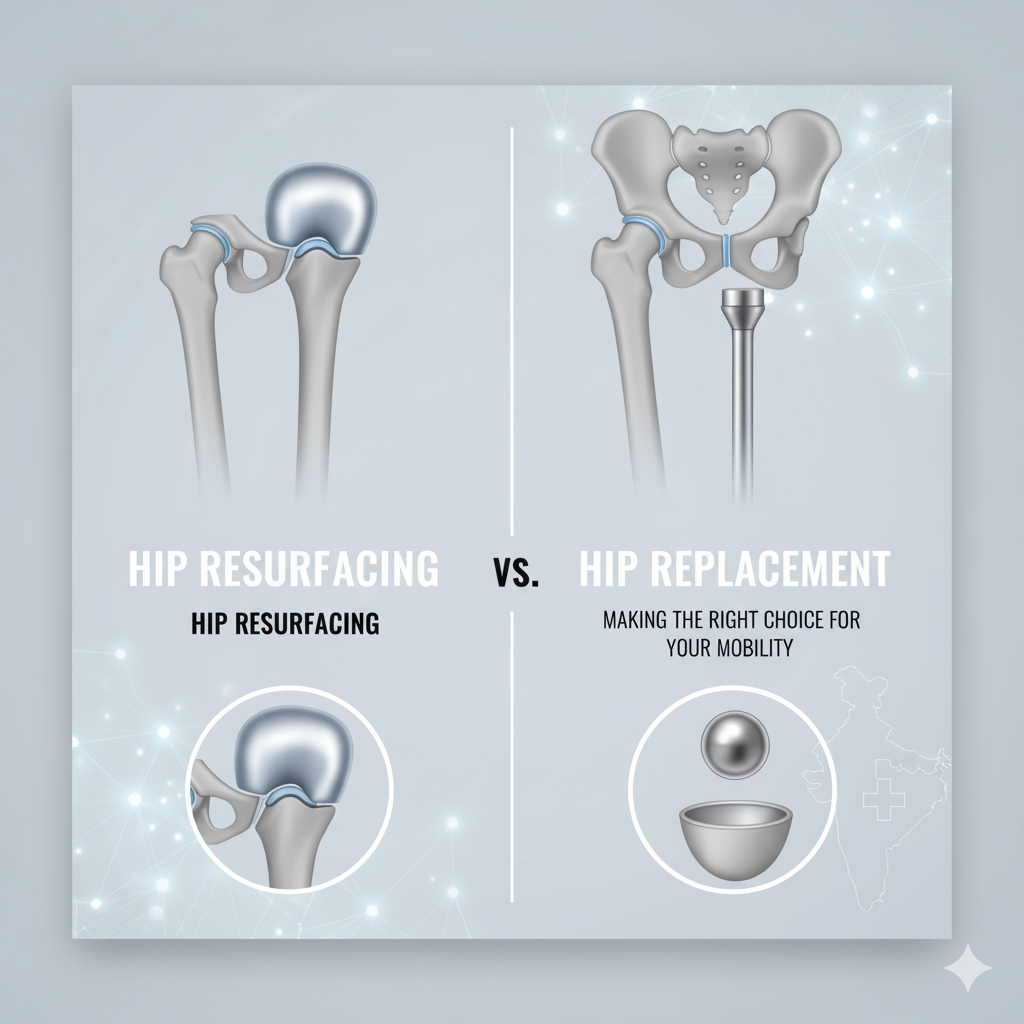
Hip resurfacing represents a bone-conserving alternative to traditional hip replacement. In this sophisticated procedure, surgeons reshape and cap the femoral head with a smooth metal covering rather than removing it entirely. The damaged hip socket lining is similarly replaced with a metal component, creating a metal-on-metal bearing surface that closely mimics the natural hip joint.
This approach offers particular advantages for younger, active patients. By preserving more natural bone, resurfacing maintains hip biomechanics more effectively and facilitates easier revision surgery if needed later in life. The procedure typically uses larger implant components that provide inherent stability, reducing dislocation risk and allowing higher activity levels post-recovery. Patients often report feeling more natural movement compared to traditional replacement.
Total Hip Replacement: Comprehensive Joint Renewal

Total hip replacement involves removing both the damaged femoral head and acetabular socket, replacing them with artificial components. The procedure features a stem inserted into the femur, topped with a new ball that articulates with a socket implanted in the pelvis. Modern materials including ceramic, polyethylene, and advanced metal alloys create durable bearing surfaces tailored to individual patient needs.
This proven approach provides excellent pain relief and functional restoration for patients with advanced arthritis or significant bone loss. The procedure has evolved significantly with minimally invasive techniques that preserve muscle and soft tissue, accelerating recovery. With implant longevity now exceeding 20-25 years in most cases, hip replacement offers a durable solution for patients across age groups.
👉 Read our complete guide here:
Hip Replacement Surgery in India (2026): Cost, Hospitals, Success Rate & Complete Guide
The Decision Matrix: Choosing Your Path to Recovery
Patient Factors: Age, Activity, and Anatomy

The choice between resurfacing and replacement hinges on several patient-specific factors. Hip resurfacing typically suits younger patients (often under 60) with good bone quality who wish to maintain high activity levels. The procedure requires adequate femoral head size and structure to support the resurfacing component securely.
Total hip replacement offers broader applicability across age groups, particularly benefiting older patients, those with osteoporosis, or individuals with anatomical deformities that make resurfacing impractical. The procedure effectively addresses severe joint destruction from advanced arthritis, regardless of bone quality.
Surgical Considerations and Outcomes
Both procedures provide excellent pain relief, but differ in their approach to hip mechanics. Resurfacing maintains more natural load transfer through the femur, potentially reducing stress shielding and preserving bone stock. The larger bearing surfaces theoretically generate less wear debris over time, though metal ion release remains a consideration.
Replacement surgery offers predictable, proven outcomes with extensive long-term data supporting its success. Modern bearing combinations minimize wear, while advanced implant designs accommodate various anatomical variations. The procedure reliably restores function even in complex cases with significant joint deformity.
Also Read: Top 10 Hospitals for Knee Replacement Surgeries in India (2026 Guide)
India’s Orthopedic Excellence: A Global Destination for Hip Surgery
Unparalleled Expertise in Hip Resurfacing
India has developed particular distinction in hip resurfacing, with surgeons performing among the highest volumes of these procedures worldwide. This concentrated experience translates to refined techniques and optimized outcomes. Many Indian orthopedic specialists trained at leading international institutions, bringing global expertise to patient care while developing innovative approaches tailored to diverse patient populations.
The country’s surgeons have contributed significantly to advancing resurfacing methodology, including refined surgical approaches that maximize preservation of blood supply to the femoral head. This technical expertise, combined with sophisticated patient selection protocols, ensures optimal matching of procedures to individual needs.
Advanced Technology and Precision Surgery
Indian orthopedic centers feature technology rivaling the world’s best medical institutions. Computer navigation systems provide real-time guidance during resurfacing procedures, ensuring optimal component positioning that maximizes implant longevity and function. Advanced imaging including 3D CT reconstruction enables precise preoperative planning for both resurfacing and replacement procedures.
Modern operating environments include laminar airflow systems that minimize infection risk, while specialized instrumentation facilitates minimally invasive approaches for both procedures. This technological sophistication, combined with surgical expertise, creates an environment where patients receive care matching international quality standards.
Remarkable Cost-Effectiveness Without Compromise
India’s most significant advantage in orthopedic care lies in its ability to provide world-class treatment at accessible prices. Hip resurfacing typically costs between $7,000 and $9,000, while total hip replacement ranges from $6,500 to $8,500 representing savings of 60-75% compared to Western countries. These transparent packages encompass the entire treatment journey without compromising quality.
This cost advantage stems from efficient healthcare delivery, optimized resource utilization, and high patient volumes that maintain surgical teams at peak proficiency. The financial accessibility ensures treatment decisions remain purely medical, free from economic pressures that might influence care elsewhere.
Also Read: Hip Replacement Surgery in India: A Comprehensive Guide (2026)
Is Hip Resurfacing Still Done in 2026?
Yes, hip resurfacing is still performed in 2026, but it is much less common than total hip replacement and is now recommended only for carefully selected patients. It is mainly considered for younger, active individuals, especially men with good bone quality, who want to preserve more natural bone and maintain a high activity level after surgery.
The procedure became less popular over the years due to concerns related to metal-on-metal implants, including implant wear, metal ion release, and higher revision rates in some patients. Because of this, modern total hip replacement has become the preferred option for most people, offering excellent long-term results and lower complication risks.
However, experienced orthopedic surgeons and specialized centers still perform hip resurfacing in suitable cases where bone preservation and future revision considerations are important.
Recovery and Rehabilitation: What to Expect

The Resurfacing Recovery Journey
Hip resurfacing patients typically experience rapid initial recovery, with most standing and walking with assistance within 24 hours. The bone-preserving nature of the procedure often allows quicker return to weight-bearing activities compared to traditional replacement. Hospital stays average 3-4 days, followed by 4-6 weeks of guided physical therapy.
Long-term recovery focuses on gradually restoring full hip function while protecting the healing joint. Most patients resume desk work within 2-3 weeks and more physically demanding activities by 3-4 months. The preservation of natural hip mechanics often enables higher activity levels long-term, including running and sports that might be discouraged after traditional replacement.
The Replacement Rehabilitation Pathway
Total hip replacement involves a carefully structured recovery process designed to protect the new joint during healing. Patients begin walking with assistance within a day of surgery, progressing to independent mobility over 2-6 weeks. The comprehensive rehabilitation program focuses on restoring movement while observing specific precautions to prevent dislocation.
Recovery continues for several months, with most patients achieving significant functional improvement within 3 months and continued gains through the first year. While high-impact activities may be limited, replacement reliably restores comfort for daily activities, work, and low-impact exercise that maintains joint health long-term.
India’s Patient-Centered Orthopedic Care

Comprehensive International Patient Services
Indian hospitals provide extensive support systems specifically designed for international patients. Dedicated coordinators assist with medical visas, travel arrangements, accommodation, and language interpretation. These services create a seamless experience that allows patients to focus entirely on their recovery rather than logistical challenges.
The support extends to arranging companion accommodations, local transportation, and cultural sensitivity that makes international patients feel welcomed and understood throughout their medical journey.
Integrated Rehabilitation and Follow-up
Successful hip surgery extends beyond the operating room, and Indian orthopedic programs emphasize comprehensive rehabilitation. Structured physical therapy begins immediately after surgery, progressing through inpatient and outpatient phases tailored to each patient’s specific procedure and recovery goals.
Many centers offer telemedicine follow-up services for international patients, ensuring continuity of care after returning home. This integrated approach to recovery demonstrates India’s commitment to complete patient wellbeing rather than just surgical intervention.
The Future of Hip Preservation in India
Advancing Orthopedic Innovation
India continues to advance hip surgery through research and innovation. Surgeons are refining minimally invasive approaches for both resurfacing and replacement that accelerate recovery while maintaining excellent outcomes. The development of advanced bearing materials promises even greater implant longevity for future patients.
The country’s high surgical volumes provide rich data for outcomes research, contributing to global understanding of hip procedures and continuously refining best practices. This commitment to innovation ensures Indian orthopedic care remains at the forefront of global standards.
Expanding Access to World-Class Care
India’s orthopedic success story continues evolving through expanded access to advanced joint care. New centers of excellence are developing across the country, while established programs continue refining their approaches based on long-term patient outcomes. This growth ensures increasing numbers of international patients can access India’s unique combination of surgical expertise, advanced technology, and remarkable value.
Conclusion
The choice between hip resurfacing and replacement represents a significant decision, but India’s orthopedic ecosystem provides the ideal environment for making this choice with confidence. The country’s particular expertise in hip resurfacing, combined with excellence in traditional replacement, ensures patients receive truly individualized recommendations based on their unique needs rather than institutional preference or economic considerations.
Whether through bone-preserving resurfacing or comprehensive replacement, India’s orthopedic specialists stand ready to restore mobility and quality of life. By choosing India for hip surgery, patients access not just advanced medical care, but a partnership dedicated to achieving the best possible long-term outcomes for their joint health and overall wellbeing.
| Take the First Step It costs Nothing Share your medical reports with Shifam Health and receive a free, personalized assessment within 24 hours. No commitment. No pressure. Just honest information to help you make the right decision for you and your family. www.shifamhealth.com | contact@shifamhealth.com | WhatsApp: +91 81785 95807 24/7 Support Available | Free Consultation | No Hidden Charges |