



Home > Blog > Parotid Gland Tumor Surgery Cost in India (2026): Parotidectomy, Best ENT Surgeons & Recovery
Parotid Gland Tumor Surgery Cost in India (2026): Parotidectomy, Best ENT Surgeons & Recovery
Filters & Insights
Parotid gland surgery cost in India ranges from $1,500–$5,000 for international patients, versus $10,000–$30,000+ in the US. Full cost breakdown, facial nerve safety, recovery timeline, and FAQs

Parotid gland tumor surgery (parotidectomy) in India typically costs $1,500 to $5,000 for international patients, depending on whether the tumor is benign or malignant, whether it’s a superficial, total, or radical parotidectomy, and whether reconstruction or neck dissection is needed. This compares to $10,000–$30,000+ for the same procedure in the United States, and typically several thousand pounds in private UK clinics. Roughly 75–80% of parotid tumors are benign (non-cancerous), which is one of the first things worth knowing before you start pricing surgery — it directly affects both your treatment plan and your cost.
| Factor | India | USA | UK (Private) |
|---|---|---|---|
| Typical Cost | $1,500–5,000 | $10,000–20,000+ | $6,000–12,000+ |
| Domestic Pricing | ₹40,000–2,50,000 | Insurance-based | NHS or Private |
| Hospital Stay | 1–3 days | 1–2 days | 1–2 days |
| Facial Nerve Preservation | Very high in experienced centers | High-volume centers | High-volume centers |
Cost figures are drawn from published hospital price listings, cash-price indices, and medical-tourism facilitator quotes current as of 2025–2026. Actual pricing depends heavily on whether your tumor is benign or malignant and should always be confirmed against your own imaging and biopsy results before booking travel.
Table of Contents
ToggleWhat Is the Parotid Gland?
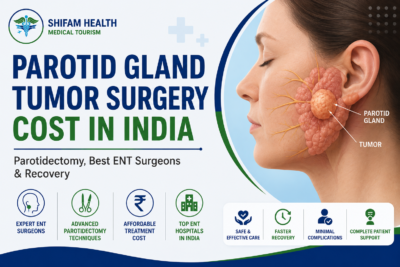
You have two parotid glands, one in front of each ear, extending down toward the jaw and occasionally below the earlobe. They’re the largest of your salivary glands, and their main job is producing the saliva that helps you chew, swallow, and keep your mouth healthy. Saliva travels from the gland into your mouth through a small duct.
One anatomical fact matters more than any other for this article: the facial nerve runs directly through the parotid gland, branching out to control the muscles that let you smile, blink, and move your face. Every decision a surgeon makes during a parotidectomy — the incision, the technique, whether nerve monitoring is used — is shaped by the need to identify and protect this nerve. This is also the single biggest reason surgeon experience matters more here than in almost any other head and neck procedure.
What Is a Parotid Gland Tumor?
A parotid tumor is an abnormal growth of cells within the gland. Most people who discover one notice it as a painless lump or swelling in front of or below the ear. The word “tumor” understandably alarms people, but it’s worth knowing upfront: most parotid tumors are not cancer. Multiple clinical sources consistently place the benign share at roughly 75–80% of cases, with malignant (cancerous) tumors accounting for the remaining 20–25%.
That said, only a biopsy and imaging — not the size or how long you’ve had the lump — can reliably tell you which category yours falls into. Painless, slow-growing lumps are more typical of benign tumors, while pain, rapid growth, facial weakness, or numbness are patterns more often (though not exclusively) associated with malignant disease.
Benign vs Malignant: Types of Parotid Tumors
Benign (Non-Cancerous) Tumors
- Pleomorphic adenoma — the most common salivary gland tumor overall, a slow-growing benign mass typically found in the superficial portion of the gland. Left untreated, it can very slowly enlarge, and in rare cases undergo malignant transformation over many years, which is one reason surgeons generally recommend removal even when benign.
- Warthin tumor — the second most common benign parotid tumor, more frequently seen in men and strongly associated with smoking.
Malignant (Cancerous) Tumors
- Mucoepidermoid carcinoma — the most common salivary gland cancer, ranging from low-grade (slower-growing) to high-grade (more aggressive) forms.
- Adenoid cystic carcinoma — less common but known for a tendency to spread along nerves, which makes surgical planning more complex.
- Acinic cell carcinoma — a slower-growing cancer that can nonetheless occur across a wide age range, including in younger patients.
The distinction between benign and malignant isn’t just academic — it changes the surgical approach (superficial vs. total vs. radical parotidectomy), whether lymph nodes in the neck need to be addressed, whether radiotherapy is added afterward, and, as a direct result, the total cost of your treatment.
Symptoms That Should Prompt an Evaluation
- A painless lump or swelling in front of, below, or behind the ear
- Facial asymmetry or a visible change in the contour of your jaw or cheek
- Numbness, tingling, or burning sensations on one side of the face
- Difficulty moving part of your face (facial weakness) — this symptom in particular warrants prompt evaluation, as it’s more commonly associated with advanced or malignant disease
- Pain in the area of the gland, particularly if it’s persistent rather than intermittent
- A lump that is enlarging over weeks or months rather than staying stable
Any new facial swelling near the ear that persists for more than a couple of weeks deserves an ENT or head and neck surgeon evaluation not because most turn out to be cancer, but because early, accurate diagnosis is what keeps treatment simple.
How Doctors Diagnose a Parotid Tumor
A thorough workup typically combines a physical exam with imaging and tissue sampling:
- Clinical examination — the surgeon assesses the size, location, mobility, and consistency of the lump, and checks facial nerve function.
- Ultrasound — often the first imaging step; useful, accessible, and helps guide biopsy needle placement.
- MRI — provides detailed soft-tissue imaging, particularly useful for assessing whether a tumor involves the deep lobe of the gland or is close to the facial nerve.
- CT scan — sometimes used alongside or instead of MRI, particularly if bone involvement needs to be assessed.
- Fine needle aspiration cytology (FNAC) — a thin needle is used to sample cells from the lump, which are then examined under a microscope. This is usually the key test that helps distinguish benign from malignant disease before surgery is even scheduled.
- Core needle biopsy — sometimes used when FNAC results are inconclusive, providing a larger tissue sample.
- PET-CT — reserved for cases where malignancy is confirmed or strongly suspected, to check whether cancer has spread beyond the gland.
If you’re planning treatment in India from abroad, sending your existing imaging and biopsy reports ahead of time lets the surgical team give you a far more accurate cost estimate and treatment plan before you travel — this single step saves the most confusion and the most money.
Types of Parotid Surgery, Compared
| Procedure | What’s Removed | Typically Used For | Facial Nerve Risk |
|---|---|---|---|
| Superficial Parotidectomy | Outer (superficial) lobe only | Most benign tumors, including pleomorphic adenoma and Warthin tumor | Lower — the nerve is identified and preserved. |
| Total Parotidectomy | Entire gland (superficial and deep lobes) | Deep lobe tumors, selected malignant tumors, or disease involving both lobes | Moderate — more nerve branches are exposed, but preservation remains the goal. |
| Radical Parotidectomy | Entire gland plus facial nerve | Aggressive cancers involving the nerve or pre-existing facial paralysis | The nerve is removed when necessary, often with nerve grafting or facial reanimation. |
| Parotidectomy with Neck Dissection | Parotid gland plus regional lymph nodes | Confirmed or suspected cancer with lymph node spread | Depends on disease extent, generally similar to total parotidectomy. |
For the vast majority of patients — those with benign, superficial tumors — superficial parotidectomy with facial nerve preservation is both the standard of care and the least complex, least expensive option. Radical parotidectomy with nerve sacrifice is reserved specifically for advanced malignant cases where the tumor has already compromised nerve function, not something offered as a default option.
Parotid Gland Tumor Surgery Cost in India: Full Breakdown
Domestic Indian pricing (what local patients pay)
Indian patients paying at private hospitals typically see quotes between ₹40,000 and ₹2,50,000 (roughly $500–$3,000) for standard parotidectomy, with an average around ₹80,000 ($950). This range mostly reflects straightforward, benign, superficial cases.
What international patients actually pay
International-patient packages generally start around $1,500 for a straightforward superficial parotidectomy for a benign tumor, and can run considerably higher — often $3,000–$5,000 or more — for total or radical parotidectomy, malignant disease requiring neck dissection, or cases needing reconstructive/nerve-grafting procedures. This wider spread compared to something like ear surgery is normal for parotid surgery specifically, because the procedure itself varies so much in complexity depending on what the biopsy shows.
| Cost Component | What It Typically Covers |
|---|---|
| Head & Neck Surgeon’s Fee | The surgeon’s professional fee, based on experience and procedure complexity. |
| Anaesthesia Charges | General anaesthesia, routinely used for parotid surgery. |
| Operating Theatre Charges | OT costs, with longer operating times for total or radical procedures. |
| Hospital Stay | Usually 1–3 days, depending on the procedure and recovery. |
| ICU Charges (If Required) | Typically needed only for extensive cancer surgery or reconstruction. |
| Diagnostic Tests | Ultrasound, MRI/CT, and FNAC, often billed separately from the surgery package. |
| Histopathology | Laboratory examination of the removed tissue to confirm the diagnosis. |
| Medicines | Post-operative antibiotics, pain relief, and supportive medications. |
| Follow-up Consultations | Usually 1–2 post-surgery visits before returning home. |
A note on advertised “starting from” prices. You’ll find listings quoting parotidectomy from as low as $1,500. Treat this as the floor price for the simplest benign, superficial case — not a reliable estimate if your biopsy shows malignant disease or if imaging suggests deep lobe involvement. Always request a quote based on your actual FNAC and imaging results, not a generic headline number.
What Actually Drives the Price
- Benign vs malignant diagnosis. This is the single biggest cost driver. Malignant disease often requires more extensive surgery, neck dissection, longer hospital stays, and sometimes radiotherapy afterward.
- Type of procedure. Superficial parotidectomy costs meaningfully less than total or radical parotidectomy, reflecting the difference in surgical time and complexity.
- Surgical technique. Minimally invasive or nerve-monitoring-assisted techniques may cost somewhat more upfront but are widely favored for better nerve preservation and cosmetic outcomes.
- Need for reconstruction. Radical cases involving nerve grafting or facial reanimation add meaningfully to cost and hospital stay.
- Hospital tier and accreditation. NABH- or JCI-accredited hospitals in metro cities typically price higher than smaller regional centers.
- Surgeon’s experience. Given the facial nerve risk involved, an experienced head and neck oncologic surgeon commands — and is generally worth — a higher fee.
- Diagnostics needed on arrival. If you arrive without prior imaging or FNAC results, expect additional testing costs before a final surgical plan and price can be confirmed.
- City. Delhi NCR, Mumbai, Bengaluru, Chennai, and Hyderabad generally price 15–30% higher than tier-2 cities for comparable procedures, largely reflecting facility overhead rather than surgical quality differences.
India vs USA, UK, and Other Countries
| Country | Typical Cost | What Drives the Cost |
|---|---|---|
| India | $1,500–$5,000 | Benign superficial cases cost less, while malignant, radical, or reconstructive surgeries are at the higher end. |
| USA | $10,000–$20,000+ Complex cases may approach $30,000 | Facility, surgeon, and anaesthesia fees are often billed separately, even with insurance. |
| UK (Private) | £5,000–£10,000+ ($6,000–$12,000+) | Most private hospitals provide individual quotes rather than fixed prices. |
| UAE / Gulf | Comparable to or above UK private pricing | Higher treatment costs, with shorter travel being the main advantage for Gulf patients. |
| Turkey | Mid-range between India and Western countries | Packages often include accommodation, airport transfers, and care coordination. |
The gap between India and Western countries for this specific procedure is large and consistent — often a 60–80% saving — and reflects India’s overall lower healthcare cost structure rather than a difference in surgical training. Many head and neck surgeons practicing at major Indian hospitals trained internationally and operate in JCI- or NABH-accredited facilities using the same facial nerve monitoring technology used in the US and UK.
That said, this is genuinely not a procedure to choose purely on price. Facial nerve outcomes are strongly tied to surgeon experience and case volume — ask directly how many parotidectomies your specific surgeon performs annually before deciding.
How Surgeons Protect the Facial Nerve
Because the facial nerve passes through the gland, protecting it is the central technical challenge of this surgery, and it’s worth understanding how experienced surgeons approach it:
- Meticulous nerve identification. Surgeons typically locate the main trunk of the facial nerve early in the procedure and carefully dissect along its branches rather than working around them blindly.
- Intraoperative facial nerve monitoring. Many hospitals now use electronic nerve monitors that alert the surgical team in real time if the nerve is being stimulated or is at risk, adding a layer of safety beyond visual identification alone.
- Tumor-tailored extent of surgery. Surgeons generally remove only as much gland tissue as the tumor’s location and nature require — this is precisely why most benign cases are treated with superficial rather than total parotidectomy.
- High-resolution preoperative imaging. MRI in particular helps the surgical team understand the tumor’s relationship to the nerve before the first incision is made, reducing surprises in the operating room.
Even with all of these measures, some degree of temporary facial nerve weakness after surgery is common and expected in a meaningful proportion of patients — this is addressed honestly in the risks section below rather than glossed over.
Choosing the Right Hospital and Surgeon
- Confirm the surgeon is specifically a head and neck surgeon or ENT oncologist, not a general surgeon occasionally performing parotid cases.
- Ask about facial nerve monitoring — is it used routinely, and is the equipment available at this specific hospital?
- Get an itemized, written quote that reflects your specific diagnosis (benign vs. malignant) rather than a generic headline price.
- Ask about the hospital’s approach if malignancy is found intraoperatively — some cases can’t be fully staged until surgery is underway, so understand how pricing and the surgical plan would adjust.
- Check accreditation — NABH and JCI are the main markers worth verifying.
- Ask whether reconstructive/nerve-grafting expertise is available in-house, in case a radical procedure becomes necessary.
- Confirm remote follow-up support — video consultations after you return home matter more for this procedure than most, given the gradual nature of facial nerve recovery.
Your Treatment Journey, Step by Step
- Initial consultation (remote or in-person). Share existing imaging and FNAC results; the surgical team gives a preliminary assessment.
- Travel and visa planning. A medical visa invitation letter from the treating hospital is typically required.
- In-country evaluation. Further imaging, FNAC, or core biopsy if not already completed, to finalize the surgical plan.
- Preoperative workup. Bloodwork and general anaesthesia fitness assessment.
- Surgery. Under general anaesthesia, typically lasting 1–4 hours depending on the extent of the procedure.
- Recovery room and hospital stay. Usually 1–3 days, with a small drain placed at the surgical site and typically removed within 24–48 hours.
- Histopathology results. The removed tissue is analyzed to confirm the final diagnosis, which may take several days to a week or more.
- Early follow-up. Wound check, suture removal (typically around a week post-op), and discussion of histopathology findings.
- Decision on further treatment. If malignancy is confirmed, this is when radiotherapy or additional treatment planning begins.
- Travel-home clearance and remote follow-up. Video consultations to track wound healing and facial nerve recovery over the following weeks and months.
Recovery Timeline
- First 24–48 hours: A drain tube remains at the surgical site to prevent fluid buildup; mild swelling, stiffness, and some numbness around the incision are expected.
- Around 1 week: Stitches are typically removed; most patients can resume light daily activities, though heavier activity is still restricted.
- 2–4 weeks: Most people are cleared to return to non-strenuous work within this window, though this varies with individual healing and job demands.
- Facial nerve recovery, if temporary weakness occurred: This can take considerably longer — weeks to several months — and physiotherapy or facial exercises are sometimes recommended to support recovery.
- Scar healing: Most surgeons use incisions designed to hide within natural skin folds near the ear, similar to a facelift incision; visible scarring generally continues to fade over the following months.
- Flying home: Confirm directly with your surgeon, but most patients are cleared to travel once the drain is removed and the wound is healing well, typically within a week to ten days, assuming no complications.
Risks and Complications: An Honest Look
Any credible source discussing this surgery should walk through these honestly, not minimize them:
- Temporary facial nerve weakness. This is relatively common after parotidectomy, even with careful nerve preservation, and usually improves gradually over weeks to months as post-surgical swelling and nerve irritation resolve.
- Permanent facial nerve weakness or paralysis. Less common with superficial procedures for benign disease, but a real and serious risk in more extensive or radical procedures, particularly where the nerve is directly involved by tumor.
- Frey syndrome. A relatively common long-term complication where sweating and flushing occur on the cheek during eating, caused by nerve regrowth crossing into sweat gland pathways. It’s usually manageable, but worth knowing about in advance.
- Salivary fistula. A leakage of saliva through the skin incision, usually temporary and managed conservatively.
- First-bite syndrome. Painful spasms in the jaw with the first bite of a meal, which tend to lessen over time for most patients who experience it.
- Numbness around the ear. Related to a sensory nerve (the greater auricular nerve) that’s sometimes affected during surgery; often improves gradually but can be permanent in some patients.
- Bleeding, infection, seroma. Standard surgical risks present in any procedure of this scale.
- Tumor recurrence. More relevant for certain benign tumor types (pleomorphic adenoma in particular has a recognized, though generally low, recurrence risk if not completely excised) and for malignant disease depending on grade and margins.
This is general information, not medical advice specific to your case. Your individual risk profile depends on tumor type, size, location relative to the facial nerve, and whether this is a first-time or revision procedure — a detailed conversation with your specific surgeon is the only reliable way to understand what applies to you.
When Is Radiotherapy Needed?
For benign tumors and most low-grade malignant tumors, surgery alone is typically curative, and radiotherapy is not routinely required.
For higher-grade malignant tumors, tumors with close or involved surgical margins, evidence of nerve involvement, or lymph node spread, radiotherapy after surgery is commonly recommended to reduce the risk of recurrence. This decision is made by a multidisciplinary team — typically involving the head and neck surgeon, a radiation oncologist, and sometimes a medical oncologist — based on the final histopathology report, not decided upfront before surgery.
If your case involves confirmed or suspected malignancy, it’s worth asking your hospital in advance whether radiation oncology services are available on-site or through a coordinated referral, so you understand the full scope — and full cost — of potential treatment before you travel.
Life After Parotid Surgery
Most patients who undergo surgery for a benign parotid tumor return to normal facial function and daily life fully, with the incision fading over time and no lasting impact on speech, eating, or facial expression. For patients treated for malignant disease, ongoing monitoring becomes part of long-term care:
- Periodic follow-up imaging and clinical exams to check for recurrence, with frequency determined by your surgical and oncology team based on tumor type and stage.
- If facial nerve weakness persisted beyond the initial recovery period, continued physiotherapy or, in select cases, further reconstructive procedures may be discussed.
- Management of any long-term Frey syndrome symptoms, if present, which can often be addressed with topical treatments if bothersome.
Frequently Asked Questions
How much does parotid gland tumor surgery cost in India?
Most international patients pay USD 1,500–3,000 for superficial parotidectomy and USD 3,000–5,000+ for complex or malignant cases.
Are most parotid tumors cancerous?
No. Around 75–80% of parotid gland tumors are benign.
How long does parotid surgery take?
Most procedures take 1–4 hours, depending on the type and complexity of surgery.
Will I lose facial movement after surgery?
Usually not. Temporary weakness may occur, but permanent facial nerve damage is uncommon in experienced hands.
How long will I stay in the hospital?
Most patients stay 1–3 days and can usually fly home within 7–10 days, if recovery is uncomplicated.
Do I need radiotherapy after surgery?
Not for most benign tumors. It may be recommended for certain malignant tumors after reviewing the pathology report.
What tests are needed before surgery?
Doctors usually request ultrasound, MRI/CT scan, and FNAC (biopsy) to confirm the diagnosis and plan treatment.
Can a parotid tumor come back?
Yes, recurrence is possible, especially if the tumor isn’t completely removed or in some malignant cases.
Will I have a visible scar?
Surgeons typically use facelift-style incisions hidden around the ear, making scars less noticeable over time.
Is parotidectomy covered by insurance?
Many insurance plans cover medically necessary parotid surgery, but international patients should confirm overseas coverage with their insurer.
A Note Before You Decide
This guide is meant to help you understand realistic costs, procedure types, and what to expect, it is not a substitute for a personalized medical evaluation. Whether your specific tumor is benign or malignant, and which surgical approach is right for you, can only be determined by a qualified head and neck surgeon reviewing your actual imaging and biopsy results.
If you’d like a personalized cost estimate based on your own scan or FNAC report, or want help connecting with an experienced head and neck surgeon in India, Shifam Health’s team can review your reports and walk you through your options — no pressure, no obligation.

Popular Posts From Last Week
- July 14, 2026
- shifamhealth
Parotid gland tumor surgery (parotidectomy) in India typically costs $1,500 to $5,000 for international patients, depending on whether…
- July 9, 2026
- shifamhealth
When the small intestine can no longer absorb enough nutrients to sustain life, the standard fallback is intravenous…
- July 8, 2026
- shifamhealth
If a scan just showed a swollen kidney and the word “UPJ obstruction,” you’re probably trying to answer…
- July 10, 2026
- shifamhealth
Kidney stones can cause severe pain, blood in the urine, recurrent infections, and even kidney damage if left…
- July 8, 2026
- Areen Fatima
Piles (hemorrhoid) surgery in India costs $500–$900 for conventional open hemorrhoidectomy, $700–$1,200 for stapled hemorrhoidopexy, and $900–$1,800 for…
- July 9, 2026
- Areen Fatima
If you or a family member has been told you need adrenal gland surgery, the first questions are…
- July 8, 2026
- shifamhealth
Can You Get Breast Reconstruction After Mastectomy in India? Yes. Breast reconstruction after mastectomy is a routine part…
- July 8, 2026
- shifamhealth
Quick Summary How Much Does Breast Reduction Surgery Cost in India? Breast reduction surgery in India costs roughly…
- July 9, 2026
- shifamhealth
Scar revision surgery can meaningfully improve but not completely erase the appearance and function of most scars. In…
- July 7, 2026
- shifamhealth
It usually starts with something small. A newborn’s skin looks a little more yellow than the nurses expected…
- July 7, 2026
- shifamhealth
Most parents don’t hear the words “cerebral palsy” during a single, calm conversation. It usually arrives in pieces…
- July 10, 2026
- shifamhealth
Recovery is one of the biggest concerns for anyone considering weight loss surgery. Questions like “How long will…