



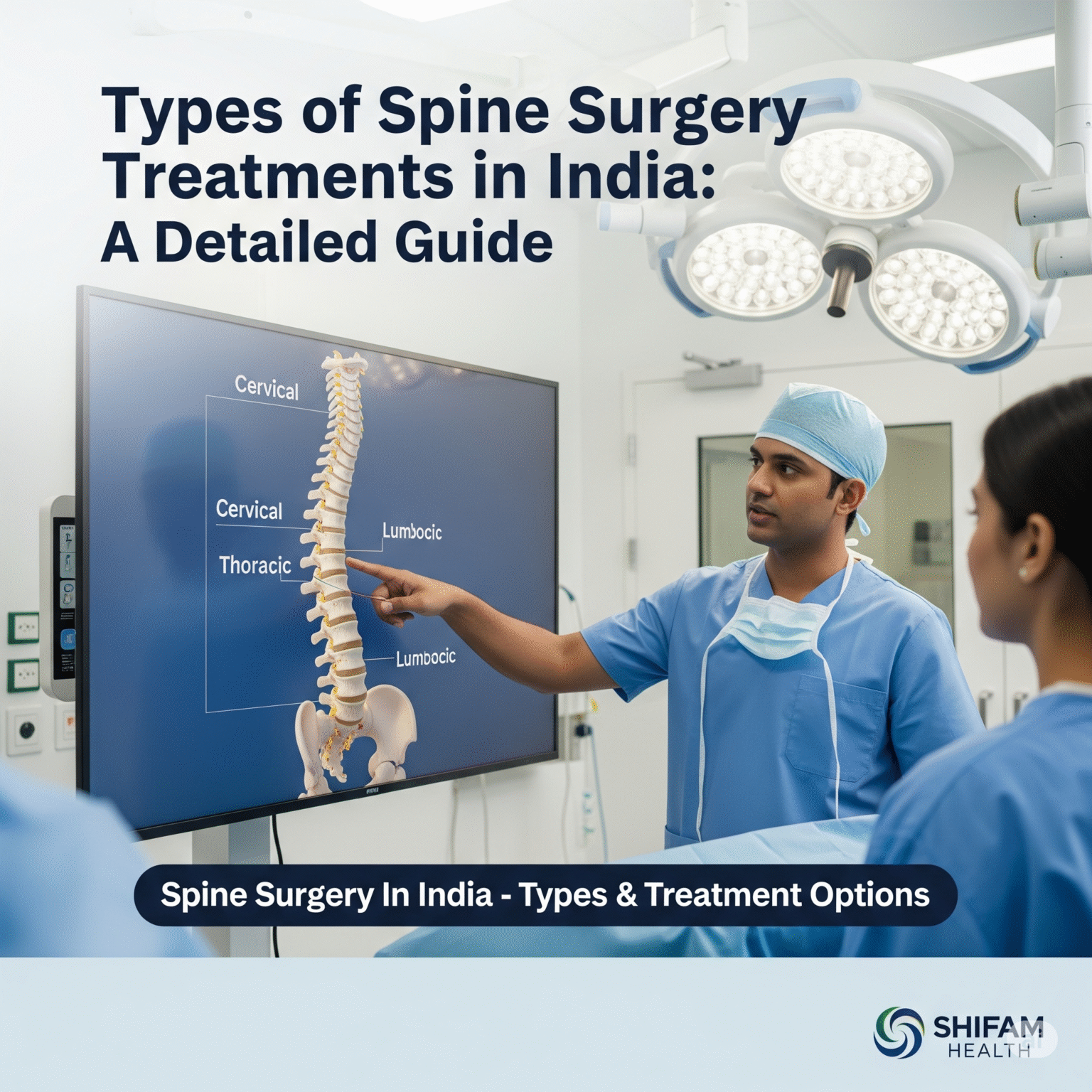
Struggling with chronic back pain or a serious spine condition? India has emerged as a leading destination for advanced spine surgery offering cutting-edge techniques, highly skilled specialists, and cost-effective care.
This guide explores the different types of spine surgery treatments available in India, helping you understand your options and choose the right path toward a healthier, pain-free life.
Understanding the various types of spine surgeries available is crucial for international patients to make informed decisions. Each procedure is tailored to specific spinal conditions, with distinct indications, procedural steps, recovery expectations, and cost considerations.
Spinal Fusion: Stability for Lasting Relief

Procedure
Spinal fusion is a surgical procedure designed to permanently connect two or more bones in the spine. It effectively eliminates motion between them. This procedure is typically performed to make the spine more stable.
It corrects significant deformities like scoliosis, or reduce chronic pain caused by conditions such as severe arthritis or after the removal of a damaged disc. By preventing movement between the fused bones, the surgery aims to alleviate pain and improve overall spinal stability.
During spinal fusion, a surgeon places bone or a bonelike material, known as a bone graft, in the space between the vertebrae intended for fusion.
This graft can be sourced from a bone bank, harvested from the patient’s own body (often from the pelvis), or be a human-made synthetic material. To enhance stability and promote the healing process, metal plates, screws, or rods are frequently inserted to hold the bones together until the fusion solidifies into a single, solid bone mass. The surgical approach can vary. With access to the spine from the front (anterior spinal fusion) or the back (posterior spinal fusion), depending on the specific location of the affected vertebrae and the nature of the condition being treated.
When does it perform?
This procedure is typically performed to make the spine more stable, correct significant deformities like scoliosis, or reduce chronic pain caused by conditions such as severe arthritis or after the removal of a damaged disc.
Patient Stay
Following spinal fusion, a hospital stay of 2 to 3 days is typically required. International patients generally need to plan for a total stay of approximately 15 days in India to accommodate the initial recovery period and necessary follow-up care.
Patients will experience some pain and discomfort, which is a natural part of the healing process; this is effectively managed with prescribed medications.
The complete fusion of bones can take several months, often 6 to 12 months for full healing and solidification of the bone graft. Physical therapy is a crucial component of rehabilitation and typically begins 6 weeks to 3 months after surgery. It focuses on teaching proper movement techniques for sitting, standing, and walking, which helps maintain spinal alignment and regain strength. Light activities, such as walking, are encouraged early on, with a gradual increase in activity levels as strength returns and the fusion progresses.
The cost for Transforaminal Lumbar Interbody Fusion (TLIF) surgery in India
The cost for Transforaminal Lumbar Interbody Fusion (TLIF) surgery in India typically ranges from USD 4,000 to USD 6,500, which is equivalent to approximately INR 3,35,000 to 5,50,000. Minimally Invasive TLIF (MIS-TLIF) for a single level is often priced between USD 4,000 and USD 4,800. The general range for spine surgery in India is around USD 1,500 to USD 7,710 (INR 1,00,000 to 5,50,000), representing a significant cost advantage compared to the USD 100,000 to USD 150,000 typically seen in the US.
Lumbar Disc Replacement: Preserving Motion

Procedure
Lumbar disc replacement surgery is a modern alternative to spinal fusion, primarily recommended for individuals suffering from chronic lower back pain caused by a damaged or worn-out intervertebral disc. Unlike spinal fusion, which restricts movement at the affected segment, this procedure aims to replace the damaged disc with an artificial one, thereby preserving natural motion in the spine and potentially reducing stress on adjacent discs. This can significantly alleviate pain and restore mobility, offering a different approach to spinal health.
When does it perform?
This surgery is typically performed under general anesthesia, ensuring the patient is unconscious and pain-free throughout the procedure. The operation usually takes between 1 to 3 hours. The surgeon accesses the spine, carefully removes the damaged disc, and then precisely implants an artificial disc into the empty space. Once the artificial disc is securely in place, the incision is closed with sutures or staples.
Patient Stay
Recovery after lumbar disc replacement is generally shorter compared to traditional spinal fusion surgery. Patients may be discharged on the same day or require a few days of hospitalization, depending on their overall condition and the extent of the surgery. Most patients can return home and resume light activities such as walking, driving, and light household chores within days to weeks post-surgery.
By the three-month mark, patients typically experience significant improvement in their symptoms and overall mobility. While individual healing rates vary, most patients can expect to return to their regular activities and exercise routines by one year, with many reporting a significant reduction in pain and improved mobility by six months.
The cost for total disc replacement surgery in India
The cost for total disc replacement surgery in India starts from INR 5,42,000 (approximately USD 6,500). For international patients, the cost of Lumbar Artificial Disc Replacement surgery typically ranges from USD 10,500 to USD 16,000. This pricing remains significantly lower, by 40-70%, compared to costs in Western countries, making it an attractive option for those seeking quality care at a more accessible price point.
Laminectomy: Decompression for Nerve Relief

Procedure
Laminectomy is a surgical procedure primarily performed to relieve pressure on the spinal cord and nerves. It is most commonly indicated for spinal canal stenosis, a condition characterized by the narrowing of the spinal canal. This narrowing can stem from various etiologies, including degenerative changes, fractures, tumors, abscesses, or spinal deformities. The primary objective is to decompress the central canal, lateral recesses, and neural foramina, thereby alleviating nerve compression and associated symptoms.
In a traditional open laminectomy, a posterior midline incision, typically 3 to 4 cm in length for a single level, is made directly over the spine. The surgeon then carefully removes the spinous process and a portion of the lamina, which is the bony arch of the vertebra. This removal creates more space around the compressed nerves and the spinal cord. Extreme care is taken to avoid damaging the facet joints, as excessive removal can lead to spinal instability. Neuromonitoring is often recommended during cervical or dorsal laminectomies to protect delicate nerves from injury during the procedure.
When does it perform?
The procedure is also considered for patients experiencing intractable pain, progressive neurological deficits, or in urgent situations such as cauda equina syndrome.
Patient Stay
After a laminectomy, mild stiffness and soreness are common but usually improve within a few weeks. Rest is important, but daily walking is encouraged to support circulation and recovery. Avoid heavy lifting and strenuous activities until cleared by your doctor. Driving is typically restricted for 2–4 weeks, and on longer trips, take breaks to walk and stretch.
Most patients take 2–4 weeks off work, while physically demanding jobs may require 4–8 weeks depending on recovery. Laminectomy has a high success rate of around 90%, with strong patient satisfaction. Pain and weakness often improve early, though some nerve-related sensations may take longer to fully resolve.
The cost of laminectomy surgery in India
The cost of laminectomy surgery in India typically ranges from INR 55,000 to INR 2,00,000, which translates to approximately USD 660 to USD 2,400. The total cost, including hospital stay and associated services, can range from USD 3,200 to USD 5,500. Patients undergoing this procedure should anticipate a total stay in India of approximately 15 days to accommodate the surgery and initial recovery period.
Kyphoplasty: Restoring Vertebral Height & Reducing Pain

Procedure
Kyphoplasty is a minimally invasive procedure primarily used to treat painful vertebral compression fractures (VCFs), which are often caused by osteoporosis (bone weakening) or spinal tumors. The main goals of kyphoplasty are to reduce or eliminate pain, restore lost vertebral height caused by the fracture, and prevent or correct kyphosis, which is an excessive outward curvature leading to a hunched-over posture.
This procedure typically takes less than an hour and is performed under moderate sedation or general anesthesia, ensuring the patient’s comfort. A small incision is made, and a narrow tube, known as a trocar, is carefully inserted into the fractured vertebra. Through this tube, an inflatable, balloon-like device is introduced and expanded within the compressed bone. This expansion creates a cavity and helps to restore the vertebral height. The balloon is then deflated and removed, and the created cavity is filled with a specialized bone cement that hardens quickly, effectively stabilizing the fracture.
When does it perform?
Kyphoplasty is primarily used to treat painful vertebral compression fractures (VCFs), which are often caused by osteoporosis (bone weakening) or spinal tumors.
Patient Stay
Kyphoplasty is often an outpatient procedure, meaning patients can usually go home on the same day. Many patients experience significant pain relief within 48 hours, and in some cases, relief is immediate. Any soreness at the needle insertion site typically resolves within a few weeks.
Most individuals are able to return to their daily activities within a day or two after the procedure. While strenuous activities should be avoided for several weeks to allow for proper healing, comprehensive physical therapy or rehabilitation is generally not required after kyphoplasty, making it a relatively quick recovery process.
The average cost of kyphoplasty in India
The average cost of kyphoplasty in India is approximately INR 3,74,000. The starting price for Kyphoplasty Surgery is around USD 8,000. Patients typically require a hospital stay of approximately 3 days and a total stay in India of around 10 days to facilitate the procedure and initial recovery.
ACDF (Anterior Cervical Discectomy & Fusion): Cervical Spine Solutions
Procedure
ACDF (Anterior Cervical Discectomy and Fusion) is considered a major surgery, usually lasting 1 to 3 hours under general anesthesia, ensuring the patient is completely asleep and pain-free. The surgeon makes a small incision on the front of the neck, typically just above the collarbone, to access the cervical spine.
The damaged or herniated disc (discectomy) is then meticulously removed to relieve pressure on the spinal cord or nerves. A bone graft, which can be sourced from the patient’s own body or a donor, is inserted into the empty space left by the removed disc. The vertebrae above and below the removed disc are then fused together, often secured with a metal plate and screws, to stabilize the spine and promote bone growth.
When is it performed
ACDF is typically recommended when conservative, non-surgical treatments, such as physical therapy, medication, or injections, have failed to provide adequate relief.
Patient Stay
Most patients stay in the hospital for 1 to 3 days following ACDF surgery. For international patients, a total stay of approximately 12 days in India is generally recommended to allow for initial recovery and necessary follow-up appointments. Patients should be able to walk and sit up shortly after surgery, and light daily activities can typically be resumed within 2 to 4 weeks.
Depending on the nature of their job, individuals in sedentary roles may be able to return to work in 3 to 6 weeks. Full recovery can take 3 to 6 months or even up to a year. While some neck flexibility might be lost due to the fusion, the primary goal of significant pain relief is highly achievable. Physical therapy may be recommended 4 to 6 weeks after surgery to strengthen neck muscles and regain flexibility.
The average cost of ACDF surgery cost in India
For international patients, ACDF surgery cost in India ranges from USD 4,760 to USD 5,740. The overall cost in India typically ranges from INR 1,09,000 to INR 2,02,000, with single-level ACDF costing between INR 1,50,000 and INR 3,00,000. These costs generally include preoperative diagnostics, the surgery itself, hospital stay, consumables, implants, and medications.
Discectomy: Targeted Relief for Herniated Discs
Procedure
Discectomy is frequently performed under general anesthesia and can often be an outpatient procedure, typically lasting about 60 minutes. The surgeon makes a small incision, carefully separates the muscles to gain access to the spine, and then meticulously removes the problematic part of the disc while preserving the majority of the outer layer.
This procedure can be performed as an open surgery or, more commonly, as a minimally invasive microdiscectomy, which utilizes smaller incisions and specialized instruments. Often, discectomy is combined with decompression to create additional space around the spinal cord or nerve roots, further alleviating pressure.
When does it perform?
It is often a preferred option for directly addressing the source of pain when conservative treatments, such as medication, physical therapy, or injections, have failed to provide adequate relief.
Patient Stay
Many patients experience prompt pain relief immediately after the procedure, with any soreness at the incision site typically resolving within 2-3 days. Depending on the specific procedure and the patient’s condition, discharge can occur on the same day (making it a daycare procedure) or after a few days of hospitalization. During the initial six weeks of recovery, activity is generally limited to gentle stretches and walking, with strict avoidance of heavy lifting and prolonged sitting or standing. After six weeks, activity can gradually increase, with a return to a normal activity level typically expected after 12 weeks.
Minimally invasive approaches offer distinct advantages, including quicker recovery times, less post-operative pain, and reduced scarring compared to open procedures. Patients are often encouraged to walk and move around shortly after minimally invasive lumbar discectomy to aid in their recovery.
The average cost of discectomy surgery in India
The general cost of discectomy surgery in India ranges from INR 1,40,000 to INR 3,20,000 (approximately USD 1,750 to USD 4,000). For international patients, the cost of Microdiscectomy Surgery typically ranges from USD 5,500 to USD 7,000.
Scoliosis Surgery: Correcting Spinal Deformities
Procedure
Scoliosis surgery involves fusing vertebrae together to stop the progression of the scoliotic curve. This can be performed from the back (posteriorly), through the chest (anteriorly), or via a combined approach, depending on the curve’s location and severity. Instrumentation, such as rods, hooks, and screws, is frequently used to help straighten the spine slightly and provide an internal brace for the bone graft. This bone graft will eventually form a solid fusion mass, creating one solid piece of bone that cannot bend, thus eliminating further curve progression over time (typically 4 to 6 months).
In some cases, particularly for young children, a brace or cast may be worn post-operation if instrumentation is not used. Other specialized techniques include hemivertebra excision, which involves removing wedge-shaped vertebrae that cause congenital scoliosis, and osteotomy, which entails cutting and reshaping the spine to correct the curvature.
When does it perform?
Scoliosis surgery is typically recommended for individuals with significant spinal curves, usually exceeding 45-50 degrees, especially if there is a high risk of the curve worsening even after skeletal growth has completed. It is also considered when the curvature causes persistent pain, limits bodily functions, or leads to breathing difficulties due to compromised lung capacity. The primary goals of scoliosis surgery are to prevent further curve progression, improve spinal alignment, and alleviate associated symptoms, thereby enhancing the patient’s quality of life.
Patient Stay
Patients typically stay in the hospital for 3 to 7 days after scoliosis surgery. For international patients, a total stay of 15 to 21 days in India is often recommended to allow for initial recovery and necessary follow-up care. Most children, a common patient group for scoliosis surgery, no longer require pain medication within 10-14 days post-operation. Patients can usually return to school or sedentary work within 3-4 weeks.
A gradual return to activities occurs over 7 days to 6 months, with full participation in all activities typically possible after 6 months to 1 year, as the spinal fusion process itself takes 6 to 12 months to fully solidify.
Scoliosis surgery cost in India
Scoliosis surgery cost in India can range from USD 6,500 to USD 17,000, which is equivalent to approximately INR 5,35,000 to 11,00,000. The cost varies based on the specific technique employed (e.g., spinal instrumentation and fusion, growing rod method, vertebral body tethering, osteotomy, hemivertebrae excision) and the overall complexity of the case. This comprehensive cost typically includes surgeon fees, operating theater charges, anesthesia, implant costs, nursing fees, hospital stay with meals, and basic diagnostic tests.
Comparing Your Options for spinal surgery: A Quick Guide

For international patients, navigating the complexities of different spine surgeries can be challenging. This comparison table offers a concise, at-a-glance overview of the most common spine surgery treatments available in India, highlighting their primary indications, average cost ranges, and typical recovery timelines. This simplified format aims to help patients quickly understand the key differences, aiding their decision-making process.
| Surgery Type | Primary Indications | Average Cost Range (USD) | Hospital Stay (Days) | Total Stay in India (Days) | Typical Recovery to Light Activity | Full Recovery |
|---|---|---|---|---|---|---|
| Spinal Fusion | Instability, Scoliosis, Damaged Disc, Severe Arthritis | $4,000 – $7,710 | 2-3 | 15 | Weeks (Walking) | 6-12 Months |
| Lumbar Disc Replacement | Chronic Lower Back Pain (Damaged Disc), Stiffness | $6,500 – $16,000 | Same day – Few | Not specified | Days/Weeks (Walking, Driving) | 1 Year |
| Laminectomy | Spinal Stenosis, Intractable Pain, Neurological Deficits | $660 – $5,500 | Not specified | 15 | Weeks (Walking) | 2 Years (for dysesthesias) |
| Discectomy | Herniated/Bulging Disc, Sciatica, Nerve Compression | $1,750 – $7,000 | Same day – Few | Not specified | 6 Weeks (Gentle stretches, walking) | 12 Weeks |
| Kyphoplasty | Vertebral Compression Fractures (Osteoporosis, Tumors) | $8,000 – $9,000 | 1 (Often outpatient) | 10 | 1-2 Days (Daily activities) | 2-3 Days (Pain relief) |
| ACDF (Anterior Cervical Discectomy and Fusion) | Pinched Nerves in Neck, Arm Pain/Numbness/Weakness | $4,760 – $5,740 | 1-3 | 12 | 2-4 Weeks (Light activities) | 3-12 Months |
| Scoliosis Surgery | Spinal Curves >45-50°, Pain, Functional/Breathing Issues | $6,500 – $17,000 | 3-7 | 15-21 | 3-4 Weeks (School/Sedentary work) | Not specified |
Conclusion
India has firmly established itself as a premier global destination for spine surgery, offering an unparalleled combination of advanced medical expertise, state-of-the-art technology, and remarkable cost-effectiveness. The comprehensive range of treatments available, from spinal fusion to minimally invasive discectomy and complex scoliosis correction, ensures that diverse patient needs are met with precision and care.
The consistent adherence to international quality standards, evidenced by JCI and NABH accreditations, coupled with the presence of highly skilled and experienced spine surgeons, directly addresses any initial concerns regarding quality versus affordability. This commitment to excellence, alongside the significant cost savings compared to Western countries, positions India as a value-driven, high-quality healthcare destination.
FAQs
Why is spine surgery in India more affordable than in Western countries?
Spine surgery in India is significantly more affordable due to lower operational costs, favorable exchange rates, and a high volume of procedures. Despite the lower cost, many Indian hospitals maintain international quality standards, holding accreditations from organizations like JCI and NABH, ensuring high-quality care comparable to Western nations.
What types of spine surgeries are commonly performed in India?
India offers a full range of spine surgeries including fusion, disc replacement, laminectomy, discectomy, kyphoplasty, ACDF, and scoliosis surgery treating conditions like herniated discs, spinal stenosis, and deformities.
How long is the typical hospital stay and total stay in India for spine surgery?
Hospital stay varies by procedure: 1 day for minimally invasive surgery and 3–7 days for complex cases. Total stay in India is usually 10–21 days, including recovery and follow-up.
Are Indian spine surgeons and hospitals internationally accredited?
Yes. Many spine surgeons in India are internationally trained, and top hospitals hold Joint Commission International (JCI) and National Accreditation Board for Hospitals & Healthcare Providers (NABH) accreditation, reflecting high global standards of care and safety.
Related Reads:
- Spine Surgery Cost in India 2025: Save 80% vs US/UK
- Top 10 Spine Surgery Hospitals in India (2025) | Best Surgeons
- Best Spine Surgeon in India | Top Doctors, Costs & Hospitals (2025 Guide)
- India Medical Visa 2025: New Rules, Application Process & FAQs
- How to get Medical Visa for India: A Complete Guide (2025)
- Hip Replacement Surgery Success Rate in India | Affordable & Trusted Outcomes
- Hip Replacement Surgery in India 2025: Cost, Top Surgeons & Hospitals
- Hip Replacement Cost in India 2025: Save 70% vs Abroad
- Knee & Hip Replacement Cost in India 2025 | Best Hospitals
- Best Hip Replacement Hospital India 2025 | Top Doctors & Costs
- Indian Medical Visa 2025: Step-by-Step Guide for International Patients
- تأشيرة طبية للهند من اليمن 2025: الشروط، التكلفة، وخطوات التقديم
- বাংলাদেশ থেকে ভারতের মেডিকেল ভিসা: সম্পূর্ণ গাইড (২০২5)
| Take the First Step It Costs Nothing Share your medical reports with Shifam Health and receive a free, personalized assessment within 24 hours. No commitment. No pressure. Just honest information to help you make the right decision for you and your family. www.shifamhealth.com | contact@shifamhealth.com | WhatsApp: +91 81785 95807 24/7 Support Available | Free Consultation | No Hidden Charges |