



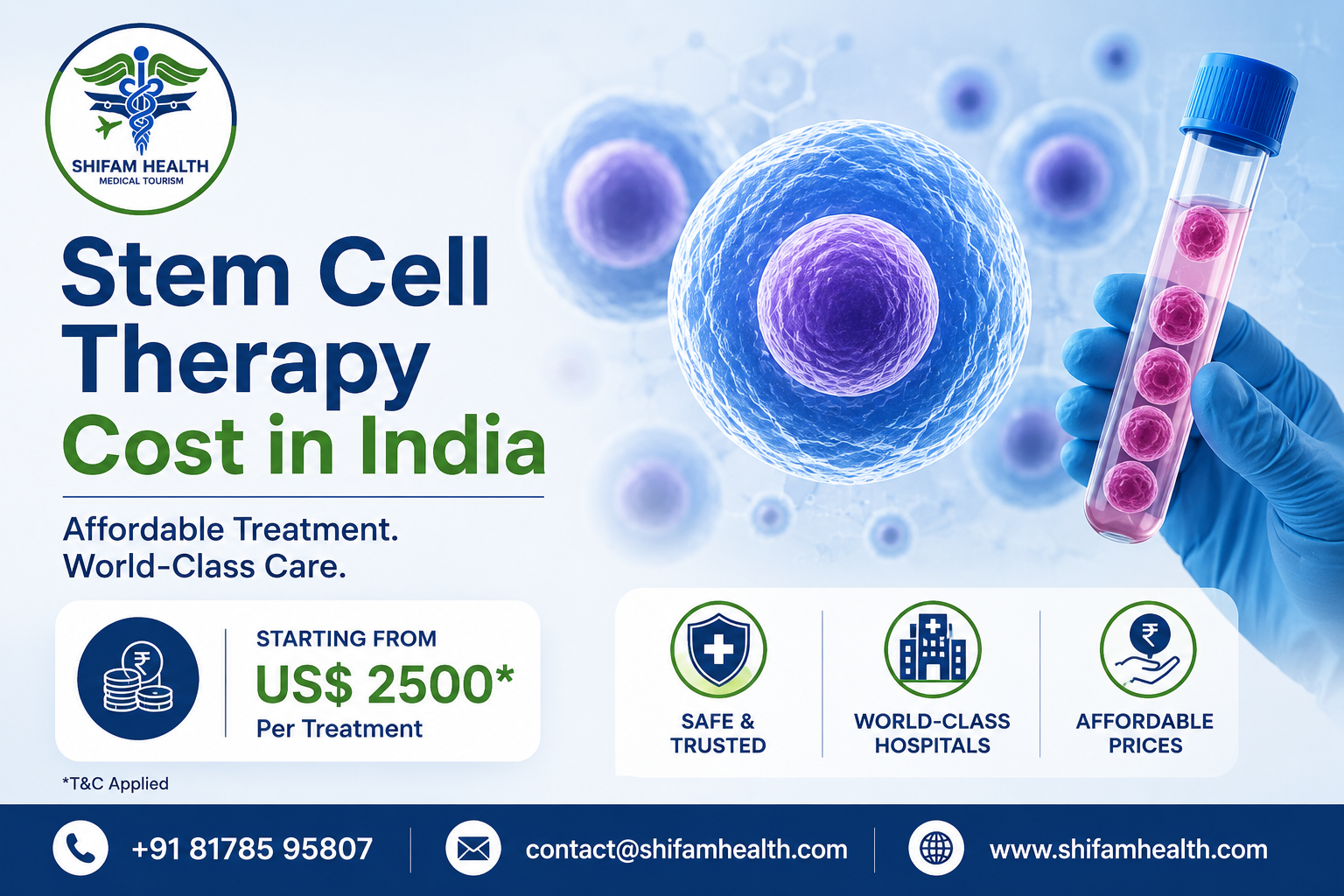
Stem cell therapy in India has become one of the most sought-after treatment options for international patients looking for advanced regenerative care at significantly lower costs. With globally recognized hospitals, experienced specialists, and modern laboratory infrastructure, India offers a unique combination of affordability, medical expertise, and accessibility.
Patients travel from Nigeria, Kenya, Zambia, Bangladesh, Uzbekistan, the UK, and the USA because India offers the same internationally approved treatments, the same quality of cell processing laboratories, and the same post-treatment care as Western hospitals, at a fraction of the cost.
Stem cell therapy in India typically costs between ₹4 lakh to ₹15 lakh ($5,000–$18,000), depending on the condition, hospital, and type of stem cells used. More complex procedures like stem cell transplants (BMT) can cost between ₹18 lakh to ₹40 lakh ($22,000–$50,000). India offers 60–80% lower costs compared to the US, UK, and Europe, while maintaining high standards of medical care.
In this guide, you’ll find a detailed breakdown of stem cell therapy costs in India, including condition-wise pricing, transplant costs, hospital comparisons, and how to choose the right treatment for your case.
How much does stem cell therapy cost in India in 2026?
Stem cell therapy cost in India ranges from INR 2.5 lakh (approx. USD 3,000) for simple regenerative procedures to INR 35 to 40 lakh (approx. USD 42,000 to USD 48,000) for a full allogeneic bone marrow transplant at a premier JCI-accredited centre. The cost depends on the type of stem cells used, the condition being treated, and whether the treatment is an established transplant or a regenerative therapy. All costs in this guide are quoted in INR first, with USD equivalents.
👉 For a deeper understanding of how regenerative treatments are transforming healthcare in India, explore our detailed guide on regenerative medicine and medical tourism.
Understanding the Two Types of Stem Cell Therapy in India
Before looking at costs, it is essential to understand what you are comparing. This distinction directly affects your expectations, your safety, and your decision.
| Category | What This Means for You |
|---|---|
| Hematopoietic Stem Cell Transplantation (HSCT) / Bone Marrow Transplant (BMT) |
Fully established, ICMR-approved, clinically proven treatment.
Standard treatment for:
High success rates (80–90%) for well-matched transplants at leading centres. Shifam Health primarily coordinates these transplants for international patients. |
| Regenerative / Mesenchymal Stem Cell Therapy (MSC Therapy) |
Growing clinical evidence for conditions such as:
Not a guaranteed cure. Outcomes vary between patients. Reputable ICMR-compliant centres provide therapy with:
|
Important: Some online providers make exaggerated claims about stem cell therapy cures. Any centre that guarantees a cure for neurological or degenerative conditions is not following ICMR or NABH guidelines. Shifam Health works exclusively with ICMR-compliant and JCI or NABH-accredited facilities. We will tell you honestly whether stem cell therapy is an established or investigational option for your specific condition before you travel.
Stem Cell Therapy Cost in India 2026: Complete Breakdown by Condition
The most commonly asked question in your search data is ‘stem cell therapy cost in India in rupees’. Here is the most detailed breakdown available online, organised by condition.
Established Treatments (HSCT / Bone Marrow Transplant)
| Condition & Transplant Type | Cost in India (USD) |
|---|---|
| Blood Cancers: Autologous BMT (own cells) – Leukaemia, Lymphoma, Multiple Myeloma | USD 9,600 to USD 18,000 |
| Blood Cancers: Allogeneic BMT (matched sibling donor) | USD 18,000 to USD 33,600 |
| Blood Cancers: Haploidentical BMT (half-matched donor) | USD 24,000 to USD 42,000 |
| Blood Cancers: Matched Unrelated Donor (MUD) Transplant | USD 30,000 to USD 48,000 |
| Thalassemia Major: Allogeneic BMT | USD 18,000 to USD 36,000 |
| Sickle Cell Disease: Allogeneic BMT | USD 18,000 to USD 33,600 |
| Aplastic Anaemia: Allogeneic BMT | USD 14,400 to USD 26,400 |
| Severe Autoimmune Disease (MS, RA): Autologous HSCT | USD 18,000 to USD 33,600 |
Regenerative MSC Therapy (Investigational / Clinical Trial Basis)
| Condition | Cost in India (USD) | |||||||||||||||||||||||||||||||||||||||||||||||||||||||||||||||||||||||||||||||||||||||||||||||||||||||||||||||||||
|---|---|---|---|---|---|---|---|---|---|---|---|---|---|---|---|---|---|---|---|---|---|---|---|---|---|---|---|---|---|---|---|---|---|---|---|---|---|---|---|---|---|---|---|---|---|---|---|---|---|---|---|---|---|---|---|---|---|---|---|---|---|---|---|---|---|---|---|---|---|---|---|---|---|---|---|---|---|---|---|---|---|---|---|---|---|---|---|---|---|---|---|---|---|---|---|---|---|---|---|---|---|---|---|---|---|---|---|---|---|---|---|---|---|---|---|---|
| Cerebral Palsy | USD 4,200 to USD 8,400 | |||||||||||||||||||||||||||||||||||||||||||||||||||||||||||||||||||||||||||||||||||||||||||||||||||||||||||||||||||
| Autism Spectrum Disorder (ASD) | USD 3,600 to USD 7,200 | |||||||||||||||||||||||||||||||||||||||||||||||||||||||||||||||||||||||||||||||||||||||||||||||||||||||||||||||||||
| Spinal Cord Injury (Paraplegia / Quadriplegia) | USD 4,800 to USD 9,600 | |||||||||||||||||||||||||||||||||||||||||||||||||||||||||||||||||||||||||||||||||||||||||||||||||||||||||||||||||||
| Stroke and Brain Injury | USD 4,800 to USD 9,600 | |||||||||||||||||||||||||||||||||||||||||||||||||||||||||||||||||||||||||||||||||||||||||||||||||||||||||||||||||||
| Parkinson’s Disease and Motor Neuron Disease | USD 5,400 to USD 10,800 |
| Cell Source & Protocol | Cost & Key Details |
|---|---|
| Autologous Bone Marrow Concentrate (BMC) |
USD 3,000 to USD 6,000 Patient’s own bone marrow cells. Same-day procedure. No rejection risk. Common for orthopaedic therapy. |
| Autologous Adipose (Fat) Tissue MSCs |
USD 3,000 to USD 5,400 Stem cells extracted via liposuction. High cell yield for regenerative therapy. |
| Expanded Mesenchymal Stem Cells |
USD 4,800 to USD 9,600 Cells cultured in GMP lab for high-dose neurological protocols. |
| Autologous HSCT (Own Cells) |
USD 9,600 to USD 18,000 Used for blood cancers such as Multiple Myeloma and Lymphoma. |
| Allogeneic Umbilical Cord MSCs |
USD 3,600 to USD 8,400 Ready-to-use donor cells from licensed cord blood banks. |
| Matched Sibling Donor HSCT |
USD 18,000 to USD 33,600 Gold standard for blood cancers and thalassemia. |
| Haploidentical HSCT (Half-Match) |
USD 24,000 to USD 42,000 Uses parent or child donor when full match unavailable. |
| Matched Unrelated Donor (MUD) |
USD 30,000 to USD 48,000 Registry-based donor transplant with highest complexity. |
What is Included in the Stem Cell Therapy Cost in India?
A common source of confusion for international patients is what a quoted cost actually covers. Here is a full itemised breakdown for both BMT and regenerative therapy packages.
Itemized Cost Breakdown (BMT at Premier Private Centre)
| Cost Component | Estimated Cost (USD) |
|---|---|
| Recipient Pre-Transplant Evaluation | USD 600 to USD 1,800 |
| Donor HLA Typing & Workup | USD 360 to USD 960 |
| Conditioning Chemotherapy / Radiation | USD 1,800 to USD 4,800 |
| Stem Cell Harvesting | USD 600 to USD 1,200 |
| GMP Laboratory Processing | USD 1,800 to USD 5,400 |
| Cryopreservation | USD 300 to USD 720 |
| Transplant Infusion Procedure | USD 480 to USD 1,200 |
| HEPA-Filtered BMT Unit Stay | USD 96 to USD 240 per day |
| Antibiotics, Antifungals & Blood Products | USD 1,200 to USD 4,800 |
| Post-Transplant Immunosuppressants | USD 600 to USD 1,800 |
| International Patient Coordination (Shifam Health) | Included |
| Total Allogeneic BMT Estimate | USD 18,000 to USD 42,000 |
What is NOT typically included: Long-term outpatient medications after discharge, donor registry fees for MUD transplants (adds INR 5 to INR 12 lakh), complications requiring extended ICU stay, travel and accommodation costs for patient and family, and physiotherapy or rehabilitation post-discharge. Shifam Health provides a complete written breakdown covering all inclusions and exclusions before you commit.
Stem Cell Therapy Cost by City in India (2026)
The city you choose affects the total cost. Metropolitan hospitals in Delhi, Mumbai, and Bengaluru carry higher overheads but offer the highest volume of complex transplant experience. Emerging medical hubs offer comparable quality at lower cost for many procedures.
| City | Cost Range & Why Choose It |
|---|---|
| Delhi & Gurugram (NCR) |
BMT: USD 14,400 to USD 48,000 Regenerative Therapy: USD 3,600 to USD 10,800 Home to Medanta, Fortis, Apollo, Artemis, and BLK-Max. Best international flight connectivity. |
| Mumbai |
BMT: USD 16,800 to USD 45,600 Regenerative Therapy: USD 4,200 to USD 11,400 Leading centres include Kokilaben, Hinduja, and NeuroGen. Popular for UK and African patients. |
| Bengaluru |
BMT: USD 12,000 to USD 38,400 Regenerative Therapy: USD 3,360 to USD 10,800 Strong biotech ecosystem and advanced GMP lab support. |
| Chennai |
BMT: USD 12,000 to USD 36,000 Regenerative Therapy: USD 3,000 to USD 9,600 Apollo Chennai and Sri Ramachandra attract large international patient volumes. |
| Hyderabad |
BMT: USD 10,800 to USD 33,600 Regenerative Therapy: USD 3,000 to USD 10,200 Yashoda Hospitals and strong pharma infrastructure via Genome Valley. |
| Ahmedabad & Pune |
BMT: USD 9,600 to USD 26,400 Regenerative Therapy: USD 2,400 to USD 8,400 20–30% lower cost than Delhi or Mumbai with growing medical tourism facilities. |
Stem Cell Therapy Cost in India vs the World
Here is how India compares to other countries for the same treatments. This is the data international patients from Nigeria, Kenya, the UK, and the USA need before making their decision.
Bone Marrow Transplant Cost Comparison (Allogeneic BMT with Matched Sibling Donor)
| Country | Cost & Key Notes |
|---|---|
| India (JCI-Accredited Centres) | USD 18,000 to USD 33,600 HEPA-filtered BMT units, internationally trained haematologists, and savings of 70–90% vs USA. |
| Nigeria |
USD 20,000 to USD 40,000 Limited BMT centres and variable quality between hospitals. |
| South Africa |
USD 50,000 to USD 90,000 High-quality care but long waiting times and limited availability. |
| Kenya |
Very limited BMT capacity Many patients already travel abroad, especially to India. |
| Turkey |
USD 30,000 to USD 55,000 Growing transplant programme with lower volume than India’s top centres. |
| United Kingdom (Private) |
USD 100,000 to USD 190,000 NHS offers free BMT but private treatment is extremely expensive. |
| Germany |
USD 80,000 to USD 160,000 Excellent quality with very high treatment costs. |
| United States |
USD 150,000 to USD 400,000 Highest global cost with major insurance dependence. |
| India vs USA | India costs only 8–20% of US pricing Patients can save approximately 80–92% with comparable outcomes at top Indian centres. |
What Are the Success Rates for Stem Cell Therapy in India?
Success rates depend entirely on the condition being treated and the type of therapy. Here is an honest breakdown:
| Treatment & Condition | Success Rate & Outcome Expectations |
|---|---|
| Autologous BMT for Multiple Myeloma | 70–85% 5-year progression-free survival at leading Indian centres. Extends remission significantly. |
| Allogeneic BMT for Acute Leukaemia (AML/ALL) | 50–70% disease-free survival at 5 years depending on donor match and disease stage. |
| BMT for Thalassemia Major (Children) | 85–92% cure rate with matched sibling donor at top centres. |
| BMT for Aplastic Anaemia | 80–90% long-term survival with matched sibling transplant. |
| MSC Therapy for Cerebral Palsy | 60–80% of patients report functional improvement. Not a cure. |
| MSC Therapy for Spinal Cord Injury | Partial improvement possible in selected cases, especially incomplete injuries. |
| Stem Cell Therapy for Liver Cirrhosis | Clinical studies show improvement in liver function markers. Evidence continues to grow. |
| BMT for Lymphoma | 60–80% long-term remission in chemosensitive relapsed disease. |
Artemis Hospital Gurugram reports 85 to 90 percent success rates for allogeneic transplants in early-stage leukaemia. BLK-Max New Delhi, home to Asia’s largest BMT centre, reports consistently strong outcomes for both malignant and non-malignant conditions. Medanta’s BMT programme, led by Dr. R.K. Chaudhary, is recognised for specialising in haploidentical and MUD transplants with among the best outcomes in the country.
Top Hospitals for Stem Cell Therapy in India: Shifam Health’s Recommended Centres
Shifam Health has direct working knowledge of the following hospitals. We have assessed them based on clinical volume, ICMR compliance, accreditation, international patient experience, and outcomes transparency. We recommend these to our patients because we know what each does well and for which conditions each is best suited.
| Hospital & Location | What Sets It Apart |
|---|---|
| BLK-Max Super Speciality Hospital, New Delhi | Asia’s largest dedicated BMT centre with 5,000+ transplants and HEPA-filtered BMT units. |
| Medanta – The Medicity, Gurugram | Leading centre for complex haploidentical and MUD transplants with strong allogeneic outcomes. |
| Apollo Hospitals | Multi-city BMT network with expertise in blood cancers, thalassemia, and cord blood transplant. |
| Fortis Memorial Research Institute (FMRI), Gurugram | Dedicated BMT unit with strong paediatric transplant and international patient support. |
|
Manipal Hospitals, Bengaluru
Manipal Hospitals, Delhi NCR | High-volume BMT programme with excellent adult and paediatric outcomes. |
| NeuroGen Brain & Spine Institute, Mumbai | India’s leading neurological stem cell therapy centre with strong rehabilitation integration. |
| GIOSTAR, Ahmedabad & Mumbai | Advanced regenerative stem cell therapy with GMP-certified lab support. |
| Artemis Hospital, Gurugram | Strong HSCT programme for leukaemia and autoimmune disorders with JCI accreditation. |
How Shifam Health Helps International Patients Access Stem Cell Therapy in India
We are not a directory. We are not a referral agency. Shifam Health is a dedicated medical access platform with direct working relationships with India’s leading stem cell therapy centres. Here is what that means for you in practice:
- Honest eligibility assessment: We will tell you upfront whether your condition is suitable for established HSCT or whether you would be accessing investigational MSC therapy. We do not send patients to India for treatments that are not appropriate for their condition.
- Condition-matched centre selection: BLK-Max is not the right centre for everyone. NeuroGen is not right for blood cancer. We know which centres lead for which specific conditions and we match you correctly. This is not something a directory can do.
- Transparent written cost estimate: We provide a detailed INR and USD breakdown for your specific case before you book a flight. No surprises.
- Medical visa coordination: We provide the official hospital invitation letter required for your Indian Medical Visa (MED Visa) and guide you through the documentation process.
👉 For a step-by-step guide, read our detailed page on the Indian Medical Visa process. - Travel and accommodation support: Airport pickup, hotel or hospital guesthouse booking, and multilingual coordinator support in Arabic, French, Swahili, Bengali, Russian, and Uzbek.
- In-hospital coordination: We remain actively in contact with the transplant team and the international patient department throughout your stay, attending key consultations where needed.
- Post-treatment follow-up: We connect you with appropriate specialists in your home country for ongoing monitoring and advise on sourcing post-transplant medications from India at significantly lower cost.
Key Factors That Affect Stem Cell Therapy Cost in India
Why does one patient pay INR 8 lakh and another pay INR 35 lakh? Here is a plain explanation of the variables:
- Transplant type: Autologous (own cells) transplants cost significantly less than allogeneic (donor cells) transplants. Haploidentical and MUD transplants are the most complex and expensive due to additional HLA typing, registry fees, and graft-versus-host disease management requirements.
- Disease stage and complexity: Patients with significant complications, organ dysfunction, or previous failed transplants require extended ICU stays and more complex conditioning regimens, increasing total cost.
- Cell dose and number of sessions: Neurological regenerative therapy for conditions like cerebral palsy or spinal cord injury often requires higher cell doses produced through laboratory expansion, which increases processing costs. Some protocols require 2 to 3 sessions.
- Hospital tier and city: JCI-accredited premier centres in Delhi and Mumbai carry higher overheads than mid-tier private hospitals. Cost difference can be 20 to 40 percent for comparable treatments.
- Duration of hospital stay: A standard autologous BMT requires 3 to 4 weeks of hospital stay in a HEPA-filtered room. An allogeneic BMT often requires 4 to 6 weeks. Each additional day in a specialist BMT unit adds INR 8,000 to INR 20,000.
- Complications: Graft-versus-host disease (GVHD) in allogeneic transplants and infections are the main drivers of cost escalation beyond the original estimate. India’s top centres have significantly lower infection rates due to HEPA filtration and dedicated transplant ICU protocols.
Frequently Asked Questions (FAQs)
Is the cost of stem cell therapy for cerebral palsy or autism in India worth it?
Published studies from ICMR-approved centers like NeuroGen Mumbai report meaningful functional improvements in 60 to 80 percent of patients. Costs of INR 3.5 to INR 7 lakh represent significant savings vs Mexico, USA, or Europe. However, it is important to understand this is investigational therapy, not a guaranteed cure. Shifam Health advises honestly on what to expect before travel.
Is bone marrow transplant covered by health insurance in India?
Yes. IRDAI regulations since October 2020 require standard Indian health insurance policies to cover HSCT (bone marrow transplant) for hematological conditions. International health insurance policies may also cover BMT. Shifam Health assists with pre-authorization documentation.
What is the cheapest city for stem cell therapy in India?
Ahmedabad and Pune are typically 20 to 30 percent cheaper than Delhi or Mumbai for comparable quality care. Hyderabad and Chennai also offer competitive pricing with strong transplant programmes. However, for the most complex allogeneic or haploidentical transplants, choosing a highest-volume center in Delhi or Bengaluru is clinically more important than cost minimization.
How long must I stay in India for stem cell therapy?
Autologous BMT: 4 to 6 weeks minimum. Allogeneic BMT: 6 to 10 weeks minimum. Neurological MSC therapy: 2 to 4 weeks typically. Orthopedic regenerative therapy: as few as 5 to 7 days for simple procedures. Shifam Health advises the expected stay duration based on your specific treatment before you travel.
Conclusion
Stem cell therapy cost in India ranges from INR 2.5 lakh for straightforward regenerative procedures to INR 40 lakh for the most complex allogeneic bone marrow transplants at premier centres. In every case, India offers the same internationally certified treatments, the same GMP laboratory standards, and outcomes that match global benchmarks, at 70 to 90 percent lower cost than the USA or UK.
The key to getting the right result is not just finding the cheapest option. It is matching the right patient to the right treatment at the right centre. That is exactly what Shifam Health does. We give you honest information, a transparent cost estimate, and dedicated personal support throughout your journey.
If you or a family member is considering stem cell therapy in India, reach out today. We will tell you exactly what is possible, what it costs, and how to make it happen safely.
| Get Your Free Personalized Cost Estimate from Shifam Health Share your medical reports or diagnosis. We reply within 24 hours with a personalized cost estimate and center recommendation. No fees. No obligation. www.shifamhealth.com | contact@shifamhealth.com | WhatsApp: +91 81785 95807 24/7 Support Available | Free Consultation | No Hidden Charges |

Start typing to see posts you are looking for.