


Bow leg correction surgery in India costs between USD 4,500 and USD 15,000, depending on the type of procedure, whether one or both legs are treated, the implants used, and the hospital category. Most international patients undergoing a single-leg High Tibial Osteotomy at a JCI-accredited hospital should expect an all-inclusive package of USD 5,000–8,000. This is 60–75% less than equivalent procedures in the UK, USA, or Germany.
Many patients live with bowed legs for years walking awkwardly, managing knee pain, avoiding sport, and quietly worrying about what the future holds for their joints. If you’re researching treatment abroad, the good news is that India has orthopedic surgeons and hospitals that routinely correct complex leg deformities for international patients, at a fraction of the cost you’d pay in your home country.
This guide walks you through everything you need to know: what the surgery involves, who it’s for, what it costs in India (broken down clearly), how recovery works, and what to expect when you travel for treatment.
What Is Bow Leg (Genu Varum)?

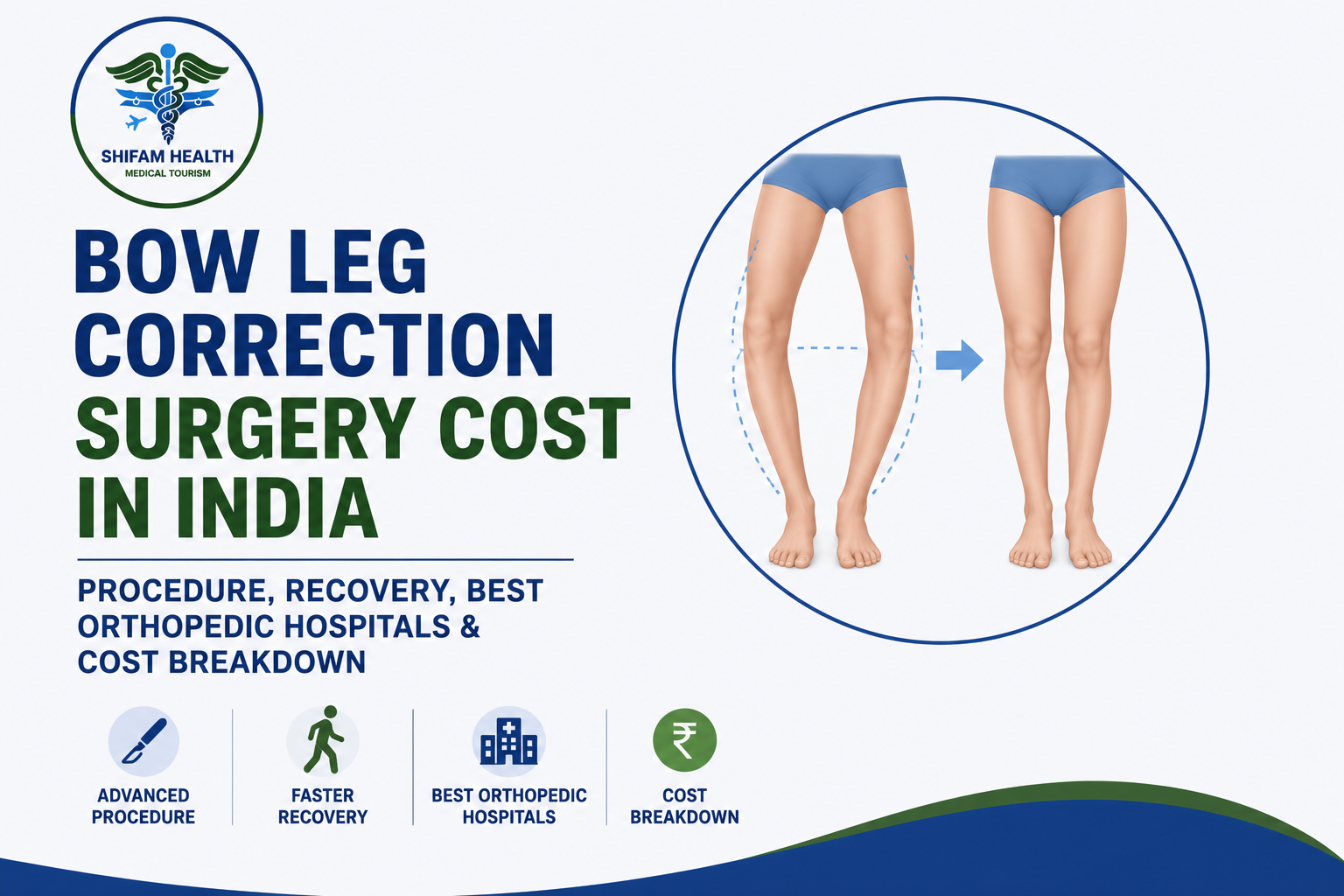
Bow leg (genu varum) is a condition in which the legs curve outward, creating a gap between the knees when the ankles are together. Mild bowing is normal in toddlers but usually corrects by age 3. Persistent or worsening bow legs in older children and adults require orthopedic evaluation.
Common Causes
Children:
- Blount’s disease
- Rickets (Vitamin D deficiency)
- Growth plate injuries
- Congenital deformities
Adults:
- Osteoarthritis
- Poorly healed fractures
- Paget’s disease
- Long-term joint wear
When Surgery May Be Needed
Surgery may be recommended if you have:
- Persistent knee pain
- Progressive bowing
- Limp or walking difficulty
- Uneven leg alignment
- Knee arthritis on X-ray
- Failed conservative treatment
When Surgery Is Not Recommended
Surgery is usually avoided in:
- Children under 2–3 years with normal developmental bowing
- Advanced knee arthritis requiring knee replacement
- Active infection or uncontrolled medical conditions
- Heavy smokers or severe obesity until optimized
Types of Bow Leg Correction Surgery

Guided Growth Surgery: A minimally invasive option for growing children with open growth plates.
High Tibial Osteotomy (HTO): Most common procedure for adults with tibial bowing and early arthritis.
Distal Femoral Osteotomy (DFO): Corrects deformity originating from the femur.
Combined Osteotomy: Used for severe deformities involving both the tibia and femur.
External Fixator (Ilizarov/Taylor Frame): Best for severe deformities, limb lengthening, or revision surgery.
Bow Leg Correction Surgery Cost in India
⚠️ Pricing note: Figures below reflect international patient pricing at established private hospitals (mid-tier to JCI-accredited). Domestic Indian patients are typically quoted 40–60% less. We strongly recommend requesting a personalized cost estimate from Shifam Health based on your X-rays and medical reports before budgeting — pricing varies considerably by case complexity.
All-Inclusive Cost Ranges (International Patients)
| Procedure | Estimated Cost (USD) | Hospital Stay | Notes |
|---|---|---|---|
| High Tibial Osteotomy (One Leg) | $4,500–$7,500 | 3–5 days | Most common procedure for adult bow legs. |
| High Tibial Osteotomy (Both Legs) | $8,000–$13,500 | 5–8 days | Simultaneous or staged 6–8 weeks apart. |
| Distal Femoral Osteotomy | $5,500–$8,500 | 4–6 days | Used when deformity originates in the femur. |
| Combined Tibial + Femoral Osteotomy | $8,500–$14,000 | 5–7 days | For complex multi-level deformities. |
| Ilizarov / External Fixator | $5,000–$9,000 | 3–5 days | Frame adjustments continue as an outpatient. |
| Guided Growth Surgery (Children) | $2,500–$5,000 | 1–2 days | Suitable only for growing children. |
| Revision Surgery | +20–40% | Varies | Depends on previous surgery and complexity. |
What a Package Typically Includes
- Pre-surgical blood work and X-rays (standing long-leg radiograph)
- Surgeon and anesthesiologist fees
- Operation theatre charges
- Implants (plate, screws, bone graft if needed)
- Hospital room (usually standard or semi-private)
- Meals during admission
- Nursing care and medications during stay
- Initial physiotherapy sessions in hospital
- Follow-up consultations during India stay
Common Extras to Budget For
- MRI (if not already done): $100–250
- CT scan for 3D planning (complex cases): $150–300
- Gait analysis: $100–200
- Outpatient physiotherapy sessions (approx. $15–30/session, 2–3 sessions/week for 8–12 weeks)
- Guest house accommodation near hospital: $20–60/day
- Interpreter services (usually provided free by international patient departments at major hospitals)
- Travel, visa, meals outside hospital
India vs Other Countries: Cost Comparison
| Country | HTO Cost (USD) | Waiting Time | Notes |
|---|---|---|---|
| India | $4,500–$7,500 | 1–3 weeks | JCI hospitals, experienced surgeons, excellent value. |
| Turkey | $5,000–$9,000 | 2–4 weeks | Growing destination; English may be limited. |
| Thailand | $7,000–$11,000 | 2–4 weeks | High-quality care with higher costs. |
| UAE | $10,000–$18,000 | 1–2 weeks | Premium hospitals and pricing. |
| UK | $18,000–$28,000 | 6–18 months (NHS) Private: Immediate | Long NHS waits; private treatment is expensive. |
| USA | $25,000–$45,000 | 2–6 weeks | Excellent care but highest overall cost. |
| Germany | $20,000–$35,000 | 4–8 weeks | Outstanding outcomes with premium pricing. |
India’s combination of short waiting times, experienced deformity-correction surgeons, JCI/NABH-accredited facilities, and English-speaking teams makes it the most practical choice for most international patients from Africa, the Middle East, Bangladesh, and Central Asia.
How to Choose a Hospital and Surgeon
There is no single “best” hospital for bow leg correction — the right choice depends on the severity of your deformity, your budget, and your proximity to specific cities in India. What matters most:
For the hospital:
- JCI or NABH accreditation (ensures international-standard patient safety protocols)
- Dedicated orthopedics and deformity correction department
- Access to advanced imaging — weight-bearing full-length X-rays, MRI, and 3D CT when needed
- International patient department with coordinators who speak Arabic, French, or Bangla
- In-house physiotherapy and rehabilitation program
For the surgeon:
- Specific experience in lower limb deformity correction (not just general orthopedics or joint replacement)
- Volume — a surgeon who performs 50+ osteotomies per year will have better outcomes than one who does a handful
- Ask explicitly: “How many HTOs have you performed in the last year?” A confident, experienced surgeon will answer directly
- Ability to review your imaging before arrival and provide a clear treatment plan
Hospitals with established deformity correction programs include Apollo Hospitals (Delhi, Chennai, Hyderabad), Medanta The Medicity (Gurugram), Fortis Hospital (multiple cities), Max Healthcare (Delhi), Artemis Hospital (Gurugram), and Kokilaben Dhirubhai Ambani Hospital (Mumbai).
The Surgical Procedure: What Actually Happens

Understanding what you’re signing up for reduces anxiety significantly.
Before surgery (1–2 days before): Full imaging is taken — a standing long-leg X-ray that shows the mechanical axis of both limbs is essential. The surgeon uses this to calculate the exact correction angle needed. Blood tests, cardiac clearance if over 50, and anesthesia assessment are completed.
On the day of surgery: You’ll receive either general anesthesia (fully asleep) or spinal anesthesia (awake but numb from the waist down — this is often preferred as it reduces blood loss and recovery time).
The procedure itself takes approximately 1.5–2.5 hours per leg. For an opening wedge HTO:
- A small incision is made below and to the inner side of the knee
- The tibia is carefully cut most of the way through — not fully severed
- The bone is gently opened to the calculated correction angle
- A bone graft (from the patient’s pelvis or a synthetic graft) fills the gap
- A titanium plate and screws lock the correction in place
- The incision is closed and a dressing applied
You’ll wake up with your leg in a brace or cast and will begin mobility exercises the next day.
Recovery Timeline: What to Expect Week by Week

Recovery from osteotomy is gradual. Bone healing cannot be rushed, and patients who push too hard too soon risk nonunion (the bone failing to fully heal).
| Phase | Timeline | Recovery & Activity |
|---|---|---|
| Hospital Recovery | Days 1–3 | Pain control, physiotherapy begins, ankle pumps, leg raises, assisted walking. |
| Early Recovery | Weeks 1–2 | Crutches, no weight-bearing, wound care, ice and leg elevation. |
| Bone Healing | Weeks 2–6 | Physiotherapy 2–3×/week; gradual partial weight-bearing. |
| Progressive Walking | Weeks 6–10 | Healing confirmed on X-ray; increase weight-bearing and reduce crutch use. |
| Independent Mobility | Months 3–4 | Walk without aids; return to light work; avoid running. |
| Advanced Recovery | Months 4–6 | Bone consolidation; return to gym, sports, and longer walks. |
| Full Recovery | 1 Year | Bone fully healed; most patients resume normal activities. |
For international patients: Most surgeons recommend a minimum stay in India of 3–4 weeks after surgery before flying home. This allows the wound to heal, initial physiotherapy to begin, and an X-ray to confirm early bone healing. Discuss your travel plans explicitly with your surgeon.
Risks and Complications — Honest Information
Experienced surgeons, accredited hospitals, and proper patient selection significantly reduce these risks — but they exist, and you deserve to know about them.
Serious but uncommon complications:
- Nonunion — the cut bone fails to heal in the corrected position (approximately 2–5% of cases; higher risk in smokers and diabetics)
- Malalignment — the correction doesn’t achieve the intended angle
- Infection — superficial wound infections occur in 1–3% of cases; deep infection around the implant is rarer but more serious
- Deep vein thrombosis (DVT) — blood clot in the leg; prevented with blood thinners and early mobilization
- Nerve injury — the peroneal nerve runs near the surgical area; numbness or weakness in the foot can occur, usually temporary
- Implant irritation — the plate can occasionally cause discomfort; some patients request removal after bone healing (a minor second procedure)
- Need for revision surgery — in complex deformities or if healing is suboptimal
What significantly reduces your risk:
- Quitting smoking at least 6 weeks before surgery (non-negotiable for bone healing)
- Maintaining a healthy weight
- Managing diabetes tightly (target HbA1c below 7.5% ideally)
- Choosing a high-volume surgeon at an accredited hospital
- Following the rehabilitation protocol strictly
Recovery, Rehabilitation, and Life After Surgery
Physiotherapy is not optional, it is part of the treatment. Expect to work with a physiotherapist starting the day after surgery.
Key milestones physiotherapy targets:
- Regain full knee flexion (bending) — most patients achieve 90 degrees by 4–6 weeks
- Reduce muscle wasting in the quadriceps and hamstrings
- Normalize gait pattern once full weight-bearing resumes
- Improve balance and proprioception
When you return home, your local physiotherapist should receive a clear discharge summary and rehabilitation protocol from the India team. Shifam Health can coordinate this handover.
When can you return to work?
- Desk-based work: 6–8 weeks
- Light physical work: 3–4 months
- Manual labor: 5–6 months (surgeon’s clearance required)
When can you drive? Typically 8–12 weeks after right-leg surgery, once you can safely perform emergency braking. Left leg may be earlier if automatic transmission.
Myths vs. Facts About Bow Leg Surgery
| Myth | Fact |
|---|---|
| Surgery is only for children. | Adults aged 25–55 are the most common candidates for HTO. |
| You’ll need a knee replacement anyway. | HTO can delay knee replacement by 10–15+ years in suitable patients. |
| Exercise or yoga can fix bow legs. | Exercise strengthens muscles but cannot correct bone alignment. |
| Recovery takes years. | Most patients walk independently by 3 months and return to sports by 6 months. |
| Surgery is only cosmetic. | The main goals are pain relief and joint preservation; cosmetic improvement is secondary. |
| All bow leg surgeries are the same. | HTO, DFO, Ilizarov, and guided growth treat different deformities and patients. |
Your Journey as an International Patient: Step by Step

- Send your reports
Share your X-rays (especially a standing full-leg X-ray if you have one), MRI if available, and a brief description of your symptoms and history. Shifam Health reviews these with the appropriate specialist.
- Receive a treatment plan and cost estimate
Within 3–5 working days, you’ll receive a personalized recommendation which procedure, which hospital tier, and a cost range based on your specific case
- Video consultation
A teleconsultation with the recommended surgeon allows you to ask questions and confirm you’re comfortable before committing.
- Apply for a medical visa
India grants a medical visa (M-Visa) for patients traveling for treatment, valid for up to 1 year with multiple entries. You’ll need a letter from the treating hospital, which Shifam Health arranges.
- Travel and arrival
Airport pickup, accommodation near the hospital, and pre-admission coordination are handled for you.
- Admission, surgery, and recovery
Surgery typically happens within 1–3 days of arrival. You’ll spend 3–5 days in hospital, then move to nearby accommodation for 2–3 weeks of outpatient physiotherapy and follow-up.
- Return home
You’ll travel home with a complete medical file, rehabilitation protocol, and remote follow-up access to your India surgeon
How Shifam Health Supports International Patients
When you come through Shifam Health, you receive:
- Free case review — your reports assessed by the right specialist, not routed to whoever is available
- Transparent cost estimates — based on your actual case, not generic website figures
- Hospital and surgeon shortlisting — matched to your clinical needs and budget
- Medical visa invitation letter — issued directly from the treating hospital
- Airport pickup and accommodation coordination — so arrival day isn’t stressful
- On-the-ground support — our coordinators are available during your India stay
- Interpretation support where needed (Arabic, French, Swahili)
- Post-treatment follow-up — so you’re not left without support once you’re home
We’ve supported patients from Bangladesh, Yemen, Nigeria, Kenya, Ethiopia, the UAE, and beyond through treatment in India. Our team understands what it means to be far from home and unwell we take that seriously.
Ready to Take the Next Step?
If you or a family member is dealing with bow legs, varus deformity, or knee pain from malalignment, the most useful thing you can do right now is share your imaging with us.
Send your X-rays (WhatsApp or email), tell us briefly about your symptoms and history, and we’ll come back to you within 24–48 hours with a clear picture of what treatment is recommended, where, and what it will cost.
There’s no commitment required. We’re here to help you understand your options and make the right decision for your health.
Frequently Asked Questions
How much does bow leg correction surgery cost in India?
The cost ranges from USD 5,000–7,500 for a single-leg High Tibial Osteotomy (HTO), depending on the hospital and complexity.
Can adults undergo bow leg correction surgery?
Yes. HTO is commonly performed in adults, while guided growth surgery is mainly for children.
How long is recovery after surgery?
Most patients use crutches for 4–6 weeks and recover fully within 3–6 months.
How long should international patients stay in India?
Plan to stay 3–4 weeks for surgery, follow-up, physiotherapy, and travel clearance.
Is bow leg correction surgery painful?
Mild to moderate pain is expected initially but is well controlled with medication and improves steadily.
Will I need a knee replacement later?
HTO can delay knee replacement by 10–15 years or more in suitable patients.
Is smoking a problem before surgery?
Yes. Smoking slows bone healing and increases the risk of complications. Most surgeons recommend stopping at least 6 weeks before surgery.
What tests are needed before surgery?
A standing full-leg X-ray is essential. An MRI may be recommended if knee cartilage damage is suspected.
How do I get started?
Share your X-rays and medical reports with Shifam Health for a free specialist review, treatment plan, and cost estimate.