



Home > Blog > Partial Knee Replacement Cost in India (2026): Best Hospitals, Recovery & Partial vs Total Knee Replacement
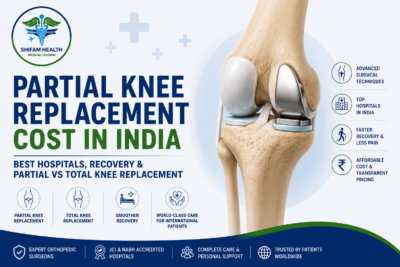
Partial Knee Replacement Cost in India (2026): Best Hospitals, Recovery & Partial vs Total Knee Replacement
Filters & Insights
Discover cost, recovery, hospitals, and benefits of partial knee replacement in India for international patients.

Knee arthritis does not always affect the entire joint. In a significant proportion of patients, degeneration is confined to a single compartment and operating on the whole knee when only part of it is damaged is, clinically speaking, unnecessary.
Partial Knee Replacement (PKR), also known as unicompartmental knee replacement, addresses exactly this. It removes and resurfaces only the damaged compartment, preserves the healthy bone and ligaments that remain, and restores function with considerably less surgical trauma than a total knee replacement.
For international patients, India has become one of the most clinically credible destinations for this procedure. JCI-accredited hospitals, fellowship-trained orthopaedic surgeons, robotic-assisted operating systems, and treatment costs 60–70% below Western equivalents with no waiting list make India a medically sound and practically accessible choice.
This guide provides a structured clinical overview: candidacy criteria, a direct comparison with total knee replacement, cost data, hospital standards, and a detailed recovery framework for international patients planning treatment in India.
Table of Contents
ToggleWhat Is Partial Knee Replacement?
The knee joint comprises three compartments: the medial (inner side), the lateral (outer side), and the patellofemoral (between the kneecap and femur). Osteoarthritis frequently begins in one compartment most commonly the medial before progressing further.
Partial Knee Replacement, or unicompartmental knee arthroplasty, replaces only the affected compartment with a prosthetic implant. The cruciate ligaments, healthy cartilage, and bone in the remaining compartments are left entirely intact. This compartmental specificity is the defining clinical advantage of PKR over total knee replacement and the reason outcomes in appropriately selected patients consistently demonstrate more natural post-operative knee kinematics.
The procedure is performed arthroscopically through a smaller incision than total knee surgery, typically under spinal anesthesia, and takes approximately 1–2 hours.
Who Is a Suitable Candidate for Partial Knee Replacement?
Patient selection is the single most important determinant of PKR success. The procedure delivers optimal outcomes when damage is genuinely confined to one compartment and the surrounding joint architecture is structurally sound. Thorough pre-operative imaging — weight-bearing X-rays and MRI — is essential to confirm eligibility.
| Clinical Criterion | Why It Matters |
|---|---|
| Single-Compartment Osteoarthritis | Partial knee replacement is suitable only when arthritis affects one compartment. |
| Intact ACL | Maintains knee stability after surgery. |
| Intact PCL | Helps preserve natural knee movement. |
| Pain Limited to One Side | Suggests isolated joint damage rather than widespread arthritis. |
| No Inflammatory Arthritis | Conditions like rheumatoid arthritis usually require total knee replacement. |
| Knee Flexion ≥90° | Improves post-operative function and recovery. |
| Conservative Treatment Failed | Surgery is considered when medicines, injections, and physiotherapy no longer relieve symptoms. |
Clinical note: Patients with severe tri-compartmental arthritis, significant varus or valgus deformity beyond 15°, inflammatory arthropathy, or ACL-deficient knees are not suitable for PKR. Total Knee Replacement is the clinically appropriate intervention in these cases. Shifam Health arranges a free specialist review of your imaging and reports before any treatment decision is made.
Partial Knee Replacement vs Total Knee Replacement: A Clinical Comparison
The choice between PKR and TKR is not a matter of patient preference — it is a clinical decision based on the extent and distribution of joint disease. For patients who meet the criteria for partial replacement, the evidence consistently supports PKR as the less morbid, faster-recovering intervention.
| Clinical Parameter | Partial Knee Replacement (PKR) | Total Knee Replacement (TKR) |
|---|---|---|
| Extent of Surgery | One knee compartment replaced. | Entire knee joint replaced. |
| Ligaments | ACL & PCL preserved. | ACL usually removed. |
| Bone Preservation | Most healthy bone retained. | More bone removed. |
| Incision | 8–10 cm (minimally invasive). | 15–20 cm. |
| Blood Loss | Low; transfusion rarely needed. | Higher; transfusion may be required. |
| Hospital Stay | 5–7 days | 10–14 days |
| Walking | Within 24–48 hours. | Usually after 3–5 days. |
| Daily Activities | 3–4 weeks. | 6–8 weeks. |
| Full Recovery | 6–8 weeks. | 3–4 months. |
| Knee Function | Feels more natural. | Excellent function but less natural. |
| Revision Risk | Slightly higher if arthritis progresses. | Lower in advanced arthritis. |
| Best For | Single-compartment osteoarthritis. | Advanced or multi-compartment arthritis. |
For international patients, the difference in hospital stay is operationally significant. A PKR patient in India requires 2–3 weeks in-country including pre-operative assessment and post-surgical physiotherapy before receiving fitness-to-fly clearance. A TKR patient requires 4–6 weeks. That distinction affects travel costs, accommodation planning, and the overall logistical burden of treatment abroad.
Why India Is a Clinically Credible Destination for Partial Knee Replacement
India’s standing in orthopaedic surgery is not built on cost alone. The clinical infrastructure supporting PKR in India’s leading hospitals is substantive and internationally benchmarked.
Surgical Expertise and Case Volume
India’s foremost orthopedic surgeons hold fellowship training from institutions in the United Kingdom, United States, Germany, and Australia. High-volume centers perform several thousand knee replacements annually. Surgical volume is a validated predictor of outcome in arthroplasty higher volume correlates with lower complication rates, more accurate implant positioning, and reduced revision surgery rates.
Robotic-Assisted Surgical Systems
Top hospitals in India use robotic platforms — including Mako (Stryker) and similar navigation systems for PKR. These systems provide real-time intraoperative feedback on bone resection, implant alignment, and soft tissue balance. The precision they afford is particularly valuable in partial replacement, where accurate compartmental resurfacing determines long-term functional success.
Internationally Accredited Standards
Leading hospitals hold JCI (Joint Commission International) accreditation or NABH certification — the internationally recognised benchmarks for clinical quality, patient safety protocols, surgical site infection control, and post-operative care standards. These are not courtesy designations; they require demonstrated compliance with rigorous operational criteria.
No Waiting Period
In the United Kingdom, National Health Service waiting times for elective knee replacement currently exceed 12 months in many regions. In Canada and across much of Europe, comparable delays apply. India’s private hospitals schedule procedures within days of receiving a patient’s medical reports — a clinically meaningful difference for patients with active joint deterioration.
Cost of Partial Knee Replacement in India: International Comparison
The cost differential between India and Western healthcare systems for PKR is substantial. The figures below represent all-inclusive surgical packages covering surgeon fees, anaesthesia, hospital stay, implants, nursing care, and standard post-operative physiotherapy.
| Country | Average Cost (USD) | Savings vs India |
|---|---|---|
| 🇮🇳 India | $4,500–$6,500 | — |
| 🇬🇧 United Kingdom | $15,000–$20,000 | India is 65–70% less expensive. |
| 🇺🇸 United States | $25,000–$35,000 | India is 75–82% less expensive. |
| 🇪🇺 Europe | $18,000–$25,000 | India is 65–75% less expensive. |
| 🇦🇺 Australia | $20,000–$28,000 | India is 70–77% less expensive. |
Additional costs for international patients pre-operative investigations ($200–$600), post-surgical physiotherapy in India ($300–$800), accommodation ($200–$600 per week), and local transfers ($100–$300) remain modest relative to Western surgical costs. Even after accounting for flights and all in-country expenses, the total spend in India typically remains well below the surgical cost alone in Western healthcare systems.
Shifam Health provides a fully itemised, all-inclusive cost estimate before any commitment to travel. There are no hidden fees and no ambiguity in what the package covers.
Hospitals Performing Partial Knee Replacement in India
India’s leading orthopaedic centres combine international accreditation, dedicated international patient departments, advanced robotic technology, and high annual procedure volumes. The hospitals below consistently serve international patients for partial and total knee replacement.
Apollo Hospitals — Operating across Delhi, Chennai, Hyderabad, and Mumbai, Apollo’s orthopedic departments perform high volumes of robotic-assisted PKR and TKR. Their internationally trained surgical teams and structured pre- and post-operative patient coordination are well-established for international cases.
Fortis Healthcare — With centres in Delhi, Gurugram, and Bangalore, Fortis offers advanced minimally invasive knee surgery through fellowship-trained surgeons and integrated rehabilitation programmes. International patient services cover clinical coordination, accommodation support, and follow-up planning.
Medanta – The Medicity (Gurugram) — One of India’s highest-volume centers for robotic joint replacement. Medanta’s Institute of Musculoskeletal Disorders handles complex arthroplasty cases routinely and maintains a dedicated international patient division.
Max Healthcare (Delhi/Noida) — Max Healthcare runs a structured international patient programme with dedicated case coordinators. Facilities include modern arthroscopy suites, robotic operating capability, and in-house rehabilitation services.
Artemis Hospital (Gurugram) — JCI-accredited with a strong orthopedic and sports medicine department. Artemis maintains consistent surgical safety outcomes and offers comprehensive international patient support infrastructure.
Kokilaben Dhirubhai Ambani Hospital (Mumbai) — A recognized center for robotic joint reconstruction and complex knee arthroplasty in Western India, with strong international patient coordination services.
All hospitals listed above hold either JCI accreditation or NABH certification. Shifam Health works directly with these institutions and matches each patient to the most appropriate facility based on clinical complexity, surgeon specialization, and geographic preferences.
Recovery After Partial Knee Replacement: What International Patients Should Expect
Recovery following PKR is one of the procedure’s most clinically distinctive features. The preservation of healthy tissue, reduced surgical trauma, and smaller incision produce a recovery arc that is measurably faster than total knee replacement at every stage.
| Recovery Milestone | Partial Knee Replacement | Total Knee Replacement |
|---|---|---|
| Walking with Support | 24–48 hours | 3–5 days |
| Physiotherapy Starts | Day 1–2 | Day 2–3 |
| Hospital Stay | 5–7 days | 10–14 days |
| Wound Review | 10–12 days | 12–14 days |
| Air Travel | 2–3 weeks | 4–6 weeks |
| Light Daily Activities | 3–4 weeks | 6–8 weeks |
| Driving | 3–4 weeks | 6–8 weeks |
| Full Recovery | 6–8 weeks | 3–4 months |
International patients undergoing PKR in India should plan for a minimum 2–3 week stay covering pre-operative assessment (1–2 days), surgery, in-hospital recovery (5–7 days), and supervised outpatient physiotherapy before fitness-to-fly clearance. Hospitals issue a formal discharge summary and post-operative protocol document for your treating physician at home.
How Shifam Health Supports Your Treatment in India
Shifam Health is a dedicated medical tourism company specialising in connecting international patients with India’s leading orthopaedic centres. Their role is not administrative facilitation — it is end-to-end clinical and logistical coordination that removes the complexity of accessing specialised care in a foreign healthcare system.
| Stage | How Shifam Health Helps |
|---|---|
| Pre-Travel Review | Reviews your X-rays/MRI and medical records, then arranges a free specialist opinion to confirm if partial knee replacement is suitable. |
| Hospital & Surgeon Selection | Matches you with the most suitable orthopedic surgeon and hospital based on your condition and budget. |
| Cost Estimate | Provides a transparent, itemized treatment quotation with no hidden charges. |
| Medical Visa Support | Assists with hospital invitation letters and Indian Medical Visa documentation. |
| Travel & Stay | Coordinates airport pickup, accommodation, and local transportation during your treatment. |
| Treatment Coordination | Schedules appointments, provides interpreter support, and assists throughout your hospital stay. |
| Aftercare | Provides discharge documents, rehabilitation guidance, and remote follow-up after you return home. |
Conclusion
Partial Knee Replacement is a clinically validated, evidence-based intervention for appropriately selected patients with single-compartment knee disease. Performed in India by fellowship-trained surgeons using robotic-assisted technology in internationally accredited hospitals, it offers international patients a procedure of demonstrably high quality at a cost that is 60–80% lower than Western equivalents — with a recovery timeline that is half that of total knee replacement.
The decision to pursue PKR should follow a thorough specialist review of your imaging and clinical history. Shifam Health provides that review at no cost, with no obligation to travel, and manages every subsequent step of the process should you decide to proceed.
Frequently Asked Questions
How is partial knee replacement different from total knee replacement?
Partial knee replacement replaces only the affected section, while total knee replacement replaces the entire knee joint.
Is partial knee replacement safe in India?
Yes, India has internationally accredited hospitals and experienced orthopaedic surgeons with high success rates.
How long do international patients need to stay in India?
Most patients stay 3–4 weeks, including surgery, recovery, and follow-up consultations.
Will I need physiotherapy after surgery?
Yes, physiotherapy is essential for faster recovery and improved knee mobility.
Can both knees be treated at the same time?
Yes, in selected cases, surgeons may perform bilateral partial knee replacement if medically suitable.
How long does a partial knee implant last?
Modern implants usually last 15–20 years with proper care and activity management.

Popular Posts From Last Week
- June 25, 2026
- shifamhealth
If you have been diagnosed with Atrial Fibrillation, your doctor has likely already spoken to you about stroke…
- June 24, 2026
- shifamhealth
If your cardiologist has used the word LVAD, you’ve likely already been living with advanced heart failure for…
- June 24, 2026
- shifamhealth
A stroke can change a life in minutes. For families in Bangladesh, the UAE, East Africa, or the…
- June 24, 2026
- shifamhealth
When a doctor tells parents their newborn has hydrocephalus or tells an adult patient that fluid is building…
- June 26, 2026
- shifamhealth
A diagnosis of multiple sclerosis changes everything suddenly there is a chronic condition to manage, medications to understand,…
- June 26, 2026
- shifamhealth
Quick Answer: India offers advanced spinal cord tumor surgery — including microsurgical tumor removal, intraoperative neuromonitoring, and minimally…
- June 30, 2026
- Zainab Khan
Knee arthritis does not always affect the entire joint. In a significant proportion of patients, degeneration is confined…
- June 26, 2026
- shifamhealth
Hydrocephalus treatment in India for international patients typically costs USD 5,000 to USD 8,500 for VP shunt surgery…
- June 26, 2026
- shifamhealth
Finding out you have a brain arteriovenous malformation particularly after a haemorrhage or a seizure is a frightening…
- June 25, 2026
- shifamhealth
How Much Does Egg Freezing Cost in India? Egg freezing in India typically costs between ₹1,50,000 and ₹3,50,000…
- June 25, 2026
- shifamhealth
The surgery is done. The new liver is in place. The hardest part is over or so everyone…
- June 25, 2026
- shifamhealth
Your son is just a baby or perhaps a toddler and the pediatrician has just told you something…