



Egg Freezing Cost in India | Ultimate Guide for Overseas Patients (2026)
Filters & Insights
Get a full breakdown of consultation, medication, retrieval, and storage costs. Compare India vs USA, UK & UAE. Plan your fertility preservation journey with confidence
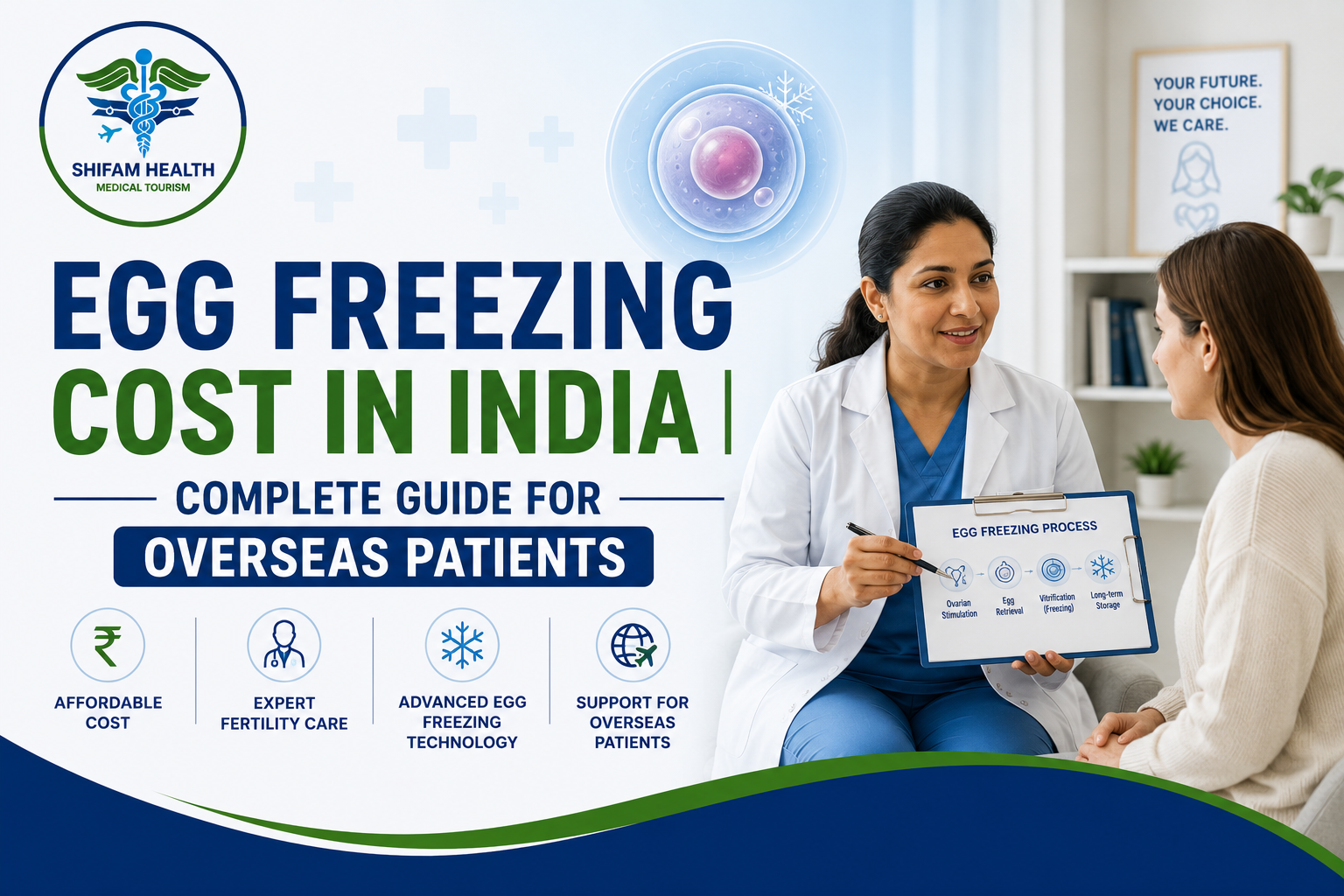
How Much Does Egg Freezing Cost in India?
Egg freezing in India typically costs between ₹1,50,000 and ₹3,50,000 (approximately USD 1,800–4,200) for a complete cycle including ovarian stimulation, monitoring scans, egg retrieval, and laboratory cryopreservation. Annual storage fees range from ₹15,000 to ₹40,000 (USD 180–480). Medications are an additional ₹60,000–₹1,20,000 (USD 720–1,450).
You have goals. You have a career, an education to finish, a relationship to build, or simply a life that isn’t quite ready for a child yet. Or perhaps you’ve just received a cancer diagnosis, and your doctor wants to begin treatment that could affect your fertility.
Whatever your reason, the desire to protect your future family on your own terms and timeline is one of the most personal and forward-thinking decisions a woman can make.
Egg freezing, or oocyte cryopreservation, has transformed from an experimental procedure into one of the most established and accessible fertility preservation methods in the world. And India has quietly become one of the leading global destinations for this treatment offering world-class fertility technology, experienced specialists, and costs that are a fraction of what patients pay in Western countries.
This guide gives you everything you need to understand egg freezing costs in India, how the procedure works, what to realistically expect, and how to plan your treatment as an international patient.
Table of Contents
ToggleWhat Is Egg Freezing and Why Does It Matter?
Egg freezing is a fertility preservation technique where mature eggs are extracted from your ovaries, frozen using a method called vitrification, and stored for future use. When you’re ready to conceive, the eggs are thawed, fertilized with sperm, and transferred to the uterus as embryos through IVF.
The science behind it has advanced dramatically. Vitrification a rapid-freeze technique has replaced older slow-freeze methods and significantly improved egg survival rates after thawing.
Egg freezing matters because a woman’s egg quality and quantity decline with age. Freezing eggs at a younger age essentially “locks in” their quality, giving you biological options regardless of when life brings you to the point of wanting a pregnancy.
Complete Egg Freezing Cost Breakdown in India
One of the most important things international patients want to know is exactly what they’re paying for. Here’s a transparent breakdown.
Cost Component Table
| Component | Estimated Cost (INR) | Estimated Cost (USD) |
|---|---|---|
| Initial Fertility Consultation | ₹1,500 – ₹3,000 | USD 18 – 36 |
| AMH + Hormone Blood Tests | ₹5,000 – ₹12,000 | USD 60 – 145 |
| Antral Follicle Count (Ultrasound) | ₹2,000 – ₹5,000 | USD 24 – 60 |
| Hormonal Stimulation Medications | ₹60,000 – ₹1,20,000 | USD 720 – 1,450 |
| Monitoring Scans (3–5 Visits) | ₹8,000 – ₹20,000 | USD 96 – 240 |
| Egg Retrieval Procedure | ₹40,000 – ₹80,000 | USD 480 – 960 |
| Anaesthesia | ₹10,000 – ₹20,000 | USD 120 – 240 |
| Laboratory Cryopreservation | ₹20,000 – ₹50,000 | USD 240 – 600 |
| First-Year Storage | ₹15,000 – ₹40,000 | USD 180 – 480 |
| Total (First Cycle, Excluding Storage) | ₹1,50,000 – ₹3,50,000 | USD 1,800 – 4,200 |
Important note: Medications are typically the most variable cost. They depend on your age, ovarian reserve, and response to stimulation. Women with lower ovarian reserve or older age may require higher medication doses, increasing the overall cost.
Some clinics offer bundled packages. Always ask for an itemized breakdown.
City-Wise Egg Freezing Cost Comparison in India
Costs vary depending on the city, the clinic’s reputation, the technology used, and the experience of the fertility specialist.
| City | Estimated Cost Range (INR) | International Accessibility | Notable Advantages |
|---|---|---|---|
| Delhi / Gurgaon | ₹1,80,000 – ₹3,50,000 | Excellent | Hub of top fertility clinics with direct international flight connections. |
| Mumbai | ₹2,00,000 – ₹4,00,000 | Excellent | Advanced IVF laboratories and strong cosmopolitan infrastructure for international patients. |
| Chennai | ₹1,50,000 – ₹3,00,000 | Good | Established medical tourism ecosystem and experienced fertility specialists. |
| Bangalore | ₹1,70,000 – ₹3,20,000 | Good | Strong technology-driven fertility centres and modern laboratory facilities. |
| Hyderabad | ₹1,50,000 – ₹3,00,000 | Good | Affordable treatment options with modern hospitals and growing fertility services. |
| Kolkata | ₹1,20,000 – ₹2,50,000 | Moderate | Lower treatment costs with quality fertility clinics available for suitable cases. |
Delhi and Gurgaon remain the top choice for international patients due to the concentration of internationally accredited hospitals, English-speaking teams, and direct flight connectivity from the Middle East, Africa, and South Asia.
Egg Freezing Cost: India vs Other Countries
This is where the numbers become genuinely compelling for international patients.
International Cost Comparison Table
| Country | Procedure Cost (USD) | Medications (USD) | Annual Storage (USD) | Total Estimated Cost – Year 1 |
|---|---|---|---|---|
| India | USD 1,800 – 4,200 | USD 720 – 1,450 | USD 180 – 480 | USD 2,700 – 6,130 |
| USA | USD 10,000 – 15,000 | USD 3,000 – 6,000 | USD 600 – 800 | USD 13,600 – 21,800 |
| UK | USD 8,000 – 12,000 | USD 1,500 – 3,000 | USD 300 – 600 | USD 9,800 – 15,600 |
| UAE | USD 6,000 – 10,000 | USD 1,500 – 3,000 | USD 400 – 700 | USD 7,900 – 13,700 |
| Singapore | USD 8,000 – 14,000 | USD 2,000 – 4,000 | USD 500 – 900 | USD 10,500 – 18,900 |
| Thailand | USD 4,000 – 7,000 | USD 1,500 – 2,500 | USD 300 – 500 | USD 5,800 – 10,000 |
| Turkey | USD 3,000 – 6,000 | USD 1,000 – 2,000 | USD 250 – 500 | USD 4,250 – 8,500 |
India offers savings of 60–80% compared to the USA and UK without compromising on technology, laboratory quality, or medical expertise. For international patients already considering travel for treatment, the financial case for India is very strong.
Who Should Consider Egg Freezing?
Egg freezing is not the right decision for everyone, but it can be a valuable option for women who want to delay pregnancy. It is often considered by women aged 30–35 who are not planning pregnancy in the next few years, as egg quality gradually declines with age.
It can also support women focused on education, career growth, or finding the right partner. For cancer patients, freezing eggs before chemotherapy or radiation may help preserve future fertility. Women with low ovarian reserve, endometriosis, or a family history of early menopause may also benefit from considering it earlier.
International patients choose India for affordable, advanced fertility care, experienced specialists, and shorter waiting times.
The Egg Freezing Process: Step by Step
Understanding exactly what happens during treatment helps reduce anxiety and allows you to plan practically.
Step 1: Initial Consultation and Fertility Assessment
Your journey begins with a comprehensive fertility evaluation. This includes a detailed history, AMH (Anti-Müllerian Hormone) blood test, Day 2 or 3 FSH and estradiol testing, and a transvaginal ultrasound to assess antral follicle count. These tests give the doctor a clear picture of your ovarian reserve essentially, how many eggs you have available and how your body is likely to respond to stimulation.
This entire process typically takes 1–2 days and can often be arranged before your arrival in India through Shifam Health’s telemedicine coordination service.
Step 2: Ovarian Stimulation (Days 1–10 or 12)
You’ll self-administer hormonal injections daily for approximately 10–12 days. These medications stimulate your ovaries to produce multiple eggs rather than the single egg your body normally releases each month. Your clinic will show you exactly how to administer these injections — most women find it manageable within the first 1–2 days.
Step 3: Monitoring (Every 2–3 Days During Stimulation)
During the stimulation phase, you’ll have regular ultrasound scans and blood tests to monitor how your follicles are developing. Your medication doses may be adjusted. This monitoring phase is essential for safety — the doctors are watching for any sign of Ovarian Hyperstimulation Syndrome (OHSS) and optimizing your response.
Step 4: Trigger Injection
When your follicles reach the right size, you’ll receive a trigger injection to prepare the eggs for retrieval. Timing here is precise the retrieval happens exactly 34–36 hours after the trigger.
Step 5: Egg Retrieval
Egg retrieval is a minor surgical procedure performed under light sedation or general anesthesia. It takes approximately 20–30 minutes. A thin needle is guided through the vaginal wall using ultrasound, and the eggs are aspirated from each follicle. You won’t feel anything during the procedure. Most women rest for a few hours and go back to their accommodation the same day.
Step 6: Laboratory Cryopreservation
Immediately after retrieval, the eggs are assessed in the embryology laboratory. Mature eggs are vitrified frozen within minutes using the rapid vitrification technique and stored in liquid nitrogen at -196°C. This process preserves their quality for years.
Step 7: Storage
Your frozen eggs remain safely stored at the clinic. Annual storage fees apply. You can maintain them as long as permitted under Indian law (currently up to 10 years, with extensions possible in certain circumstances).
Step 8: Future Use
When you’re ready to use your frozen eggs, they are thawed, fertilized with sperm (your partner’s or donor sperm), and one or two resulting embryos are transferred to your uterus in an IVF cycle. The cost of this future IVF cycle is separate from the egg freezing costs.
Egg Freezing Success Rate in India: Realistic Expectations
Success rates for egg freezing are influenced by several factors. Being honest about this helps patients make informed decisions.
What Affects Success?
Age at freezing: This is the single most important factor. Eggs frozen before age 35 have significantly better quality and higher survival rates after thawing. Success rates decline progressively from 35 onward.
Number of eggs frozen: Most fertility specialists recommend freezing 10–20 mature eggs to achieve a reasonable chance of a live birth. Younger women may achieve this in one cycle. Older women or those with lower reserves may need 2–3 cycles.
Egg survival after thawing: Vitrification has dramatically improved this modern clinics report 80–90% egg survival rates after thawing.
Laboratory quality: This is non-negotiable. The quality of the embryology laboratory directly impacts outcomes. India’s leading fertility centers use international-standard equipment and protocols.
Future IVF success: Frozen egg IVF success rates per transfer are generally 30–50% for women who froze eggs under 35, and lower for older age groups.
Age-Wise Guidance Table
| Age at Egg Freezing | Expected Egg Quality | Typical Cycles Needed | Live Birth Potential |
|---|---|---|---|
| Under 30 | Excellent | Usually 1 cycle is sufficient. | Good to very good |
| 30–34 | Very good | Usually 1–2 cycles. | Good |
| 35–37 | Good but gradually declining | Usually 1–2 cycles; more eggs may be needed. | Moderate to good |
| 38–40 | Moderate decline | 2–3 cycles may be advisable. | Moderate |
| 40–42 | Significant decline | Multiple cycles are often needed. | Guarded |
| Over 42 | Poor | Egg freezing is not usually recommended using own eggs. | Limited |
Important: Egg freezing does not guarantee a future pregnancy. It significantly improves your options, but it is not an insurance policy. Doctors advise discussing realistic expectations during consultation.
Egg Freezing vs Embryo Freezing: Which Is Right for You?
| Factor | Egg Freezing | Embryo Freezing |
|---|---|---|
| Partner Required | No partner is required. | Yes, a partner or donor sperm is required. |
| Flexibility | High flexibility — eggs can be fertilised later using sperm chosen in the future. | Lower flexibility — embryos are created using specific sperm and may involve shared decisions. |
| Legal Complexity | Usually simpler for single women, as the eggs belong only to the woman. | May require consent forms, couple agreements, or legal clarity regarding embryo ownership and future use. |
| Success Rates | Good outcomes with modern vitrification, especially when eggs are frozen at a younger age. | May have slightly higher success rates per transfer because fertilisation and embryo development are already confirmed. |
| Best For | Single women, women without a partner, or those wanting maximum future reproductive control. | Married or partnered women who are ready to fertilise eggs now and have clear plans for future embryo use. |
| Cost | Usually slightly lower because fertilisation and embryo culture are not included initially. | Similar overall, but includes additional fertilisation, laboratory culture, and embryo development costs. |
For single women or women who do not have a partner, egg freezing is the appropriate option. Embryo freezing is generally recommended for couples who are certain about their partnership and want to potentially maximize future success rates.
Risks and Important Considerations
- OHSS: A rare but important risk where ovaries overreact to stimulation medicines. Careful monitoring helps reduce this risk.
- Medication effects: Temporary bloating, mood changes, breast tenderness, and fatigue may occur.
- Retrieval risks: Minor risks of bleeding or infection are rare.
- Storage planning: Understand the clinic’s storage policy, annual fees, and international egg transport options.
- Emotional wellbeing: The process can feel emotionally demanding, so clear expectations and support are important.
- No guarantee: Egg freezing improves future fertility options but cannot guarantee pregnancy.
Why International Patients Choose India for Egg Freezing
- Culturally sensitive care, including dietary, language, and religious preferences.
- Experienced fertility specialists and advanced IVF laboratories.
- Modern vitrification technology and international-standard protocols.
- Costs significantly lower than the USA, UK, and Gulf countries.
- Short waiting times, with treatment often starting within 1–2 weeks.
- English-speaking doctors and international patient coordinators.
- Medical visa, travel, accommodation, and airport support through Shifam Health.
How Shifam Health Supports International Fertility Patients
Shifam Health is not just a hospital referral service it is a complete medical journey coordinator for international patients.
For women traveling to India for egg freezing, Shifam Health provides:
- Free medical evaluation: Before you book anything, share your medical reports and fertility test results. Shifam Health’s team evaluates your situation and recommends the most suitable clinic and doctor based on your specific needs, budget, and location.
- Hospital and doctor selection: India has hundreds of fertility clinics. Quality varies significantly. Shifam Health works exclusively with accredited clinics that have demonstrated success with international patients and maintain the laboratory standards required for egg freezing.
- Transparent cost estimation: You receive a clear, itemized cost estimate before committing covering consultation, tests, stimulation medications, retrieval, cryopreservation, and storage. No hidden fees.
- Video consultation: You can speak with your chosen fertility specialist before traveling to India, allowing you to ask questions, understand your protocol, and arrive prepared.
- Medical visa assistance: From application guidance to invitation letters, Shifam Health assists patients from Bangladesh, Yemen, Nigeria, Kenya, the UAE, the UK, and beyond with medical visa documentation.
- Travel and accommodation coordination: Shifam Health coordinates airport pickup, accommodation near the clinic, and local transport so your medical journey is seamless.
- Language support: Interpretation assistance is available for Arabic, Bengali, and other languages as needed.
- Post-treatment follow-up: After your return home, Shifam Health maintains contact for any questions and coordinates with your clinic for reports and future planning.
The goal is simple: to make one of the most personal medical decisions of your life as straightforward and stress-free as possible.
Conclusion: Your Future Family, Protected on Your Terms
Egg freezing is not about putting life on pause. It is about making a clear-eyed, empowered decision to protect your options while you live the life you’ve built.
India has become one of the world’s most credible destinations for fertility preservation not because it is the cheapest option, but because it combines genuine medical expertise, advanced laboratory technology, and an established tradition of welcoming and caring for international patients.
If you are considering egg freezing and want to understand exactly what treatment would cost for your specific situation, what clinic would be most appropriate, and how to plan your journey from your home country to India and back, Shifam Health is here to help.
Get a personalized egg freezing consultation and cost estimate. Share your medical reports and questions with Shifam Health’s team and receive a clear treatment plan — at no obligation.
Your reproductive future deserves careful, expert guidance. We’re ready to provide it.
Frequently Asked Questions
How much does egg freezing cost in India?
A complete cycle typically costs ₹1,50,000–₹3,50,000 (USD 1,800–4,200). Medications may cost an additional ₹60,000–₹1,20,000, while annual storage is around ₹15,000–₹40,000.
What does the package include?
Usually egg retrieval, anesthesia, laboratory charges, freezing, and first-year storage. Medication and monitoring may be extra, so request an itemized quote.
What is the best age to freeze eggs?
Ideally between 28 and 35, when egg quality and ovarian reserve are generally higher. Freezing after 37 is possible but may require more cycles.
How many eggs should be frozen?
Most specialists recommend 10–20 mature eggs for a reasonable chance of one future pregnancy. The exact target depends on age and ovarian reserve.
Is egg freezing painful?
Stimulation may cause mild bloating or discomfort. Egg retrieval is performed under sedation, and mild cramps afterward usually settle within 1–2 days.
Can international patients freeze eggs in India?
Yes. International patients can undergo egg freezing in India with a Medical Visa. Shifam Health can assist with hospital coordination, visa support, travel, and accommodation.
How long can eggs remain frozen?
Indian regulations generally allow storage for up to 10 years, with extensions possible in specific situations.
Can cancer patients freeze eggs before treatment?
Yes. Egg freezing before chemotherapy or radiation is strongly recommended where medically appropriate. Timing should be discussed immediately with an oncologist and fertility specialist.
Does egg freezing guarantee pregnancy?
No. It improves future fertility options but does not guarantee pregnancy. Success depends on age at freezing, egg quality, sperm quality, and embryo development.
Which city is best for egg freezing in India?
Delhi and Gurgaon are popular choices for international patients due to advanced fertility centers, experienced specialists, English-speaking teams, and strong flight connectivity.
Planning Your Egg Freezing Journey to India: Practical Timeline
For international patients, here is a realistic planning timeline.
| Stage | Timeline |
|---|---|
| Initial Inquiry and Medical Evaluation | 1–2 weeks before travel |
| Medical Visa Application | 2–3 weeks before travel |
| Video Consultation With Fertility Specialist | Around 1 week before travel |
| Arrive in India and Complete Baseline Testing | Day 1–2 |
| Begin Stimulation Injections | Day 2–3 of menstrual cycle |
| Monitoring Scans | Every 2–3 days |
| Egg Retrieval Procedure | Approximately Day 12–14 |
| Rest and Recovery | 1–2 days |
| Return Home | Day 14–16 |
Most women can complete their egg freezing cycle within approximately 14–16 days in India. Shifam Health coordinates the entire process so your time and energy are focused on treatment, not logistics.
Relatable Reads:
- IVF Treatment Cost in India
- Fertility Treatments Beyond IVF: ICSI, IUI & Egg Freezing
- Best IVF Hospitals in India for International Patients
- Best IVF Doctors in India
- Fertility Preservation for Cancer Patients in India
- Women’s Health & Fertility Tourism India
- Medical Visa Assistance for International Patients
Medical costs and success rates mentioned in this article are approximate ranges for informational purposes. Exact costs depend on individual clinical assessment, the specific clinic chosen, medication requirements, and other patient-specific factors. Always obtain a personalized cost estimate from your chosen fertility center.
Ready to Explore Your Egg Freezing Options?
Share your AMH report, ultrasound results, or medical history with Shifam Health for a confidential specialist review. Receive a personalised treatment plan, transparent cost estimate, and complete support for your medical visa, travel, and stay in India.



Popular Posts From Last Week
- September 21, 2026
- shifamhealth
Hearing “neurofibromatosis” attached to your own or your child’s diagnosis often raises a specific kind of confusion, because…
- September 20, 2026
- shifamhealth
Medically reviewed content · Published 2026 · Last reviewed September 2026 A limb deformity in a child is…
- September 24, 2026
- shifamhealth
Osteopenia means bone mineral density lower than the young-adult reference range but not low enough to meet the…
- September 25, 2026
- shifamhealth
Spina bifida is a group of neural tube defects caused by incomplete closure or development of the neural…
- September 26, 2026
- shifamhealth
Skeletal dysplasia is not one disease — it’s an umbrella term for a large, genetically diverse group of…
- September 21, 2026
- shifamhealth
Medically reviewed content · Published 2026 · Last reviewed September 2026 Hip dysplasia describes a hip joint where…
- September 20, 2026
- shifamhealth
Still having pain after spine surgery — whether it never fully went away, or came back after a…
- September 22, 2026
- shifamhealth
Medically reviewed content · Published 2026 · Last reviewed September 2026 The meniscus is a C-shaped piece of…
- September 24, 2026
- shifamhealth
Osteoarthritis is a whole-joint disorder not simply cartilage “wearing out” involving changes to cartilage, the underlying bone, the…