


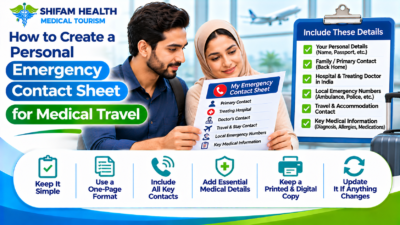
How to Create a Personal Emergency Contact Sheet for Medical Travel
Filters & Insights
Written By :
Medically Reviewed By :

Shifam Health Medical Team
Shifam Health - Medical Reviews Department
10+ Years Of Experience
Create a medical travel emergency contact sheet with hospital numbers, family contacts, medical details, and travel information.
📅
Last updated: November 24, 2026

Traveling to another country for medical treatment requires more preparation than booking flights and selecting a hospital. Patients and their families also need to know whom to contact if an unexpected situation occurs. A medical emergency, lost passport, delayed flight, or difficulty reaching the treating hospital can become stressful when important information is scattered across emails, messages, and documents.
A personal emergency contact sheet helps keep essential details in one accessible place. It allows patients, accompanying family members, and caregivers to find important telephone numbers, hospital information, and basic medical details quickly.
For international patients traveling to India, preparing a medical travel emergency contact sheet is a simple but useful part of travel planning. This guide explains what information to include, how to organize emergency contacts, which documents to keep available, and how to update the sheet throughout the medical journey.
Table of Contents
ToggleWhy Do You Need an Emergency Contact Sheet for Medical Travel?
Patients traveling abroad may be unfamiliar with local emergency services, hospital procedures, transportation arrangements, and communication systems. They may also face language barriers or need assistance from family members who are not traveling with them.
An emergency contact sheet helps patients and accompanying attendants locate important information without searching through multiple documents.
It can be useful when:
- A patient suddenly becomes unwell outside the hospital.
- An accompanying family member needs to contact the treating hospital.
- The patient cannot communicate their medical history clearly.
- A passport or travel document is lost.
- A flight is delayed or canceled.
- A family member in the home country needs an urgent update.
- The patient needs assistance after hospital discharge.
- A healthcare professional needs to identify an emergency contact.
The sheet should be short, clear, and easy to access. It does not replace a complete medical record, hospital discharge summary, or emergency medical assessment.
Before preparing it, patients can review the medical tourism in India guide to understand the main stages of planning treatment and travel.
What Information Should an Emergency Contact Sheet Include?
A useful emergency contact sheet should contain the details that someone may need to respond to an unexpected situation.
| Information category | Details to include |
|---|---|
| Patient information | Full name, date of birth, nationality, preferred language |
| Medical information | Important conditions, allergies, current medicines |
| Family contacts | Primary and secondary emergency contacts |
| Hospital information | Hospital name, branch, address, emergency telephone number |
| Doctor information | Treating specialist’s name and department |
| Local support | Hospital coordinator or authorized caregiver contact |
| Accommodation | Name, full address, and telephone number |
| Emergency services | Local emergency response number |
| Embassy or consulate | Official contact details |
| Travel information | Airline, flight details, and booking reference |
| Insurance | Provider and emergency assistance telephone number |
Only include accurate and necessary information. Keep sensitive details, such as passport scans and complete medical records, in a separate secure folder.
Step-by-Step Guide to Creating Your Emergency Contact Sheet
Add the Patient’s Basic Information
Start with the patient’s identifying information so that healthcare professionals and emergency contacts can understand whose details they are viewing.
Include:
- Full name as shown on the passport.
- Date of birth.
- Nationality.
- Preferred language.
- Important medical conditions.
- Known medication allergies.
- Current prescribed medicines.
- Hospital patient identification number, if assigned.
If the patient’s diagnosis is still being evaluated, do not describe it as confirmed. Use wording such as “under medical evaluation” where appropriate.
You can use the following format:
| Patient information | Details |
|---|---|
| Full name | ________________________________ |
| Date of birth | ________________________________ |
| Nationality | ________________________________ |
| Preferred language | ________________________________ |
| Medical condition | ________________________________ |
| Known allergies | ________________________________ |
| Current medicines | ________________________________ |
| Hospital patient ID | ________________________________ |
Patients who are still arranging treatment can also review how to get medical treatment abroad for guidance on preparing medical information and coordinating with hospitals.
Add Primary and Secondary Family Contacts
Choose at least two trusted people who can be contacted if the patient needs assistance.
Ideally, include one person accompanying the patient in India and another person who remains in the home country.
For each contact, record:
- Full name.
- Relationship to the patient.
- Mobile number with international country code.
- WhatsApp number, if different.
- Email address.
- Country of residence.
- Preferred contact language.
Use this format:
| Contact | Relationship | Telephone number |
|---|---|---|
| Primary emergency contact | ________________________ | ________________________ |
| Secondary emergency contact | ________________________ | ________________________ |
| Accompanying attendant | ________________________ | ________________________ |
Ask each person for permission before including their contact details. Inform them that they may be contacted if the patient needs assistance.
If a family member is traveling with the patient, check the relevant travel documentation in advance. Shifam Health’s guide to the medical attendant visa in India explains the purpose of this visa category and related planning considerations.
Record the Hospital’s Contact Details
The treating hospital should be one of the most important entries on the emergency contact sheet.
Include:
- Full hospital name.
- Exact branch or facility.
- Complete street address.
- Main hospital telephone number.
- Emergency department number, if provided.
- International patient department contact.
- Treating doctor’s name and specialty.
- Hospital coordinator’s name and contact details.
- Patient registration number, if available.
Confirm the details directly with the hospital. A hospital group may operate several branches, and the telephone number or services available at one location may differ from another.
Patients can use the Shifam Health hospital directory to explore listed hospitals. However, the emergency number and department contact should be verified with the selected facility before travel.
Ask the hospital which number should be used for medical emergencies and which number is intended for routine appointments or administrative questions.
Include India’s Emergency Contact Number
International patients should know how to request immediate assistance while staying in India.
India’s national emergency response number is 112. It is the integrated emergency response number for situations requiring police, fire, rescue, or medical assistance.
Save 112 in your mobile phone and include it on your emergency contact sheet. The Ministry of Home Affairs provides information through the Emergency Response Support System.
Patients should also ask their hospital for the appropriate local ambulance contact and emergency department number. Ambulance arrangements and service availability may vary by location.
For additional information, refer to the Government of India’s national emergency helpline directory.
In a serious medical emergency, contact emergency services or seek immediate medical attention. Do not wait for a medical travel coordinator or routine hospital contact to respond.
Add the Treating Doctor’s and Medical Coordinator’s Details
Patients may communicate with several people during their treatment journey. These can include the treating specialist, hospital international patient coordinator, admission team, and medical travel coordinator.
Record their responsibilities separately so that family members know whom to contact.
| Contact | Details to record |
|---|---|
| Treating specialist | Name, specialty, hospital, approved contact method |
| Hospital emergency department | Telephone number |
| International patient coordinator | Name, telephone number, email |
| Medical travel coordinator | Name, telephone number, email |
| Follow-up department | Telephone number and appointment process |
A hospital coordinator may help with appointments, communication, and administrative arrangements. However, a coordinator is not a substitute for emergency medical services or clinical advice.
Patients researching specialists can review the Shifam Health doctor directory. Before adding a doctor’s details, confirm their current hospital affiliation and the appropriate contact method.
Include Important Medical Information
A short medical summary can help healthcare professionals understand important aspects of the patient’s health.
Depending on the patient’s condition, include:
- Confirmed diagnosis.
- Recent major surgery or procedure.
- Important existing medical conditions.
- Known medication allergies.
- Current prescribed medicines.
- Relevant implants or medical devices.
- Important treatment restrictions.
- Emergency instructions provided by the treating doctor.
For patients who have undergone surgery, include the procedure date and the hospital where it was performed.
Keep detailed medical reports separately. The emergency contact sheet should provide a brief summary, not attempt to reproduce the patient’s complete medical history.
Before leaving India, patients should also collect their discharge summary and relevant treatment records. The CDC’s medical tourism guidance discusses the importance of medical records and follow-up planning when receiving care abroad.
Add Accommodation and Local Address Details
Patients may stay in a hotel, serviced apartment, guesthouse, or other accommodation near the hospital.
Record:
- Accommodation name.
- Complete street address.
- Reception telephone number.
- Booking reference, if useful.
- Room number, if appropriate.
- Nearby landmark.
- Hospital address.
- Contact details of the accompanying family member.
An exact address can help emergency responders or hospital staff locate the patient if assistance is needed outside the hospital.
If the patient changes accommodation, update the contact sheet immediately. Patients arranging a stay near their treatment facility can review affordable accommodation for medical tourists in India before finalizing their arrangements.
Include Embassy or Consulate Contact Information
International patients should know how to contact their country’s embassy, high commission, or consulate in India.
Consular assistance may be relevant if a passport is lost, travel documents are stolen, or a serious incident occurs.
Record:
- Embassy or consulate name.
- Official address.
- Telephone number.
- After-hours emergency contact, if available.
- Official website.
- Consular email address.
Use your government’s official website to verify these details before traveling. Do not rely on an old telephone number saved in an informal message.
For example, the US Department of State provides emergency assistance information for US citizens abroad. Patients from other countries should use the official consular resources of their own government.
An embassy or consulate is not a replacement for local emergency services or hospital care.
Add Insurance and Travel Assistance Details
If the patient has travel insurance, medical insurance, or an international assistance provider, record the relevant contact information.
Include:
- Insurance provider’s name.
- Policy reference number.
- Emergency assistance telephone number.
- Claims contact.
- Authorization process, if applicable.
- Policy expiry date.
Before traveling, review the policy carefully. Planned medical treatment abroad, complications related to surgery, and medical evacuation may be excluded or subject to specific conditions.
Do not assume that a standard travel insurance policy covers treatment that was planned before the journey.
Add Travel and Visa Information
The contact sheet can also include basic travel details that may be useful if an unexpected situation affects the patient’s journey.
Record:
- Airline name.
- Flight number.
- Departure and arrival dates.
- Booking reference.
- Airline customer support number.
- Airport transfer contact.
- Visa category and expiry date.
Keep passport scans, visa documents, and payment information in a separate secure folder rather than displaying sensitive details on a sheet that may be misplaced.
Patients can review Shifam Health’s Indian medical visa application guide for general planning information. For current application requirements, use the official Indian Visa Online portal.
Emergency Contact Sheet Template for Medical Travelers
The following template can be copied into a document, completed, and printed before departure.
Personal Information
| Field | Details |
|---|---|
| Patient’s full name | ________________________________ |
| Date of birth | ________________________________ |
| Nationality | ________________________________ |
| Preferred language | ________________________________ |
| Medical condition | ________________________________ |
| Known allergies | ________________________________ |
| Current medicines | ________________________________ |
Emergency and Family Contacts
| Contact | Name and telephone number |
|---|---|
| India emergency services | 112 |
| Hospital emergency department | ________________________________ |
| Primary family contact | ________________________________ |
| Secondary family contact | ________________________________ |
| Accompanying attendant | ________________________________ |
Hospital and Medical Contacts
| Field | Details |
|---|---|
| Hospital name and branch | ________________________________ |
| Hospital address | ________________________________ |
| Treating specialist | ________________________________ |
| Specialist’s department | ________________________________ |
| Hospital coordinator | ________________________________ |
| Patient identification number | ________________________________ |
Local and Travel Information
| Field | Details |
|---|---|
| Accommodation name | ________________________________ |
| Accommodation address | ________________________________ |
| Accommodation telephone | ________________________________ |
| Embassy or consulate | ________________________________ |
| Insurance provider | ________________________________ |
| Insurance emergency number | ________________________________ |
| Airline and flight number | ________________________________ |
| Airport transfer contact | ________________________________ |
Important Medical Notes
| Field | Details |
|---|---|
| Recent procedure and date | ________________________________ |
| Important medical conditions | ________________________________ |
| Prescribed medicines | ________________________________ |
| Emergency instructions from doctor | ________________________________ |
| Local follow-up doctor | ________________________________ |
| Last updated | ________________________________ |
Keep this completed sheet accessible to the patient and accompanying attendant. Give a copy to a trusted family member when appropriate.
How to Store and Share the Emergency Contact Sheet Safely
Preparing the sheet is only the first step. It should also be stored in a way that allows the patient or family to access it when needed.
Keep a Printed Copy
Carry a printed copy in a travel document folder or another easily accessible location. The accompanying family member should also have a copy.
Do not place the only copy inside checked luggage. It should remain available during airport transfers and other parts of the journey.
Save a Digital Copy
Save a digital version on the patient’s mobile phone and, where appropriate, the accompanying person’s phone.
A secure folder that can be accessed without an internet connection may be useful. Do not rely entirely on cloud storage because internet access may not always be available.
Share It With Trusted People
Share the contact sheet with people who may need to assist the patient, such as:
- Accompanying family members.
- A trusted emergency contact in the home country.
- Authorized caregivers.
- Relevant healthcare professionals.
Ask the patient’s permission before sharing medical information, subject to applicable legal requirements and emergency circumstances.
Protect Sensitive Information
Avoid including information that is not needed for emergency communication, such as:
- Bank passwords.
- Payment card security codes.
- Email or social media passwords.
- Unnecessary personal identification numbers.
- Detailed financial information.
Keep passport copies, insurance documents, and complete medical records in a separate secure folder.
When Should You Update the Emergency Contact Sheet?
The information on the sheet may change during the patient’s medical journey. Review it at important stages.
| Stage | Details to review |
|---|---|
| Before leaving home | Family contacts, medical conditions, medicines, and travel details |
| After selecting the hospital | Hospital address, treating doctor, and department contacts |
| After arriving in India | Local telephone number, accommodation, and transport contact |
| After hospital admission | Patient ID, ward, and relevant hospital contacts |
| After treatment | Updated medicines, procedure details, and emergency instructions |
| Before returning home | Flight details, local follow-up doctor, and post-discharge contacts |
If the patient changes accommodation, receives a new prescription, or is assigned a different hospital contact, update the sheet.
Patients preparing to return home after surgery should also review how to plan return travel after a major procedure. The treating team should assess medical readiness for travel before the patient confirms departure arrangements.
Common Mistakes to Avoid
Saving Only One Emergency Contact
One person may be unavailable or unable to answer. Include at least two trusted family contacts and the relevant hospital emergency number.
Forgetting International Dialing Codes
Record telephone numbers with their country codes. This makes it easier to contact family members across borders.
Confusing a Coordinator With Emergency Services
A medical travel coordinator may help with routine communication and arrangements, but cannot replace emergency responders or hospital emergency departments.
Including Outdated Medication Information
Treatment and medication instructions may change during hospitalization. Update the sheet using the latest information provided by the treating doctor.
Leaving Out the Accommodation Address
A hotel name alone may not be enough to locate the patient. Include the complete address and a telephone number.
Sharing Too Much Personal Information
Only include information that is necessary for emergency communication and relevant medical care. Keep sensitive records protected.
Forgetting to Update the Sheet After Discharge
After treatment, add the relevant discharge instructions, updated medication details, and follow-up contacts. Patients should also arrange local medical follow-up before leaving India. Shifam Health’s guide on coordinating local doctor follow-up before leaving India explains how to prepare for continued care after returning home.
When Should You Contact the Hospital or Specialist?
Contact the hospital or treating specialist before travel if you are unsure which medical details should be included in the emergency sheet.
You should also request clarification when:
- The patient has a complex medical condition.
- Medication or allergy information is unclear.
- The patient has recently undergone major surgery.
- The hospital has not provided an appropriate emergency contact number.
- The patient requires oxygen or another medical device.
- An accompanying family member needs guidance about warning signs.
- The patient is being discharged and needs updated emergency instructions.
If the patient develops severe or sudden symptoms, seek immediate medical attention. Do not wait for a routine consultation, email response, or medical travel coordinator.
How Shifam Health Can Help With Medical Travel Coordination
International patients may need help organizing hospital communication, medical records, accommodation, and travel arrangements before arriving in India.
Shifam Health can assist with practical coordination, depending on the patient’s requirements and service availability. This may include:
- Coordinating communication with the selected hospital.
- Helping patients obtain relevant hospital department contact details.
- Organizing medical records for hospital review.
- Coordinating requests for online specialist consultations.
- Helping with medical visa invitation-letter requests where applicable.
- Assisting with accommodation and airport pickup arrangements.
- Coordinating interpreter services where available.
- Helping organize post-treatment communication with the hospital.
Patients and families should independently confirm emergency contact details with the relevant hospital and government authorities.
Shifam Health is a medical travel facilitator, not an emergency response service or clinical provider. It does not replace ambulance services, hospital emergency departments, or the treating medical team.
If you are preparing for treatment in India, contact Shifam Health to discuss hospital communication and practical travel coordination.
Frequently Asked Questions
What should I include in a medical travel emergency contact sheet?
Include the patient’s name, important medical conditions, allergies, current medicines, family emergency contacts, hospital details, India’s emergency number, accommodation address, embassy contact, and insurance assistance number.
What is the emergency number in India?
India’s national integrated emergency response number is 112. It can be used to request assistance for emergencies requiring police, fire, rescue, or medical response.
Should I carry a printed emergency contact sheet?
Yes. Carry a printed copy and keep a secure digital version on your phone. An accompanying family member should also have access to the information.
Should my emergency contact sheet include medical information?
Include essential information such as important medical conditions, known allergies, current medicines, and relevant emergency instructions. Keep detailed medical records separately.
Can I share my emergency contact sheet with the hospital?
Yes, when appropriate and with the patient’s permission. The hospital may also ask the patient or family to complete its own emergency contact form during admission.
How often should I update the contact sheet?
Review it before departure, after arriving in India, after hospital admission, whenever treatment details change, and before returning home.
Can Shifam Health provide emergency medical assistance?
Shifam Health can help coordinate routine hospital communication and practical medical travel arrangements. For a medical emergency, contact local emergency services or the hospital’s emergency department directly.
Conclusion
Creating a personal emergency contact sheet is a practical way to prepare for medical travel to India. It gives patients and their families quick access to essential information during unexpected situations and reduces the need to search through multiple documents or messages.
Start with the patient’s basic information, family emergency contacts, treating hospital details, and India’s national emergency number. Add relevant medical conditions, allergies, current medicines, accommodation information, embassy contacts, and insurance details where applicable. Confirm important telephone numbers directly with the organizations involved.
Keep the sheet short, accurate, and easy to access. Carry a printed copy, save a secure digital version, and share it with trusted people who may need to assist. Update it whenever the hospital, accommodation, treatment plan, medication, or travel arrangements change.
Remember that an emergency contact sheet supports communication; it does not replace medical care. Patients with urgent symptoms should seek immediate assessment from qualified healthcare professionals rather than waiting for a routine response.
For international patients planning treatment in India, Shifam Health can help coordinate hospital communication, medical record review, and practical travel arrangements. Preparing an emergency contact sheet alongside these arrangements can help patients and families stay organized throughout the medical journey.

Popular Posts From Last Week
- November 22, 2026
- Razi Khan
A practical guide for international patients on understanding different hospital treatment recommendations, organizing medical records, and requesting a…
- November 21, 2026
- Razi Khan
A practical guide for international patients on confirming medical equipment, procedure availability, specialist schedules, and hospital facilities in…
- November 21, 2026
- Razi Khan
Online hospital reviews and patient stories can help international patients understand the healthcare experience, but they should be…
- November 24, 2026
- Razi Khan
Learn how to prepare a personal emergency contact sheet before traveling to India for medical treatment. This practical…
- November 21, 2026
- Razi Khan
Planning medical travel becomes more complicated when a diagnosis is still being investigated or may change after further…
- November 20, 2026
- Razi Khan
Preparing a medical history timeline helps international patients explain their symptoms, previous diagnoses, investigations and treatments during a…
- November 20, 2026
- Razi Khan
When doctors provide different diagnoses or treatment recommendations, organizing their opinions can help patients prepare for another specialist…
- November 20, 2026
- Razi Khan
Understanding treatment risks and alternatives helps patients participate in informed discussions with their doctors. This guide explains how…
- November 19, 2026
- Razi Khan
When surgery is recommended, patients may want to understand whether medication, physiotherapy, injections or other non-surgical options are…
- November 19, 2026
- Razi Khan
Planning treatment abroad involves understanding what happens after the procedure, not just the hospital stay. This guide explains…
- November 19, 2026
- Shifam Health
After hospital discharge, some patients need help walking, using the bathroom, getting into vehicles or attending follow-up appointments….
- November 18, 2026
- Shifam Health
Learn how to organize a child’s medical records before travelling to India for treatment, including medical summaries, diagnostic…