



How to Plan a Medical Journey from Initial Enquiry to Follow-Up
Filters & Insights
Written By :
Medically Reviewed By :

Shifam Health Medical Team
Shifam Health - Medical Reviews Department
10+ Years Of Experience
Plan medical treatment in India with this step-by-step guide, from the first enquiry and hospital review to travel and follow-up.
📅
Last updated: November 24, 2026
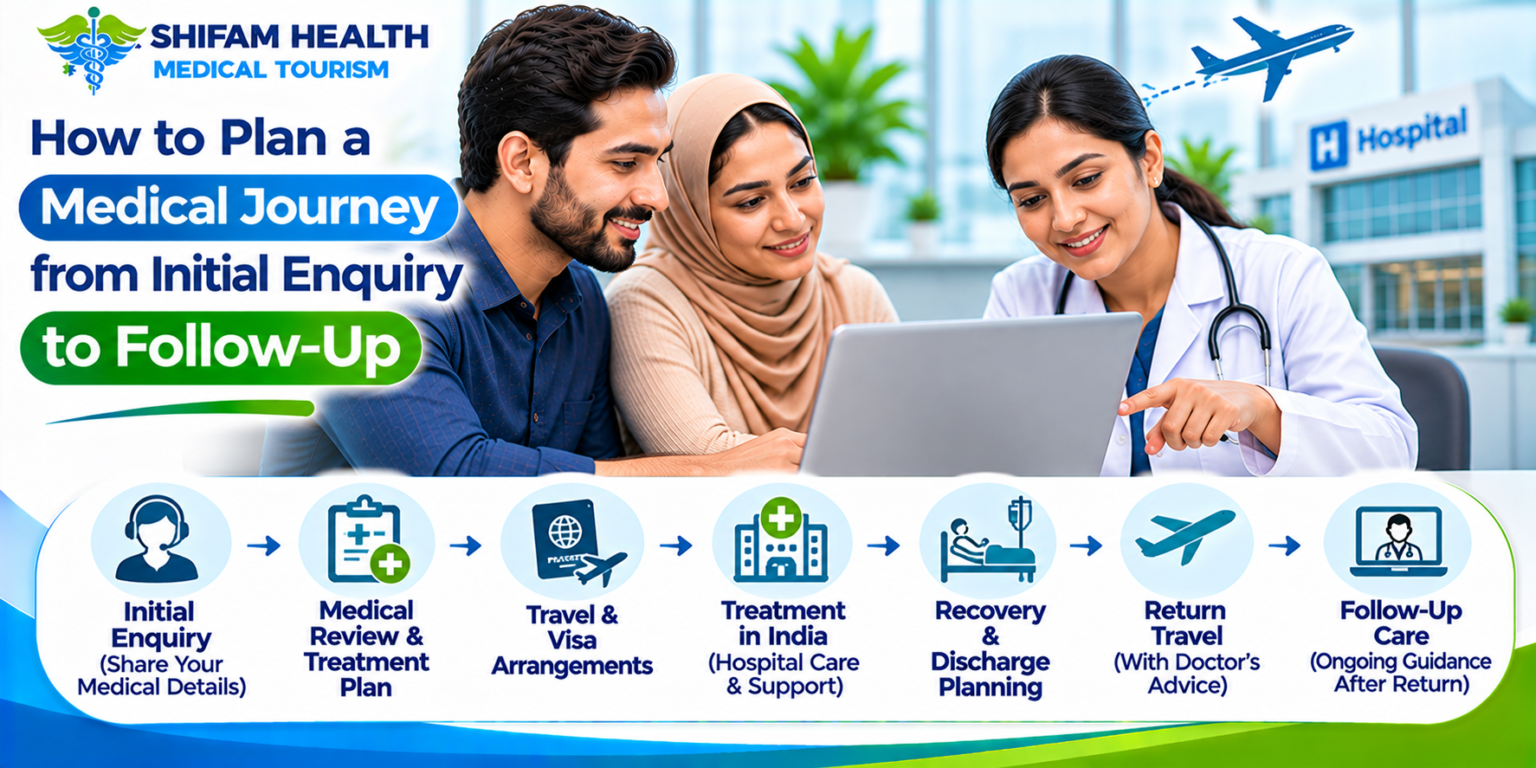
Traveling to another country for medical treatment involves several stages. Patients and families need to understand their treatment options, communicate with hospitals, arrange medical records, review estimated costs, prepare travel documents, and plan what happens after returning home.
For international patients considering treatment in India, the process may involve coordination between the patient, family members, doctors, hospital teams, travel providers, and medical tourism facilitators. Each stage has different requirements, and some arrangements can take time.
A clear plan helps patients understand what needs to happen before departure, during their hospital stay, and after returning home. It also helps families identify questions early and avoid making travel arrangements before important medical and administrative details are confirmed.
This guide explains how to plan a medical journey from the first enquiry to post-treatment follow-up, with practical steps for patients considering medical treatment in India.
Table of Contents
ToggleUnderstanding the Stages of a Medical Journey
A medical journey is not limited to the hospital visit or procedure. It begins when a patient first seeks information and continues through medical assessment, treatment planning, travel, hospital care, discharge, and follow-up.
The process generally includes these stages:
- Initial enquiry and sharing medical information.
- Hospital and specialist evaluation.
- Review of treatment options and estimated costs.
- Confirmation of the hospital and treatment arrangements.
- Visa, travel, and accommodation preparation.
- Arrival, hospital admission, and treatment.
- Discharge planning and recovery arrangements.
- Return travel and follow-up with healthcare professionals.
The sequence may vary depending on the patient’s condition, the urgency of treatment, the hospital’s requirements, and the type of procedure. Some patients may need additional tests or consultations before a treatment plan can be confirmed.
For a broader introduction to the process, read our guide to medical tourism in India.
Step 1: Make an Initial Enquiry and Explain Your Requirements
The first step is to explain why you are seeking medical treatment and what kind of assistance or information you need.
Patients or family members can begin by contacting a hospital, its international patient department, or a medical tourism facilitator. A clear enquiry helps the receiving team understand the patient’s requirements and identify what information is needed for the next step.
Information to include in your first enquiry
Try to provide the following details:
- Patient’s full name and age.
- Country of residence and nationality.
- Main diagnosis or suspected medical condition, if known.
- Brief medical history.
- Previous treatments or surgeries.
- Current symptoms and relevant concerns.
- Preferred treatment or specialist, if known.
- Approximate travel timeframe.
- Whether a family member or attendant will accompany the patient.
- Preferred method of communication.
You do not need to write a long medical explanation in your first message. A short summary supported by relevant reports is usually a more practical starting point.
Explain what you want to know
Be specific about the information you are seeking. For example, you may want to know:
- Whether the hospital has a department that treats the condition.
- Which medical reports are needed for an initial review.
- Whether an online specialist consultation can be arranged.
- Whether the hospital can provide an estimated treatment plan and cost.
- How long the patient may need to stay in India.
- What documents are required before travel.
Patients who are unfamiliar with the process can also read how to get medical treatment abroad to understand the initial steps involved.
Step 2: Collect and Share Relevant Medical Records
After the initial enquiry, the next step is to organize the patient’s medical information. Specialists need relevant records to understand the patient’s medical history and decide whether further assessment is required.
The documents needed will depend on the condition and proposed treatment.
Common medical documents to prepare
| Document | Why it may be needed |
|---|---|
| Recent consultation notes | To understand the diagnosis and previous medical advice |
| Blood test results | To review relevant laboratory findings |
| CT, MRI, PET-CT, or X-ray reports | To assess available imaging information |
| Biopsy or pathology reports | To review tissue findings where applicable |
| Previous surgery records | To understand earlier procedures |
| Discharge summaries | To review previous hospital treatment |
| Medication list | To identify current medicines |
| Previous treatment records | To understand therapies already received |
For certain conditions, the hospital may request original imaging files rather than only the written report. Ask the receiving hospital how it prefers to receive large files and whether any additional tests are required.
Organize the records before sharing them
Use clearly named files and arrange them by date. If reports are available in different languages, ask the hospital whether an English translation is required.
Keep a copy of everything you share. Use an appropriate secure method to send medical records, and confirm that you are communicating with the correct hospital or authorized recipient.
Our guide to keeping digital and printed copies of medical travel documents explains how to organize and protect these records.
Step 3: Arrange a Medical Review and Understand the Treatment Options
Once the relevant records have been received, the next stage is medical review.
The hospital’s clinical team or relevant specialist may review the available information to understand the patient’s condition and determine what further assessment is needed. Depending on the case, the specialist may request additional reports, updated investigations, or an online consultation.
A medical review based on shared records is not necessarily a final diagnosis or confirmation of treatment. The treating specialist may need to examine the patient and review additional findings before making clinical decisions.
Questions to ask during the medical review
Patients and families can prepare questions such as:
- Does the specialist need additional medical reports?
- Is an online consultation recommended before travel?
- What treatment options may need to be discussed?
- Will the patient need further investigations after arrival?
- Which specialist or department should evaluate the case?
- Can the hospital explain the likely admission process?
- What information is still needed before an estimate can be prepared?
If the patient wants another medical opinion before deciding, they can explore the cancer second opinion service where relevant to their condition. The appropriate specialist and service will depend on the patient’s diagnosis.
Do not rush the treatment decision
A patient should have enough time to understand the proposed treatment, its purpose, potential risks, alternatives, and expected recovery requirements.
Clinical decisions should be made by qualified healthcare professionals in consultation with the patient. A medical travel facilitator can help coordinate communication and share information, but it should not replace the treating specialist’s advice.
Step 4: Review the Treatment Plan, Estimated Cost, and Hospital Details
After the medical review, the hospital may provide a proposed treatment plan or estimated cost based on the information available.
Patients should read these documents carefully and clarify what is included before making a financial or travel commitment.
What to check in a treatment estimate
Ask whether the estimate covers:
- Specialist consultation fees.
- Hospital room and admission charges.
- Proposed procedure or surgery charges.
- Anesthesia charges, where applicable.
- Medicines and medical supplies.
- Diagnostic tests and investigations.
- Intensive care charges, if required.
- Expected hospital stay.
- Follow-up consultations.
- Any additional services or exclusions.
An estimate based on preliminary records may change after the patient arrives, undergoes further assessment, or requires a different treatment approach. Ask the hospital to explain the circumstances that could affect the final cost.
Compare hospitals carefully
Do not select a hospital based only on the lowest estimate. Consider the relevant specialty, the treating team’s experience, available facilities, hospital credentials, treatment requirements, communication arrangements, and the practical needs of the patient.
You can use the Shifam Health hospital directory to explore hospital information. For a comparison of selected hospital groups, read Apollo vs. Medanta vs. Fortis.
Patients should also verify relevant accreditation and hospital information directly. Our guide to JCI-accredited hospitals in India provides additional context about international hospital accreditation.
Questions to ask before confirming
- Is the estimate preliminary or based on a confirmed treatment plan?
- What services are included?
- Which expenses may be charged separately?
- How long is the estimate valid?
- What happens if additional treatment is required?
- Which doctor or department will be responsible for the patient’s care?
- What is the hospital’s payment and refund policy?
Ask for important details in writing so that the patient and family can review them before proceeding.
Step 5: Confirm the Hospital and Coordinate the Pre-Travel Arrangements
After reviewing the medical information, treatment plan, hospital details, and estimated costs, the patient can decide whether to proceed with the proposed arrangements.
Before booking travel, confirm the relevant details with the hospital.
Confirm appointment and admission information
Check:
- The name of the hospital and its location.
- The specialist or department involved.
- Consultation or admission date.
- Whether additional tests are required before admission.
- Whether the patient needs to arrive earlier for assessment.
- The documents required at registration.
- The hospital’s instructions for international patients.
If the patient has not yet received a confirmed appointment or admission date, avoid assuming that a preliminary estimate guarantees a treatment slot.
Plan the medical visa process
International patients traveling to India for treatment should review the applicable visa requirements for their nationality and circumstances.
Depending on eligibility and the current rules, a patient may need to apply for an Indian Medical Visa. An accompanying family member may need to consider the applicable Medical Attendant Visa arrangements.
Useful resources include:
Check the latest instructions and required documents through official government sources. A hospital invitation letter or assistance with application documentation does not guarantee visa approval. The decision rests with the relevant authorities.
Arrange flights and accommodation
Book flights after checking the hospital’s appointment or admission arrangements and any medical travel restrictions that may apply.
Accommodation should be selected according to the patient’s mobility, treatment schedule, expected recovery needs, and distance from the hospital.
Consider:
- Distance and travel time to the hospital.
- Availability of elevators or accessible rooms.
- Whether a family attendant can stay with the patient.
- Access to food and essential services.
- Transportation arrangements.
- Booking flexibility if treatment dates change.
For accommodation guidance, read affordable accommodation for medical tourists in India.
Confirm airport and local transportation
Patients may need an airport pickup, accessible transportation, or assistance carrying luggage. If these arrangements are required, confirm the details in advance.
Share the arrival date, flight number, terminal information, accommodation address, and a reachable contact number with the relevant person coordinating the transfer.
Step 6: Prepare for Arrival and Hospital Admission
The arrival stage involves moving from travel arrangements to hospital-based care.
Before departure, keep essential documents in your hand luggage. These may include the passport, visa documents, hospital appointment confirmation, medical reports, prescriptions, and emergency contact information.
After arriving in India, follow the hospital’s instructions for registration and consultation.
What to expect during hospital registration
Depending on the hospital and treatment, the process may include:
- Identity and document verification.
- Patient registration.
- Review of previous medical records.
- Consultation with the treating specialist.
- Physical examination.
- Additional investigations.
- Discussion of the treatment plan.
- Admission arrangements, if required.
The specialist may revise the initial plan after examining the patient or reviewing new test results. The patient should discuss any proposed changes, including their implications for cost, hospital stay, and recovery.
Keep communication organized
Patients and attendants should know whom to contact for different questions. Clinical concerns should be directed to the treating medical team. Administrative questions about appointments, billing, admission, and documents should go to the relevant hospital department.
Keep a written record of important instructions, appointments, and contact details. This can help family members stay informed and reduce misunderstandings.
For further preparation, patients can review how to prepare a checklist for choosing a hospital in India before finalizing their hospital arrangements.
Step 7: Understand Treatment, Recovery, and Discharge Planning
Treatment is an important stage of the medical journey, but patients should also plan for recovery and discharge.
The recovery period differs according to the patient’s condition, procedure, general health, and response to treatment. Some patients may be discharged within a short period, while others may need a longer hospital stay or additional rehabilitation.
Questions to discuss with the treating team
Before discharge, ask the hospital to explain:
- The patient’s current condition and discharge status.
- Medicines prescribed after discharge.
- How and when medicines should be taken.
- Wound-care or dressing instructions, if relevant.
- Activity restrictions and mobility guidance.
- Dietary instructions, if applicable.
- Warning signs that require medical attention.
- Follow-up appointment dates.
- Whether rehabilitation or additional care is needed.
- Whether the patient is medically fit to travel.
Ask for written discharge instructions and a copy of relevant reports. If the patient or attendant does not understand an instruction, request clarification before leaving the hospital.
Collect important discharge documents
Depending on the case, these may include:
- Discharge summary.
- Final diagnosis and treatment details.
- Procedure or surgery notes, where applicable.
- Investigation and laboratory reports.
- Imaging reports and files.
- Current prescription.
- Medication list.
- Follow-up recommendations.
- Relevant payment and insurance documents.
Keep these records safely. They may be needed for future consultations or when sharing the patient’s medical history with a doctor in the home country.
Step 8: Plan Return Travel and Local Follow-Up
The final stage of the medical journey should be planned before the patient leaves India.
Do not book a return flight based only on an expected discharge date. The treating team should assess the patient’s condition and advise whether travel is appropriate.
Confirm fitness to travel
Ask the treating specialist whether the patient is medically fit to fly or undertake the planned journey. This is particularly important after major surgery, procedures that affect mobility, or treatment that may increase the risk of travel-related complications.
Airlines may have their own medical clearance requirements. Some patients may need additional documentation or arrangements before boarding.
For practical guidance, read how to plan return travel after a major procedure.
Arrange follow-up in the home country
Before departure, ask the treating hospital about the recommended follow-up schedule and what type of healthcare professional should review the patient after returning home.
Patients should prepare a record containing:
- Discharge summary.
- Treatment and procedure details.
- Recent test results.
- Current medication list.
- Follow-up instructions.
- Any pending test or report information.
- Contact details for the treating hospital.
Where possible, identify a local doctor or specialist who can review the patient’s condition after returning home. Share relevant records with that professional and clarify which team should be contacted if questions arise.
Our guide to coordinating local doctor follow-up before leaving India explains how patients can prepare for this transition.
Understand post-treatment communication
Some patients may need to contact the Indian hospital after returning home to discuss reports, appointments, or questions about their discharge instructions.
Ask the hospital what communication channels are available and how to contact the appropriate department. Do not assume that every hospital offers the same remote consultation or follow-up arrangements.
You can also read about telemedicine follow-up care in Indian medical tourism to understand how remote consultations may form part of a follow-up plan where available and clinically appropriate.
Documents and Questions to Prepare Before Your Medical Journey
A practical checklist can help patients identify missing information before departure.
| Stage | Documents or information to prepare |
|---|---|
| Initial enquiry | Patient details, diagnosis, medical history, and treatment requirements |
| Medical review | Recent reports, imaging, prescriptions, and previous treatment records |
| Hospital selection | Specialist details, hospital information, treatment estimate, and cost inclusions |
| Pre-travel planning | Passport, visa documents, appointment confirmation, and travel bookings |
| Arrival | Original identification documents, medical reports, and hospital contact details |
| Hospital admission | Registration documents and any additional records requested by the hospital |
| Discharge | Discharge summary, prescriptions, test results, and follow-up instructions |
| Return travel | Medical clearance where required, travel documents, and airline arrangements |
| After returning home | Medical records, local doctor details, and follow-up schedule |
Patients and family members should also prepare a written list of questions for the hospital.
Questions about treatment
- What is the purpose of the proposed treatment?
- What alternatives may be available?
- What additional tests might be required?
- What risks and possible complications should be discussed?
- What recovery support may be needed?
Questions about costs
- What is included in the estimate?
- Which expenses are excluded?
- How are additional investigations or hospital days charged?
- What payment methods are accepted?
And Questions about travel
- When should the patient arrive?
- How long might the patient need to stay?
- What documents should be carried?
- What arrangements are needed for an accompanying attendant?
Questions about follow-up
- When is the next consultation recommended?
- Which reports should be shared with the local doctor?
- What symptoms or changes require urgent medical attention?
- How can the hospital be contacted after departure?
Common Medical Journey Planning Mistakes to Avoid
A medical journey can become more difficult when patients make arrangements without confirming important details. The following mistakes are worth avoiding.
Booking flights before receiving hospital confirmation
A preliminary discussion or estimate does not necessarily mean that an appointment, admission, or procedure date has been confirmed. Check with the hospital before finalizing travel arrangements.
Sending incomplete or outdated medical records
Missing reports can delay medical review. Share relevant records in an organized format and ask whether updated investigations are required.
Choosing a hospital based only on price
A lower estimate does not automatically mean that a hospital is the most suitable option. Consider the specialist’s relevant experience, hospital facilities, treatment requirements, and the services included in the estimate.
Assuming the initial treatment plan cannot change
A plan based on records shared before travel may change after an in-person examination or additional investigations. Keep some flexibility in travel and accommodation arrangements where possible.
Overlooking visa and attendant requirements
Check the applicable visa category, eligibility, supporting documents, and requirements for accompanying family members through official sources. Do not assume that a medical visa invitation letter guarantees approval.
Not planning for recovery after discharge
Patients may need additional rest, mobility support, medication arrangements, or local medical care after leaving the hospital. Discuss these needs with the treating team before discharge.
Leaving India without collecting medical records
Discharge summaries, prescriptions, test results, and follow-up instructions are important for continuity of care. Ask the hospital for the necessary documents before departure.
Failing to arrange local follow-up
Patients should understand who will review their condition after they return home. Identify a suitable local healthcare professional and share the relevant records.
When to Contact a Hospital or Specialist
Patients should contact the hospital or relevant specialist whenever important medical or administrative details remain unclear.
Seek clarification before traveling if:
- The hospital needs additional reports or updated investigations.
- The diagnosis or treatment history has changed.
- The patient has developed new or worsening symptoms.
- The proposed treatment plan is unclear.
- The estimated cost does not explain important inclusions or exclusions.
- The appointment or admission date has not been confirmed.
- The patient needs clarification about medicines or travel restrictions.
- The hospital has not provided clear discharge or follow-up instructions.
Clinical questions should be addressed by qualified medical professionals. If the patient experiences severe or sudden symptoms, seek appropriate urgent medical care rather than waiting for routine travel coordination or an online response.
The CDC’s medical tourism guidance also provides information about health and safety considerations when traveling abroad for medical care.
How Shifam Health Can Help Coordinate Your Medical Journey
Planning treatment in another country can involve several organizations and communication steps. Patients may need help sharing reports, contacting hospitals, arranging consultations, understanding estimates, and organizing travel-related requirements.
Shifam Health supports international patients by coordinating medical travel arrangements in India. Depending on the patient’s needs, this may include:
- Helping organize medical records for review by a hospital.
- Coordinating communication with relevant hospitals and specialists.
- Assisting with requests for online consultations, where available.
- Requesting treatment plans and estimated costs from hospitals.
- Providing information about hospital options.
- Coordinating medical visa invitation-letter documentation where applicable.
- Assisting with accommodation and airport pickup arrangements.
- Coordinating interpreter support where available.
- Helping patients organize administrative communication before and during their stay.
Shifam Health does not replace the treating doctor or hospital. Diagnosis, treatment decisions, medical advice, discharge clearance, and fitness-to-travel assessments remain the responsibility of qualified healthcare professionals. Visa approval is determined by the relevant authorities.
If you are considering treatment in India and would like assistance understanding the coordination process, contact Shifam Health to discuss your requirements.
Frequently Asked Questions
How early should I start planning a medical journey to India?
Start once you have decided to explore treatment abroad and have relevant medical records available. The time needed depends on the condition, hospital review, additional investigations, visa processing, and travel arrangements. Urgent medical situations require advice from qualified healthcare professionals rather than waiting for routine planning.
Can I receive a treatment estimate before traveling to India?
A hospital may provide a preliminary estimate after reviewing the patient’s medical records. The estimate may change after an in-person examination or additional tests. Ask the hospital to explain what is included and which expenses may be separate.
Do I need an online consultation before traveling?
Not every patient requires one, but a hospital or specialist may recommend an online consultation to discuss the available records and clarify the next steps. Confirm the consultation requirements directly with the hospital.
Can a family member accompany me for treatment in India?
An accompanying family member may be able to travel under the applicable visa arrangements, depending on eligibility and current rules. Check the official requirements before applying.
What should I collect from the hospital before returning home?
Request the discharge summary, relevant test results, procedure records where applicable, current prescriptions, medication list, and follow-up instructions. Ask how to contact the hospital if you have questions after returning home.
Who should manage follow-up after I return to my country?
The patient’s treating team should explain the recommended follow-up plan. Patients should also identify an appropriate local doctor or specialist who can review their records and provide care after they return.
Final Thoughts
Planning a medical journey from the first enquiry to follow-up requires more than choosing a hospital and booking a flight. Patients need to organize medical information, understand the proposed treatment, review estimated costs, confirm hospital arrangements, prepare travel documents, and plan for recovery after discharge.
The most practical approach is to move through the process step by step. Begin with a clear enquiry, share complete medical records, allow the relevant specialists to review the case, and ask questions before making treatment or financial decisions. Confirm hospital appointments and visa requirements before finalizing travel arrangements.
During the hospital stay, keep communication organized and collect all relevant discharge documents. Before returning home, discuss fitness to travel with the treating team and understand the follow-up arrangements. Identifying a local healthcare professional can also help support continuity of care.
Every patient’s journey is different. The time required, treatment plan, hospital stay, travel arrangements, and follow-up needs depend on individual medical circumstances. With careful preparation and clear communication, international patients and their families can approach treatment in India with a better understanding of each stage.




Popular Posts From Last Week
- November 21, 2026
- Razi Khan
Online hospital reviews and patient stories can help international patients understand the healthcare experience, but they should be…
- November 24, 2026
- Razi Khan
A practical guide for international patients planning treatment in India. Understand each stage, from sharing medical records and…
- November 21, 2026
- Razi Khan
Planning medical travel becomes more complicated when a diagnosis is still being investigated or may change after further…
- November 20, 2026
- Razi Khan
Preparing a medical history timeline helps international patients explain their symptoms, previous diagnoses, investigations and treatments during a…
- November 20, 2026
- Razi Khan
When doctors provide different diagnoses or treatment recommendations, organizing their opinions can help patients prepare for another specialist…
- November 20, 2026
- Razi Khan
Understanding treatment risks and alternatives helps patients participate in informed discussions with their doctors. This guide explains how…
- November 19, 2026
- Razi Khan
When surgery is recommended, patients may want to understand whether medication, physiotherapy, injections or other non-surgical options are…
- November 19, 2026
- Razi Khan
Planning treatment abroad involves understanding what happens after the procedure, not just the hospital stay. This guide explains…
- November 19, 2026
- Shifam Health
After hospital discharge, some patients need help walking, using the bathroom, getting into vehicles or attending follow-up appointments….
- November 18, 2026
- Shifam Health
Learn how to organize a child’s medical records before travelling to India for treatment, including medical summaries, diagnostic…
- November 18, 2026
- Razi Khan
Learn how to prepare for a child’s hospital consultation abroad. This guide covers hospital checks, doctor credentials, medical…
- November 18, 2026
- Razi Khan
Planning medical travel for an older adult involves more than choosing a hospital. Learn how to assess travel…