



Home > Blog > IVC Filter Cost in India (2026): Placement, Removal, Best Vascular Hospitals & Cost Breakdown
IVC Filter Cost in India (2026): Placement, Removal, Best Vascular Hospitals & Cost Breakdown
Filters & Insights
Learn the cost of IVC filter placement and removal in India, top vascular hospitals, recovery time and procedure details

How much does an IVC filter cost in India? Published pricing from Indian hospitals ranges widely — roughly ₹80,000 to ₹4,50,000 (approximately $950–$5,400) depending on the filter type, whether placement is planned or emergency, and the hospital tier. For international patients, a complete package covering consultation, imaging, the procedure, hospital stay, and follow-up typically starts around $2,000–$2,750, though this should always be confirmed with a written quote after your case is reviewed.
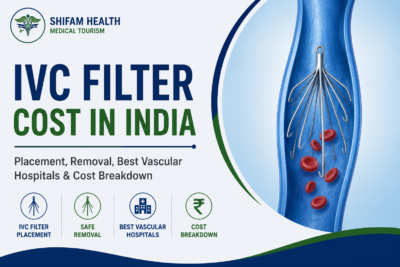
What is an IVC filter and when is it needed? An IVC filter is a small, cage-like device placed inside the inferior vena cava — the body’s largest vein — to catch blood clots before they can travel to the lungs and cause a pulmonary embolism. It is generally reserved for patients who have a confirmed clotting risk but cannot safely take blood-thinning medication, most often due to recent surgery, active bleeding, or trauma.
A Realistic Scenario
Consider a patient who develops a deep vein thrombosis (DVT) in the leg shortly after major trauma or surgery. Normally, doctors would manage this with anticoagulant (blood-thinning) medication to prevent the clot from breaking loose and traveling to the lungs. But in this patient, blood thinners aren’t safe — perhaps because of ongoing bleeding risk from the surgical site, a recent brain injury, or another contraindication. In this specific situation, a vascular specialist may recommend an IVC filter as a mechanical, temporary safeguard while the bleeding risk resolves.
This is the key point that gets lost in most online content: an IVC filter is not a routine or first-line treatment for blood clots. It’s a targeted intervention for a specific clinical problem — usually a bridge, not a permanent solution — and it requires careful specialist evaluation, not a default booking.
Table of Contents
ToggleWhat Is an IVC Filter?
The inferior vena cava (IVC) is the large vein that runs alongside your spine, collecting blood from your legs, pelvis, and abdomen and carrying it back to the heart. Because all blood returning from the lower body passes through this single vein, it’s also the natural “checkpoint” where a filter can be placed to intercept clots before they reach the heart and lungs.
An IVC filter is a small metal device — often described as cage- or umbrella-shaped — inserted through a vein in the neck or groin using a thin catheter, then expanded and anchored inside the IVC using imaging guidance (fluoroscopy). Once in place, it allows normal blood flow through but physically traps larger clots migrating up from the legs or pelvis, reducing the chance they reach the lungs and cause a pulmonary embolism.
It’s important to understand what a filter does and doesn’t do: it reduces the risk of clot migration, it does not treat the underlying clot already present in the leg, and it does not eliminate clotting risk entirely. It is a mechanical risk-reduction device, used alongside not instead of the broader management of the clotting condition once anticoagulation becomes safe again.
Who Typically Needs an IVC Filter?
IVC filters are indicated in a narrower set of situations than many patients assume. The most widely recognized indications include:
| Situation | Why a Filter May Be Considered |
|---|---|
| Confirmed DVT or PE with a Contraindication to Anticoagulants | Blood thinners cannot be used safely, so an IVC filter acts as a mechanical barrier to prevent clots reaching the lungs. |
| Active or Recent Significant Bleeding | Anticoagulants could increase bleeding risk, making a temporary filter a safer option. |
| Recent Major Trauma or Surgery | Provides protection during a high-risk period when blood thinners are not yet appropriate. |
| Recurrent Pulmonary Embolism Despite Anticoagulation | Considered when medication alone does not adequately prevent clot migration. |
| Poor Cardiopulmonary Reserve | Offers extra protection for patients who may not tolerate even a small pulmonary embolism. |
Note that in nearly every case above, the filter is being used because something else (medication) can’t be used safely — not because it’s the preferred first option.
When Is an IVC Filter Not Recommended?
This is the section most competitor pages skip, and it matters. Current vascular and interventional radiology guidance generally does not support IVC filter placement in the following situations:
- Patients who can safely take anticoagulant medication. If blood thinners are an option and are working, they remain the standard of care — a filter is not a substitute or an “extra layer of protection” added on top of medication in routine cases.
- As a precautionary measure without a confirmed clotting event or a clear, specific risk indication. Filters placed “just in case” are not supported by current evidence and carry their own risks (discussed below).
- Long-term or indefinite use in patients whose bleeding risk has resolved. Once a patient can safely resume anticoagulation, a retrievable filter should generally be reassessed for removal rather than left in place indefinitely by default.
- As a routine addition for every trauma or surgical patient. Filter use should be based on individual clot risk assessment, not applied as a blanket precaution.
If a hospital or clinic recommends an IVC filter without a clear, specific reason tied to your individual bleeding risk or clot history, it’s reasonable and advisable — to ask for that reasoning explicitly, or seek a second opinion.
How IVC Filter Placement Is Performed
The procedure is minimally invasive and generally follows this sequence:
- Pre-procedure assessment — review of your clotting history, imaging (ultrasound, CT, or venography), and bleeding risk factors to confirm the filter is appropriate.
- Local anesthesia at the access site (neck or groin), with light sedation in most cases — general anesthesia is not usually required.
- Catheter insertion — a thin catheter is guided into a vein and advanced toward the IVC under fluoroscopic (real-time X-ray) guidance.
- Filter deployment — the collapsed filter is released through the catheter and expands to anchor itself against the vein walls at the correct position, typically just below the kidney veins.
- Confirmation imaging — the position is verified before the catheter is withdrawn and the access site is closed.
- Post-procedure monitoring — most patients are observed for several hours to overnight before discharge.
The procedure itself usually takes 30 minutes to an hour, though complex cases (difficult venous access, unusual anatomy, prior vascular procedures) can take longer.
Permanent vs. Retrievable IVC Filters
Most modern filters placed today are retrievable, but the choice depends on your specific situation.
| Feature | Permanent Filter | Retrievable Filter |
|---|---|---|
| Intended Duration | Indefinite. | Temporary, ideally removed once bleeding risk resolves. |
| Typical Use | Long-term contraindication to anticoagulants with no expected recovery. | Short-term risk after surgery, trauma, or other temporary conditions. |
| Follow-up | Periodic monitoring; no planned removal. | Scheduled reviews to assess and plan retrieval. |
| Long-term Risk | Device remains in place permanently. | Reduced after successful retrieval. |
| Common Pitfall | N/A | Missed follow-up can leave the filter in place longer than intended. |
The most important practical point: if a retrievable filter is placed, retrieval planning should happen at the time of placement, not left as an afterthought. Missed follow-up is one of the most common and most avoidable issues with retrievable filters worldwide, not just in India.
IVC Filter Removal (Retrieval) Procedure
When the clotting risk has resolved and anticoagulation is safe again, a retrievable filter is generally reassessed for removal. The retrieval procedure:
- Is performed similarly to placement — catheter-based, under imaging guidance, usually via a neck (jugular) approach
- Involves capturing a small hook at the top of the filter with a specialized catheter snare and withdrawing it through the vein
- Is generally more straightforward when performed within the manufacturer’s recommended retrieval window, and can become more technically difficult the longer a filter has been in place, sometimes due to tissue growth around the device
- May occasionally require advanced retrieval techniques if the filter has tilted, embedded, or been in place longer than ideal — this should be discussed honestly with your specialist rather than assumed to be routine in every case
Follow-up imaging is typically done both before retrieval (to confirm the filter is clot-free and safe to remove) and afterward (to confirm the vein is clear).
Why timely retrieval matters: the longer a filter remains in place beyond its intended window, the higher the theoretical risk of complications like filter tilting, fracture, or difficulty during eventual removal. This is precisely why follow-up scheduling at the time of placement is not optional — it’s part of responsible filter management.
Benefits and Risks
Benefits
- Reduces the risk of a potentially life-threatening pulmonary embolism in patients who cannot safely use anticoagulants
- Minimally invasive, performed under local anesthesia with sedation
- Short procedure time and typically brief hospital stay
- Retrievable options avoid a lifelong implant when the risk period is temporary
Risks (discussed honestly, not minimized)
- Filter migration — the device shifting from its original position
- Filter fracture — a rare but recognized complication, particularly with longer dwell times
- Insertion-site complications — bruising, bleeding, or infrequent infection at the access site
- IVC thrombosis — clot formation at or around the filter itself
- Caval penetration — the filter’s anchoring struts extending through the vein wall, which is more likely to be identified incidentally on imaging than to cause symptoms, but is a recognized finding
- Retrieval difficulty — particularly if retrieval is delayed well beyond the recommended window
Experienced interventional radiology and vascular teams reduce these risks through careful filter selection, precise placement technique, and — critically — proactive retrieval scheduling for retrievable filters. No legitimate provider should present the procedure as risk-free.
Recovery After IVC Filter Placement
| Timeframe | What to Expect |
|---|---|
| Same Day | The procedure usually takes 30–60 minutes, followed by several hours of observation. |
| Day 1 | Most patients go home within 24 hours, and some are discharged the same day. |
| First Few Days | Mild soreness at the catheter access site is common. Light daily activities are usually allowed. |
| First 1–2 Weeks | Avoid heavy lifting and strenuous exercise as advised by your specialist. |
| Ongoing | Attend regular follow-up visits, especially if a retrievable filter was placed, to plan timely removal. |
Most patients can resume normal daily activity within a few days, though your specific recovery plan depends on why the filter was placed (the underlying clot condition matters as much as the procedure itself).
IVC Filter Cost in India
Cost data for this procedure is genuinely less consistent across published sources than for more common procedures — which is worth being transparent about rather than presenting a single confident number.
| Source Pattern | Reported Range |
|---|---|
| Domestic hospital estimates (standard permanent filter) | ₹80,000–₹1,50,000 (~$950–$1,800) |
| Domestic estimates including diagnostics and short hospital stay | ₹1,00,000–₹2,50,000 (~$1,200–$3,000) |
| Premium retrievable filter, tertiary hospital, emergency placement, or complex retrieval | Up to ₹4,50,000 (~$5,400) |
| International patient package (consultation, procedure, and short stay) | Approximately $2,000–$2,750 |
Why the range is so wide: unlike many procedures, a large share of the total cost is the filter device itself, and pricing varies significantly by brand and whether it’s a domestic or imported filter, plus whether placement is planned versus an emergency add-on to an existing hospital admission. Retrieval, if needed later, is typically billed separately from the initial placement.
What’s typically included in a full cost breakdown:
| Component | Note |
|---|---|
| Specialist Consultation | Assessment by a vascular surgeon or interventional radiologist. |
| Diagnostic Imaging | Doppler ultrasound, CT venography, or other imaging to confirm the need for a filter. |
| Procedure / Interventional Radiology Fee | Professional fee for filter placement. |
| Filter Device Cost | The largest factor affecting the total treatment cost. |
| Hospital / Facility Charges | Procedure suite, imaging equipment, and facility use. |
| Hospital Stay | Usually same-day discharge or one overnight stay. |
| Medications | Peri-procedure medicines; excludes long-term anticoagulants. |
| Follow-up Visits | Essential after placement, especially for retrievable filters. |
| Filter Removal (If Planned) | Charged separately when the filter is scheduled for retrieval. |
For international patients specifically: the domestic figures above reflect what Indian patients are typically quoted directly. As an international patient, expect your actual quote to run higher once consultation, translated medical record review, a fuller diagnostic workup, and coordination support are bundled into a package — this is standard practice, not overcharging, but it does mean the lower end of the domestic range shouldn’t be treated as your expected price. Request a written, itemized estimate after your medical records and imaging have been reviewed by the treating specialist, rather than relying on any online figure as final.
Why International Patients Consider India for This Procedure
| Factor | India | US | UK | UAE |
|---|---|---|---|---|
| Typical Package Cost | ~$2,000–$2,750 | $8,000–$15,000+ | £5,000–£10,000+ | Generally higher than India |
| Interventional Radiology / Vascular Expertise | Widely available in major cities | Available | Available | Available in major centers |
| Waiting Time for Specialist Evaluation | Often within days | May vary by healthcare system | May involve longer waits | Varies |
| International Patient Support | Common at larger private hospitals | Varies | Varies | Common |
The core reasons international patients from Bangladesh, the Middle East, and Africa consider India for this procedure are consistent with broader medical tourism patterns: significantly lower cost for comparable interventional radiology technology, shorter scheduling delays, and hospitals with dedicated international patient support.
Planning Your Trip: Practical Logistics
Because IVC filter placement is typically a short-stay procedure, most international patients plan a compact trip:
- Medical visa: required for treatment in India; hospitals with international patient departments typically assist with invitation letters
- Length of stay: often 3–5 days total (evaluation, procedure, short observation, follow-up check before flying)
- Pre-travel review: sharing existing imaging and medical records for a preliminary specialist opinion before you travel is strongly advisable given how case-specific the filter decision is
- Follow-up after returning home: if a retrievable filter is placed, arrange in advance how retrieval will be scheduled — either a return trip, or coordination with a local specialist, since missed retrieval follow-up is a genuine and avoidable risk
Getting a Specialist Opinion Before You Decide
Because IVC filter placement is a case-specific decision — appropriate for some patients and not recommended for others — the most responsible next step is not booking a procedure, but requesting a specialist review of your medical records and imaging by a vascular surgeon or interventional radiologist. This allows you to get an honest opinion on whether a filter is actually indicated in your case, what type would be appropriate, a realistic cost estimate, and guidance on visa and travel logistics if treatment in India is the right path forward for you.
Frequently Asked Questions
What is an IVC filter?
A small device placed in the inferior vena cava to catch blood clots traveling from the legs or pelvis before they can reach the lungs and cause a pulmonary embolism.
How much does an IVC filter cost in India?
Published domestic estimates range from roughly ₹80,000 to ₹4,50,000 depending on filter type and hospital tier. International patient packages typically start around $2,000–$2,750, confirmed only after specialist review of your case.
Who actually needs an IVC filter?
Primarily patients with a confirmed DVT or PE risk who cannot safely take blood-thinning medication due to bleeding risk, recent surgery, or trauma — not patients for whom anticoagulation is a safe, available option.
Can an IVC filter be removed?
Yes, if it’s a retrievable filter and the underlying bleeding risk has resolved. Retrieval is typically easier the sooner it’s done within the recommended window.
Is the placement procedure painful?
It’s done under local anesthesia with sedation; most patients report mild discomfort at the access site rather than significant pain.
How long does the placement procedure take?
Generally 30 minutes to an hour, though complex anatomy can extend this.
What are the main risks of an IVC filter?
Filter migration, fracture, insertion-site complications, clotting around the filter itself, and, for filters left in place too long, more difficult retrieval.
Do all DVT patients need an IVC filter?
No. Most DVT patients are managed with anticoagulant medication alone. A filter is considered specifically when medication isn’t a safe option
People Also Ask
Is a permanent or retrievable filter better?
Neither is universally “better” — the choice depends on whether your clotting risk is expected to be temporary or long-term, and should be made with your specialist based on your individual case.
What happens if a retrievable filter is never removed?
It can generally remain functional, but the theoretical risks (fracture, migration, embedding into the vein wall, harder future retrieval) accumulate over time, which is why scheduled follow-up matters
Is an IVC filter the same as a stent?
No. A stent holds a vessel open; an IVC filter traps clots while allowing normal blood flow through the vein.
Do international patients need to be hospitalized for this procedure?
Usually only briefly — same-day to overnight observation is typical for straightforward placements.
Is IVC filter placement covered by insurance in India?
Often yes when medically indicated, though coverage varies by insurer and policy — confirm directly with your provider.
How is an IVC filter different from taking blood thinners?
Blood thinners prevent new clots from forming and help the body break down existing ones; an IVC filter is a mechanical barrier that doesn’t treat the clot itself but reduces the chance of a fragment reaching the lungs. They serve different purposes and are used in different situations.
What imaging is needed before the procedure?
Typically Doppler ultrasound and/or CT venography to confirm the clot location and appropriateness of filter placement.
Can the filter be seen or felt after placement?
No — it’s positioned internally and is not visible or palpable externally; its position is confirmed only through imaging.


Popular Posts From Last Week
- July 9, 2026
- shifamhealth
When the small intestine can no longer absorb enough nutrients to sustain life, the standard fallback is intravenous…
- July 8, 2026
- shifamhealth
If a scan just showed a swollen kidney and the word “UPJ obstruction,” you’re probably trying to answer…
- July 10, 2026
- shifamhealth
Kidney stones can cause severe pain, blood in the urine, recurrent infections, and even kidney damage if left…
- July 8, 2026
- Areen Fatima
Piles (hemorrhoid) surgery in India costs $500–$900 for conventional open hemorrhoidectomy, $700–$1,200 for stapled hemorrhoidopexy, and $900–$1,800 for…
- July 9, 2026
- Areen Fatima
If you or a family member has been told you need adrenal gland surgery, the first questions are…
- July 11, 2026
- Areen Fatima
HIPEC surgery cost in India typically ranges from USD 8,000 to 18,000 for a complete international-patient package —…
- July 10, 2026
- shifamhealth
If you or a family member has just been told there’s a bulge, an aneurysm in the aorta,…
- July 8, 2026
- shifamhealth
Can You Get Breast Reconstruction After Mastectomy in India? Yes. Breast reconstruction after mastectomy is a routine part…
- July 8, 2026
- shifamhealth
Quick Summary How Much Does Breast Reduction Surgery Cost in India? Breast reduction surgery in India costs roughly…
- July 9, 2026
- shifamhealth
Scar revision surgery can meaningfully improve but not completely erase the appearance and function of most scars. In…
- July 14, 2026
- shifamhealth
How much does an IVC filter cost in India? Published pricing from Indian hospitals ranges widely — roughly…
- July 10, 2026
- shifamhealth
Recovery is one of the biggest concerns for anyone considering weight loss surgery. Questions like “How long will…