



Home > Blog > Medical Visa from Eritrea to India (2026): Requirements, Documents & Application Process
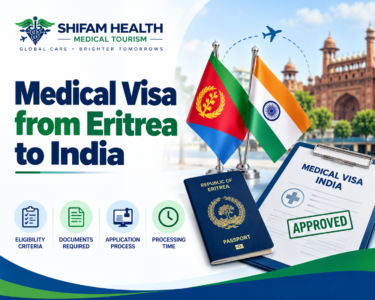
Medical Visa from Eritrea to India (2026): Requirements, Documents & Application Process
Filters & Insights
Last reviewed: 27-Sept-26 · General information for patients from Eritrea planning treatment in India. Not legal or immigration advice —

Last reviewed: 27-Sept-26 · General information for patients from Eritrea planning treatment in India. Not legal or immigration advice — always confirm current requirements with the Embassy of India, Asmara, or the official Indian visa portal before applying or booking travel.
Quick Answer
- Eritrean nationals are eligible for an Indian e-Medical Visa and e-Medical Attendant Visa — the Embassy of India in Asmara specifically recommends Eritrean citizens use this online route.
- The e-Medical Visa is valid 60 days from first arrival, allows triple entry, and is applied for entirely online at indianvisaonline.gov.in — no embassy visit required for most cases.
- Up to two attendants can travel with the patient on a separate e-Medical Attendant Visa, each needing proof of relationship to the patient.
- If treatment is expected to take longer than an e-Visa allows, a regular (paper) Medical Visa, applied through the Embassy of India, Asmara, can be issued for up to one year and can be extended inside India through the FRRO — the e-Visa itself cannot be extended.
- Visa fees follow a reciprocal, nationality-based schedule set by the Government of India that is revised periodically; confirm the exact current fee on the official portal rather than relying on any third-party figure, including this article.
Table of Contents
ToggleCan Eritrean Citizens Travel to India for Medical Treatment?
Yes. India has offered e-Visa access to Eritrean passport holders since 2016, and the Embassy of India in Asmara — the mission with consular jurisdiction over Eritrea — actively directs Eritrean applicants to the e-Visa system for tourism, business, and medical treatment. This makes India one of the more straightforward international treatment destinations for Eritrean patients, since in most cases there is no need to travel to a third country to lodge a paper visa application.
That said, “eligible for a visa” and “your specific case qualifies for the e-Visa” are not automatically the same thing. Eligibility depends on your passport type, your treatment plan, and whether your case fits within the e-Visa’s rules. The sections below walk through exactly what to check.
Which Visa Do You Need — e-Medical Visa or Regular Medical Visa?
India runs two separate systems for foreign patients, and mixing them up is one of the most common (and most disruptive) mistakes.
e-Medical Visa (e-Medical)
- Applied for entirely online at indianvisaonline.gov.in/evisa — the only official portal.
- Available to nationals of the countries listed on that portal, which currently includes Eritrea.
- Valid 60 days from the date of first arrival, with triple entry allowed within that window.
- Cannot be extended from inside India. If treatment runs longer than the visa allows, the patient must exit India (or, in specific circumstances, apply through the FRRO to convert to a regular visa) before it lapses.
- Must be applied for at least 4 days before the intended arrival date, and the system allows booking up to 120 days ahead.
- Best suited to shorter, well-defined treatment episodes: diagnostics, day-care or minor procedures, short surgical admissions, or a course of treatment with a clear endpoint inside 60 days.
Regular (Paper) Medical Visa — MED Visa
- Applied for through the Embassy of India, Asmara, not online.
- Can be issued for up to one year, or the expected period of treatment, whichever is shorter — Indian missions may grant six months with triple entry as a default for most nationalities.
- Can be extended from inside India by the FRRO, generally on production of a medical certificate from the treating hospital confirming the need for continued treatment.
- Better suited to longer, staged, or uncertain treatment timelines — transplants, cancer treatment with multiple cycles, complex orthopaedic or neurological programmes, or any case where a 60-day window is too tight to plan around confidently.
Practical rule of thumb: if your Indian hospital’s treatment plan comfortably fits inside roughly six to eight weeks including recovery and follow-up, the e-Medical Visa is usually the faster route. If the treatment plan is open-ended, staged over months, or involves an uncertain recovery timeline, ask the hospital’s international patient team whether a regular Medical Visa via the Embassy is the more realistic choice — this decision is worth confirming before you finalise flights.
A Note on Tourist Visas
A tourist e-Visa is not designed for planned medical treatment and should not be used as a substitute for the correct visa category, even if it appears easier to obtain. Using the wrong visa category for medical treatment can create complications with hospital admission, insurance, and immigration compliance.
Is the Indian e-Medical Visa Available to Eritrean Citizens in 2026?
Yes. The Embassy of India in Asmara states directly on its official website that Eritrea is among the countries whose citizens are eligible for the e-Visa, and that the e-Visa “can be used if you want to travel to India for … short duration medical treatment.” The e-Visa has three sub-categories — e-Tourist, e-Business, and e-Medical (triple entry) and the Embassy “strongly recommends” Eritrean nationals use this facility rather than a paper application, provided they meet the standard conditions (passport validity, blank pages, return ticket, sufficient funds).
This is a general nationality-level eligibility confirmation. It does not guarantee approval of any individual application — that still depends on your documents, your stated purpose of travel, and standard immigration checks.
Medical Visa Requirements from Eritrea — What to Check Before You Apply
| Requirement | Status | Detail |
|---|---|---|
| Nationality eligibility | Verified | Eritrea is listed among e-Visa eligible countries; confirmed directly by the Embassy of India, Asmara |
| Application channel | Verified | Online via indianvisaonline.gov.in for e-Medical; Embassy of India, Asmara for a regular Medical Visa |
| Passport validity | Verified | At least 6 months from date of arrival in India |
| Blank passport pages | Verified | At least 2 blank pages for immigration stamps |
| Return/onward ticket | Verified | Required as part of the application |
| Proof of sufficient funds | Verified | Required; exact documentary form can vary by case |
| Hospital invitation/medical documentation | Verified as standard practice | Government guidance requires hospitals to issue invitation letters in a prescribed format for Mission use; for e-Visa applications, uploading the hospital letter and medical reports is standard practice |
| Biometrics | Confirm with mission | Not typically required for e-Visa; may apply for paper visa processing depending on the mission |
| Exact visa fee for Eritrean nationals | Confirm on official portal | Fees are set on a reciprocal, per-nationality basis and revised periodically by the Government of India |
| Processing time | Confirm on official portal | Varies by case; do not assume a fixed number of days |
Documents Required for the Patient
A. Core Application Documents
- Valid passport (6+ months validity, 2+ blank pages)
- Recent passport-style photograph (front-facing, white background)
- Completed online e-Visa application (or paper application for a regular Medical Visa)
- Proof of return/onward travel
- Proof of sufficient funds to cover the stay
B. Medical/Treatment Documents
- Referral or summary letter from a treating doctor in Eritrea, where available
- Recent diagnostic reports, imaging, and lab results relevant to the condition
- A hospital invitation or appointment letter from the Indian hospital confirming the diagnosis, proposed treatment, and estimated duration/cost
- A treatment cost estimate from the Indian hospital, where issued
C. Documents That May Be Requested Depending on the Case
Indian missions can request additional supporting material case by case. This may include:
- Further clinical records if the initial documentation is incomplete
- Additional financial proof if the stay is longer or the case is complex
- Custody or parental consent documentation if a minor is travelling
- Clarification of previous travel history
Do not treat this list as universally mandatory — it exists so you are not caught off guard if the mission asks for more.
Medical Attendant Visa from Eritrea to India
An Eritrean patient rarely travels alone, and India’s visa system accounts for this through the e-Medical Attendant Visa (or the paper Medical Attendant Visa where a regular Medical Visa applies).
Key points, based on current government guidance:
- Up to two attendants may be granted an attendant visa per patient.
- Attendants are generally expected to be close family members, and proof of relationship (marriage certificate, birth certificate, or equivalent) should be ready to submit.
- The attendant visa is co-terminus with the patient’s visa — meaning it shares the same validity and, where relevant, the same extension process. An attendant cannot independently hold a longer visa than the patient.
- Minor children accompanying a parent who holds a Medical Visa may be issued a different visa category (X-Misc.) that is also co-terminus with the parent’s visa — check current guidance with the mission if children are travelling.
- Each attendant applies with their own passport — attendants, including children, cannot be added to the patient’s application.
- Attendants need the same core documents as the patient (passport, photo, funds, return ticket) plus proof of their relationship to the patient and a reference to the patient’s own visa/application.
Shifam Health’s dedicated guide to the Medical Attendant Visa for India covers the full attendant application process in more depth if a family member is travelling with the patient.
The Indian Hospital Invitation Letter
For most e-Medical Visa applications, and for all regular Medical Visa applications, the Indian hospital’s documentation is central. Government guidance requires hospitals to provide invitation letters (and later, extension/registration letters if needed) directly to the concerned Indian Mission or to the applicant, in a format the hospital and Mission recognise.
A typical hospital letter generally includes:
- Patient’s full name and passport number
- Diagnosis or reason for referral
- Proposed treatment and treating department/specialist
- Estimated duration of treatment and hospital stay
- Estimated cost, where the hospital is able to provide one
- Hospital’s registration/accreditation details and contact information
Formats differ between hospitals — there is no single universal government template — but the content above is what missions typically expect to see.
Preparing Your Medical Records Before You Apply
Before an Indian hospital can issue a meaningful invitation letter or treatment estimate, it needs to understand your case. Gathering the following in advance speeds up both the specialist review and the eventual visa application:
- Recent diagnostic reports (blood work, imaging, biopsy/pathology as relevant)
- A summary of previous treatment and current medication
- Any prior surgical or discharge reports
- A referral letter from your treating doctor in Eritrea, if you have one
- A copy of your passport bio page
Complete records let the Indian specialist give a realistic treatment plan and duration — which in turn shapes whether an e-Medical Visa or a regular Medical Visa is the right fit. More documents do not, by themselves, improve the chance of visa approval; they exist to support an accurate treatment plan and a consistent, well-supported application.
Step-by-Step Application Process
- Gather your medical records — reports, imaging, current medication list, and any referral letter.
- Share records for specialist/hospital review in India — either directly or through a coordination partner such as Shifam Health.
- Confirm the treatment plan and expected duration with the Indian hospital.
- Decide, with the hospital’s input, whether an e-Medical Visa or a regular Medical Visa fits your treatment timeline (see the comparison above).
- Obtain the hospital invitation letter and cost estimate.
- For the e-Medical Visa: complete the online application at indianvisaonline.gov.in, upload your passport scan, photo, hospital letter, and medical reports, and pay online — at least 4 days before your intended arrival date. For a regular Medical Visa: submit your application and documents to the Embassy of India, Asmara, following its current submission instructions.
- Track your application status through the official portal (or the Embassy, for paper applications).
- Receive your e-Visa approval by email as a PDF, or collect your visa from the Embassy for a paper application.
- Print your visa/approval — do not rely solely on a phone screenshot when travelling.
- Book travel only after your visa is confirmed, especially if flights are non-refundable.
- Travel and complete Indian immigration formalities on arrival, entering through a designated e-Visa airport or seaport if travelling on an e-Visa.
- Register with the FRRO if required — generally not needed for stays of 180 days or less, but confirm based on your visa type and duration.
- Attend treatment, and if it looks likely to run past your visa’s validity, raise this with the hospital and the FRRO well before the visa expires.
Where Eritrean Applicants Submit Their Application
- e-Medical Visa / e-Medical Attendant Visa: entirely online at indianvisaonline.gov.in/evisa — this is the only official Government of India portal. The Embassy of India, Asmara explicitly warns that fraudulent look-alike websites exist and should be avoided.
- Regular Medical Visa / Medical Attendant Visa: through the Embassy of India, Asmara, which holds consular jurisdiction for Eritrea. For questions about the process, the Embassy can be contacted at admn.asmara@mea.gov.in.
Visa Fees
India’s e-Visa fees (including e-Medical and e-Medical Attendant) are charged on a reciprocal, per-nationality basis set by the Government of India, and this schedule is revised from time to time — it is not a single flat fee for every applicant. A bank processing charge typically applies on top of the base fee. Regular (paper) Medical Visa fees are set separately by the Embassy.
Because these figures change and vary by nationality and visa category, this article does not quote a specific amount for Eritrean applicants. Confirm the current fee directly on indianvisaonline.gov.in before paying, and never pay through a third-party website that is not the official government portal.
Processing Time
Indian authorities do not publish a single guaranteed processing time for e-Medical or Medical Attendant Visas, and third-party sources vary widely (some cite a few working days, others longer for complex or paper applications). Processing can be affected by document completeness, additional queries from the mission, and public holidays on either side.
Practical guidance: apply as early as the system allows (e-Medical applications open up to 120 days ahead, with a 4-day minimum), and avoid booking non-refundable flights until your visa is actually approved.
Visa Validity vs. Permitted Stay — Do Not Confuse the Two
These are not the same thing, and confusing them is a common source of overstay problems:
- Visa validity is the window during which the visa can be used to enter India (e.g., 60 days from first arrival for an e-Medical Visa, up to a year for a regular Medical Visa).
- Permitted stay is how long you are actually allowed to remain in India once you arrive, which is generally tied to the visa’s validity but should be checked against the entry stamp/visa sticker on arrival.
If your treatment plan is uncertain, ask the hospital and, where relevant, the FRRO, to confirm exactly how validity and permitted stay apply to your specific visa before you rely on either.
What If My Treatment Takes Longer Than Expected?
- On an e-Medical Visa: it cannot be extended from inside India. If treatment is genuinely likely to exceed 60 days, discuss with the hospital and, if necessary, the FRRO whether converting to a regular visa is realistic, or plan to exit and re-enter within the visa’s multiple-entry allowance if that fits your treatment schedule. Do not assume an automatic extension.
- On a regular Medical Visa: an extension of up to a further year is possible through the FRRO/FRO, generally on production of a medical certificate from a recognised hospital confirming that continued treatment is needed. Approval is not automatic and should be applied for well before the current visa expires.
- In either case: overstaying without registering or extending can lead to penalties and future immigration complications. If treatment is extending, raise it with your hospital’s international patient coordinator as early as possible.
Arrival in India
On arrival, be ready to present:
- Passport and visa/e-Visa approval (printed, not just on your phone)
- Hospital invitation letter and any treatment documentation
- Return/onward travel proof
- Accommodation details
- Attendant documentation, if travelling with a companion
If travelling on an e-Visa, entry is restricted to a list of designated international airports and seaports that the Government of India updates periodically — the current list should be checked on the official portal close to your travel date rather than assumed from an older source, since it has changed more than once in recent years.
Medical Travel Safety — A Visa Is Not a Fitness-to-Fly Certificate
Getting a visa approved says nothing about whether it is medically safe for a specific patient to take a long international flight. Before booking travel, discuss with your current treating doctor whether your condition is stable enough to fly, particularly if you have:
- An active infection or uncontrolled bleeding risk
- Severe anaemia
- Very recent surgery
- Advanced heart or lung disease, or an oxygen requirement
- A high-risk pregnancy
- A condition that may require a medical escort or airport wheelchair assistance
Patients experiencing a medical emergency should seek urgent local care in Eritrea rather than delaying treatment to arrange international travel. Airlines may also require their own medical clearance for certain conditions — check this with the airline directly.
Financial Preparation
Keep these budgets separate when planning:
| Category | Includes |
|---|---|
| Visa costs | Government e-Visa/visa fee, bank charges |
| Treatment costs | Consultation, diagnostics, procedure, hospital stay, medicines |
| Travel costs | Flights, airport transfer, local transport |
| Living costs | Accommodation, food, and attendant expenses during treatment and recovery |
A visa approval does not fix or guarantee your treatment cost — that is a separate estimate from the hospital, which can change if your clinical picture changes after further tests in India.
Common Application Mistakes
- Assuming e-Medical Visa eligibility without checking current Eritrea-specific guidance
- Applying under the wrong visa category (tourist instead of medical)
- Passport details that don’t exactly match across the application, the hospital letter, and supporting documents
- Incomplete medical records slowing down the hospital’s invitation letter
- Booking non-refundable flights before the visa is approved
- Confusing e-Medical Visa validity (60 days, non-extendable) with a regular Medical Visa’s extendable validity
- Forgetting that each attendant, including children, needs their own passport and application
- Using an unofficial website that imitates the government e-Visa portal
- Assuming a visa extension is automatic if treatment runs long
- Delaying urgent local medical care in Eritrea while arranging international travel
Visa Safety and Fraud Prevention
The Embassy of India, Asmara, specifically warns that fraudulent websites imitate the official e-Visa portal. Protect yourself by:
- Applying only at indianvisaonline.gov.in
- Verifying any embassy or visa-centre contact details directly against the Embassy of India, Asmara’s own published information
- Never paying a “guaranteed approval” fee to a private agent
- Keeping copies of every document submitted and every payment receipt
- Contacting the Embassy directly (admn.asmara@mea.gov.in) if anything about a website or process looks inconsistent
Application Process at a Glance
| Stage | What You Do | Main Documents | Where Verify | Key Point |
|---|---|---|---|---|
| 1. Records & review | Share medical records, get hospital review | Reports, referral letter | Indian hospital / coordination partner | Treatment plan confirmed |
| 2. Choose visa type | Match treatment length to e-Medical vs. regular Medical Visa | Hospital’s estimated duration | With hospital’s international patient team | Confirm before booking flights |
| 3. Apply | Complete online or paper application | Passport, photo, hospital letter, funds proof | indianvisaonline.gov.in or Embassy of India, Asmara | Use only the official portal |
| 4. Approval | Receive and print visa/e-Visa | Approval PDF or visa sticker | Email / Embassy | Check validity dates carefully |
| 5. Travel | Enter India | Visa, ticket, hospital letter | Designated e-Visa airport/seaport if on e-Visa | Confirm current entry-point list |
| 6. Treatment & compliance | Register with FRRO if required, monitor visa validity | Hospital documentation | India | Extend/convert visa in good time if treatment runs long |
Shifam Health’s Role
Shifam Health is an international healthcare coordination and medical travel support company. For Eritrean patients, this can include:
- Collecting and organising medical records for specialist review
- Coordinating with Indian hospitals to obtain treatment plans and invitation letters
- Helping patients understand which visa category fits their treatment timeline
- Supporting travel, airport pickup, accommodation, and local coordination
- Coordinating follow-up care after the patient returns home
Shifam Health does not issue, approve, or represent the Government of India’s visa process, and cannot guarantee visa approval, hospital acceptance, treatment dates, or exact costs. Visa decisions rest entirely with the Indian government and its missions.
If you are an Eritrean patient planning treatment in India, you can share your medical reports with Shifam Health for coordination of specialist review, hospital options, and the visa-related documentation your case will need — with no obligation.
Myths vs. Facts
| Myth | Fact |
|---|---|
| “A hospital invitation letter guarantees visa approval.” | It supports the application, but the mission makes the final decision based on all documents and standard checks. |
| “Every foreign patient can use the e-Medical Visa.” | Eligibility depends on nationality and passport type; Eritrea is currently eligible, but this should still be confirmed for each application. |
| “A tourist visa is fine for planned medical treatment.” | Medical treatment should be applied for under the correct medical visa category, not a tourist visa. |
| “Visa validity and permitted stay are the same thing.” | Validity is the window to enter/use the visa; permitted stay is how long you can remain — check both, not just one. |
| “An attendant automatically gets the same visa type without a separate application.” | Attendants must apply individually, even though their visa is co-terminus with the patient’s. |
| “A visa extension is automatic if treatment runs long.” | Only regular Medical Visas can be extended, and only with supporting medical documentation approved by the FRRO — it is not automatic. |
| “Getting the visa means you’re medically fit to fly.” | Visa approval is an immigration decision, not a medical clearance — confirm fitness to travel with your doctor separately. |
FAQs
Can Eritrean citizens get a medical visa for India?
Yes. Eritrean citizens can apply for an Indian e-Medical Visa or a regular Medical Visa, subject to current eligibility and documentation requirements.
Can Eritrean patients apply for an Indian e-Medical Visa?
Yes. Eligible applicants can apply online through the official Indian visa portal.
What documents are required?
A valid passport, photograph, travel details, medical reports, and treatment-related documents such as a hospital invitation letter may be required.
Is a hospital invitation letter required?
Hospital documentation is generally important for demonstrating the medical purpose of travel and planned treatment.
Can family members accompany the patient?
Yes. Eligible attendants can apply separately for an e-Medical Attendant Visa or Medical Attendant Visa.
How many attendants can accompany a patient?
Up to two attendants may be permitted under current e-Visa rules, subject to eligibility requirements.
How long does an Indian Medical Visa take?
Processing times vary. Applicants should apply early and avoid making non-refundable travel arrangements before approval.
How long can a medical-visa holder stay in India?
An e-Medical Visa generally permits a 60-day stay from first arrival. Regular Medical Visas may allow longer stays depending on treatment requirements.
Can a Medical Visa be extended?
Regular Medical Visas may be extended in India through the appropriate authorities when medically justified. e-Medical Visas cannot generally be extended.
Can children travel to India for treatment?
Yes. Children require their own passport and appropriate visa documentation.
Can Shifam Health help with the visa process?
Yes. Shifam Health can assist with document coordination, hospital communication, and understanding the application process, but visa decisions remain with the Government of India.
Conclusion
For an Eritrean patient, the practical path runs: gather medical records → get a treatment plan and hospital invitation from an Indian hospital → confirm whether an e-Medical Visa or a regular Medical Visa matches the treatment timeline → apply through the correct official channel → travel only once the visa is approved → stay on top of visa validity throughout treatment. India’s e-Visa system makes the process genuinely accessible for Eritrean citizens, but every time-sensitive detail — fees, processing time, exact document lists — can change, so it is always worth a final check against the official Indian visa portal or the Embassy of India, Asmara, before you apply or travel. If your condition needs urgent attention, seek local emergency care first rather than waiting on visa arrangements.
Related Guides from Shifam Health:
- Indian Medical Visa Guide— Complete Overview
- How to Apply for an Indian Medical Visa Online— Step-by-Step
- Indian Medical Visa Rejection Guide 2026 — Reasons, Solutions & Prevention
- Medical Visa Extension India— FRRO Process Explained
- Cancer Treatment in India— International Patient Guide
- Heart Surgery in India— Costs, Hospitals & Patient Journey
- Organ Transplant in India — Legal Requirements for International Patients
- Medical Tourism in India— Why International Patients Choose India
© Shifam Health. All rights reserved.



Popular Posts From Last Week
- September 21, 2026
- shifamhealth
Hearing “neurofibromatosis” attached to your own or your child’s diagnosis often raises a specific kind of confusion, because…
- September 24, 2026
- shifamhealth
Osteopenia means bone mineral density lower than the young-adult reference range but not low enough to meet the…
- September 25, 2026
- shifamhealth
Spina bifida is a group of neural tube defects caused by incomplete closure or development of the neural…
- September 26, 2026
- shifamhealth
Skeletal dysplasia is not one disease — it’s an umbrella term for a large, genetically diverse group of…
- September 21, 2026
- shifamhealth
Medically reviewed content · Published 2026 · Last reviewed September 2026 Hip dysplasia describes a hip joint where…
- September 20, 2026
- shifamhealth
Still having pain after spine surgery — whether it never fully went away, or came back after a…
- September 22, 2026
- shifamhealth
Medically reviewed content · Published 2026 · Last reviewed September 2026 The meniscus is a C-shaped piece of…
- September 24, 2026
- shifamhealth
Osteoarthritis is a whole-joint disorder not simply cartilage “wearing out” involving changes to cartilage, the underlying bone, the…
- September 27, 2026
- shifamhealth
Last reviewed: 27-Sept-26 · General information for patients from Eritrea planning treatment in India. Not legal or immigration…