



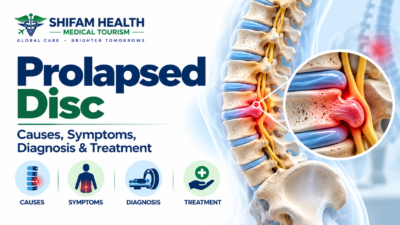
Prolapsed Disc (2026): Causes, Symptoms, Diagnosis & Treatment
Filters & Insights
Learn about prolapsed disc causes, symptoms, diagnosis, treatment options, risk factors, & recovery to better understand this spinal condition.

“Slipped disc,” “herniated disc,” “prolapsed disc” — these terms get used almost interchangeably by patients, and the imagery that comes with “slipped” (something sliding out of place) is often more frightening than what’s actually happening anatomically.
Understanding what a spinal disc actually does, what changes when it “prolapses,” and — critically — that many disc findings on MRI don’t require surgery at all, changes how manageable this diagnosis feels.
Table of Contents
ToggleWhat Is a Prolapsed Disc?
A prolapsed disc occurs when the soft, gel-like center of a spinal disc pushes outward through a weakened or torn area of the disc’s tougher outer layer, sometimes contacting a nearby nerve.
“Prolapsed disc,” “herniated disc,” and “slipped disc” are commonly used by patients to describe the same general phenomenon, though “slipped disc” is technically misleading — the disc doesn’t actually slide out of position between the vertebrae. Disc changes can occur at any level of the spine, most commonly the lower back (lumbar spine) and neck (cervical spine).
A disc abnormality visible on imaging does not automatically mean it’s causing symptoms — many disc bulges and even herniations are found incidentally in people with no back or neck pain at all, which is why matching imaging findings to your actual symptoms and examination matters more than the MRI report on its own.
Prolapsed Disc vs. Herniated Disc vs. Slipped Disc — Are They the Same Thing?
| Term | What It Actually Means |
|---|---|
| Prolapsed disc | General/patient term for disc material displacing outward; used somewhat interchangeably with “herniated disc” |
| Herniated disc | The more precise clinical term; disc material has pushed through a tear in the outer disc layer |
| Slipped disc | A common lay term — misleading, since the disc doesn’t literally slip out of position; usually refers to the same thing as a herniated/prolapsed disc |
| Bulging disc | The disc’s outer layer extends beyond its normal boundary without a clear tear or displaced fragment — often less clinically significant than herniation |
| Disc extrusion | Disc material has broken through the outer layer and displaced beyond it, sometimes remaining connected to the parent disc |
| Sequestered disc | A free fragment of disc material has completely separated from the parent disc |
Terminology genuinely varies between clinicians, radiologists, and countries — you may see these terms used with slightly different precision depending on your source, which is worth keeping in mind when researching your own situation or comparing opinions.
How Does a Spinal Disc Work?
Each spinal disc sits between two vertebrae, acting as a shock absorber, allowing spinal movement, and distributing load across the spine.
A disc has two main components: the annulus fibrosus — a tough, layered outer ring of fibrous tissue — surrounding the nucleus pulposus, a softer, gel-like center.
With age-related degeneration or, sometimes, acute mechanical stress, the annulus can weaken, develop small tears, or lose structural integrity, allowing nucleus material to bulge or push through — the basic mechanism behind disc bulging, protrusion, extrusion, and sequestration, which represent a spectrum of increasing displacement rather than entirely separate conditions.
Where Can a Prolapsed Disc Occur?
| Spinal Region | Common Associated Symptoms |
|---|---|
| Cervical spine (neck) | Neck pain, shoulder pain, arm pain, hand numbness/weakness |
| Thoracic spine (mid-back) | Mid-back pain, band-like pain around the trunk; less common overall |
| Lumbar spine (lower back) | Low back pain, sciatica, leg pain, numbness, weakness |
Lumbar disc herniation is the most common presentation and the one most associated with sciatica. Thoracic disc herniation is genuinely uncommon relative to cervical and lumbar disease — worth knowing, since unusual chest or abdominal symptoms shouldn’t be automatically attributed to a thoracic disc without appropriately ruling out other, more common causes first.
What Causes a Prolapsed Disc?
Most cases arise from a combination of age-related disc degeneration and mechanical stress, rather than one single identifiable event. Contributing factors include repetitive lifting, awkward or twisting movements under load, sudden significant strain, physically demanding occupational work, prolonged sitting, and, per some evidence, genetic susceptibility to disc degeneration.
Smoking is associated with accelerated disc degeneration, and excess body weight is associated with increased mechanical loading on the lumbar spine specifically.
Many cases genuinely can’t be traced to one single lifting incident or moment — a “final straw” event often occurs against a backdrop of gradual, pre-existing degenerative change.
Modifiable vs. Non-Modifiable Risk Factors
Modifiable: smoking, physical inactivity/deconditioning, lifting technique, excess body weight, occupational strain patterns.
Non-modifiable: age, genetic predisposition to disc degeneration, prior disc problems.
Does Bad Posture Cause a Prolapsed Disc?
Posture and prolonged static positions may influence spinal loading and symptom experience, but it would be an oversimplification to claim poor posture alone directly causes disc prolapse — this is a multifactorial condition, and no single postural habit has been established as a sole cause.
Symptoms of a Prolapsed Disc
Symptoms depend on the disc’s location, size of displacement, direction it has moved, whether it’s contacting a nerve, and the degree of associated inflammation.
Possible symptoms include back or neck pain, radiating limb pain, numbness, tingling, weakness, reduced reflexes, and, in more severe cases, difficulty walking.
Some disc herniations cause no symptoms whatsoever — this is genuinely common and part of why imaging alone can’t diagnose a symptomatic problem.
Prolapsed Disc and Sciatica
Sciatica refers to pain radiating from the lower back into the buttock and leg, following the sciatic nerve’s distribution, often alongside numbness, tingling, or weakness.
Lumbar disc herniation compressing or irritating a nerve root is a common cause of sciatica, but not every case of sciatica is caused by a disc herniation — spinal stenosis and other nerve-root irritation causes can produce a similar pattern, which is why proper evaluation matters rather than assuming disc herniation by default.
Cervical Prolapsed Disc
Cervical disc herniation can cause neck pain, shoulder pain, arm pain, and numbness, tingling, or weakness in the hand or arm, from nerve-root compression (radiculopathy). Less commonly, cervical disc disease can cause spinal cord compression (myelopathy) rather than just nerve-root irritation — distinct warning signs include hand clumsiness, gait imbalance, weakness affecting multiple limbs, and, in severe cases, bowel or bladder changes.
Not every cervical disc herniation causes myelopathy — this is a distinct, less common presentation requiring its own recognition and prompt evaluation when suspected.
Lumbar Prolapsed Disc
Lumbar disc herniation commonly causes low back pain, sciatica, leg pain, numbness, tingling, and weakness, with symptom pattern depending on which nerve root is affected (commonly discussed by level — L4, L5, or S1 nerve roots each following somewhat different, though not perfectly predictable, symptom and dermatome patterns).
Thoracic Prolapsed Disc
Thoracic disc herniation is less common than cervical or lumbar disease and can cause mid-back pain, sometimes band-like pain wrapping around the trunk, and, less commonly, spinal cord-related symptoms given the thoracic spinal canal’s relatively narrow space.
Unusual chest or abdominal symptoms deserve appropriate evaluation for non-spinal causes — many conditions unrelated to the spine can produce similar symptoms, and thoracic disc disease shouldn’t be assumed without proper workup.
Emergency Symptoms and Cauda Equina Syndrome
This deserves unmissable emphasis, even briefly: new bowel or bladder dysfunction, saddle numbness (around the genitals, anus, or inner thighs), or rapidly worsening leg weakness after a disc-related back problem can indicate cauda equina syndrome — a genuine medical emergency requiring immediate care, not a routine appointment.
Other symptoms warranting urgent assessment include significant trauma, fever with severe back pain, a cancer history with new neurological symptoms, and significant immunosuppression with concerning symptoms. For a fuller discussion of red flags and when urgent evaluation is warranted more broadly, see our Chronic Back Pain guide.
Myelopathy vs. Radiculopathy vs. Sciatica
| Feature | Radiculopathy | Myelopathy |
|---|---|---|
| Location of problem | Nerve root | Spinal cord itself |
| Typical symptoms | Radiating limb pain, numbness, weakness in a specific distribution | Balance/gait problems, broader neurological signs, possible multi-limb involvement |
| Common cause | Disc herniation, foraminal narrowing | Spinal cord compression (e.g., from cervical disc disease or stenosis) |
“Sciatica” commonly describes the radiating-leg-pain pattern associated with lumbar radiculopathy, though not all sciatica represents confirmed radiculopathy, and not every radiculopathy produces textbook sciatica — clinical correlation, not just symptom labels, determines the actual diagnosis.
How Is a Prolapsed Disc Diagnosed?
Diagnosis is built from medical history, neurological examination (strength, sensation, reflexes, gait), physical examination including straight-leg-raise or other nerve-tension testing where relevant, and selective, not automatic, imaging.
When Is MRI Needed?
MRI is genuinely useful when severe or progressive neurological deficits are present, cauda equina syndrome is suspected, symptoms persist despite an adequate trial of appropriate conservative management, surgery or another invasive treatment is being considered, or another serious underlying condition is suspected.
Routine early MRI for uncomplicated, new back pain is not recommended by current guidelines — early imaging without these indications hasn’t been shown to improve outcomes, and can lead to unnecessary intervention based on incidental findings. This principle is explored in more depth in our Chronic Back Pain guide.
MRI can show disc degeneration, bulging, protrusion, extrusion, nerve-root compression, and spinal canal narrowing — but, again, findings must be matched with your actual symptoms and examination, since incidental abnormalities are common at every adult age.
X-rays don’t directly visualize discs or nerve compression well, but can assess bone alignment, fractures, degenerative changes, and instability in selected cases.
CT is useful when MRI is unavailable or contraindicated, for detailed bony anatomy, and, in selected circumstances, CT myelography — though it’s not generally equivalent to MRI for soft-tissue and nerve visualization.
EMG/nerve conduction studies can help when the clinical picture is unclear, particularly distinguishing radiculopathy from a peripheral nerve problem unrelated to the spine, though they’re not routinely needed for every disc herniation.
Differential Diagnosis
Other causes of similar back, neck, or radiating limb symptoms include spinal stenosis, general degenerative disc disease without a discrete herniation, facet joint disease, sacroiliac joint disorders, muscle strain, peripheral neuropathy, hip disease, and, less commonly, vascular conditions, infection, malignancy, or inflammatory disease.
How Is a Prolapsed Disc Treated?
Many symptomatic disc herniations genuinely improve with conservative (non-surgical) management, which typically includes staying reasonably active within symptom tolerance, avoiding prolonged bed rest, appropriate pain medication, physiotherapy and exercise, activity modification, and, for persistent radicular symptoms, selected injections — with surgery reserved for appropriately selected patients.
Should You Rest?
Short periods of relative rest may help during severe acute flares, but prolonged bed rest is not generally recommended and can worsen outcomes — gradual return to normal activity, guided by symptoms, is the more evidence-supported approach. This doesn’t mean pushing through severe neurological symptoms; it means avoiding extended, unnecessary inactivity for ordinary pain.
Pain Medications
NSAIDs, acetaminophen/paracetamol, selected neuropathic pain medications (when a nerve-pain component is present), short-term muscle relaxants in selected cases, and, occasionally, carefully justified short-term opioids for severe acute symptoms are among the medication categories used — this article doesn’t prescribe or provide dosing, and medication choice requires your clinician’s direct involvement given your specific health history.
Can Physiotherapy Help?
Physiotherapy — individualized exercise, core/trunk strengthening, mobility work, posture and movement strategies, and graded activity — has reasonable evidence supporting benefit for many patients with disc-related symptoms.
No specific exercise “puts the disc back into place” — this is a common but inaccurate claim; physiotherapy’s real value is improving function, strength, and movement confidence, which often accompanies symptom improvement rather than mechanically repositioning disc material.
Appropriate exercise generally includes walking, gentle mobility work, trunk stabilization, progressive strengthening, and aerobic conditioning, adjusted based on your specific symptoms and neurological findings.
Certain activities may aggravate symptoms during an acute flare — heavy lifting, uncontrolled twisting, or poorly controlled loaded spinal flexion — but this doesn’t mean permanently avoiding bending or lifting; most patients can gradually return to normal activity as symptoms allow.
Epidural Steroid Injections and Nerve-Root Blocks
Epidural injections (delivered via transforaminal, interlaminar, or caudal approaches) may provide short-term relief for selected patients with radicular pain, and selective nerve-root blocks can serve a diagnostic role in clarifying which nerve root is involved.
These injections do not physically repair the disc — benefit, when present, is symptomatic and often temporary rather than structurally curative. A more detailed discussion of injection evidence and limitations is available in our Chronic Back Pain guide.
When Does a Prolapsed Disc Require Surgery?
Most people with a prolapsed disc do not need surgery. Surgery becomes more relevant when there’s cauda equina syndrome, a significant or progressive neurological deficit, severe persistent radicular pain that hasn’t improved despite an adequate trial of appropriate conservative care, or when imaging findings clearly correlate with your specific clinical symptoms.
MRI severity alone does not determine whether surgery is needed — this bears repeating, since it’s easy to feel pressured into a procedure by an alarming-sounding radiology report rather than your actual symptom trajectory.
Microdiscectomy
The standard surgical procedure for a herniated disc causing nerve compression, aiming to remove the specific disc material compressing the nerve. Performed under anesthesia, often with a relatively short hospital stay for appropriately selected patients.
Recovery varies genuinely between individuals — there’s no single universal timeline, and it depends on your specific situation, occupation, and how your body responds.
Endoscopic Discectomy
A minimally invasive approach using specialized endoscopic instruments through a smaller access point, potentially offering advantages like less tissue disruption for appropriately selected cases. It requires specific surgeon expertise and technical setup, and is not automatically superior to conventional microdiscectomy for every patient — appropriateness depends on the specific disc pathology, location, and surgeon experience with the technique.
Open Discectomy
Conventional surgical decompression remains appropriate in selected cases, particularly more complex or larger herniations, aiming to relieve nerve-root pressure by removing the offending disc fragment.
Is Spinal Fusion Necessary?
Most uncomplicated lumbar disc herniations do not require spinal fusion. Fusion may be considered specifically when there’s associated spinal instability, significant deformity, or certain recurrent pathology scenarios — not as a routine addition to standard discectomy. If fusion is proposed alongside a straightforward disc herniation without one of these specific additional indications, it’s reasonable to ask directly why.
Cervical Disc Replacement
For selected cervical disc problems, artificial disc replacement (arthroplasty) aims to preserve motion at the treated level rather than fusing it. It’s not appropriate for every cervical disc patient — candidacy depends on specific anatomical and clinical factors your surgical team will assess.
Surgery Risks
Relevant risks include infection, bleeding, dural tear, nerve injury, recurrent disc herniation at the same level, persistent pain, anesthesia-related risks, and, uncommonly, the need for additional surgery. Common, minor risks are distinct from rare, more serious ones — your surgical team can walk through which apply specifically to your planned procedure.
Surgery vs. Conservative Treatment
| Approach | Advantages | Limitations |
|---|---|---|
| Conservative care (activity, physiotherapy, medication) | No surgical risk; many patients improve meaningfully | Slower symptom resolution for some; doesn’t help everyone |
| Epidural injection | Can reduce radicular pain, support rehabilitation participation | Temporary effect; doesn’t address underlying structural change |
| Microdiscectomy | Can provide faster relief for persistent nerve-compression symptoms in appropriately selected patients | Surgical risks; not needed for most disc herniations |
| Endoscopic discectomy | Less tissue disruption in appropriately selected cases | Requires specific expertise; not universally available or appropriate |
Surgery can provide faster relief for appropriately selected patients with persistent radicular symptoms, while many patients improve without it — surgery isn’t consistently “better” long-term for every patient, and the right choice depends on your specific presentation and how you’ve responded to appropriate conservative treatment.
Can a Prolapsed Disc Heal Without Surgery?
Many disc herniations genuinely improve clinically over time, and — worth knowing, since it’s reassuring and not widely understood — some herniated disc material can spontaneously shrink or resorb on follow-up imaging, particularly larger extrusions, through immune-mediated processes and gradual dehydration of the displaced material.
Symptom improvement doesn’t require the disc to look completely normal on a repeat scan — you can feel substantially better with imaging that still shows some residual change.
Not every prolapsed disc “heals” in the sense of returning to its original anatomy — but meaningful symptomatic improvement is common even without that.
How Long Does Recovery Take?
Recovery timing depends on the disc’s location, severity, degree of nerve involvement, your general health, the specific treatment pursued, and your activity level — there is no single universal recovery timeline that applies across patients, and you should be skeptical of any source promising a fixed number of weeks without knowing your specific situation.
A general pattern involves an acute phase, followed by gradual improvement, with reassessment appropriate if symptoms aren’t improving as expected.
Can It Come Back? (Recurrence)
Disc herniation can recur, whether after conservative management or after surgery (recurrent herniation at the same operated level is a recognized, though not inevitable, possibility).
Risk factors associated with recurrence include continued smoking, ongoing degenerative changes, and occupational strain patterns — though exact recurrence likelihood varies across published studies and shouldn’t be quoted as one fixed percentage.
Prevention
Regular physical activity, general strength training, maintaining a healthy body weight where relevant, smoking cessation, reasonably safe lifting technique, avoiding prolonged inactivity, sensible workplace ergonomics, and gradual training progression for athletic activity are all supportive measures.
These reduce risk; they don’t guarantee prevention — disc degeneration is, to a genuine extent, a normal part of aging that can’t be fully avoided through lifestyle measures alone.
Special Situations: Pregnancy, Age, and Athletes
Pregnancy commonly involves back pain from biomechanical changes; not all pregnancy-related back pain is disc-related, and imaging or medication decisions during pregnancy should always involve your obstetric provider directly, alongside prompt attention to any red-flag symptoms.
Older adults may have disc problems coexisting with other degenerative changes (spinal stenosis) or need osteoporotic fracture considered in the differential — evaluation approach can differ somewhat from younger patients given these overlapping possibilities.
Younger adults can develop disc herniation from sports, lifting, occupational strain, or acute injury — it’s not exclusively an older-adult condition, and genetic predisposition plays a real role independent of age.
Athletes generally benefit from gradual, sport-specific rehabilitation and a progressive return to training guided by symptoms and functional testing, rather than a fixed universal return-to-play date.
Can a Prolapsed Disc Cause Paralysis or Permanent Nerve Damage?
Severe nerve or spinal cord compression can cause significant neurological impairment, but paralysis is not the typical outcome of most lumbar disc herniations — this is an uncommon, severe-end-of-spectrum possibility, not the expected course.
Prolonged or severe compression genuinely can cause lasting nerve injury, with risk related to severity and duration of compression — which is precisely why progressive neurological deficits require prompt, not delayed, assessment, without a rigid “wait exactly this many hours” rule that isn’t well supported by current evidence.
When to See a Spine Specialist, and When to Get a Second Opinion
Specialist evaluation is reasonable for persistent symptoms, progressive weakness, significant numbness, recurrent symptoms, failure of appropriate conservative treatment, an uncertain diagnosis, or when surgery is genuinely being considered.
A second opinion is particularly worth seeking when surgery — especially fusion — has been recommended, when your symptoms and MRI findings seem mismatched, when surgery is being recommended despite relatively mild symptoms, or when you’ve received conflicting opinions.
Useful records to bring or share include your actual MRI images (not just the written report), any X-rays or CT, documented neurological examination findings, current medication list, physiotherapy records, any previous injection records, and prior specialist opinions.
Prolapsed Disc Treatment in India
International patients researching evaluation and treatment in India will find spine specialist consultation (orthopedic or neurosurgical), MRI and other imaging, EMG/NCS where needed, physiotherapy, pain management including epidural injections, and both microdiscectomy and endoscopic discectomy available at major centers — though not every hospital offers every service, and endoscopic discectomy specifically requires confirming a center’s specific expertise with that technique rather than assuming universal availability.
Cost
| Component | Typical Range (International Patient, Indicative) | Notes |
|---|---|---|
| Specialist consultation | $50 – $150 | Per visit |
| MRI | $200 – $500 | Not needed for every patient |
| Physiotherapy course | $300 – $1,000 | Varies by duration |
| Epidural/nerve-root injection | $400 – $1,200 | Per procedure |
| Microdiscectomy | $4,500 – $7,500 | For appropriately selected nerve-compression cases |
| Endoscopic discectomy | $5,000 – $9,000 | Varies with technique and facility; confirm specific expertise before comparing quotes |
These figures are consistent with cost data in our companion Chronic Back Pain guide and remain indicative estimates requiring case-specific verification — no responsible provider should quote a fixed surgical price before clinical evaluation of your specific case.
International Patient Journey
- Submit your medical records and, where available, MRI images (not just reports)
- Specialist review
- Clinical assessment and diagnosis confirmation, correlating imaging with your actual symptoms
- Conservative vs. interventional treatment discussion
- Treatment and cost estimate
- Travel planning, where treatment is pursued
- Hospital treatment
- Rehabilitation and follow-up
Final treatment recommendations may reasonably change after direct, in-person examination — this is a normal part of responsible care, not a sign of inconsistent initial advice.
How Shifam Health Can Help
Shifam Health is a medical tourism facilitator — not a hospital, surgeon, or diagnostic center — and we don’t diagnose your disc problem or determine your treatment plan ourselves.
We can help by coordinating the collection and sharing of your medical records and MRI images with appropriate spine specialists, arranging appointments, providing transparent cost estimates once a plan is established, and supporting visa, travel, and follow-up logistics.
Reach out on WhatsApp or submit a quick inquiry — our team responds within 24 hours, with no obligation to proceed.
Myths vs. Facts
| Myth | Fact |
|---|---|
| A “slipped disc” means the disc has literally slipped out of place | The disc doesn’t slide out of position — material from its center pushes outward through the outer layer |
| Every prolapsed disc requires surgery | Most people improve with conservative management; surgery is reserved for specific indications |
| An MRI showing a disc bulge means you need surgery | Bulges and even herniations are commonly found in people without symptoms |
| A prolapsed disc always causes pain | Many disc herniations are asymptomatic |
| Bed rest is the best treatment | Prolonged bed rest is generally discouraged; gradual activity is favored |
| A prolapsed disc can never improve without surgery | Many cases improve clinically over time, sometimes with visible resorption on imaging |
| Fusion is required for every disc prolapse | Most uncomplicated herniations don’t require fusion |
| Injections repair the disc | Injections provide symptomatic relief; they don’t structurally repair disc material |
| Sciatica always means a prolapsed disc | Other causes, including spinal stenosis, can also produce sciatica |
Frequently Asked Questions
What is a prolapsed disc?
It occurs when the soft center of a spinal disc pushes through a weakened outer layer, sometimes compressing a nearby nerve.
Is a prolapsed disc the same as a herniated disc?
Yes. These terms are generally used interchangeably.
Is a slipped disc actually slipped?
No. The disc does not literally slide out of position; “slipped disc” is a common lay term.
Can a prolapsed disc cause no symptoms?
Yes. Many disc herniations are found on imaging without causing symptoms.
Can it cause sciatica?
Yes. A herniated lumbar disc is a common cause of sciatica.
Can a prolapsed disc heal without surgery?
Yes. Many patients improve with conservative treatment, and herniated material may shrink naturally over time.
Do I need an MRI?
Not always. MRI is usually considered for red flags, neurological deficits, or persistent symptoms despite appropriate treatment.
Can physiotherapy help?
Yes. It can improve strength, movement, function, and symptom management.
When is surgery needed?
Surgery may be considered for cauda equina syndrome, progressive neurological weakness, or persistent severe nerve pain despite appropriate conservative treatment.
What is microdiscectomy?
A surgical procedure that removes disc material compressing a spinal nerve in appropriately selected patients.
What are the emergency warning signs?
New bowel or bladder problems, saddle numbness, or rapidly worsening leg weakness require immediate medical attention.
Can a prolapsed disc recur?
Yes. Recurrence is possible after both conservative treatment and surgery.
Final Takeaway
A prolapsed disc is a common, usually manageable condition — not the alarming “slipped out of place” event its nickname suggests. Most people improve with conservative treatment, imaging findings need to be matched to your actual symptoms rather than acted on alone, and surgery is reserved for specific situations rather than being a default response to an MRI report. Red flags — new bowel/bladder dysfunction, saddle numbness, or progressive weakness — deserve immediate attention. For most patients, the path forward involves appropriate activity, physiotherapy, and time, with surgical options available and genuinely helpful for those who need them.
International patients can share their MRI and medical records with Shifam Health to help coordinate an appropriate specialist review and understand realistic treatment options in India.
This article is for general informational purposes and does not constitute medical advice. Prolapsed disc diagnosis and treatment planning require individualized clinical evaluation, with imaging findings interpreted in the context of your specific symptoms and neurological examination. If you experience new bowel/bladder dysfunction, saddle numbness, or progressive weakness, seek immediate medical attention.


Popular Posts From Last Week
- September 21, 2026
- shifamhealth
Hearing “neurofibromatosis” attached to your own or your child’s diagnosis often raises a specific kind of confusion, because…
- September 24, 2026
- shifamhealth
Osteopenia means bone mineral density lower than the young-adult reference range but not low enough to meet the…
- September 25, 2026
- shifamhealth
Spina bifida is a group of neural tube defects caused by incomplete closure or development of the neural…
- September 26, 2026
- shifamhealth
Skeletal dysplasia is not one disease — it’s an umbrella term for a large, genetically diverse group of…
- September 22, 2026
- shifamhealth
Medically reviewed content · Published 2026 · Last reviewed September 2026 The meniscus is a C-shaped piece of…
- September 24, 2026
- shifamhealth
Osteoarthritis is a whole-joint disorder not simply cartilage “wearing out” involving changes to cartilage, the underlying bone, the…
- September 28, 2026
- shifamhealth
“Slipped disc,” “herniated disc,” “prolapsed disc” — these terms get used almost interchangeably by patients, and the imagery…
- September 27, 2026
- shifamhealth
Last reviewed: 27-Sept-26 · General information for patients from Eritrea planning treatment in India. Not legal or immigration…