




Home > Blog > Spine Surgery in India vs Turkey (2026): Cost, Hospitals & Which Country Is Right for You?
Spine Surgery in India vs Turkey (2026): Cost, Hospitals & Which Country Is Right for You?
Filters & Insights
Comparing spine surgery in India and Turkey? Real cost ranges by procedure, surgeon expertise, technology & honest guidance no rankings, no sales pressure.

- Both India and Turkey have established, accredited spine surgery programs covering everything from microdiscectomy to complex deformity correction — the meaningful differences are in cost structure, technology adoption pattern, and travel logistics, not baseline surgical competence.
- Cost varies enormously by procedure, not just by country. A single-level microdiscectomy and a multi-level fusion with instrumentation are not comparable line items — published India ranges run roughly $1,000–$12,000+ across procedure types, while Turkey ranges roughly $800–$39,000, with robotic-assisted fusion at the very top of that range in Turkey specifically.
- Implants are the most commonly under-disclosed cost variable in both countries — imported titanium hardware can add significantly to a quote, and it’s worth asking explicitly what implant brand and material is included before comparing two quotes.
- Neither country is universally cheaper or better for every case. For straightforward, single-level procedures, India’s published ranges are generally the lower option; for patients specifically wanting robotic-assisted technology with a shorter regional flight from Europe or the Gulf, Turkey has built out that niche more visibly in recent marketing, though the underlying robotic platforms are not exclusive to either country.
- Shifam Health helps international patients get a records-based spine surgery opinion and written, procedure-specific quote from partner hospitals in India not a generic country-level estimate.
Table of Contents
ToggleCountry Comparison Scorecard
| Factor | India | Turkey |
|---|---|---|
| Cost Range | $1,000–12,000+ | $800–16,000 (up to $39,000 robotic) |
| Robotic / Navigation Surgery | Available at major centers; growing adoption | Widely marketed in JCI hospitals as premium offering |
| Hospital Accreditation | NABH + JCI hospitals in metro cities | Strong JCI presence in private hospitals |
| English Communication | Widely available in international departments | Dedicated English coordinators in major hospitals |
| Travel Access | Direct flights from Gulf, Africa, South Asia | Easy access from Gulf; closer for Europe |
| Stay Duration | 10–14 days (procedure-dependent) | 10–14 days (procedure-dependent) |
| Visa Process | e-Medical Visa available for many nationalities | Standard visa/e-visa based on nationality |
| Overall Value | Best for cost-sensitive patients | Strong for Europe proximity & robotic focus |
This scorecard summarizes general patterns from published sources — it is not a ranking, and individual hospital and surgeon quality varies meaningfully within both countries.
What Is Spine Surgery, and When Is It Actually Needed?
Spine surgery covers a range of procedures aimed at relieving pressure on nerves, stabilizing the spine, or correcting structural deformity it is not a single operation, and the right procedure depends entirely on the specific condition, its location (cervical, thoracic, or lumbar), and how it’s affecting the patient.
Surgery is generally considered only after conservative treatment has been tried and hasn’t worked, typically including physical therapy, medication, and sometimes targeted injections, usually over a period of 6–12 weeks for non-urgent cases. Exceptions exist: progressive neurological weakness, loss of bladder/bowel control (cauda equina syndrome), spinal infection, unstable fractures, or tumors are situations where surgery may be recommended more urgently, regardless of how long conservative treatment has been tried.
A useful mental model for patients: the goal of most spine surgery isn’t to eliminate all future back pain — it’s to relieve pressure on a specific nerve or stabilize a specific unstable segment. Surgeons who set this expectation clearly during consultation are generally giving you a more honest picture than those promising complete pain resolution.
Common Conditions Treated With Spine Surgery
| Condition | Description |
|---|---|
| Lumbar Disc Herniation | Disc presses on nerve in lower back, causing sciatica. |
| Cervical Disc Herniation | Neck disc compresses nerves, causing arm pain or weakness. |
| Lumbar Spinal Stenosis | Narrow canal compresses nerves, common with aging. |
| Cervical Myelopathy | Spinal cord compression affecting coordination and hands. |
| Sciatica | Radiating leg nerve pain; usually from disc or stenosis. |
| Degenerative Disc Disease | Age-related disc wear causing chronic back pain. |
| Spondylolisthesis | One vertebra slips forward over another. |
| Scoliosis / Kyphosis | Abnormal spinal curvature, mild to severe. |
| Spinal Fractures | Bone breaks from trauma or osteoporosis. |
| Spinal Tumors | Growths needing specialized surgical oncology care. |
| Spinal Infections | Rare but serious; requires urgent treatment. |
| Failed Back Surgery Syndrome | Persistent pain after surgery; may need revision. |
Types of Spine Surgery
| Procedure | What It Involves |
|---|---|
| Microdiscectomy | Minimally invasive removal of herniated disc pressing a nerve. |
| Laminectomy | Removes part of vertebral bone to relieve nerve pressure. |
| Spinal Fusion | Joins vertebrae using grafts and hardware to stop painful motion. |
| Artificial Disc Replacement | Replaces damaged disc with a mobile implant to preserve motion. |
| Endoscopic Spine Surgery | Ultra-minimally invasive using camera via tiny incision. |
| Minimally Invasive Spine Surgery (MISS) | Smaller incisions with less muscle damage than open surgery. |
| Robotic / Navigation-Assisted Surgery | Uses robotic or computer guidance for precise implant placement. |
| Scoliosis / Deformity Correction | Complex multi-level surgery to correct spinal curvature. |
| Revision Spine Surgery | Repeat surgery to fix issues from prior procedures. |
Spine Surgery Cost: India vs Turkey, by Procedure
Spine surgery cost varies more by procedure complexity than by country alone — comparing a single number for “spine surgery in India” against “spine surgery in Turkey” is close to meaningless without knowing which specific procedure is being quoted.
India: Published Cost Ranges by Procedure
| Procedure | Typical Cost (Intl Patients) |
|---|---|
| Microdiscectomy (Single Level) | $1,000–$9,000 |
| Endoscopic Discectomy | $3,000–$5,500 |
| Laminectomy | $4,500–$6,000 |
| Single-Level Lumbar Fusion (TLIF/PLIF) | $4,200–$11,000 |
| Multi-Level Lumbar Fusion | $7,000–$14,500+ |
| Cervical Fusion (ACDF) | $3,000–$7,200 |
| Cervical Disc Replacement | $4,800–$9,600 |
| Scoliosis / Deformity Correction | $9,500–$14,500+ |
Turkey: Published Cost Ranges by Procedure
| Procedure | Typical Cost (Intl Patients) |
|---|---|
| Microdiscectomy / Vertebroplasty | $800–$5,000 |
| Standard Spinal Fusion (Non-Robotic) | $5,000–$16,000 |
| Lumbar Fusion (Market Range) | $15,000–$25,000 |
| Robotic-Assisted Spinal Fusion | $26,500–$39,000 |
| Scoliosis Correction | Higher-end; varies by complexity |
Why the ranges are this wide, honestly explained: Microdiscectomy alone is quoted anywhere from ~$1,000 to ~$9,000 in India depending on the source — this isn’t necessarily dishonesty, it reflects real differences in what’s bundled (some quotes are the surgeon’s fee only; others include hospital stay, implants where relevant, and post-op care), hospital tier, and city. The same pattern holds in Turkey, where robotic-assisted fusion in particular is marketed at a significant premium over standard technique — worth confirming whether robotic assistance is medically necessary for your specific case or being offered as a premium add-on.
What’s Typically Included in a Quoted Package
| Usually Included | Often Billed Separately |
|---|---|
| Surgeon’s fee | Pre-travel diagnostics |
| Standard implants (screws, cages, rods) | Premium/imported implant upgrades |
| Operating theatre & anaesthesia | Flights |
| Standard hospital stay | Extended hotel stay |
| Basic post-op medication | Companion stay & meals |
| Initial physiotherapy sessions | Extended rehab/physiotherapy |
| Medical visa fees | |
| Unplanned extended stay or complications | |
| Follow-up imaging after return |
The single most important cost question to ask both a potential India hospital and a Turkey hospital: “What specific implant brand and material is included, and what would it cost to upgrade?” This one variable — implant type — is the most commonly under-disclosed driver of final bill differences between an initial quote and the final invoice.
Hidden and Incidental Costs to Budget For
- Flights — often the single largest non-medical line item
- Extended stay — spine recovery, particularly after fusion, can require a longer in-country stay than initially quoted if healing is slower than average
- Companion travel — most patients travel with support; budget for a second person’s costs
- Physiotherapy beyond the initial package — ongoing rehabilitation is often needed for weeks after discharge
- Implant upgrades — as noted above, confirm this explicitly before comparing quotes
- Post-return imaging and follow-up — your home doctor may order additional scans not covered by the original package
- Travel insurance — worth confirming what it does and doesn’t cover for a pre-planned surgical trip
India vs Turkey: Evidence-Based Comparison
| Factor | India | Turkey |
|---|---|---|
| Affordability (Standard Procedures) | Lower end for most single-level procedures | Competitive; higher for robotic packages |
| Neurosurgery & Spine Capacity | High volumes at metro hospitals; strong training | Strong programs in Istanbul & Ankara |
| Robotic / Navigation Technology | Available at select centers, expanding | Widely marketed as premium offering |
| Complex / Revision Surgery | Available at high-volume tertiary centers | Available at major private hospitals |
| Hospital Accreditation | NABH and/or JCI at leading hospitals | Strong JCI presence in private groups |
| Waiting Time | Short after evaluation | Short after evaluation |
| English Communication | Widely available in IPD teams | Widely available in medical tourism hospitals |
Neither country has a demonstrated across-the-board clinical outcome advantage over the other based on publicly available comparative data — the meaningful comparison happens at the individual hospital and surgeon level, not the country level.
How to Evaluate a Spine Hospital and Surgeon (Without Relying on Rankings)
We’re deliberately not publishing a “best hospitals” list for either country — hospital rankings on medical tourism sites are frequently sponsored placements rather than independent clinical assessments, and presenting them as objective fact would be misleading. Use these questions directly with any hospital or surgeon you’re evaluating:
- Board certification and fellowship training: Is the surgeon fellowship-trained specifically in spine surgery (neurosurgical or orthopedic pathway)?
- Procedure-specific volume: How many of your specific procedure has this surgeon performed in the past 12 months, not just “spine surgeries” generally?
- Revision/complex case experience: If your case is complex or a revision, ask specifically about that surgeon’s experience with revision surgery — it’s a meaningfully different skill set from first-time procedures
- Multidisciplinary team: Is there dedicated neuro-monitoring, ICU access if needed, and a rehabilitation/physiotherapy team specific to spine patients?
- Navigation/robotic technology: If offered, ask whether it’s medically indicated for your case or being presented as a default premium option
- Complication transparency: A surgeon willing to discuss realistic complication rates for your specific procedure is a better sign than one offering only success stories
Preoperative Evaluation: What to Expect
Before any spine surgery abroad, expect a structured workup, most of which can often be reviewed remotely before you travel:
- MRI — the primary imaging for soft tissue (disc, nerve, spinal cord) evaluation
- CT scan — often used for detailed bone anatomy, particularly before fusion or deformity surgery
- Dynamic (flexion-extension) X-rays — assess spinal instability that static imaging can miss
- Blood investigations — standard pre-surgical workup
- Cardiac assessment — particularly for older patients or longer procedures
- Neurological examination — documents baseline function to compare against post-surgery
- Anaesthesia clearance — confirms fitness for the planned anaesthesia approach
Sending existing MRI/CT scans and reports for an initial remote review is generally the most useful first step before committing to travel, it allows a surgeon to give a genuinely informed opinion rather than a generic estimate.
The Patient Journey: Step by Step
- Remote records review — MRI, CT, and clinical history reviewed by a spine surgical team
- Case evaluation and written quote — confirmation of surgical plan and cost estimate
- Visa and travel arrangements
- Arrival and final pre-op workup — confirmatory imaging, anaesthesia consult
- Surgery — duration varies significantly (a single-level microdiscectomy may take under an hour; multi-level fusion or deformity correction can take several hours)
- ICU or high-dependency monitoring, if required for the specific procedure
- Ward stay and early mobilization with physiotherapy support
- Discharge with a clear activity and rehabilitation plan
- Extended in-country recovery period before flying is medically cleared
- Travel home and follow-up, ideally coordinated with your home physician
Recovery Timeline (General Guidance — Always Procedure-Specific)
| Milestone | General Range |
|---|---|
| Hospital Stay | 2–5 days (simple); 5–10+ days (fusion/deformity) |
| First Walking | Usually within 24–48 hours |
| Sitting Tolerance | Improves over 1–2 weeks |
| In-Country Stay | Typically 10–14 days post-surgery |
| Driving | After 2–4 weeks with surgeon clearance |
| Return to Desk Work | Usually 3–6 weeks |
| Return to Physical Work | Often 8–12+ weeks |
| Full Fusion Healing | 6–12 months (bone healing phase) |
These are general patterns, not guarantees — your surgeon’s individualized guidance always takes priority over a general timeline.
Risks and Complications (Honest Overview)
Spine surgery carries real risks that deserve direct discussion, not minimization:
- Bleeding and infection — present with any surgery
- Nerve injury — a recognized risk given the proximity of surgical instruments to neural structures
- CSF (cerebrospinal fluid) leak — a known complication of certain spine procedures, usually manageable if identified promptly
- Implant failure or hardware complications — screws, rods, or cages can, in a minority of cases, loosen, migrate, or fail to achieve solid fusion
- Non-union (failed fusion) — the bone doesn’t fully fuse as intended, sometimes requiring revision
- Adjacent segment disease — increased stress on spinal segments next to a fused level, potentially requiring future treatment
- Need for revision surgery — a recognized possibility with any spine procedure, more common in complex or multi-level cases
Myth vs. fact: It’s a myth that minimally invasive or robotic-assisted techniques eliminate these risks — they generally reduce soft-tissue trauma and can improve certain outcomes (like implant placement accuracy in fusion surgery), but the underlying surgical risks listed above still apply. It’s a fact that surgeon experience with your specific procedure remains the most consistently cited factor in outcome quality across the published literature, more so than which specific technology is used.
Why International Patients Choose India for Spine Surgery
- Generally the lower end of published cost ranges for most standard single- and multi-level procedures
- Large surgical volumes at major metro-city hospitals with established spine fellowship training
- Growing adoption of minimally invasive, endoscopic, and navigation-guided techniques
- NABH/JCI-accredited hospital options with dedicated international patient departments
- Established medical visa pathway and remote records-review process before travel
India tends to make the most sense for: patients prioritizing cost across a range of standard-to-moderately-complex spine procedures, and patients with direct flight access from South Asia, the Gulf, or Africa.
Why Some Patients Choose Turkey for Spine Surgery
- Well-established medical tourism infrastructure with extensive experience serving European and Gulf patients specifically
- Several JCI-accredited hospitals actively marketing robotic and navigation-guided spine technology as a distinct offering
- Convenient regional access for European patients
- Modern private hospital infrastructure in Istanbul and Ankara
Turkey tends to make the most sense for: patients based in or near Europe prioritizing shorter flight times, and patients specifically seeking a hospital that has built and marketed a dedicated robotic/navigation spine program while confirming that technology is genuinely indicated for their case rather than a premium upsell.
Frequently Asked Questions
Is spine surgery in India or Turkey safe?
Both countries have JCI and/or nationally accredited hospitals with established international patient programs and experienced spine surgical teams. Safety depends more on the specific hospital and surgeon you choose than on the country itself — verify accreditation and surgeon-specific experience directly rather than assuming based on country alone.
Is robotic spine surgery worth the extra cost?
It depends on your specific procedure. Robotic/navigation guidance has published evidence supporting improved implant placement accuracy in fusion surgery specifically for simpler procedures like a single-level microdiscectomy, the added cost may not offer a proportional benefit. Ask your surgeon directly whether robotic assistance is medically indicated for your case.
How long do I need to stay in India or Turkey after spine surgery?
Commonly 10–14 days post-surgery in both countries before being medically cleared to fly, though this varies significantly by procedure — a straightforward microdiscectomy generally requires less recovery time in-country than a multi-level fusion.
Are implants included in the quoted price?
Standard implants are usually included in package pricing in both countries, but premium or imported implant brands often cost extra. This is the single most important line item to clarify before comparing two quotes.
What imaging do I need to send for an initial evaluation?
Typically your MRI (and CT if you have one), any X-rays including dynamic/flexion-extension views if available, and a summary of your symptoms, prior treatments, and relevant medical history
People Ask Further
How soon after surgery can I fly home?
This is determined individually by your surgical team based on your recovery, not a fixed calendar rule — generally after the recommended in-country recovery period and a final clearance check, though this varies by procedure complexity.
Is scoliosis correction available for adults, not just adolescents?
Yes — adult scoliosis/degenerative deformity correction is a recognized, though more complex, category of spine surgery available at major centers in both countries, generally requiring surgeons with specific deformity correction experience.
How is cervical spine surgery different from lumbar spine surgery in terms of risk?
Cervical spine surgery involves working close to the spinal cord and major blood vessels in the neck, carrying a distinct risk profile from lumbar surgery — ask your surgeon specifically about cervical-specific risks like swallowing difficulty or voice changes, which are procedure-specific concerns not relevant to lumbar surgery.
How does Shifam Health support patients comparing spine surgery options?
Shifam Health arranges remote MRI/CT review and written, itemized quotes from partner hospitals in India, assists with medical visa documentation and logistics, and helps patients compare options clearly while always encouraging a decision based on your own surgeon’s evaluation, not marketing pressure.
Making Your Decision
Neither India nor Turkey is universally the “better” choice for spine surgery — the right decision depends on your specific diagnosis, procedure complexity, budget, and travel constraints. What the published evidence does support is that cost varies far more by procedure type and implant choice than by country alone, and that both countries have genuinely accredited, high-volume spine programs worth evaluating on their individual hospital and surgeon merits rather than a blanket country preference.
The most useful next step, regardless of which country you’re leaning toward, is a records-based evaluation by an actual spine surgeon — not a general comparison article, including this one.
[Upload Your MRI or CT Scan for a Free Spine Review →] Or speak with a patient coordinator: [Book a Free Consultation Call →]
Sources referenced: Published hospital and medical-tourism-facilitator cost data for India and Turkey (2025–2026), cross-referenced across multiple independent sources for range consistency; general clinical literature on spine surgery risk categories and recovery patterns.
This article was last reviewed for accuracy and cost currency in February 2026. Cost figures are indicative estimates from published sources, not quotes always request a current, written, itemized estimate from the treating hospital, specifying implant type, before making any travel or financial decisions.



Popular Posts From Last Week
- September 21, 2026
- shifamhealth
Hearing “neurofibromatosis” attached to your own or your child’s diagnosis often raises a specific kind of confusion, because…
- September 18, 2026
- shifamhealth
Written by: Shifam Health Editorial Team — Orthopedic Content Division Medically reviewed by: Shifam Health Clinical Advisory Panel…
- September 20, 2026
- shifamhealth
Medically reviewed content · Published 2026 · Last reviewed September 2026 A limb deformity in a child is…
- September 24, 2026
- shifamhealth
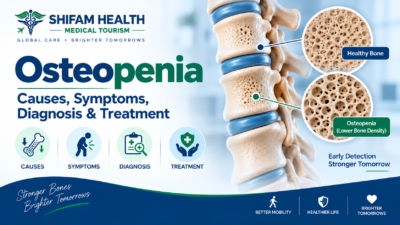
Osteopenia means bone mineral density lower than the young-adult reference range but not low enough to meet the…
- September 19, 2026
- shifamhealth
Finding a purple or reddish patch on your skin that won’t fade, or hearing “Kaposi sarcoma” mentioned during…
- September 18, 2026
- shifamhealth
Kyphosis means forward curvature of the spine — and some kyphosis is completely normal anatomy in the mid-back…
- September 21, 2026
- shifamhealth
Medically reviewed content · Published 2026 · Last reviewed September 2026 Hip dysplasia describes a hip joint where…
- September 19, 2026
- shifamhealth
Lumbar radiculopathy is a neurological syndrome caused by irritation, inflammation, or compression of a nerve root in the…
- September 20, 2026
- shifamhealth
Still having pain after spine surgery — whether it never fully went away, or came back after a…
- September 22, 2026
- shifamhealth
Medically reviewed content · Published 2026 · Last reviewed September 2026 The meniscus is a C-shaped piece of…
- September 24, 2026
- shifamhealth
Osteoarthritis is a whole-joint disorder not simply cartilage “wearing out” involving changes to cartilage, the underlying bone, the…