



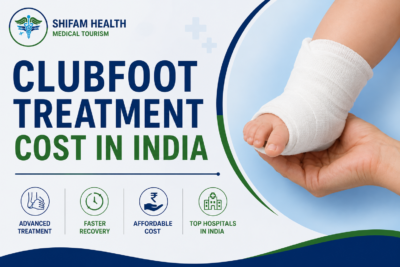
Home > Blog > Clubfoot Treatment Cost in India (2026): Best Children’s Hospitals, Ponseti Method, Surgery & Cost Breakdown
Clubfoot Treatment Cost in India (2026): Best Children’s Hospitals, Ponseti Method, Surgery & Cost Breakdown
Filters & Insights
Explore clubfoot treatment cost in India, top children's hospitals, the Ponseti method, surgery options, recovery, and treatment planning for families.

A few days after birth, a doctor points to your baby’s foot and says the word “clubfoot.” In that moment, most of what you hear next barely registers, you’re already thinking about whether your child will ever walk normally, whether this means surgery, and how a family with a newborn is supposed to plan for something this big.
Here’s the reassuring part, stated plainly and early: clubfoot is one of the most treatable congenital conditions in pediatric orthopedics. With the right treatment started early, most children go on to walk, run, and play without limitation. This guide walks you through exactly what that treatment looks like in India, what it realistically costs, and how to evaluate your options as an international family without exaggeration and without vague reassurances.
What Does Clubfoot Treatment Cost in India?
For international patients, a complete Ponseti-method program in India (specialist evaluation, serial casting, Achilles tenotomy, and the initial foot abduction brace) typically runs $3,500–$5,500. Cases that need surgical correction — tendon transfer or soft tissue release for resistant, recurrent, or neglected clubfoot — generally range from $4,500–$8,000, and more complex reconstructive procedures (corrective osteotomy, syndromic cases) can reach $8,000–$14,000. These figures are indicative package ranges for international patients and should always be confirmed against a specific hospital quote, since severity, age at treatment, and whether one or both feet are affected all move the number.
Domestic Indian pricing you’ll see quoted on some aggregator sites (often $2,500–$3,200) reflects the local-patient rate structure, not the typical international-patient package — which usually includes more comprehensive specialist consultation time, coordination support, and follow-up planning. Always ask for a written breakdown before comparing hospitals.
Table of Contents
ToggleWhat Is Clubfoot?
Clubfoot medically known as Congenital Talipes Equinovarus (CTEV) is a birth condition where a baby’s foot is turned inward and downward, rather than pointing straight ahead. It happens in roughly 1 in every 1,000 live births, is more common in boys, and affects one foot (unilateral) or both feet (bilateral) in fairly equal proportion.
It’s caused by how the tendons, muscles, and bones in the lower leg and foot develop before birth. In most cases there’s no identifiable single cause — it’s described as “idiopathic.” Left untreated, a child would eventually walk on the side or top of the foot, leading to pain, calluses, and long-term mobility problems. Treated early, the outlook is very different.
Importantly: clubfoot itself is not painful for a newborn. The correction process involves gentle stretching and casting, not a distressing procedure, a detail that brings real relief to most anxious parents.
Types of Clubfoot
| Type | What It Means | Typical Treatment Path |
|---|---|---|
| Idiopathic Clubfoot | No underlying syndrome; the most common type. | Ponseti method, with excellent success in most children. |
| Syndromic Clubfoot | Associated with conditions such as spina bifida or arthrogryposis. | Often more rigid and may require combined orthopedic and neurological care. |
| Positional Clubfoot | Caused by pressure in the womb without structural abnormalities. | Usually improves with stretching; casting is not always needed. |
| Neglected Clubfoot | Untreated until later childhood or adolescence. | Often requires corrective surgery. |
| Recurrent / Resistant Clubfoot | Returns after initial correction, commonly due to poor brace compliance. | May require repeat casting, surgery, or both. |
Signs Parents Should Recognize
| Sign | What to Look For |
|---|---|
| Inward-Turning Foot | The foot points inward toward the opposite leg instead of straight ahead. |
| Downward-Pointing Foot | The toes angle downward and the heel appears raised. |
| Rigid Position | The foot cannot be easily moved into a normal position by hand. |
| Smaller Calf Muscle | The affected leg often has a smaller calf, especially in one-sided cases. |
| Bilateral Involvement | About half of children with clubfoot have both feet affected. |
| Associated Features | Occasionally linked with hip dysplasia or other congenital conditions, warranting a broader pediatric assessment. |
If you notice these signs, or if a prenatal ultrasound flags a suspected clubfoot, an orthopedic evaluation within the first 1–2 weeks of life gives your child the best starting position — tissue is at its most flexible in early infancy, which is exactly when casting works best.
How Clubfoot Is Diagnosed
Diagnosis is usually straightforward and doesn’t require invasive testing:
- Physical examination — an orthopedic specialist assesses the foot’s flexibility, angle, and range of motion
- Prenatal ultrasound — clubfoot is often visible from around 20 weeks of pregnancy, giving families time to prepare and connect with a specialist before birth
- Severity scoring — specialists commonly use the Pirani Score or Dimeglio Classification to grade severity from mild to very severe
This scoring matters directly for your planning: it influences how many casts are likely needed, whether tenotomy will be required, and gives a realistic timeline — rather than a generic “it depends” answer.
The Ponseti Method: The Gold Standard
The Ponseti method is the internationally recognized, non-surgical gold standard for treating idiopathic clubfoot, and it’s what the large majority of newborns will be treated with in India.
How it works, step by step:
- Gentle manipulation — the specialist carefully stretches the foot toward a corrected position
- Serial casting — a plaster cast holds that position; casts are changed weekly, with each one nudging the foot slightly further, typically over 4–8 weeks
- Achilles tenotomy — in roughly 80–90% of cases, a minor procedure (often done under local anesthesia in a clinic setting, not full surgery) lengthens the tight Achilles tendon
- Foot Abduction Brace — after the final cast, the child wears a brace nearly full-time (about 23 hours/day) for around 3 months, then nights and naps only, typically continuing until age 4–5
Why the brace phase matters more than most parents expect: the casting phase corrects the foot’s shape, but the brace is what prevents relapse while the child grows. Clinical studies consistently identify inconsistent brace use — not the casting itself — as the single biggest driver of recurrence. This is worth internalizing before treatment starts, because it’s a multi-year commitment, not a one-time procedure.
When Is Clubfoot Surgery Needed?
Surgery is not the default path — it’s reserved for specific situations:
- Resistant clubfoot that doesn’t respond adequately to casting
- Recurrent deformity, most often linked to brace non-compliance
- Neglected clubfoot presenting later in childhood, where tissues have stiffened
- Syndromic clubfoot, where the deformity is more rigid from the outset
Surgical options range from relatively contained procedures tendon transfer or soft tissue release up to a corrective osteotomy for older children with established bony deformity. A pediatric orthopedic surgeon will only recommend surgery after assessing how the foot has responded to conservative treatment; jumping straight to surgery without attempting Ponseti casting first (when the child is a suitable candidate) is not standard of care.
Clubfoot Treatment Cost in India: Complete Breakdown
| Sign | What to Look For |
|---|---|
| Inward-Turning Foot | The foot points inward toward the opposite leg instead of straight ahead. |
| Downward-Pointing Foot | The toes angle downward and the heel appears raised. |
| Rigid Position | The foot cannot be easily moved into a normal position by hand. |
| Smaller Calf Muscle | The affected leg often has a smaller calf, especially in one-sided cases. |
| Bilateral Involvement | About half of children with clubfoot have both feet affected. |
| Associated Features | Occasionally linked with hip dysplasia or other congenital conditions, warranting a broader pediatric assessment. |
What typically increases the total: bilateral involvement, delayed diagnosis (neglected cases need more intervention), syndromic clubfoot requiring multidisciplinary input, and brace replacement as the child’s foot grows.
What’s often excluded from headline “package” prices: international flights, accommodation during the casting phase (which requires weekly hospital visits over 1–2 months), a travel companion visa, and brace replacements after the first year. Ask explicitly what’s bundled before comparing quotes across hospitals.
Note: These figures are indicative international-patient ranges compiled from publicly available medical tourism sources and should be confirmed against a specific hospital’s written quote — cost estimates for your child’s exact case should always come after a specialist reviews photographs and reports.
What Actually Drives the Total Cost
- Age at treatment start — earlier treatment is generally simpler and less costly than correcting a neglected case in an older child
- Severity (Pirani/Dimeglio score) — more severe cases need more casts and a higher likelihood of surgical intervention
- Unilateral vs. bilateral — treating both feet costs more than one
- Ponseti vs. surgery — surgical cases involve anesthesia, OR time, and hospital admission
- Recurrence — if brace non-compliance leads to relapse, repeat casting adds cost
- Hospital tier and city — metro flagship hospitals in Delhi NCR, Mumbai, and Chennai are typically priced higher than equally competent regional centers
- Duration of follow-up — treatment doesn’t end when the last cast comes off; budget for years of periodic monitoring
Recovery and Long-Term Follow-Up
Correction of the foot’s shape happens relatively quickly through casting, but full treatment is a multi-year process:
- After the final cast — the tenotomy site heals within about 3 weeks, at which point the brace begins
- Brace phase — near-full-time wear for roughly 3 months, then nights/naps until age 4–5
- Walking milestones — most children treated early reach normal walking milestones on a typical timeline
- Ongoing physiotherapy — supports ankle mobility and gait as the child grows
- Long-term monitoring — periodic specialist check-ins are recommended through early childhood to catch any early signs of recurrence
The most common mistake families make isn’t choosing the wrong hospital — it’s underestimating the brace-compliance commitment or missing follow-up visits after returning home. Before you finalize a treatment plan, ask specifically how remote follow-up works once you’ve left India, since this is the phase most medical tourism content quietly skips over.
Possible Complications — An Honest Look
No credible clinic will promise a guaranteed outcome, and you should be cautious of any that does. Balanced information here matters more than reassurance:
- Recurrence — the most common issue, strongly linked to inconsistent brace wear
- Residual deformity — a small percentage of cases retain some correction gap even after full treatment
- Overcorrection — rare, but possible with aggressive casting technique
- Skin irritation from casting — usually minor and temporary
- Stiffness — can occur, particularly in cases needing surgical intervention
Timely follow-up and strict brace adherence are the two factors within a family’s control that most directly reduce these risks.
Best Pediatric Orthopedic Hospitals in India for Clubfoot
| Hospital Group | Accreditation | Why International Patients Choose It |
|---|---|---|
| Apollo Hospitals | JCI, NABH | Well-established Ponseti programs with experienced pediatric orthopedic specialists. |
| Fortis Healthcare | JCI, NABH | Multi-city network with dedicated international patient services. |
| Manipal Hospitals | NABH | Strong pediatric orthopedic teams and competitive treatment packages. |
| Rainbow Children’s Hospital | NABH | Pediatric-focused hospital with all services designed exclusively for children. |
| Max Healthcare | NABH | Integrated pediatric orthopedic, rehabilitation, and follow-up care. |
| Narayana Health | JCI, NABH | Known for value-driven international treatment packages and pediatric expertise. |
Beyond brand name, what actually matters for a clubfoot case: the surgeon’s specific Ponseti caseload (ask directly how many cases they treat per year — this method has a real learning curve), whether the hospital has dedicated pediatric anesthesia (relevant if tenotomy or surgery is needed), and whether they offer structured remote follow-up for families who return home after initial treatment.
How to Choose the Right Clubfoot Specialist
A practical checklist for evaluating a specialist, not just a hospital brand:
- Ponseti-specific experience — general orthopedic training is not the same as dedicated Ponseti expertise; ask how many clubfoot cases they treat annually
- Recurrence management protocol — how do they handle relapse if the brace phase doesn’t go smoothly?
- Pediatric physiotherapy access — is this in-house or referred elsewhere?
- International patient coordination — is there a single point of contact who can explain the full multi-visit timeline before you book travel?
- Transparent severity-based estimate — a specialist who reviews your child’s Pirani/Dimeglio score before quoting a price is giving you a real estimate; one who quotes a flat number without seeing the case is not.
India vs. Other Popular Destinations
| Factor | India | USA / UK | Turkey / Thailand |
|---|---|---|---|
| Typical Full-Program Cost | ~$3,500–$8,000 | $15,000–$30,000+ | $6,000–$12,000 |
| Ponseti Specialist Availability | Widely available in major metro hospitals | High availability, but significantly higher cost | Growing availability, though more limited |
| Waiting Time | Generally short | May involve longer specialist waiting times | Moderate |
| Weekly Casting Logistics | Manageable with extended-stay planning | Convenient for domestic patients; similar challenge for international visitors | Requires extended stay for weekly casting |
| Visa Process | Structured medical visa pathway for infant and parent | Standard visa process with no medical fast-track | Varies by country |
India’s core advantage for this specific procedure is the combination of high Ponseti caseloads (given the volume of clubfoot cases treated domestically each year) with international-patient pricing that remains a fraction of Western costs — without requiring the more limited specialist access some destinations face.
Myths vs. Facts About Clubfoot Treatment
| Myth | Fact |
|---|---|
| “Clubfoot always requires surgery.” | Most cases are successfully corrected with the Ponseti method. Surgery is usually reserved for resistant, recurrent, or neglected clubfoot. |
| “Casting is painful for babies.” | Ponseti stretching is gentle, and most babies tolerate casting well with only mild, temporary discomfort. |
| “Treatment ends when the casts come off.” | The brace phase is essential to prevent relapse and typically continues for several years. |
| “A treated foot will never look or work normally.” | With early treatment, most children achieve near-normal foot appearance, walk normally, and participate in regular activities. |
| “It’s too late if treatment starts later.” | Older children can still be treated successfully, although surgery is more commonly needed in neglected cases. |
How Shifam Health Supports Your Family’s Journey
Getting your child’s medical reports and photographs reviewed by a pediatric orthopedic specialist is the first real step — before travel, before a firm cost estimate, before anything else. Shifam Health coordinates that first review, helps you compare treatment plans and realistic cost ranges across partner hospitals, and manages the practical side that’s easy to underestimate from abroad: medical visa documentation for your child and an accompanying parent, appointment scheduling around the multi-visit casting timeline, accommodation near the hospital, and a plan for remote follow-up once you’re back home.
None of this replaces the specialist’s clinical judgment, it just means you’re not managing a multi-week, multi-visit medical process alone in an unfamiliar country while also caring for a newborn.
Frequently Asked Questions
Can clubfoot be corrected without surgery?
Yes — the majority of idiopathic clubfoot cases are fully corrected through the Ponseti method (casting plus a minor tenotomy), without major surgery.
What is the Ponseti method?
A non-surgical treatment involving weekly serial casting to gradually reposition the foot, typically followed by a minor Achilles tenotomy and a long-term bracing phase.
How many casts does a baby typically need?
4. Most cases require 5–8 casts over 4–8 weeks, though this varies with severity.
How long does full treatment take?
Initial casting takes weeks, but the brace phase continues until around age 4–5, making this a multi-year commitment overall, even though active hospital visits are concentrated early on.
Is the Achilles tenotomy a major surgery?
No — it’s typically a minor, quick procedure, often done under local anesthesia, distinct from full corrective surgery.
Will my child walk normally after treatment?
With early, well-managed treatment, most children walk, run, and participate in sports without limitation. Individual outcomes depend on severity, age at start, and brace compliance.
What happens if the brace isn’t worn consistently?
Inconsistent brace use is the leading cause of clubfoot recurrence — it’s the single most important factor within a family’s control.
How many hospital visits are required during casting?
Weekly visits are standard during the casting phase, meaning families typically need to plan for a 4–8 week stay near the hospital.
People Also Ask
Is clubfoot painful for the baby?
No — clubfoot itself is not painful, and the correction process (gentle stretching and casting) is generally well tolerated by infants.
Which hospitals in India specialize in clubfoot correction?
Apollo, Fortis, Manipal, Rainbow Children’s Hospital, Max Healthcare, and Narayana Health all run dedicated pediatric orthopedic and Ponseti programs.
What’s included in a typical clubfoot treatment package?
Usually consultation, casting supplies, the tenotomy procedure, and the initial brace. Confirm whether physiotherapy, follow-up visits, and brace replacements are included.
Does clubfoot recur after successful treatment?
Recurrence is possible, most often linked to brace non-compliance, which is why long-term follow-up matters even after the foot looks corrected.
Is a medical visa required for infant treatment in India?
Yes, along with a visa for at least one accompanying parent; documentation requirements should be confirmed with the treating hospital or a coordination service in advance.
How do I know if my child needs surgery instead of casting?
This depends on how the foot responds to initial casting attempts and its Pirani/Dimeglio severity score — a decision made by the specialist after assessment, not before.
Can follow-up be managed remotely after returning home?
Many hospitals offer remote/photo-based follow-up check-ins for international patients, though in-person visits are recommended at key growth milestones, ask your hospital specifically how this is structured
This guide is for informational purposes and does not replace individualized medical advice. Every clubfoot case should be evaluated by a qualified pediatric orthopedic specialist before a treatment plan or cost estimate is finalized.
Recent Posts

Quick Inquiry Form
Popular Posts From Last Week
- July 13, 2026
- shifamhealth
Written by: Shifam Health Content Team | Medically reviewed by: Endocrine Surgery Advisory Panel, Shifam Health | Published:…
- July 9, 2026
- shifamhealth
When the small intestine can no longer absorb enough nutrients to sustain life, the standard fallback is intravenous…
- July 8, 2026
- shifamhealth
If a scan just showed a swollen kidney and the word “UPJ obstruction,” you’re probably trying to answer…
- July 10, 2026
- shifamhealth
Kidney stones can cause severe pain, blood in the urine, recurrent infections, and even kidney damage if left…
- July 8, 2026
- Areen Fatima
Piles (hemorrhoid) surgery in India costs $500–$900 for conventional open hemorrhoidectomy, $700–$1,200 for stapled hemorrhoidopexy, and $900–$1,800 for…
- July 9, 2026
- Areen Fatima
If you or a family member has been told you need adrenal gland surgery, the first questions are…
- July 11, 2026
- Areen Fatima
HIPEC surgery cost in India typically ranges from USD 8,000 to 18,000 for a complete international-patient package —…
- July 10, 2026
- shifamhealth
If you or a family member has just been told there’s a bulge, an aneurysm in the aorta,…
- July 8, 2026
- shifamhealth
Can You Get Breast Reconstruction After Mastectomy in India? Yes. Breast reconstruction after mastectomy is a routine part…
- July 9, 2026
- shifamhealth
Scar revision surgery can meaningfully improve but not completely erase the appearance and function of most scars. In…
- July 14, 2026
- shifamhealth
A few days after birth, a doctor points to your baby’s foot and says the word “clubfoot.” In…
- July 10, 2026
- shifamhealth
Recovery is one of the biggest concerns for anyone considering weight loss surgery. Questions like “How long will…