


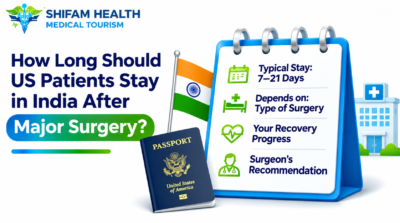
How Long Should US Patients Stay in India After Major Surgery?
Filters & Insights
Written By :
Medically Reviewed By :

Shifam Health Medical Team
Shifam Health - Medical Reviews Department
10+ Years Of Experience
Learn why recovery time in India varies by procedure, complications and fitness to fly, and what to discuss with your treating surgeon,
📅
Last updated: November 27, 2026

For US patients planning major surgery in India, one of the most important questions is how long they should remain in the country before flying home. The answer depends on the type of surgery, the patient’s medical condition, postoperative recovery, and whether the treating surgeon considers long-distance travel safe.
Recovery does not end when a patient leaves the hospital. After discharge, patients may still need wound assessments, medication adjustments, rehabilitation, follow-up consultations, or additional monitoring. Traveling too early may create unnecessary risks, particularly when the return journey involves a long international flight.
There is no universal number of days that makes every patient fit to fly after surgery. A patient who has undergone an uncomplicated procedure may have different recovery requirements from someone recovering from major abdominal, cardiac, orthopedic, neurological, or cancer surgery.
This guide explains the factors that influence the recovery stay in India after surgery, the checks that may be required before departure, and how US patients can plan a safer return journey with their treating healthcare team.
Table of Contents
ToggleWhy Recovery Time After Surgery Varies
The length of time a patient should stay in India depends on more than the number of days spent in the hospital. Doctors consider the procedure performed, the patient’s recovery, and the medical support that may be required after discharge.
Several factors influence the recommended recovery period.
Type and complexity of surgery
Different procedures place different demands on the body. Major operations may involve extensive tissue healing, changes in mobility, or the need for closer postoperative monitoring.
A patient recovering from a major joint replacement may need mobility assessments and rehabilitation. Someone who has undergone abdominal surgery may need monitoring of bowel function, nutrition, wound healing, and possible postoperative complications.
Age and existing medical conditions
Medical conditions such as diabetes, cardiovascular disease, respiratory disease, kidney disease, or a history of blood clots can influence postoperative recovery and travel planning.
Age alone does not determine when someone can travel. The treating team must consider the patient’s overall health and clinical progress.
Postoperative complications
Complications can delay discharge or make additional observation necessary. Examples include:
- Surgical wound infection
- Bleeding
- Blood clots
- Respiratory complications
- Poorly controlled pain
- Difficulty eating or drinking
- Delayed mobility
- Problems related to the underlying medical condition
A patient who develops a complication may require additional treatment, investigations, or a longer stay in India.
Distance and duration of the return journey
US patients often face a lengthy journey from India, potentially involving connecting flights, airport transfers, and prolonged periods of sitting.
Long-distance travel can be physically demanding after major surgery. It may also increase concern about venous thromboembolism, particularly when recent surgery and reduced mobility are already present.
The Centers for Disease Control and Prevention (CDC) identifies recent surgery, hospitalization, and limited mobility as risk factors for travel-associated blood clots. Patients should review the CDC’s guidance on blood clots during travel and discuss their individual risks with the treating team.
Procedure-Specific Recovery Considerations
The expected recovery stay varies significantly across surgical specialties. Patients should avoid relying on generalized recovery timelines found online when booking flights.
The following table outlines important considerations rather than fixed waiting periods.
| Type of Major Surgery | Recovery Considerations Before Flying |
|---|---|
| Hip or Knee Replacement | Wound healing, walking ability, rehabilitation, blood clot risk, and ability to sit comfortably |
| Cardiac Surgery | Cardiovascular stability, breathing, wound healing, medication management, and specialist review |
| Abdominal Surgery | Bowel function, nutrition, wound healing, pain control, and postoperative complications |
| Spine Surgery | Neurological status, mobility, pain control, wound condition, and sitting tolerance |
| Brain Surgery | Neurological recovery, seizure risk where relevant, intracranial air or pressure concerns, and neurosurgical clearance |
| Cancer Surgery | Extent of surgery, wound recovery, complications, and plans for additional treatment |
| Organ Transplant Surgery | Graft function, infection risk, immunosuppressive medication, monitoring, and specialist follow-up |
These considerations are not a substitute for individualized medical advice.
Orthopedic surgery
Patients undergoing hip or knee replacement may need physiotherapy, mobility training, and postoperative assessments before returning home.
The surgeon and rehabilitation team may assess whether the patient can:
- Walk safely with prescribed mobility aids
- Transfer between a bed and chair
- Manage basic daily activities
- Sit for the expected travel duration
- Follow the prescribed rehabilitation plan
- Recognize symptoms requiring urgent medical attention
Joint replacement and reduced mobility may increase blood clot concerns. Patients should discuss thrombosis prevention, medications, and travel arrangements with the treating team rather than independently starting or changing blood-thinning medication.
Cardiac surgery
After major cardiac surgery, travel readiness depends on cardiovascular stability and postoperative recovery.
The treating team may need to evaluate heart function, breathing, wound healing, fluid balance, medications, and the need for further monitoring.
Patients should also ask whether any airline medical clearance or special travel assistance is necessary.
Abdominal and gastrointestinal surgery
After major abdominal surgery, the surgeon may assess wound healing, bowel function, nutrition, hydration, and the presence of complications.
Certain procedures also raise concerns about residual gas, abdominal discomfort, or the ability to tolerate a long journey.
The required observation period depends on the exact operation and postoperative findings.
Spine and neurological surgery
Patients recovering from spine surgery may experience pain, movement restrictions, or difficulty remaining seated for long periods.
After brain surgery, the surgeon may also consider neurological stability, seizures, postoperative imaging findings, and whether intracranial air or other conditions make flying unsafe.
These patients should obtain advice from the relevant surgical team before making travel arrangements.
Cancer surgery
Cancer surgery recovery depends on the organ involved, the extent of the operation, the patient’s overall condition, and whether additional treatment is planned.
Some patients may need pathology review, wound assessment, further imaging, or discussions about chemotherapy, radiation therapy, or other treatment before departure.
The treating oncology team should determine which appointments need to occur in India and which can be coordinated after the patient returns to the United States.
Wound Healing and Mobility Checks Before Departure
Being discharged from the hospital does not automatically mean that a patient is ready for international travel.
Before departure, the treating team may need to assess wound healing, mobility, pain control, hydration, and the patient’s ability to manage the journey.
Surgical wound assessment
The surgeon or postoperative care team may check:
- Whether the wound is healing as expected
- Whether there is unusual redness, swelling, or drainage
- Whether stitches, staples, or dressings require attention
- Whether a wound drain remains in place
- Whether further wound care is needed
- Whether signs of infection are present
Patients should receive clear instructions about dressing changes, bathing, wound care, and when to seek medical attention.
A wound that appears closed does not necessarily mean all internal healing is complete.
Mobility and physical endurance
A patient may be able to walk short distances inside a hospital but still struggle with airport queues, long corridors, connecting flights, or prolonged sitting.
Ask the rehabilitation team whether the patient can safely manage the expected journey and whether assistance is required.
Pain and medication control
Pain should be manageable with the prescribed treatment plan, and the patient should understand how to take their medications during travel.
Patients should not discontinue prescribed medication or adjust doses solely to accommodate a flight without medical advice.
Warning symptoms
Seek urgent medical evaluation for symptoms such as:
- New or worsening chest pain
- Sudden shortness of breath
- Fainting or severe dizziness
- New weakness or significant neurological changes
- Heavy bleeding
- Fever with concerning wound changes
- New one-sided leg swelling or pain
Chest pain, breathing difficulty, or other symptoms suggesting a serious complication require emergency medical attention rather than waiting for a routine follow-up appointment.
Schedule Follow-Up Visits Before Leaving India
Postoperative follow-up allows the treating team to assess recovery, review investigations, and determine whether further treatment is required.
US patients should ask the hospital to identify the appointments that must take place before international departure.
Common postoperative appointments
Depending on the surgery, follow-up may include:
- Surgical wound inspection
- Suture or staple removal, when indicated
- Review of pathology or imaging results
- Assessment of pain and mobility
- Physiotherapy or rehabilitation review
- Medication adjustments
- Review of laboratory results
- Discussion of complications or unexpected symptoms
- Final assessment before planned travel
Not every patient requires every appointment. The schedule must be individualized.
Questions to ask the surgeon
Before discharge, ask:
- When is my next postoperative appointment?
- Which checks must be completed before I leave India?
- Do I need stitches or staples removed?
- Are any laboratory tests or scans required before departure?
- What symptoms should prompt urgent medical attention?
- What activities should I avoid during recovery?
- When should I arrange my next appointment in the United States?
- Who should my US doctor contact if questions arise about the surgery?
Patients can also review how to coordinate local doctor follow-up before leaving India to prepare for continued care at home.
Fit-to-Fly Clearance After Major Surgery
A fit-to-fly assessment helps determine whether a patient is medically ready to undertake the proposed flight. It should consider both the patient’s clinical condition and the practical demands of the journey.
Hospital discharge, surgeon approval, and airline acceptance are not necessarily the same thing.
A surgeon may consider the patient medically stable, while the airline may still require additional documentation or a medical clearance process.
What doctors may consider before clearing a patient to fly
The treating specialist may assess:
- General clinical stability
- Recent surgical complications
- Heart and respiratory function
- Blood clot risk
- Pain control
- Wound condition
- Mobility and sitting tolerance
- Need for oxygen or medical assistance
- Ability to take medicines and maintain hydration
- Whether the patient may require urgent care during the journey
For certain surgeries, additional restrictions may apply because of cabin pressure changes, trapped gas, or other procedure-specific risks.
Is there a fixed waiting period after major surgery?
No single waiting period is appropriate for every major operation.
Some aviation medical guidance provides procedure-specific minimum intervals or precautions, but these are not universal clearance rules. The treating surgeon must consider the exact procedure, postoperative findings, and the patient’s individual risk factors.
Patients should avoid booking a return flight based on an arbitrary number of days.
The CDC’s medical tourism guidance highlights the importance of considering postoperative complications, long-distance travel, and follow-up care.
Check airline medical requirements
Airlines may have their own policies for passengers who have recently undergone surgery or require medical assistance.
Before booking or changing a flight, ask the airline:
- Is medical clearance required after my procedure?
- Do I need a medical information form?
- Is a doctor’s letter necessary?
- Are there restrictions related to oxygen or medical equipment?
- Can wheelchair assistance be arranged?
- Are there special requirements for traveling with a caregiver?
- What happens if my medical condition changes before departure?
The International Air Transport Association provides information about medical considerations in air travel. Patients can review IATA’s medical and health resources while confirming the actual requirements directly with their airline.
How to Plan the Return Journey to the United States
The return journey should be planned around the patient’s medical condition, not simply the earliest available flight.
Choose travel arrangements carefully
Depending on medical advice, patients may benefit from:
- A flight itinerary that reduces unnecessary transfers
- Airport wheelchair assistance
- Extra time for boarding and connections
- An accompanying family member or caregiver
- Easy access to prescribed medicines
- Arrangements for mobility aids
- Flexible flight-change conditions
A more expensive or flexible ticket may be preferable to a non-refundable booking if the recovery schedule remains uncertain.
Discuss blood clot prevention
Long-distance travel and recent major surgery can increase the risk of deep vein thrombosis or pulmonary embolism in susceptible patients.
The treating team may recommend individualized preventive measures based on the patient’s clinical risk. These may include movement strategies, prescribed medication, or other interventions where appropriate.
Do not start aspirin, anticoagulants, or compression stockings without confirming their suitability with the treating clinician. These measures are not appropriate for every patient.
Carry essential medical documents
Before departure, request:
- Hospital discharge summary
- Operative or procedure report
- Final diagnosis and relevant investigation reports
- Updated medication list
- Written wound-care instructions
- Rehabilitation instructions
- Follow-up recommendations
- Contact information for the treating team
- Fit-to-fly or airline medical documents, if required
Carry essential documents in your hand luggage and keep accessible digital copies.
For a document preparation guide, see how to keep digital and printed copies of medical travel documents.
Prepare for possible changes
A recovery plan should allow for unexpected changes. Additional investigations, complications, or delayed healing may require the patient to remain in India longer than originally anticipated.
Patients should account for potential extra accommodation, transportation, meals, caregiver expenses, and flight changes.
For broader travel preparation, review how to plan return travel after a major procedure.
Arrange Postoperative Care in the United States Before Returning Home
Follow-up care should be discussed before the patient leaves the United States for surgery, rather than arranged only after the operation.
Some US healthcare professionals may require the operative report, discharge summary, and details of the procedure before agreeing to provide postoperative care.
What to arrange with your US healthcare team
Ask whether your local doctor or relevant specialist can help with:
- Postoperative wound checks
- Medication review
- Laboratory tests or imaging
- Physiotherapy and rehabilitation
- Management of chronic medical conditions
- Assessment of new symptoms
- Referral to an appropriate specialist if complications occur
Confirm who will be responsible for routine follow-up and where you should seek urgent care if a complication develops.
The CDC recommends planning follow-up care and understanding potential complications before undertaking medical tourism. See its guidance for medical tourists.
Virtual follow-up with the Indian specialist
Some hospitals may offer remote consultations after the patient returns home. These can help the treating team review recovery progress, discuss reports, and communicate recommendations.
However, virtual follow-up cannot replace an in-person examination when one is medically necessary, and availability may depend on hospital policies and applicable regulations.
For additional information, see telemedicine follow-up care in Indian medical tourism.
Recovery Stay Planning Checklist for US Patients
Use this checklist when discussing your expected stay with the hospital.
| Planning area | What to confirm |
|---|---|
| Expected admission | Estimated hospital stay for the proposed surgery |
| Recovery accommodation | Whether a nearby stay is needed after discharge |
| Wound review | Date of required postoperative wound checks |
| Mobility | Ability to walk, sit, and manage the airport journey |
| Rehabilitation | Physiotherapy and activity restrictions |
| Investigations | Tests or scans required before departure |
| Complications | Symptoms and situations that may delay travel |
| Fit-to-fly assessment | When the surgeon will assess travel readiness |
| Airline requirements | Medical clearance forms and assistance services |
| Medication | Sufficient supplies and instructions for the journey |
| US follow-up | Local doctor and appointments after returning |
| Contingency budget | Additional accommodation and flight-change expenses |
The treating team should determine the clinical requirements. The patient and family can use those recommendations to make practical travel arrangements.
How Shifam Health Can Help Coordinate Recovery and Return Travel Planning
For international patients, postoperative planning may involve communication between the hospital, accommodation provider, airline, caregiver, and healthcare professionals in the home country.
Shifam Health can help coordinate administrative aspects of the medical journey, depending on the patient’s requirements and service availability.
Support may include:
- Coordinating hospital communication about the expected treatment and recovery schedule
- Helping patients obtain information about postoperative appointments
- Coordinating accommodation arrangements where available
- Assisting with airport pickup and local transportation arrangements
- Helping organize medical documents provided by the hospital
- Facilitating administrative communication about return travel planning
- Supporting communication with the treating hospital about follow-up arrangements
The treating surgeon and healthcare team remain responsible for determining medical recovery requirements and fitness to fly. Shifam Health does not provide medical clearance, guarantee recovery timelines, or replace emergency or postoperative clinical care.
US patients planning treatment in India can contact Shifam Health to discuss medical travel coordination and the information they may need from their selected hospital.
Frequently Asked Questions
How many days should I stay in India after major surgery?
There is no fixed number of days suitable for every patient. The required stay depends on the procedure, recovery progress, complications, and the treating surgeon’s assessment of travel readiness.
Can I fly home immediately after hospital discharge?
Not necessarily. Hospital discharge means the patient meets the hospital’s discharge criteria, but it does not automatically establish fitness for a long international flight.
Is it safe to take a long flight after hip or knee replacement?
Recent surgery and prolonged immobility can increase blood clot concerns. Your surgeon should assess your individual risk, mobility, and recovery before recommending when to fly.
Do I need a fit-to-fly certificate after surgery?
Some airlines require medical clearance or specific documentation after recent surgery. Requirements vary by airline and medical condition. Check with your airline and treating specialist.
What if my recovery takes longer than expected?
The surgeon may recommend additional observation, investigations, or treatment. Patients should allow for possible accommodation extensions and flight changes.
Should I arrange follow-up care in the US before surgery?
Yes. Discuss the planned procedure and expected postoperative needs with your US healthcare professional before traveling, and confirm who can provide appropriate care after you return.
Conclusion
The recovery stay in India after major surgery should be based on individual medical needs rather than a standard travel schedule. The type of operation, existing health conditions, wound healing, mobility, complications, and the length of the return journey all influence when a patient may be ready to fly.
US patients should discuss the expected hospital stay and postoperative observation period with their treating surgeon before making firm travel arrangements. The hospital should explain which follow-up visits, investigations, rehabilitation assessments, and wound checks are needed before departure. If recovery does not proceed as expected, the travel plan may need to change.
Fitness to fly requires particular attention because long-distance travel after surgery may involve risks related to immobility, blood clots, respiratory function, pain, and other procedure-specific concerns. A hospital discharge alone is not sufficient evidence that a patient can safely undertake an international flight. Patients should obtain individualized medical advice and confirm any airline clearance requirements.
Finally, returning home should be part of the treatment plan from the beginning. Arrange appropriate follow-up care in the United States, obtain complete medical records, understand warning symptoms, and prepare for possible changes to the recovery schedule. Careful coordination between the treating hospital, patient, caregiver, airline, and US healthcare professionals can help support a more organized transition from surgery in India to continued recovery at home.



Popular Posts From Last Week
- November 27, 2026
- Razi Khan
Understand how long US patients should stay in India after major surgery before travelling back home. This guide…
- November 25, 2026
- Razi Khan
A practical guide for international patients preparing to choose a hospital in India. Learn how to check hospital…
- November 22, 2026
- Razi Khan
A practical guide for international patients on understanding different hospital treatment recommendations, organizing medical records, and requesting a…
- November 21, 2026
- Razi Khan
A practical guide for international patients on confirming medical equipment, procedure availability, specialist schedules, and hospital facilities in…
- November 25, 2026
- Razi Khan
A practical guide for international patients on asking hospitals in India about infection prevention, hygiene, sterilization, accreditation, and…
- November 21, 2026
- Razi Khan
Online hospital reviews and patient stories can help international patients understand the healthcare experience, but they should be…
- November 26, 2026
- Razi Khan
Planning medical treatment in India involves hospital charges as well as travel and daily living expenses for accompanying…
- November 24, 2026
- Razi Khan
Learn how to organize digital and printed medical travel documents before treatment in India. This guide covers medical…
- November 24, 2026
- Razi Khan
Learn how to prepare a personal emergency contact sheet before traveling to India for medical treatment. This practical…
- November 25, 2026
- Razi Khan
A practical guide for international patients arranging follow-up care after treatment in India. Learn how to identify a…
- November 22, 2026
- Razi Khan
A practical guide for international patients planning their journey home after major surgery in India. Learn about medical…
- November 22, 2026
- Razi Khan
Learn how to prepare a clear one-page patient summary before contacting an Indian hospital. This guide covers medical…