


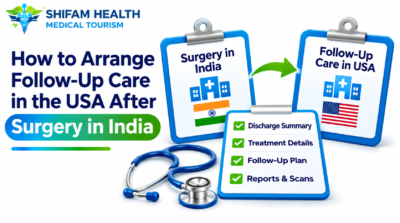
How to Arrange Follow-Up Care in the USA After Surgery in India
Filters & Insights
Written By :
Medically Reviewed By :

Shifam Health Medical Team
Shifam Health - Medical Reviews Department
10+ Years Of Experience
Plan continuity of care after returning to the USA, including discharge summaries, medication lists, wound checks and communication,
📅
Last updated: November 27, 2026

Returning to the United States after surgery in India is an important stage of the medical journey. Although the operation and initial hospital recovery may be completed, patients often need continued medical attention at home. This may include wound checks, medication reviews, laboratory tests, rehabilitation, specialist consultations, or monitoring for postoperative complications.
Planning this care before leaving India can help patients avoid gaps in communication between the Indian hospital and their US healthcare professionals. It also helps ensure that the doctors providing follow-up care understand what procedure was performed, what happened during admission, which medicines were prescribed, and what further treatment may be required.
For US patients, continuity of care should be discussed before traveling for surgery not postponed until after returning home. The Centers for Disease Control and Prevention (CDC) recommends arranging follow-up care in the United States before traveling abroad for medical treatment and obtaining copies of overseas medical records before returning. Read the CDC’s medical tourism guidance for additional preparation advice.
This guide explains how to organize follow-up care in the USA after surgery in India, which documents to obtain, how to review medications, and how to coordinate communication between healthcare professionals in both countries.
Table of Contents
ToggleArrange Follow-Up Care Before Traveling Home
The best time to plan postoperative care in the United States is before the surgery takes place. Patients should discuss their expected recovery needs with the Indian treating team and identify an appropriate healthcare professional in the United States who can help with continued care.
The type of follow-up required depends on the operation, the patient’s medical history, recovery progress, and the recommendations of the treating specialist.
Identify the right healthcare professional
Depending on the procedure, follow-up may involve:
- A primary care physician for general health assessment and coordination
- The relevant US surgical specialist for procedure-specific review
- An orthopedic specialist after joint replacement or other orthopedic surgery
- A cardiologist after certain cardiac procedures
- An oncologist after cancer surgery
- A neurologist or neurosurgeon after neurological procedures
- A physical therapist for rehabilitation and mobility
- A wound-care professional when specialized wound management is needed
The appropriate professional should be selected according to the patient’s medical needs. A primary care physician may help coordinate care but may not replace the specialist who needs to assess the surgical outcome.
Contact your US healthcare team before departure
Inform your local healthcare professional that you are planning or have undergone surgery in India. Explain the type of procedure, the hospital, the expected discharge date, and the follow-up recommendations provided by the treating surgeon.
Ask whether the clinician can review the discharge summary and other records after you return.
Confirm:
- Whether the practice can provide postoperative appointments
- Whether a specialist referral is required
- Whether the clinician needs records before scheduling
- Which tests or assessments may be needed
- Whether rehabilitation or home-care services should be arranged
- Where to seek urgent medical attention if a complication develops
Do not assume that a US doctor will automatically take over the care of a procedure performed overseas. Discuss the arrangements in advance.
Confirm who is responsible for each part of follow-up
Patients may receive care from several professionals after returning home. It is useful to clarify which clinician will manage each aspect.
For example, the Indian surgeon may provide procedure-specific recommendations, while a US primary care physician may review general health and coordinate referrals. A physical therapist may manage the rehabilitation plan, subject to the treating team’s instructions.
For additional preparation, see how to coordinate local doctor follow-up before leaving India.
Obtain Complete Medical Records Before Leaving India
A complete set of medical records helps US healthcare professionals understand the treatment received in India. Without these documents, the local clinician may have difficulty confirming the exact procedure, reviewing complications, understanding medication changes, or deciding what additional investigations are needed.
Request your records before discharge or early enough to resolve missing documents before departure.
Essential documents to request
| Document | Why it is important |
|---|---|
| Discharge summary | Explains the diagnosis, hospital stay, treatment, and condition at discharge |
| Operative or procedure report | Describes the surgery or procedure performed |
| Final diagnosis | Records the treating team’s documented diagnosis |
| Investigation reports | Provides relevant laboratory, imaging, and pathology results |
| Imaging files | Allows further review of scans when needed |
| Medication list | Identifies prescribed medicines, doses, and instructions |
| Allergy information | Records known allergies and relevant reactions |
| Histopathology report | Provides tissue examination findings, when applicable |
| Implant or device details | Identifies relevant implants or medical devices used |
| Wound-care instructions | Explains dressing care and postoperative precautions |
| Rehabilitation plan | Provides prescribed mobility and exercise guidance |
| Follow-up recommendations | Identifies future appointments, tests, and monitoring requirements |
Depending on the procedure, additional records may be necessary. For example, a patient who undergoes cancer surgery may need pathology and staging information, while someone who receives a joint replacement may need implant documentation and rehabilitation instructions.
Check the discharge summary carefully
The discharge summary is one of the most important documents for the US healthcare team. Before leaving the hospital, check whether it includes:
- Patient identification details
- Admission and discharge dates
- Diagnosis and relevant medical history
- Procedure or surgery performed
- Important findings during admission
- Complications or additional treatment, if any
- Condition at discharge
- Medication instructions
- Wound-care and activity recommendations
- Follow-up appointments and pending investigations
- Contact details for the treating department or hospital
If a test result is pending, ask whether it will be sent later and how you can obtain it.
The Agency for Healthcare Research and Quality (AHRQ) highlights the importance of structured discharge information, including diagnoses, hospital course, medication changes, follow-up arrangements, and pending tests. See its care transitions guidance.
Obtain records in a usable format
Request readable digital copies, preferably in PDF format for written reports. Ask for original imaging files in the format used by the hospital when your US specialist may need to review the scans.
If any documents are not in English, ask the Indian hospital whether an English version or translation can be provided.
Keep both digital and printed copies. Store the files in an organized folder and make sure you can access them when meeting your US healthcare professional.
For more preparation advice, see how to keep digital and printed copies of medical travel documents.
Review and Reconcile Your Medications
Medication changes are common after surgery. A patient may receive new medicines, have previous medicines temporarily stopped, or need changes to existing doses.
The medication list provided at discharge should be reviewed with the US healthcare professional who will continue the patient’s care.
Prepare an updated medication list
For every medicine, record:
- Generic and brand name, if available
- Strength and prescribed dose
- How often it should be taken
- Route of administration
- Reason for taking it
- Start date, if known
- Planned duration or review date, if specified
- Whether it replaces or changes a previous medicine
Include prescription medicines, over-the-counter products, vitamins, herbal products, and supplements.
Identify medicines that have changed
Do not assume that the medicines taken before surgery should automatically be restarted. Some medicines may have been paused, replaced, or adjusted during admission.
Ask the Indian treating team to explain:
- Which previous medicines should be continued
- Which medicines should remain stopped
- Which new medicines have been prescribed
- Whether any medicine requires monitoring
- How long each medicine is expected to be taken
- Whether a follow-up test is needed to review its effects
Pay particular attention to medicines such as anticoagulants, antiplatelet drugs, insulin, blood pressure medicines, antibiotics, and pain medications. The correct plan depends on the procedure and the patient’s medical condition.
Review the medication list with your US clinician
Bring the discharge medication list and your previous prescriptions to your US appointment. Ask the clinician to compare them and clarify any differences.
This process is known as medication reconciliation. It helps identify missing medicines, duplicate prescriptions, possible interactions, and unclear instructions.
AHRQ’s post-discharge follow-up guidance emphasizes checking medication-list accuracy and resolving inconsistencies between discharge information and the medicines the patient is actually taking.
Do not independently stop, restart, or change prescribed medication because two lists appear different. Ask a qualified healthcare professional to clarify the instructions.
Coordinate the Handover Between the Indian Hospital and Your US Doctor
A good handover gives the US healthcare professional enough information to understand the treatment received in India and plan appropriate follow-up.
Patients can support this process by requesting permission-based communication between the treating hospital and their local clinician, where such communication is available.
What information should be shared?
The Indian hospital’s handover information should ideally cover:
- The original diagnosis and reason for surgery
- The procedure performed and its date
- Important findings during surgery
- Any complications and how they were managed
- The patient’s condition at discharge
- Current medications and relevant changes
- Wound-care and activity instructions
- Pending test results
- Recommended follow-up appointments
- Symptoms or developments that require urgent assessment
The US clinician should also receive relevant preoperative reports when they help explain the patient’s condition or treatment history.
Ask for a clinical contact point
If the US doctor has questions about the procedure, it may be helpful to have the name and contact details of the relevant Indian hospital department or treating specialist.
Before departure, ask the hospital:
- Which department should the US clinician contact?
- Can the hospital provide clarification about the operative report?
- How can pending test results be obtained?
- Is remote communication with the treating specialist available?
- What is the appropriate process for requesting additional records?
Not every hospital provides direct doctor-to-doctor communication after discharge. Confirm availability rather than assuming it is included.
Keep your own copy of the communication
Maintain copies of:
- Medical records sent to your US doctor
- Appointment confirmations
- Medication instructions
- Questions and responses from the treating hospital
- Pending test-result notifications
- Any revised follow-up recommendations
This can help reduce confusion if several healthcare professionals are involved.
For broader preparation, read how to plan a medical journey from initial enquiry to follow-up.
Monitor Your Recovery and Recognize Warning Signs
After returning to the United States, follow the postoperative instructions provided by the treating team. Recovery may involve wound care, mobility restrictions, prescribed exercises, medication, and scheduled assessments.
Patients should not assume that every symptom is part of normal recovery. New, worsening, or unexpected symptoms should be discussed with a healthcare professional.
Warning signs that need medical attention
The appropriate response depends on the symptom and its severity. Examples of concerning symptoms include:
- Fever or chills, particularly with wound changes
- Increasing redness, swelling, warmth, or discharge around the surgical wound
- Worsening pain that is not controlled by the prescribed plan
- Persistent vomiting or inability to maintain hydration
- New or worsening swelling or pain in one leg
- Unusual bleeding
- New weakness, numbness, or other neurological changes
- Difficulty breathing or chest discomfort
Seek emergency medical care immediately for severe symptoms such as sudden shortness of breath, chest pain, fainting, stroke-like symptoms, or uncontrolled bleeding. Do not wait for an online consultation or a reply from the hospital in India.
Do not delay assessment because the surgery took place overseas
A complication can occur after a patient returns home. The CDC advises medical tourists to seek medical care promptly if they suspect a complication during travel or after returning to the United States.
Tell the healthcare professional that you recently underwent surgery in India. Share the procedure details, hospital records, medication list, and relevant travel dates.
This information can help the local team understand the context of the patient’s symptoms and decide what assessment is required.
Understand the Role and Limitations of Teleconsultations
Some Indian hospitals offer remote consultations after patients return to the United States. These appointments may help patients discuss recovery progress, review reports, clarify medication instructions, or ask questions about the original treatment.
However, a virtual consultation is not suitable for every postoperative concern.
What a remote consultation may help with
Depending on the hospital’s service and the patient’s condition, a remote appointment may be useful for:
- Discussing recovery progress
- Reviewing investigation reports
- Clarifying discharge instructions
- Discussing medication questions
- Reviewing wound photographs when appropriate
- Explaining the next planned follow-up step
- Coordinating communication with the treating department
What teleconsultation cannot replace
A video or telephone appointment cannot reliably replace every physical assessment.
For example, a clinician may need to examine a wound directly, assess swelling, check mobility, perform a neurological examination, or arrange urgent investigations.
If the patient has symptoms suggesting a complication, local in-person medical assessment may be necessary. Emergency symptoms should never be managed by waiting for a routine remote appointment.
Confirm teleconsultation arrangements before departure
Ask the Indian hospital:
- Is postoperative teleconsultation available for international patients?
- When should the first remote appointment take place?
- What documents or reports should be submitted beforehand?
- Are there charges for follow-up consultations?
- Which time zone will be used for scheduling?
- How should urgent concerns be handled?
- What happens if an in-person examination is needed?
Patients can review telemedicine follow-up care in Indian medical tourism for more information about remote follow-up arrangements.
Understand Medical Records, Privacy, and Insurance
Medical information must be shared carefully when healthcare professionals are located in different countries. Patients should confirm how their records will be transferred, who will receive them, and which documents are required.
Give permission for record sharing
Ask the Indian hospital what authorization is required to share records directly with a US doctor. Similarly, the US provider may require a signed release before requesting or receiving information from an overseas facility.
HIPAA governs certain US healthcare providers, health plans, and other covered entities. It does not automatically impose the same obligations on every overseas hospital or organization.
The US Department of Health and Human Services explains patients’ rights to access their information under applicable HIPAA rules. See HHS guidance on medical records.
Keep your own records
Do not depend entirely on one hospital sending documents to another. Maintain your own secure copies of the discharge summary, operative report, imaging, prescriptions, and follow-up instructions.
You can also request relevant electronic records from US healthcare providers. HHS explains the right to receive electronic copies of protected health information maintained by covered entities in its guidance on electronic medical records.
Check insurance coverage for follow-up care
Do not assume that your US health insurance will cover every expense related to surgery performed in India or complications that arise after returning home.
Contact your insurer and ask:
- Are postoperative consultations in the United States covered?
- Are complications related to overseas surgery covered?
- Are additional investigations covered?
- Are rehabilitation and physical therapy included?
- Is emergency treatment covered?
- Are there network or referral requirements?
- Is prior authorization required?
The CDC recommends checking domestic insurance coverage and understanding the possible costs of follow-up or emergency care after medical tourism.
Patients should confirm coverage directly with their insurer rather than relying on assumptions about overseas treatment.
Follow-Up Care Checklist for US Patients
Use this checklist before leaving India and after returning home.
| Stage | What to complete |
|---|---|
| Before discharge | Confirm the next postoperative appointment and recovery instructions |
| Before departure | Obtain the discharge summary and operative report |
| Before departure | Collect investigation reports and relevant imaging |
| Before departure | Obtain an updated medication and allergy list |
| Before departure | Ask about pending test results and how they will be delivered |
| Before departure | Confirm wound-care and activity instructions |
| Before departure | Obtain the Indian hospital’s contact information |
| Before departure | Confirm whether remote follow-up is available |
| Before departure | Check that a US healthcare professional can provide appropriate follow-up |
| After returning | Attend the planned US medical appointment |
| After returning | Review medications and resolve discrepancies |
| After returning | Complete recommended tests and rehabilitation |
| During recovery | Report new or worsening symptoms promptly |
| During recovery | Keep copies of medical reports and follow-up communications |
A simple, organized handover can make it easier for the US healthcare team to understand the patient’s treatment history and ongoing needs.
How Shifam Health Can Help Coordinate Follow-Up Arrangements
For international patients, arranging postoperative care involves communication with the treating hospital, collecting documents, confirming follow-up recommendations, and preparing for the transition back to healthcare services in the home country.
Shifam Health supports administrative coordination for patients traveling to India for medical treatment. Depending on the case and service availability, this may include:
- Coordinating communication with the Indian hospital before discharge
- Helping patients organize medical records provided by the hospital
- Requesting discharge documents and follow-up recommendations
- Coordinating communication about remote consultation availability
- Helping patients understand the administrative steps involved in continued follow-up
- Supporting coordination of return travel and related arrangements
The treating hospital and qualified healthcare professionals remain responsible for medical decisions, postoperative assessments, prescriptions, and clinical follow-up. Shifam Health does not replace a US doctor, provide emergency medical care, or independently assess surgical recovery.
Patients can explore the services offered by Shifam Health or contact the coordination team to discuss administrative support for their medical journey.
Frequently Asked Questions
Should I arrange a US doctor before having surgery in India?
Yes. Ideally, identify a US healthcare professional who can help coordinate postoperative care before traveling. Discuss the procedure, expected follow-up needs, and the documents that will be required.
Which medical records should I bring back from India?
Obtain the discharge summary, operative report, diagnosis, investigation results, imaging files when relevant, medication list, allergy information, wound-care instructions, and follow-up recommendations.
Can my US doctor communicate directly with the Indian surgeon?
This may be possible when both providers agree and appropriate patient authorization is available. Ask the Indian hospital for the relevant department’s contact details and confirm whether direct communication is offered.
What should I do if I develop a complication after returning to the US?
Seek prompt medical assessment from a local healthcare professional. For emergency symptoms such as chest pain, severe breathing difficulty, fainting, or uncontrolled bleeding, seek emergency care immediately. Inform the clinician about your recent surgery in India.
Can I use telemedicine for all postoperative follow-up?
No. Remote consultations may help with certain discussions and report reviews, but some concerns require an in-person examination, diagnostic testing, or urgent medical care.
Will my US insurance cover complications after surgery in India?
Coverage varies by policy and circumstances. Contact your insurer before traveling and ask specifically about complications, emergency treatment, postoperative consultations, and rehabilitation after returning home.
Conclusion
Follow-up care in the United States should be part of the medical travel plan from the beginning. Patients who undergo surgery in India may need continued wound assessments, medication reviews, rehabilitation, investigations, and specialist consultations after returning home. Identifying the appropriate US healthcare professional before travel can help make this transition more organized.
Before leaving India, obtain a complete set of medical records, including the discharge summary, operative report, relevant test results, imaging, medication list, and follow-up recommendations. Check that pending results and any important clinical instructions have a clear route for delivery. Keep your own secure copies and make sure your US clinician can access the information needed to understand the treatment received.
Medication reconciliation and clear communication between healthcare professionals are also important. Medicines may have changed during admission, and the discharge list should be reviewed rather than compared informally or adjusted without medical advice. Patients should understand which medicines to continue, which have been stopped, and what monitoring is required.
Finally, do not rely exclusively on remote consultations when an in-person assessment is necessary. New or worsening symptoms after surgery require appropriate medical attention, and emergency symptoms should never be delayed while waiting for an overseas provider to respond. With advance planning, complete records, and communication between the treating hospital and the US healthcare team, patients can prepare for a more coordinated transition from surgery in India to recovery at home.



Popular Posts From Last Week
- November 27, 2026
- Razi Khan
Learn how to arrange follow-up care in the USA after undergoing surgery in India. Discover how to coordinate…
- November 25, 2026
- Razi Khan
A practical guide for international patients preparing to choose a hospital in India. Learn how to check hospital…
- November 22, 2026
- Razi Khan
A practical guide for international patients on understanding different hospital treatment recommendations, organizing medical records, and requesting a…
- November 21, 2026
- Razi Khan
A practical guide for international patients on confirming medical equipment, procedure availability, specialist schedules, and hospital facilities in…
- November 25, 2026
- Razi Khan
A practical guide for international patients on asking hospitals in India about infection prevention, hygiene, sterilization, accreditation, and…
- November 21, 2026
- Razi Khan
Online hospital reviews and patient stories can help international patients understand the healthcare experience, but they should be…
- November 24, 2026
- Razi Khan
Learn how to organize digital and printed medical travel documents before treatment in India. This guide covers medical…
- November 24, 2026
- Razi Khan
Learn how to prepare a personal emergency contact sheet before traveling to India for medical treatment. This practical…
- November 25, 2026
- Razi Khan
A practical guide for international patients arranging follow-up care after treatment in India. Learn how to identify a…
- November 22, 2026
- Razi Khan
A practical guide for international patients planning their journey home after major surgery in India. Learn about medical…
- November 22, 2026
- Razi Khan
Learn how to prepare a clear one-page patient summary before contacting an Indian hospital. This guide covers medical…
- November 24, 2026
- Razi Khan
A practical guide for international patients planning treatment in India. Understand each stage, from sharing medical records and…