


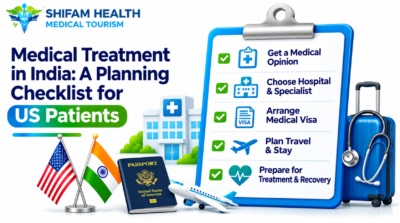
Medical Treatment in India: A Planning Checklist for US Patients
Filters & Insights
Written By :
Medically Reviewed By :

Shifam Health Medical Team
Shifam Health - Medical Reviews Department
10+ Years Of Experience
A practical checklist for US patients planning treatment in India, covering medical records, consultations, travel preparation.
📅
Last updated: November 28, 2026

Traveling from the United States to India for medical treatment requires careful preparation. Patients and families need to coordinate medical records, specialist consultations, hospital arrangements, travel documents, flights, accommodation, and plans for recovery after treatment.
India offers healthcare services across specialties such as oncology, cardiology, orthopedics, neurology, organ transplantation, and advanced surgery. However, choosing to receive treatment abroad is a significant decision. Patients should understand the proposed treatment, verify the hospital and specialist, clarify the estimated costs, and consider how medical care will continue after returning to the United States.
A practical checklist can make this process easier to manage. It helps patients identify what needs to be completed before departure, what to carry during the journey, and which arrangements should be confirmed before returning home.
This guide is designed for US patients considering medical treatment in India. It covers seven important planning stages, from confirming the medical need to organizing follow-up care after returning home.
Table of Contents
ToggleConfirm the Medical Need and Decide Whether Treatment Abroad Is Appropriate
Before arranging international travel, discuss the possibility of receiving treatment in India with your current healthcare professional in the United States. This is an important first step because the decision should consider the patient’s medical condition, available treatment options, travel-related risks, and the practical requirements of receiving care abroad.
Discuss your options with your current doctor
Ask your US-based doctor to explain:
- The current diagnosis and its level of certainty.
- The treatment options available in the United States.
- Whether a second opinion may be useful.
- Whether treatment can be delayed safely for travel and evaluation.
- Whether the patient’s condition makes long-distance travel appropriate.
- What medical support may be needed during the journey.
- What follow-up care will be required after returning home.
Do not assume that traveling abroad is suitable simply because a hospital provides the requested treatment. The patient’s medical condition and the risks of travel must be considered individually.
Identify the purpose of seeking treatment in India
Be clear about what you want to achieve by contacting an Indian hospital. You may be seeking:
- A specialist consultation.
- A second medical opinion.
- Evaluation for a complex procedure.
- Cancer treatment or surgical assessment.
- A treatment option that is not readily accessible to you.
- An estimate of treatment and hospital expenses.
- Further evaluation of an uncertain diagnosis.
The purpose of the enquiry helps the receiving hospital understand which department should review the case and what information may be required.
For a broader overview of treatment options and the medical travel process, read the complete guide to medical tourism in India.
Collect and Organize Your Medical Records
Medical records are essential when contacting hospitals in India. Specialists need relevant information about the patient’s diagnosis, previous treatment, investigations, medicines, and medical history before they can assess the case.
Sending complete and clearly organized records can make the initial review more efficient.
Prepare a medical document checklist
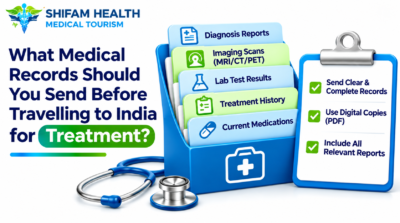
Collect the documents relevant to your condition. These may include:
| Medical Document | Why It May Be Needed |
|---|---|
| Recent Consultation Notes | To understand the current diagnosis and medical concerns |
| Blood Test Results | To review relevant laboratory findings |
| CT, MRI, PET-CT, or X-ray Reports | To understand available imaging information |
| Original Imaging Files | If requested by the receiving hospital |
| Biopsy and Pathology Reports | To review tissue findings, where applicable |
| Previous Surgery Records | To understand earlier procedures |
| Hospital Discharge Summaries | To review previous admissions and treatment |
| Current Prescriptions | To identify medicines being taken |
| Medication and Allergy List | To communicate important safety information |
| Previous Treatment Records | To understand therapies already received |
The exact documents required will depend on the patient’s condition and the specialist’s request.
Prepare a short medical history
Along with the reports, prepare a concise summary containing:
- Patient’s full name and age.
- Main diagnosis or suspected condition.
- When the symptoms began.
- Previous treatments and surgeries.
- Existing medical conditions.
- Current medicines and dosages, where known.
- Known allergies and reactions.
- Important recent investigation findings.
- The reason for seeking treatment in India.
If a diagnosis has not been confirmed, clearly describe it as suspected or under investigation. Do not interpret medical findings or change the wording of a doctor’s report.
Our guide to preparing a one-page patient summary for an Indian hospital explains how to organize this information into a concise document.
Organize digital and printed copies
Save medical records in clearly labeled folders and use consistent file names. Keep the latest reports easy to identify, and retain a secure backup.
For example:
MRI_Report_2026-11-10.pdfBlood_Test_2026-11-12.pdfDischarge_Summary_2026-10-25.pdfCurrent_Prescription_2026-11-15.pdf
Keep essential printed documents in your hand luggage. Do not rely only on a phone or cloud account when traveling.
Read how to keep digital and printed copies of medical travel documents for a more detailed document preparation process.
Protect your personal health information
Medical records contain sensitive personal information. Share them only with the intended hospital, specialist, or authorized recipient through an appropriate secure channel.
Before sending documents, confirm the recipient’s email address or file submission method. Avoid public sharing links and unfamiliar websites.
Get a Specialist Review Before Finalizing Travel
After collecting the medical records, contact the relevant Indian hospital or specialist to request an initial review.
Depending on the case, the hospital may offer an online consultation, request additional reports, or ask the patient to undergo further investigations before discussing treatment options.
Confirm that the hospital treats the specific condition
Do not select a hospital only because it is well known or advertises a broad range of specialties.
Ask:
- Does this hospital location treat the patient’s specific condition?
- Which specialist or department will review the records?
- Is the relevant subspecialty available?
- Are the required diagnostic facilities available?
- Will more than one specialist need to evaluate the patient?
- Does the hospital need additional reports before reviewing the case?
A hospital group may operate multiple locations with different services. Confirm the facilities available at the exact location where the patient may receive treatment.
You can explore the Shifam Health hospital directory to review hospital information and the doctor directory to explore available specialist profiles. Confirm current doctor affiliations, availability, and clinical responsibilities directly with the hospital.
Verify specialist qualifications and experience
Ask for the specialist’s relevant qualifications, specialty, professional registration details, and experience with the condition or procedure under consideration.
Useful questions include:
- What is the doctor’s specialty and subspecialty?
- Does the doctor regularly manage similar cases?
- Who will perform the proposed procedure?
- Will other specialists be involved?
- Who will provide post-treatment care?
Years of experience alone do not establish suitability for every complex procedure. The patient’s case should be reviewed by the appropriate specialist.
Ask about hospital accreditation and facilities
Check whether the exact hospital location holds current accreditation, such as NABH or JCI, where applicable. Verify the status through the relevant accreditation organization’s official directory.
Also ask whether the hospital has the diagnostic equipment, operating facilities, critical care support, and other services relevant to the proposed treatment.
Accreditation can be a useful quality indicator, but it does not guarantee a particular outcome or replace an individual assessment.
Prepare questions for an online consultation
If a virtual consultation is arranged, prepare questions in advance.
Consider asking:
- What does the available medical information indicate?
- Are additional tests required?
- What treatment options may be considered?
- What are the possible risks and alternatives?
- What is the expected hospital stay if treatment is recommended?
- What recovery support may be needed?
- What should be confirmed before traveling?
Record the answers and identify questions that remain unresolved. A virtual consultation based on shared records may not replace a physical examination or additional investigations.
Review the Treatment Plan, Estimated Cost, and Expected Stay
Before making travel arrangements, understand the information provided by the hospital. Patients should distinguish between a preliminary opinion, an estimated cost, and a confirmed treatment plan.
Request a written treatment plan or consultation summary
Ask the hospital to explain:
- The specialist’s assessment based on the available records.
- Whether additional investigations are required.
- Which treatment options may be considered.
- Whether an in-person examination is necessary.
- What decisions remain pending.
- What the next step should be.
Clinical recommendations should come from the treating specialist. Do not assume that a preliminary discussion confirms that a particular procedure is appropriate.
Request an itemized cost estimate
Ask whether the estimate includes:
- Specialist consultation fees.
- Diagnostic investigations.
- Hospital room charges.
- Procedure or surgery charges.
- Anesthesia fees.
- Medicines and consumables.
- ICU charges, if required.
- Blood products, where applicable.
- Rehabilitation or physiotherapy.
- Follow-up consultations.
- Other services or exclusions.
Clarify what could change the estimate
A preliminary estimate may change after an in-person assessment, additional tests, or changes in the treatment plan.
Ask:
- Is the estimate preliminary or confirmed?
- How long is it valid?
- What services are excluded?
- How are additional hospital days charged?
- What happens if complications or unexpected treatment are required?
- Are medicines after discharge included?
- What are the payment and refund policies?
Compare estimates only after checking that the proposed treatment and included services are reasonably comparable.
Estimate the total time needed in India
Do not plan the trip around the procedure date alone. The patient may need time for initial consultation, investigations, treatment, recovery, and follow-up appointments.
Ask the hospital to explain the expected schedule, while understanding that it may change according to the patient’s condition and clinical findings.
Consider separate time allowances for:
- Arrival and initial hospital evaluation.
- Additional tests or consultations.
- Treatment or surgery, if recommended.
- Hospital recovery and discharge.
- Follow-up assessment.
- Medical clearance and return travel.
The treating team should advise when the patient may be fit to travel. Do not use a standard number of recovery days for every procedure.
Prepare US-to-India Travel Documents and Visa Requirements
Once the patient has received sufficient medical information to proceed with planning, review the applicable travel and visa requirements.
Check passport and visa requirements
US citizens traveling to India for medical treatment should review the appropriate visa category and current application instructions.
Depending on eligibility and the current rules, a patient may apply for an Indian Medical Visa. An accompanying family member may need to consider the applicable Medical Attendant Visa arrangements.
Prepare the documents requested by the relevant authorities. These may include:
- Valid passport.
- Completed visa application.
- Recent photograph, where required.
- Hospital appointment or invitation documentation, where applicable.
- Medical records or supporting documents requested for the application.
- Other documents specified by the Indian authorities.
Use the official Indian Visa Online portal to review current information and apply through the authorized government website.
Do not rely on unofficial websites or assume that a hospital invitation letter guarantees visa approval. The decision rests with the relevant Indian authorities.
For additional guidance, review the Indian medical visa application guide and information about the Medical Attendant Visa for India.
Check passport validity and travel details
Before booking flights, check:
- Passport validity.
- Visa approval and permitted stay.
- Correct spelling of the patient’s name on bookings.
- Arrival airport and hospital location.
- Return or onward travel requirements.
- Airline rules relevant to the patient’s medical condition.
Keep copies of important documents in both digital and printed formats.
Review US travel guidance
Before departure, review the US Department of State’s India Travel Advisory for current travel information, safety guidance, and US Embassy and Consulate contact details.
You can also consider enrolling in the Department of State’s Smart Traveler Enrollment Program (STEP) to receive relevant travel and security updates.
Review Health Insurance, Payment, and Financial Arrangements
Patients traveling from the United States should not assume that their existing health insurance will pay for planned treatment in India.
Coverage depends on the individual policy, insurer, type of treatment, and circumstances.
Contact your health insurance provider
Before making a financial commitment, ask your insurer:
- Does the policy cover planned treatment outside the United States?
- Are any overseas hospitals or providers included?
- Is prior authorization required?
- Are consultations, surgery, medicines, and hospital stays covered?
- Are complications after returning home covered?
- What documents are needed for reimbursement?
- Are there exclusions for planned medical travel?
Request written clarification where possible.
Understand Medicare and other coverage limitations
Medicare generally does not cover healthcare received outside the United States, although limited exceptions exist. Patients with Medicare should review the official Medicare guidance on healthcare outside the United States and confirm their circumstances directly with their plan.
Medicare Advantage, Medigap, employer-sponsored plans, and private insurance may have different terms. Do not assume that emergency coverage, planned treatment, and post-treatment care are covered in the same way.
Consider additional travel and medical insurance
Ask an insurance provider whether a suitable policy is available for:
- Emergency medical treatment during travel.
- Medical evacuation, if needed.
- Travel disruption related to medical circumstances.
- Complications arising after treatment abroad.
- Additional accommodation or return travel expenses.
Read exclusions carefully. Some travel policies exclude planned treatment abroad or complications related to procedures undertaken specifically for medical travel.
Prepare a realistic budget
Your budget should consider more than the hospital estimate.
Include:
- Medical consultations and investigations.
- Hospital and treatment expenses.
- Medicines.
- Flights.
- Accommodation.
- Local transportation.
- Meals and daily expenses.
- Attendant travel and accommodation.
- Insurance premiums.
- Additional recovery days.
- Possible follow-up or emergency expenses.
Keep a financial reserve for unexpected changes. Confirm accepted payment methods and whether deposits or advance payments are required.
Plan Flights, Accommodation, and Caregiver Support
Travel arrangements should be based on the patient’s medical needs and the hospital’s schedule.
Choose flights according to medical requirements
Before booking, discuss travel with the patient’s US healthcare professional and the Indian treating team where appropriate.
Ask whether:
- The patient is medically fit to fly.
- Any travel restrictions apply.
- Special seating or mobility assistance is needed.
- Medical clearance documents are required by the airline.
- An attendant should travel with the patient.
- The patient needs additional time before the return journey.
After surgery or certain medical procedures, long-distance air travel may increase health risks. The CDC identifies blood clots and other travel-related concerns as important considerations for medical tourists. The treating team should advise on an appropriate travel plan for the individual patient.
Arrange accommodation near the hospital
Choose accommodation based on the patient’s mobility, recovery requirements, and distance from the hospital.
Consider:
- Travel time to the hospital.
- Elevator and wheelchair accessibility.
- Availability of suitable rooms for an attendant.
- Access to food and essential services.
- Transportation availability.
- Flexible booking arrangements.
- Whether the accommodation is appropriate for the expected recovery period.
Read affordable accommodation for medical tourists in India for additional planning considerations.
Plan for an accompanying caregiver
A family member or trusted companion may help with travel, communication, documents, and daily arrangements.
Before departure, agree on responsibilities such as:
- Keeping copies of medical documents.
- Managing appointment details.
- Maintaining a list of questions.
- Communicating with family members.
- Organizing payments and receipts.
- Helping with mobility and daily activities when appropriate.
- Keeping emergency contact details accessible.
The caregiver should understand that clinical instructions and medical decisions must come from the treating healthcare professionals.
Prepare medicines and travel health supplies
Carry current medicines in their original packaging where possible, along with copies of prescriptions and a medication list.
Check the rules that apply to carrying prescription medicines into India. Do not assume that every medicine prescribed in the United States can be brought into another country without additional documentation or restrictions.
Discuss routine vaccinations, travel health precautions, and any condition-specific concerns with a travel medicine specialist before departure.
The CDC’s medical tourism guidance recommends a pre-travel consultation with a healthcare professional and emphasizes the importance of discussing medication supplies, travel-related risks, and plans for complications.
Prepare for Hospital Admission and Treatment in India
Before leaving the United States, confirm the hospital appointment or admission arrangements. A preliminary consultation or cost estimate should not be treated as confirmation of a procedure date.
Confirm the appointment and admission details
Ask the hospital:
- What date and time should the patient arrive?
- Which department should the patient contact?
- What documents are required at registration?
- Are additional tests scheduled before admission?
- Should the patient bring original reports or imaging files?
- Are there specific pre-admission instructions?
- What payment or deposit arrangements apply?
Keep the hospital’s address and contact information accessible offline.
Carry an essential document folder
Keep the following items in hand luggage:
- Passport and visa documents.
- Hospital appointment confirmation.
- Medical reports and investigation results.
- Current prescriptions and medication list.
- Allergy information.
- Insurance documents.
- Flight and accommodation confirmations.
- Emergency contact information.
- Details of the US doctor and Indian hospital.
Avoid placing all important documents in checked baggage.
Understand consent and treatment discussions
Before treatment, the patient should have an opportunity to discuss the proposed procedure, expected benefits, possible risks, alternatives, and recovery requirements with the treating specialist.
Ask for explanations in language the patient understands. If something is unclear, request clarification before signing consent documents.
Patients should not feel pressured to proceed without understanding the information relevant to their decision.
Plan Recovery, Discharge, and Return Travel
The medical journey continues after treatment. Patients should understand the discharge process, recovery requirements, and travel arrangements before leaving the hospital.
Ask for written discharge instructions
Before discharge, request:
- Discharge summary.
- Final diagnosis and treatment details.
- Surgery or procedure notes, where applicable.
- Relevant laboratory and imaging reports.
- Current prescriptions.
- Medication instructions.
- Wound-care instructions, if applicable.
- Activity and mobility guidance.
- Follow-up appointment details.
- Warning signs that require medical attention.
- Contact information for the relevant hospital department.
Ask questions if any instruction is unclear.
Confirm fitness to travel
Do not book a return flight solely because the expected hospital stay has ended.
Ask the treating specialist to assess whether the patient is medically fit to fly and whether any additional precautions or documentation are needed. The airline may also have medical clearance requirements.
The timing of return travel depends on the procedure, recovery, complications, and individual health circumstances. There is no single waiting period suitable for every patient.
For additional guidance, read how to plan return travel after a major procedure.
Arrange follow-up care in the United States before departure
Identify a US-based doctor or specialist who can review the patient’s medical records after returning home.
Before leaving India:
- Confirm the recommended follow-up schedule.
- Obtain complete medical records.
- Request reports in English.
- Collect prescriptions and medication instructions.
- Ask whether remote follow-up is available.
- Confirm how to contact the Indian hospital if questions arise.
- Share the relevant records with the healthcare professional in the United States.
The CDC recommends arranging follow-up care before travel and obtaining copies of overseas medical records for subsequent healthcare professionals. Patients should also understand the possible financial costs of complications or additional care after returning home.
Our guide to coordinating local doctor follow-up before leaving India explains how to prepare for continuity of care.
Complete Medical Treatment in India Checklist for US Patients
Use this checklist to review the main arrangements before departure.
| Planning Stage | Checklist Item | Status |
|---|---|---|
| Medical Decision | Discussed overseas treatment with US doctor | ☐ |
| Medical Decision | Clarified diagnosis and treatment objectives | ☐ |
| Medical Records | Collected recent reports and imaging | ☐ |
| Medical Records | Prepared medical history and medication list | ☐ |
| Medical Records | Shared records securely with the hospital | ☐ |
| Specialist Review | Confirmed relevant department and specialist | ☐ |
| Specialist Review | Completed consultation or initial review, if required | ☐ |
| Hospital Selection | Checked hospital location and relevant facilities | ☐ |
| Hospital Selection | Reviewed specialist credentials and accreditation | ☐ |
| Cost Planning | Received written estimate and checked exclusions | ☐ |
| Insurance | Checked overseas coverage and exclusions | ☐ |
| Insurance | Reviewed emergency and medical evacuation options | ☐ |
| Visa | Checked applicable Indian visa requirements | ☐ |
| Travel | Confirmed flight arrangements and medical fitness to travel | ☐ |
| Accommodation | Arranged suitable accommodation | ☐ |
| Caregiver | Confirmed attendant and support arrangements | ☐ |
| Hospital Admission | Confirmed appointment and required documents | ☐ |
| Recovery | Discussed discharge and recovery requirements | ☐ |
| Return Travel | Confirmed fitness to fly with treating team | ☐ |
| Follow-up | Identified a US-based healthcare professional | ☐ |
| Follow-up | Collected complete medical records before departure | ☐ |
The checklist is a planning aid, not a substitute for instructions from the hospital, airline, insurer, or relevant authorities. Requirements vary according to the patient’s condition and travel circumstances.
Common Planning Mistakes US Patients Should Avoid
Booking flights before medical review
Do not finalize travel solely on the basis of an initial enquiry or general estimate. Obtain the relevant specialist’s guidance and confirm the hospital’s appointment arrangements first.
Sending incomplete medical records
Missing imaging, pathology reports, prescriptions, or previous treatment details may delay the review. Organize the records before sending them and ask the hospital whether anything else is required.
Assuming insurance will cover treatment in India
Many US insurance plans have restrictions on overseas treatment. Confirm planned treatment, emergency coverage, and post-treatment care directly with the insurer.
Underestimating the time required in India
The patient may need additional tests, consultations, treatment, and recovery time. Ask the hospital about the likely schedule and maintain flexibility.
Ignoring caregiver requirements
A patient recovering from complex treatment may need assistance with mobility, meals, communication, and daily activities. Discuss caregiver arrangements before traveling.
Planning the return flight too early
Discharge does not automatically mean that a patient is ready to fly. Obtain medical advice about fitness to travel and check airline requirements.
Returning without complete medical records
A discharge summary alone may not contain every detail needed for continued care. Request procedure notes, investigation results, prescriptions, and follow-up instructions.
Failing to arrange care in the United States
Identify a local healthcare professional before departure and discuss how records will be transferred. Do not assume that the overseas hospital will automatically coordinate all care after the patient returns.
How Shifam Health Can Help US Patients Coordinate Treatment in India
Planning treatment abroad can involve communication with hospitals, specialists, travel providers, and family members across different time zones. Keeping these arrangements organized can make the process easier to manage.
Shifam Health assists international patients with medical travel coordination in India. Depending on the patient’s requirements, support may include:
- Helping organize medical records for hospital review.
- Coordinating communication with relevant hospitals and specialists.
- Assisting with requests for online consultations, where available.
- Requesting hospital treatment plans and estimated costs.
- Sharing information about available hospital options.
- Coordinating medical visa invitation-letter documentation where applicable.
- Assisting with accommodation and airport pickup arrangements.
- Coordinating interpreter support where available.
- Helping organize administrative communication before and during the patient’s stay.
Shifam Health is a medical travel facilitator, not a hospital or clinical provider. Medical assessments, diagnosis, treatment recommendations, discharge decisions, and fitness-to-travel assessments remain the responsibility of qualified healthcare professionals. Visa approval is determined by the relevant authorities.
If you are considering treatment in India from the United States and need assistance understanding the coordination process, contact Shifam Health to discuss your requirements.
Frequently Asked Questions
Can US citizens travel to India for medical treatment?
US citizens can apply for the appropriate Indian visa category if they meet the applicable eligibility and documentation requirements. Check the latest instructions through the official Indian Visa Online portal before making travel arrangements.
What medical documents should US patients send to an Indian hospital?
Patients should generally prepare relevant consultation notes, investigation results, imaging reports and files, pathology reports where applicable, previous discharge summaries, prescriptions, and a medication and allergy list. The receiving hospital may request additional documents depending on the condition.
Will US health insurance cover medical treatment in India?
Coverage depends on the insurer and individual policy. Medicare generally has limited coverage outside the United States, and many plans exclude planned overseas treatment. Contact your insurer and obtain written clarification before proceeding.
How long should US patients stay in India for treatment?
The required stay depends on the medical condition, investigations, treatment, recovery, and follow-up needs. Ask the treating hospital for an estimated schedule, but understand that it may change according to clinical findings.
Can a family member accompany a patient to India?
An accompanying family member may be able to apply for the applicable Medical Attendant Visa, subject to current eligibility and government requirements. Review the official visa instructions before applying.
Should I arrange follow-up care in the United States before traveling?
Yes. Identify a local doctor or specialist who can review the patient’s records after returning. Discuss the expected follow-up schedule and possible costs before leaving the United States.
When can I fly back to the United States after treatment?
The timing depends on the procedure, recovery, and the patient’s medical condition. The treating specialist should assess fitness to fly, and patients should also check airline medical clearance requirements.
Final Thoughts
Planning medical treatment in India from the United States involves more than choosing a hospital and booking an international flight. Patients should begin by discussing overseas treatment with their current healthcare professional, collecting relevant medical records, and arranging a specialist review.
Before committing to travel, verify the hospital and specialist, understand the proposed treatment, request an itemized cost estimate, and review insurance limitations. Medicare and private insurance policies may have significant restrictions on overseas treatment, so financial arrangements should be confirmed in advance.
Travel preparation should include visa documentation, flights, accommodation, medication planning, and caregiver support where needed. Allow enough time for medical evaluation, treatment, recovery, and follow-up rather than planning the journey around the procedure date alone.
Most importantly, arrange continuity of care before leaving the United States. Discuss follow-up with a local healthcare professional, obtain complete medical records from the Indian hospital, and confirm when the treating specialist considers the patient fit to travel.
Every patient’s medical journey is different. A careful checklist, clear communication, and realistic planning can help patients and families understand the responsibilities involved in receiving treatment abroad and make decisions with better preparation.

Popular Posts From Last Week
- November 26, 2026
- Razi Khan
Compare Indian hospitals for complex treatment by reviewing specialist experience, accreditation, diagnostic facilities, ICU support, patient safety, costs,…
- November 28, 2026
- Razi Khan
Planning medical treatment in India from the United States? This practical guide covers medical records, specialist consultations, hospital…
- November 26, 2026
- Razi Khan
Learn how international patients and their families can document treatment decisions, organize questions for doctors, track hospital discussions,…
- November 27, 2026
- Shifam Health
Choosing an Indian surgeon for treatment requires careful evaluation before making a decision. International patients should ask important…
- November 25, 2026
- Razi Khan
A practical guide for international patients preparing to choose a hospital in India. Learn how to check hospital…
- November 25, 2026
- Razi Khan
A practical guide for international patients on asking hospitals in India about infection prevention, hygiene, sterilization, accreditation, and…
- November 26, 2026
- Razi Khan
Planning medical treatment in India involves hospital charges as well as travel and daily living expenses for accompanying…
- November 24, 2026
- Razi Khan
Learn how to organize digital and printed medical travel documents before treatment in India. This guide covers medical…
- November 24, 2026
- Razi Khan
Learn how to prepare a personal emergency contact sheet before traveling to India for medical treatment. This practical…
- November 25, 2026
- Razi Khan
A practical guide for international patients arranging follow-up care after treatment in India. Learn how to identify a…
- November 22, 2026
- Razi Khan
A practical guide for international patients planning their journey home after major surgery in India. Learn about medical…
- November 22, 2026
- Razi Khan
Learn how to prepare a clear one-page patient summary before contacting an Indian hospital. This guide covers medical…