


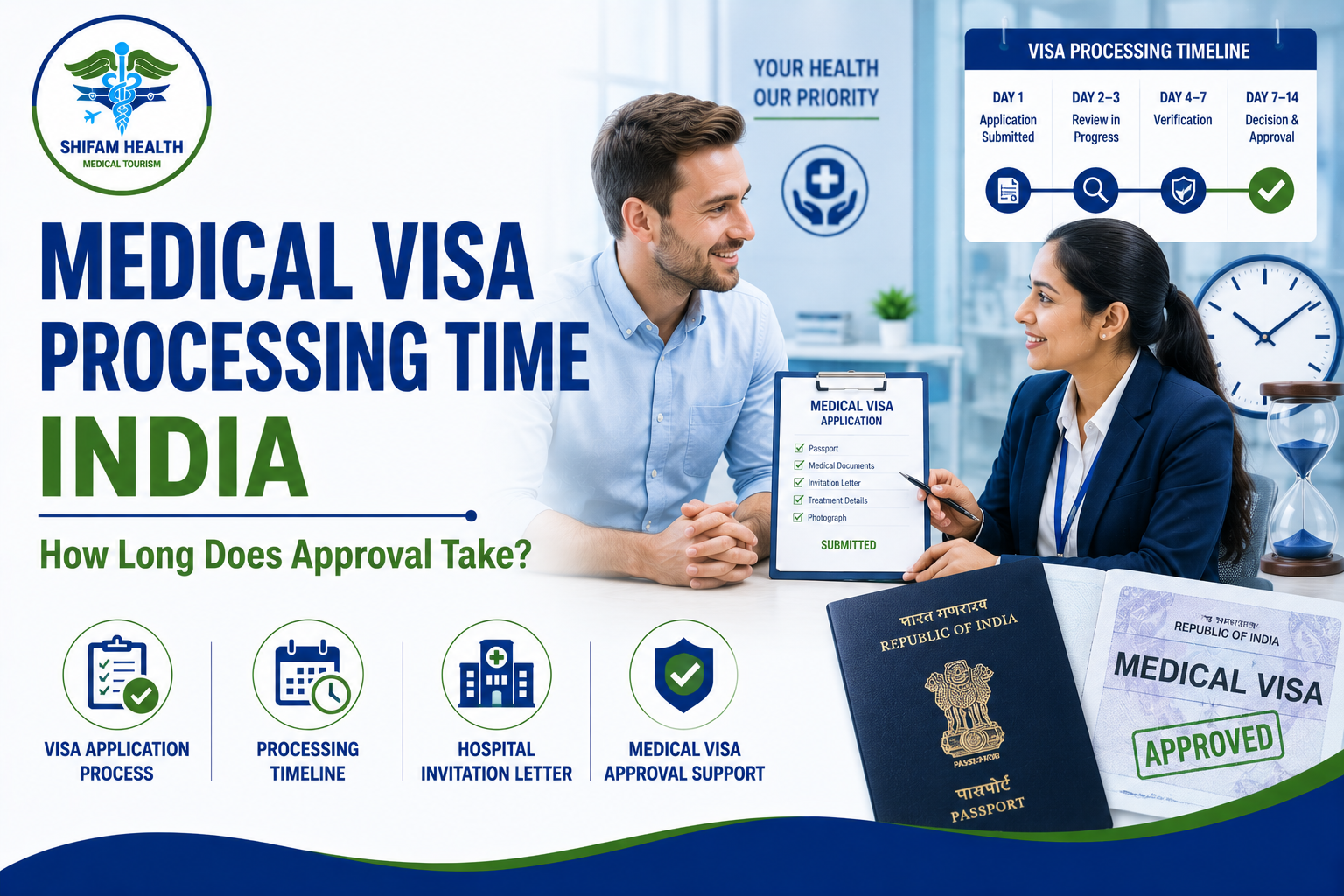
Medical Visa Processing Time India (2026): How Long Does Approval Take?
Filters & Insights
Written By :
Medically Reviewed By :

Shifam Health Medical Team
Shifam Health - Medical Reviews Department
10+ Years Of Experience
How long does an Indian medical visa take? Full 2026 breakdown by country, e-Medical Visa vs embassy route, emergency processing & how to avoid delays.
📅
Last updated: June 16, 2026
Sources: Indian Bureau of Immigration (boi.gov.in), Ministry of Home Affairs (mha.gov.in), Indian Visa Online portal (indianvisaonline.gov.in)
What is the processing time for an Indian medical visa?
Most Indian medical visa (e-Medical Visa) applications are processed within 3 to 5 working days once a complete application — including a hospital invitation letter from a recognised Indian hospital is submitted. Regular medical visas applied through an Indian embassy or consulate typically take 5 to 10 working days, though this can extend to 2–3 weeks during peak season or if documents are incomplete. Genuinely urgent medical cases (cancer, transplants, cardiac emergencies) can sometimes be fast-tracked to 24–72 hours when the hospital and facilitator submit a clear emergency justification letter alongside the application.
Quick Summary Table
| Visa Type | Average Processing Time | Urgent Cases | Validity | Extension Possible |
|---|---|---|---|---|
| e-Medical Visa (e-Medical) | 3–5 Working Days | 24–72 Hours (rare, case-dependent) | Up to 60 Days from Arrival | Yes, up to 3 times locally (subject to approval) |
| e-Medical Attendant Visa | 3–5 Working Days (processed alongside the patient) | 24–72 Hours (case-dependent) | Matches the Patient’s e-Medical Visa | Yes, linked to the patient’s visa status |
| Regular Medical Visa (Embassy/Consulate) | 5–10 Working Days | 2–3 Days with strong medical documentation | Up to 1 Year (Multiple Entry) | Yes, through FRRO/e-FRRO in India |
| Triple-Entry Medical Visa | 7–14 Working Days | Rarely Expedited | Up to 1 Year | Yes, subject to medical necessity and approval |
Note: These figures are general guidance based on standard government processing windows and Shifam Health’s coordination experience. Actual processing time depends on your nationality, the Indian mission handling your case, completeness of documents, and seasonal application volume.
Table of Contents
ToggleWhat Is an Indian Medical Visa?
An Indian medical visa is a special category of visa issued by the Government of India specifically for foreign nationals travelling to India to receive medical treatment at a recognized hospital. It’s distinct from a tourist visa because it allows for longer stays, easier extensions, and critically permits one or two companions to travel on a linked Medical Attendant (MX) visa.
There are two practical routes:
- e-Medical Visa (most common): An online application submitted through the official Indian Visa Online portal. Available to citizens of most countries (check eligibility by nationality).
- Regular (paper) Medical Visa: Applied for in person or through a visa application centre (such as VFS Global or IVAC) connected to an Indian embassy or consulate. Required for nationals not eligible for e-Visa, or for longer multiple-entry visas.
Both routes require a medical invitation letter from an Indian hospital, which is one of the single biggest factors affecting how quickly your application is approved.
How Long Does an Indian Medical Visa Take?
For most applicants, an Indian medical visa takes between 3 and 10 working days, depending on whether you apply through the e-Medical Visa system or the embassy route.
e-Medical Visa Timeline
The e-Medical Visa is generally the faster option:
- Application submission to initial review: 1–2 working days
- Document verification (hospital letter, passport, photo): 1–2 working days
- Approval and e-Visa issuance: 1 working day once verification is complete
In total, applicants who submit a complete file — passport scan, photograph, and a properly formatted hospital invitation letter typically receive their e-Medical Visa within 3 to 5 working days.
Embassy/Consulate Route Timeline
If your nationality requires a regular medical visa, or you’re applying for a longer multiple-entry visa, expect:
- Appointment booking at visa centre: Can add 1–5 days depending on availability
- Document submission and biometric capture: Same day as appointment
- Embassy processing: 5–10 working days
- Passport return/collection: 1–2 additional days
This route generally takes 7 to 14 working days from the date of your visa center appointment, not from the date you start preparing documents.
Country-Specific Delays
Processing times can vary because:
- Some Indian missions abroad have smaller visa teams and longer backlogs
- Certain nationalities undergo additional security clearance (this is standard for some countries and not an indication of any issue with your application)
- Peak travel seasons (October–March) often see higher application volumes
Medical Visa Processing Time by Country
Processing times vary by country mainly due to embassy capacity, security clearance requirements, and whether e-Medical Visa is available for that nationality — but most patients across these countries receive approval within 3–10 working days when documents are complete.
| Country | Typical Processing Time | e-Medical Visa Available? | Notes |
|---|---|---|---|
| Bangladesh | 5–10 Working Days | Yes | High volume of applications; visa centre appointment slots may fill quickly, so early application is recommended. |
| Nigeria | 3–7 Working Days | Yes | Security verification may occasionally add 1–3 additional days to processing. |
| Kenya | 3–7 Working Days | Yes | Applications are generally processed smoothly when documentation is complete and accurate. |
| Ethiopia | 5–10 Working Days | Yes | Document authentication or verification by the Indian mission may extend processing in some cases. |
| Saudi Arabia | 3–5 Working Days | Yes (Eligible Categories) | Processing is often faster when strong hospital documentation and treatment schedules are provided. |
| UAE | 3–5 Working Days | Yes | One of the faster-processing categories for eligible medical visa applicants. |
| Iraq | 5–14 Working Days | Limited | Additional security clearances are common; patients should apply well in advance of travel. |
| Yemen | 7–21 Working Days | Limited / Case-Dependent | Many applicants may need to use the regular medical visa route through a third-country Indian mission. Extra planning time is advisable. |
| Afghanistan | 7–21 Working Days | Limited / Case-Dependent | Additional verification and clearance procedures are common. Early application is strongly recommended. |
If you’re applying from a country with limited e-Medical Visa access (such as Yemen or Afghanistan), Shifam Health can advise on the nearest Indian mission handling applications for your nationality and the realistic timeline for your case.
Emergency Medical Visa Processing
Genuinely time-critical medical cases such as advanced cancer requiring immediate intervention, organ transplant matches, or acute cardiac conditions can sometimes be processed within 24 to 72 hours, but this requires a clear, well-documented emergency justification from the treating hospital, not just a request for speed.
Conditions That May Qualify for Expedited Processing
- Cardiac emergencies: Unstable angina, urgent bypass or valve procedures where the cardiologist confirms a time-sensitive risk
- Cancer treatment: Cases where delay would allow disease progression (documented by an oncology report)
- Organ transplants: Living-donor transplant cases with a confirmed donor match and surgical date
- Neurosurgical emergencies: Conditions where the treating neurosurgeon documents urgency (e.g., rapidly progressing tumours)
What’s Needed for Expedited Review
- A hospital invitation letter that explicitly states the medical urgency and proposed treatment date
- A doctor’s letter or medical report explaining why delay poses a risk
- A complete, error-free application incomplete urgent applications are more likely to be delayed, not less
- Where possible, support from a medical tourism facilitator who can liaise directly with the hospital’s international patient department
Realistic Expectations
It’s important to be honest here: expedited processing is not guaranteed and is handled at the discretion of the Indian mission reviewing the application. Embassies do not have a formal “24-hour emergency visa” product that can be requested on demand but in practice, well-documented urgent medical cases are often prioritized within the existing review queue. Building in a buffer of at least 3–5 days, even for urgent cases, is the safer approach.
Factors That Delay Medical Visa Approval
The most common causes of medical visa delays are incomplete documentation, problems with the hospital invitation letter, passport issues, embassy backlogs, and routine security verification most of which are preventable with careful preparation.
Incomplete Documents
This is, by far, the leading cause of delay. Missing items typically include:
- Passport-size photograph not meeting specifications (size, background colour, recency)
- Passport with less than 6 months’ validity remaining
- Incomplete or inconsistent personal details across the application form and passport
Hospital Invitation Letter Issues
The hospital letter must include specific details patient name (matching the passport exactly), diagnosis or treatment category, proposed treatment dates, and the hospital’s official letterhead and contact details. A letter that’s generic, undated, or missing required fields is one of the most common reasons applications are sent back for clarification.
Passport Problems
- Passport nearing expiry
- Damaged or illegible passport pages
- Previous visa overstays or irregularities on record
Embassy Backlog
Some Indian missions process a high volume of applications relative to staff capacity, particularly during peak medical tourism seasons (typically October through March). This is outside any applicant’s control but can be partially mitigated by applying as early as possible.
Security Verification
For applicants from certain countries, Indian authorities conduct standard security and background checks as part of the visa process. This is routine and not necessarily a sign of a problem but it can add several days to the overall timeline, so it’s worth factoring into your planning from the outset.
How to Get Faster Medical Visa Approval
The fastest way to get medical visa approval is to apply with a complete file from day one correct passport details, a properly formatted hospital invitation letter, and accurate personal information submitted as early as possible relative to your planned travel date.
Step-by-Step Strategy
- Confirm your hospital and treatment plan first
You cannot get a valid medical invitation letter without a confirmed hospital and treatment plan, so this is the essential first step — not something to rush at the end.
- Request the hospital invitation letter early
Ask the hospital’s international patient department or shifam health team for the letter as soon as your treatment is confirmed. Make sure it includes your full name (exactly as on your passport), passport number, diagnosis/treatment category, and proposed dates.
- Check your passport validity
Ensure at least 6 months of validity remain from your intended date of travel. Renew well in advance if needed.
- Prepare a compliant photograph
Follow the exact specifications listed on the Indian Visa Online portal — incorrect photo specifications are a frequent cause of rejection or resubmission requests
- Double-check every field on the application form
Names, dates of birth, and passport numbers must match your passport exactly. Even small typos can trigger manual review delays
- Apply at least 2–3 weeks before your planned travel date
even for “fast” e-Medical Visa categories. This buffer absorbs unexpected delays without affecting your treatment schedule
- Use a medical tourism coordinator for documentation review
A second pair of eyes on your hospital letter and application — ideally someone familiar with what Indian missions expect catches issues before submission rather than after rejection.
- Avoid applying during major holiday periods
(Indian public holidays, year-end) when processing centres may have reduced staffing.
Common Reasons Medical Visas Get Delayed
Direct answer: Beyond document issues, visas are commonly delayed due to mismatched information between the application and supporting documents, applying through the wrong visa category, missing attendant visa coordination, and underestimating embassy review times for first-time applicants.
- Visa category mismatch: Applying for a tourist visa and later trying to convert it for medical treatment causes significant delays — always apply under the correct medical visa category from the start.
- Attendant visa not aligned with patient visa: If a family member or caregiver is travelling, their Medical Attendant (MX) visa application should be submitted alongside the patient’s submitting separately or later can create processing gaps.
- Inconsistent treatment dates: If the hospital letter states one treatment date but the application form states another, this discrepancy often triggers a query and resubmission.
- Unfamiliarity with the e-Visa portal: First-time applicants sometimes submit forms with errors that aren’t caught until the review stage, adding days to the process.
- Currency/payment issues during application: Visa fee payment failures or mismatches can stall an application in the queue until resolved.
Can Medical Visas Be Fast-Tracked?
There is no formal “express” or “premium” Indian medical visa product that guarantees same-day approval but applications with a clear medical urgency, complete documentation, and a properly worded hospital letter are often reviewed with priority within the existing system.
In practice, “fast-tracking” an Indian medical visa means:
- Eliminating every possible point of friction before submission, so the application doesn’t sit in a query/clarification loop
- Including an explicit urgency statement from the treating hospital, addressed to the visa-issuing authority
- Applying through the correct channel for your nationality the first time — switching channels mid-process resets the clock
- Having a facilitator follow up appropriately with the hospital and visa centre if processing exceeds the typical window
Patients sometimes hear claims of “guaranteed 24-hour medical visas” from agencies — treat these with caution. While urgent cases are sometimes processed quickly, no third party can override the Indian government’s review process, and promises of guaranteed timelines should be viewed skeptically.
e-Medical Visa vs Regular Medical Visa Processing Time
The e-Medical Visa is generally faster (3–5 working days) and more convenient because it’s applied for entirely online, while the regular medical visa (5–14 working days) requires an in-person appointment at a visa application centre but offers longer validity and multiple-entry options.
| Feature | e-Medical Visa | Regular Medical Visa |
|---|---|---|
| Application Method | Fully online application process through the Indian e-Visa system. | Applied through an Indian embassy, consulate, or authorized visa application centre. |
| Average Processing Time | 3–5 working days in most cases. | 5–14 working days, depending on nationality, documentation, and embassy workload. |
| Validity | Up to 60 days from the date of arrival in India. | Up to 1 year with multiple-entry privileges, depending on nationality and approval. |
| Entries Allowed | Triple entry permitted during the visa validity period. | Single, double, or triple entry depending on visa category and approval conditions. |
| Attendant Visa | e-Medical Attendant Visa available for eligible accompanying family members. | Medical Attendant (MX) Visa available for accompanying relatives or caregivers. |
| Eligibility | Available to citizens of most countries eligible under India’s e-Visa program. | Required for patients from non-eligible countries or those requiring longer validity and additional flexibility. |
| Best For | Single treatment cycles, short-term procedures, consultations, diagnostic evaluations, ophthalmology treatments, fertility procedures, and shorter medical stays. | Ongoing or multi-visit treatment such as cancer follow-ups, chemotherapy, radiotherapy, organ transplant monitoring, neurological rehabilitation, bone marrow transplantation, and long-term treatment plans. |
Which should you choose? If your treatment is a single procedure with a defined recovery period (under 60 days) and your nationality is e-Visa eligible, the e-Medical Visa is almost always the faster and simpler choice. If your treatment plan involves multiple visits over months (such as cancer therapy cycles or transplant follow-up), a regular multiple-entry medical visa may serve you better despite the longer initial processing time.
How Shifam Health Helps Avoid Visa Delays
Shifam Health simplifies the medical visa process by helping patients avoid common mistakes that can lead to delays.
- Hospital Coordination: We work directly with partner hospitals to obtain accurate medical invitation letters quickly.
- Document Review: Our team checks visa documents, passport details, and application information before submission.
- Visa Guidance: We help ensure all required paperwork is complete and correctly prepared.
- Appointment Planning: For embassy-route applications, we assist with scheduling and timeline planning.
- End-to-End Support: From treatment confirmation to visa application, we guide patients through every step.
While we cannot influence government processing times, we help eliminate preventable errors and make the process as smooth as possible.
Frequently Asked Questions
Can a medical visa be approved in 24 hours?
In rare medical emergencies, faster processing may be possible, but most applications take 3–10 working days.
Can cancer patients get urgent visa approval?
Patients with urgent medical documentation and a hospital letter may receive priority review, though approval timelines are not guaranteed.
How long does Indian medical visa processing take?
Most applications are processed within 5–10 working days, depending on nationality and documentation.
What documents are required?
A valid passport, recent photograph, completed visa application, and hospital invitation letter are typically required.
Can family members travel with the patient?
Yes. Family members can apply for a Medical Attendant Visa, linked to the patient’s medical visa.
Does nationality affect processing time?
Yes. Some nationalities are eligible for e-Medical Visas, while others require embassy processing and additional verification.
Can I travel before my visa is approved?
No. You must wait until the medical visa is issued before travelling to India.
Can a medical visa be extended in India?
Yes. Extensions are usually possible through the FRRO with supporting hospital documentation.
Can I apply without a hospital confirmation letter?
No. A hospital invitation letter is a mandatory requirement for a medical visa application.
How early should I apply?
Apply at least 2–3 weeks before travel to allow time for processing and any additional verification.
How can Shifam Health help?
Shifam Health assists with hospital documentation, visa guidance, and treatment planning to help patients complete the process smoothly.
Ready to Start Your Medical Treatment Journey to India?
Visa delays are one of the most stressful and most preventable parts of planning treatment abroad. Shifam Health’s international patient team handles hospital coordination, invitation letters, and documentation review so your medical visa application moves as smoothly as possible from day one.
Get Free Medical Visa Assistance for India
Or send your medical reports for a free review and treatment plan: Submit Your Medical Records
Helpful Reads
- Indian Medical Visa Guide (2026)
- Medical Visa from Bangladesh to India
- Indian Medical Visa Fee Bangladesh
- e-Medical Visa vs Regular Medical Visa India
- Medical Visa from USA to India
- Medical Visa from UK to India
- Cancer Treatment Cost in India
- Heart Bypass Surgery Cost in India
- Medical Tourism in India: A Complete Guide

Popular Posts From Last Week
- October 27, 2026
- Razi Khan
Imagine you have decided to seek a specialist’s opinion from another country. You have laboratory reports, prescriptions, scan…
- October 23, 2026
- shifamhealth
A fluttering chest, a sudden racing heartbeat or a skipped beat can be frightening, and it is hard…
- October 27, 2026
- Razi Khan
Receiving a medical treatment package from a hospital can feel like a major step forward. You have a…
- October 26, 2026
- Razi Khan
Learn how to send large MRI and CT files to an Indian hospital for specialist review. This guide…
- October 25, 2026
- shifamhealth
What is a ventricular septal defect? A ventricular septal defect (VSD) is an opening in the wall (septum)…
- October 22, 2026
- shifamhealth
A remote medical second opinion from India allows patients living in the USA, UK and other countries to…
- October 21, 2026
- shifamhealth
When you receive treatment estimates from two hospitals in India, do not compare only the final amounts. To…
- October 22, 2026
- shifamhealth
An itemized hospital quote in India should clearly explain the expected cost of treatment by separating major charges,…