



Home > Blog > Minimally Invasive Orthopaedic Surgery in India for International Patients: Cost, Hospitals and Recovery Guide (2026)
Minimally Invasive Orthopaedic Surgery in India for International Patients: Cost, Hospitals and Recovery Guide (2026)
Filters & Insights
Discover minimally invasive orthopedic surgery in India for international patients. Learn about costs, recovery, procedures.

Every day you wait for orthopaedic surgery, your joint deteriorates further. In the UK, Canada, and across Europe, that wait stretches 6 to 18 months, while the pain continues and the life you want back feels increasingly out of reach.
Thousands of patients have taken a different route. They travelled to India, received minimally invasive surgery from world-class specialists, and walked out of the hospital within days, at 60–80% less than what the same procedure costs at home.
Same robotic technology. Same surgical standards. A fraction of the cost. No waiting list.
This guide explains why India leads the world in minimally invasive orthopaedic care, and how Shifam Health gets you there.
Table of Contents
ToggleWhat Is Minimally Invasive Orthopaedic Surgery?
Minimally invasive orthopaedic surgery (MIOS) uses small incisions, specialised instruments, and real-time imaging guidance to treat conditions affecting bones, joints, and the spine. Instead of opening large areas of tissue, surgeons work through keyhole-sized openings, often just 1–3 centimetres wide.
Surgeons now routinely use this approach for:
| Procedure Category | Common Conditions Treated |
|---|---|
| Arthroscopy | Knee, shoulder, wrist, ankle joint problems |
| Spine Surgery | Herniated discs, stenosis, sciatica, spondylosis |
| Joint Replacement | Hip and knee arthroplasty |
| Ligament Reconstruction | ACL, PCL, rotator cuff tears |
| Fracture Fixation | Minimally invasive plating and nailing |
| Cartilage Repair | Damaged cartilage restoration and grafting |
The fundamental goal: treat the problem precisely while causing the least possible disruption to surrounding muscles, nerves, and tissue.
Why International Patients Choose Minimally Invasive Surgery?
For patients travelling abroad for orthopaedic treatment, minimally invasive techniques dramatically reduce the stress and risk of combining surgery with international travel.
| Benefit | What It Means for You |
|---|---|
| Smaller incisions | Minimal scarring, lower infection risk |
| Less post-operative pain | Reduced need for strong painkillers |
| Shorter hospital stay | 1–4 days versus 5–10 days for traditional surgery |
| Faster recovery | Return to walking and travel significantly sooner |
| Reduced blood loss | Safer for patients with certain health conditions |
| Quicker wound healing | Better for international travel timelines |
For medical tourists specifically, these advantages translate to shorter overall trips, lower accommodation costs, and a safer return journey home.
Why India Is a Global Leader in Minimally Invasive Orthopaedics
India’s reputation as a top destination for orthopaedic surgery rests on four pillars: surgical expertise, technology, affordability, and accessibility.
1. Highly Experienced Orthopaedic Surgeons
India’s leading orthopaedic specialists have trained at institutions in the UK, USA, Germany, and Australia. Major hospitals perform thousands of joint replacements and arthroscopic procedures every year, and this case volume directly improves surgical outcomes and reduces complication rates.
2. Advanced Surgical Technology
Top Indian hospitals invest in the same technology that the world’s best orthopaedic centres use:
| Technology | Application |
|---|---|
| Robotic-assisted joint replacement | Precise implant positioning, reduced surgical errors |
| 3D imaging and navigation systems | Real-time intraoperative guidance |
| High-definition arthroscopic cameras | Detailed visualisation inside joints |
| Computer-assisted spine surgery | Accuracy in complex vertebral procedures |
| Intraoperative fluoroscopy | Live X-ray guidance during surgery |
3. Significant Cost Advantage
| Procedure | India (USD) | UK / Europe (USD) | Savings |
|---|---|---|---|
| Knee Arthroscopy | $2,500 – $4,000 | $10,000 – $15,000 | Up to 75% |
| Shoulder Arthroscopy | $3,000 – $5,000 | $12,000 – $18,000 | Up to 73% |
| ACL Reconstruction | $4,000 – $6,000 | $15,000 – $22,000 | Up to 73% |
| Minimally Invasive Spine Surgery | $6,000 – $10,000 | $25,000 – $50,000 | Up to 80% |
| Hip Replacement (Minimally Invasive) | $7,000 – $9,500 | $25,000 – $40,000 | Up to 76% |
| Knee Replacement (Minimally Invasive) | $6,500 – $9,000 | $20,000 – $35,000 | Up to 74% |
Note: Most packages include surgeon fees, anaesthesiology, hospital stay, nursing care, implants, and basic post-surgery physiotherapy.
4. No Waiting Lists
In the UK, Canada, and many European countries, patients wait 6–18 months for elective orthopaedic surgery. In India, hospitals can schedule procedures within days of arrival, a critical advantage for patients in pain or with deteriorating mobility.
Popular Minimally Invasive Orthopaedic Procedures in India
Arthroscopy (Knee, Shoulder, Ankle, Wrist)
The surgeon inserts a fibre-optic camera, smaller than a pencil, into the joint through a tiny incision, allowing precise visualisation and repair of damage. Common procedures include meniscus repair, ACL and PCL ligament reconstruction, cartilage repair, rotator cuff repair, and treatment of shoulder instability and impingement.
Most patients walk the same day or within 24 hours. Hospital stay typically runs 1–2 days.
Minimally Invasive Spine Surgery (MISS)
Using tubular retractors and advanced imaging, surgeons access the spine through incisions often smaller than 2 cm, sparing the large back muscles that traditional open surgery damages.
Surgeons use MISS to treat herniated (slipped) discs, spinal stenosis, degenerative disc disease, sciatica and nerve compression, spondylolisthesis, and vertebral fractures. Patients typically stay 2–4 days in hospital and experience significantly less post-operative pain compared to open surgery.
Must Read: Spine Surgery Treatment Cost in India for International Patients: Updated Price Guide
Minimally Invasive Hip Replacement
Modern hip replacement uses muscle-sparing approaches that avoid cutting through the large muscles surrounding the hip joint. Robotic assistance improves implant placement accuracy and reduces the risk of post-operative dislocation.
Key outcomes include faster return to walking, reduced blood loss, lower transfusion requirement, lower dislocation risk, and a considerably shorter rehabilitation period compared to traditional hip replacement.
Also Read : Cost of Hip Replacement Surgery in India: A Comprehensive Guide for Medical Tourists
Minimally Invasive Knee Replacement
Robotic-assisted and computer-navigated techniques allow surgeons to position implants precisely through smaller incisions, reducing tissue trauma and improving alignment outcomes.
| Recovery Milestone | Timeline |
|---|---|
| Walking with support | Within 24 hours |
| Hospital discharge | 2–4 days |
| Climbing stairs | 1–2 weeks |
| Return to light activities | 4–6 weeks |
| Full recovery | 3–6 months |
Must Read : Knee Replacement Surgery Cost in India: Complete Guide
Leading Hospitals for Minimally Invasive Orthopaedic Surgery in India
India hosts internationally accredited hospitals with advanced robotic technology, modern operating theatres, and dedicated international patient departments.
With centres across Delhi, Chennai, Hyderabad, and Mumbai, Apollo delivers robotic joint replacement, arthroscopy, and complex spine surgery through highly experienced orthopaedic teams with strong international patient support services.
Fortis operates centres across Delhi and Bangalore, offering advanced minimally invasive orthopaedic and sports injury treatments backed by strong rehabilitation support and internationally trained surgeons.
Located in Gurugram near Delhi, Medanta leads India in robotic joint replacement and minimally invasive spine surgery, serving a high volume of international patients each year.
Based in Delhi and Noida, Max Healthcare runs a dedicated international patient care programme alongside modern arthroscopy and joint replacement facilities.
This JCI-accredited hospital in Gurugram delivers advanced orthopaedic and sports medicine procedures with consistently high safety standards.
Narayana Health
With centres in Bangalore and Kolkata, Narayana Health provides affordable, high-quality orthopaedic surgery combined with strong post-surgery rehabilitation support.
Kokilaben Dhirubhai Ambani Hospital
Located in Mumbai, Kokilaben leads in robotic surgery and complex joint reconstruction procedures.
All of the above hospitals hold either JCI accreditation or NABH certification, ensuring internationally recognised standards of care, patient safety, and infection control.
Recovery Timeline for International Patients
Patients recover considerably faster after minimally invasive surgery than after traditional open procedures, which is one of the key reasons international patients prefer this approach.
| Recovery Stage | Timeline |
|---|---|
| Hospital stay | 1–4 days (procedure-dependent) |
| Walking with support | Day 1–3 post-surgery |
| Physiotherapy begins | Immediately post-surgery |
| Suture/wound review | 7–10 days |
| Cleared for air travel | 2–3 weeks (short procedures) |
| Return to routine activities | 4–8 weeks |
| Full functional recovery | 3–6 months |
Most hospitals issue a fitness-to-fly certificate and detailed post-operative instructions for your treating doctor at home before they discharge you.
Total Cost of a Medical Trip to India for Orthopaedic Surgery
Beyond the surgical cost, international patients should plan for the following additional expenses:
| Expense Category | Estimated Cost (USD) |
|---|---|
| Pre-surgery investigations | $200 – $600 |
| Post-surgery physiotherapy (in India) | $300 – $800 |
| Accommodation (per week) | $200 – $600 |
| Airport transfers and local travel | $100 – $300 |
| Travel insurance | $100 – $400 |
Even after accounting for all travel and stay expenses, patients in India typically spend 50–70% less than the surgical cost alone in Western countries.
Who Is an Ideal Candidate?
You may suit minimally invasive orthopaedic surgery if you experience any of the following:
| Condition | Details |
|---|---|
| Persistent joint pain | Knee, hip, shoulder, or ankle |
| Sports injuries | Ligament tears, cartilage damage |
| Arthritis affecting mobility | Reduced range of motion, stiffness |
| Spinal pain or nerve compression | Back pain, leg pain, weakness, numbness |
| Failed non-surgical treatments | Physiotherapy, injections, medication |
| Fractures requiring surgical fixation | Bone injuries needing hardware |
A specialist needs to review your medical reports, imaging (X-ray/MRI), and history to confirm suitability. Shifam Health can arrange a free medical opinion from an Indian specialist before you commit to travelling.
How to Plan Your Orthopaedic Surgery in India: Step by Step
| Step | Action |
|---|---|
| 1 | Share medical reports for a free specialist opinion |
| 2 | Receive treatment plan, hospital recommendation, and cost estimate |
| 3 | Apply for an Indian Medical Visa (MED Visa) |
| 4 | Book flights and hospital-arranged accommodation |
| 5 | Arrive 1–2 days early for pre-operative assessment |
| 6 | Undergo surgery and in-hospital recovery |
| 7 | Complete physiotherapy and follow-up consultations |
| 8 | Receive fitness-to-travel clearance and return home |
| 9 | Continue rehabilitation with your local doctor using the India-issued discharge summary |
Shifam Health supports international patients at every step — from the first medical opinion to safe return home. Shifam Health handles hospital and surgeon selection, visa documentation, travel coordination, interpreter support, and on-ground assistance throughout your stay.
Conclusion
Minimally invasive orthopaedic surgery has fundamentally changed what patients travelling abroad can access. Smaller incisions, shorter hospital stays, faster recovery, and significantly lower costs make India one of the strongest choices for international patients seeking world-class orthopaedic care.
With JCI-accredited hospitals, internationally trained surgeons, robotic-assisted technology, and dedicated international patient services, India offers a medical travel experience that is both clinically excellent and practically convenient.
With the right planning and Shifam Health guiding every step, patients arrive prepared, receive the best available care, and return home safely with a clear path to full recovery.
Frequently Asked Questions
Is minimally invasive surgery available for all orthopaedic conditions?
Not all conditions qualify, your medical reports determine suitability, and a specialist review is required.
How do I get a free medical opinion from an Indian orthopaedic specialist?
Share your reports with Shifam Health and receive an expert opinion within 24–48 hours.
How long will I need to stay in India for a knee replacement?
Most patients stay 3–4 weeks to cover surgery, initial recovery, and physiotherapy before they are cleared to fly.
Is post-surgery physiotherapy available in India before I fly home?
Yes, physiotherapy begins in the hospital and continues at outpatient facilities before your departure.
Do Indian hospitals use internationally recognised implants?
Yes, brands such as Zimmer Biomet, Stryker, Johnson & Johnson, and Smith & Nephew are widely used.
Is robotic surgery available for knee and hip replacement in India?
Yes, leading hospitals like Apollo, Medanta, and Fortis offer robotic-assisted joint replacement as standard.

Popular Posts From Last Week
- September 10, 2026
- shifamhealth
Medically reviewed content · Published 2026 · Last reviewed August 2026 Blount’s disease, also called tibia vara, is…
- September 14, 2026
- shifamhealth
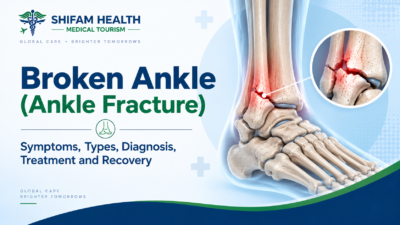
Medically reviewed content · Published 2026 · Last reviewed September 2026 A “broken ankle” is the common term…
- September 13, 2026
- shifamhealth
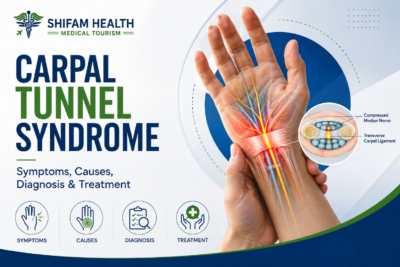
Carpal tunnel syndrome (CTS) is compression of the median nerve as it passes through the carpal tunnel —…
- September 9, 2026
- shifamhealth
A cervical herniated disc occurs when the soft inner material of a disc in the neck pushes through…
- September 13, 2026
- shifamhealth
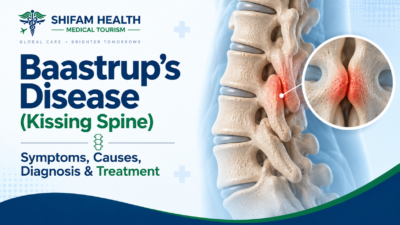
If a lumbar MRI report mentions “kissing spinous processes” or “Baastrup’s disease,” it’s worth pausing before assuming this…
- September 10, 2026
- shifamhealth
Chronic back pain is one of the most common reasons people seek medical care, and also one of…
- September 11, 2026
- shifamhealth
Myelopathy means dysfunction of the spinal cord itself — not a single disease, but a syndrome that can…
- September 9, 2026
- shifamhealth
Medically reviewed content · Published 2026 · Last reviewed September 2026 Disc degeneration seen on an MRI does…
- September 12, 2026
- shifamhealth
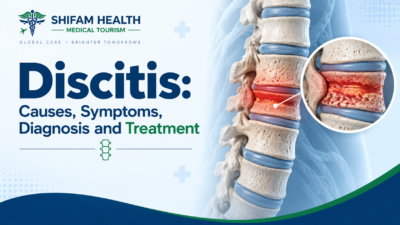
Medically reviewed content · Published 2026 · Last reviewed September 2026 Discitis is inflammation or infection involving an…
- September 12, 2026
- shifamhealth
A femoral hernia occurs when tissue often part of the bowel or fatty tissue — pushes through the…
- September 11, 2026
- shifamhealth
Kümmell’s disease refers to a delayed collapse of a vertebra — a nonunion or failure to heal properly…
- September 8, 2026
- shifamhealth
Written by: Shifam Health Editorial Team — Neuro-Oncology Content Division Medically reviewed by: Shifam Health Clinical Advisory Panel…