



The Question Every Couple Asks Before Starting IVF
“Will it work for us?”
That’s the question sitting at the back of every couple’s mind when they start researching IVF. It’s a deeply personal question and honestly, there’s no single answer that fits everyone. But understanding the data, the factors involved, and what realistically shapes your chances can make all the difference between starting this journey with clarity and starting it with fear.If you’re considering IVF treatment in India — whether you’re coming from Bangladesh, Nigeria, Yemen, the UK, or anywhere else this guide is written specifically for you.
India has quietly become one of the world’s most trusted destinations for fertility treatment. Not just because it’s affordable (though it is), but because the quality of care, the technology available, and the experience of fertility specialists here genuinely rival what patients would find in far more expensive countries.
This article will walk you through everything what IVF success rates actually look like in India, how age affects your outcomes, what factors improve your chances, what things can go wrong, and how to make the smartest possible decision for your fertility journey.
Not sure what your IVF success chances might be?
Share your age, fertility history, AMH reports, and previous treatment details to receive personalized guidance on your IVF options, expected success rates, and suitable fertility centers in India.
What Is IVF?
IVF In Vitro Fertilisation is a fertility treatment where eggs are retrieved from a woman’s ovaries and fertilised by sperm in a laboratory. The resulting embryo is then transferred into the uterus with the goal of achieving a successful pregnancy. The word “in vitro” literally means “in glass” referring to the lab dish where fertilisation happens outside the body. IVF is typically recommended when:
- Fallopian tubes are blocked or damaged
- Ovulation disorders are present (including PCOS)
- Endometriosis has affected fertility
- Male infertility factors are involved (low sperm count, poor motility)
- Unexplained infertility persists after other treatments
- Previous fertility treatments have failed
- Genetic screening is needed before embryo transfer
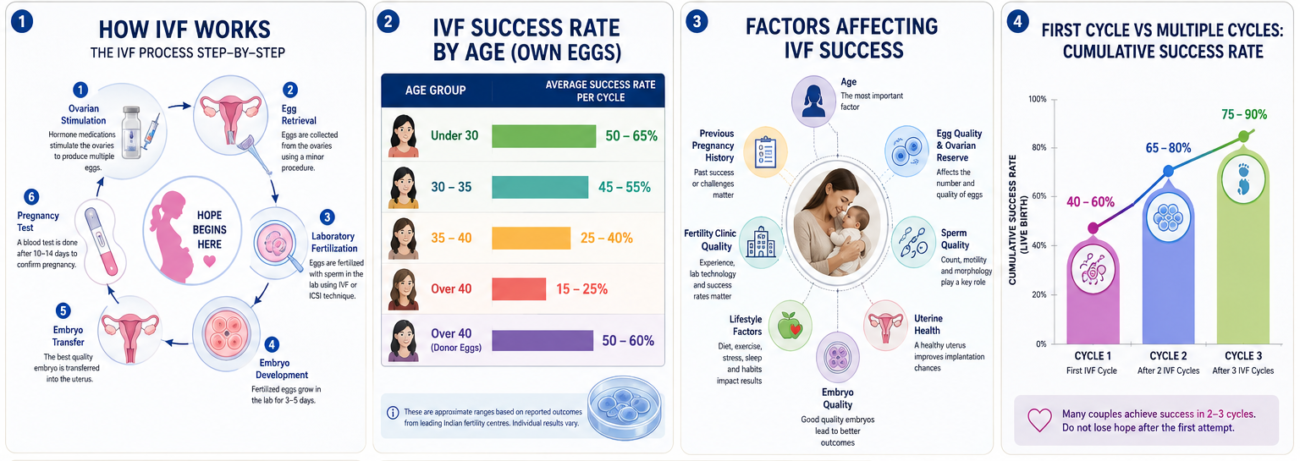
IVF is not a single treatment it’s a cycle of steps: ovarian stimulation, egg retrieval, fertilisation, embryo development, and embryo transfer. Each step matters, and each step is where your care team makes a difference.
IVF Success Rate in India: The Overall Picture
Let’s start with an honest number.
The average IVF success rate in India per cycle ranges from 40% to 60% for women under 35, depending on the clinic, the cause of infertility, and individual patient factors. For women between 35 and 40, success rates typically fall between 25% and 40%. For women over 40, success rates with their own eggs drop to 15% to 25%, though donor egg cycles significantly improve outcomes. These figures are broadly in line with and in many cases comparable to success rates reported by top clinics in the UK, USA, and Europe.
It’s worth understanding what “success rate” actually means. Clinics may report:
- Clinical pregnancy rate — a heartbeat detected at 6–8 weeks
- Live birth rate — the most meaningful measure: a baby actually born
- Implantation rate — the percentage of transferred embryos that implant
When comparing clinics or countries, always ask: are they reporting clinical pregnancy rates or live birth rates? The latter is what truly matters. India does not yet have a fully centralised national IVF registry like the UK’s HFEA, which means published statistics vary across clinics. However, leading hospitals and fertility centres in Delhi, Mumbai, Bangalore, and Chennai consistently report live birth rates that are competitive globally.
IVF Success Rate by Age: What the Data Shows
Age is the single most important factor in IVF success. This isn’t a medical opinion — it’s a biological reality, and understanding it helps patients set realistic expectations.
IVF Success Rate Under 30
Women under 30 generally have the best IVF outcomes. Egg quality and ovarian reserve are typically at their highest, and the uterine environment is optimal. Success rates per cycle in India for this age group range from 50% to 65%.
IVF Success Rate Between 30–35
Still strong. Egg quality remains good, though there’s a gradual natural decline. Most couples in this age bracket achieve success within 2–3 cycles. Success rates per cycle: 45% to 55%.
IVF Success Rate Between 35–40
This is where things begin to shift more noticeably. Egg quality declines, and chromosomal abnormalities in embryos become more common, which is why fewer cycles result in a live birth. Success rates per cycle for this group: 25% to 40%.
Preimplantation Genetic Testing (PGT) — testing embryos for chromosomal health before transfer — can significantly improve outcomes in this age group by selecting only viable embryos.
IVF Success Rate Over 40
For women over 40 using their own eggs, success rates drop to approximately 15% to 25% per cycle in India. This doesn’t mean IVF isn’t worth trying — many women over 40 do achieve successful pregnancies. But expectations need to be honest and realistic.
The picture changes substantially with donor eggs. Women over 40 using younger donor eggs typically see success rates of 50% to 60% per cycle because the egg quality reflects the donor’s age, not the recipient’s.
Every IVF journey is different—and so are the success rates.
Connect with our team to understand how factors like age, ovarian reserve, sperm quality, and medical history may affect your chances of success before starting treatment.
| Age Group | Average IVF Success Rate |
|---|---|
| Under 30 Years | 50–65% |
| 30–35 Years | 45–55% |
| 35–40 Years | 25–40% |
| Over 40 Years | 15–25% |
| Over 40 Years (Using Donor Eggs) | 50–60% |
Clinical Insight: Female age is one of the strongest predictors of IVF success because both egg quality and ovarian reserve decline over time. While success rates generally decrease after the age of 35, the use of donor eggs can significantly improve outcomes for women over 40, often achieving pregnancy rates comparable to those seen in younger patients.
Note: These are approximate ranges based on reported outcomes from leading Indian fertility centres. Individual results vary.
What Factors Actually Affect IVF Success?
While age is one of the most important factors in IVF success, several other elements also play a significant role.
- Egg Quality & Ovarian Reserve: AMH levels and antral follicle count help assess egg quantity and quality. Better ovarian reserve generally improves success chances.
- Sperm Quality: Sperm count, movement, and shape affect fertilization. ICSI can help overcome many male infertility issues.
- Uterine Health: Conditions such as fibroids, polyps, or a thin uterine lining can reduce implantation rates.
- Clinic & Laboratory Quality: Experienced embryologists, advanced technology, and high-quality IVF labs can significantly improve outcomes.
- Embryo Quality: Healthy blastocyst-stage embryos have higher implantation and pregnancy rates.
- Embryo Transfer Strategy: Single embryo transfer (SET) is often preferred to reduce the risk of multiple pregnancies while maintaining strong success rates.
- Lifestyle Factors: Smoking, obesity, excessive alcohol consumption, and chronic stress can negatively impact IVF results.
- Previous Pregnancy History: Women who have conceived before often have higher chances of IVF success.
- Cause of Infertility: IVF outcomes vary depending on the underlying fertility issue. Some conditions, such as blocked fallopian tubes, respond particularly well to IVF treatment.
First Cycle vs Multiple Cycles: What to Expect
One of the most important things to understand about IVF is that success often comes cumulatively across multiple cycles, not necessarily on the first attempt.
IVF Success on the First Cycle
For women under 35, approximately 40–50% will achieve a live birth on their first IVF cycle in India. That means, statistically, that many couples will need more than one cycle — and this is completely normal, not a sign that IVF isn’t working.
Cumulative Success Rates
This is the more meaningful number for many patients. Across 3 IVF cycles:
- Women under 35: cumulative live birth rates of 70–80%
- Women 35–40: cumulative live birth rates of 50–65%
- Women over 40 (own eggs): cumulative live birth rates of 30–40%
Frozen embryo transfers (FET) from previously stimulated cycles often contribute significantly to these cumulative outcomes, which is why clinics that create and freeze multiple good-quality embryos per cycle can offer patients more attempts without repeated full stimulation cycles.
Planning IVF treatment in India from abroad?
We can help you compare fertility clinics, understand treatment costs, arrange medical visa documentation, and connect with experienced IVF specialists based on your specific needs.

IVF with Donor Eggs: Success Rates
For women with poor ovarian reserve, premature ovarian failure, or significant age-related egg quality decline, donor egg IVF offers a genuinely transformative option.
In India, donor egg IVF success rates are consistently 50–65% per cycle — among the highest achievable in fertility medicine. This is because donors are typically young women (usually 21–32 years old) with healthy ovarian reserve and screened for genetic conditions.
India has a well-regulated donor egg programme with:
- Anonymous or known donation options
- Comprehensive medical and psychological screening of donors
- Genetic testing before donation
- Strong matching support for international patients
The cost of donor egg IVF in India ranges from ₹2.5 to ₹4.5 lakhs (approximately USD 3,000–5,500), which is a fraction of what similar treatment costs in the USA or UK.
Concerned about how age may affect your IVF success rate?
Our team can help you understand your fertility profile, discuss available treatment options, and connect you with experienced specialists for personalized recommendations.
ICSI vs IVF: Which Has Better Success?
Intracytoplasmic Sperm Injection is a variation of IVF where a single sperm is injected directly into an egg, rather than allowing natural fertilisation to occur in a dish.
ICSI is recommended when:
- Male infertility is a factor (low count, poor morphology)
- Previous conventional IVF had poor or failed fertilisation
- Frozen sperm is being used
- Surgical sperm retrieval is required
ICSI does not automatically improve success rates over conventional IVF when male factor infertility is not present. However, in cases of male factor infertility, ICSI significantly improves fertilisation rates and overall success.
In India, ICSI is commonly offered as a standard part of most IVF protocols, particularly when any male infertility factor is identified.
Why IVF Sometimes Fails
Understanding IVF failure is important — not to discourage patients, but to help them make informed decisions about what to investigate and how to proceed.
The most common reasons for IVF failure include:
Poor Embryo Quality Even when fertilisation occurs, embryos may have chromosomal abnormalities that prevent successful implantation. This is more common with age, particularly over 38.
Implantation Failure An embryo may fail to implant even when it appears healthy. Uterine factors, immune responses, and endometrial receptivity all play roles that aren’t always fully understood.
Ovarian Response Issues Poor response to stimulation medications means fewer eggs are retrieved, reducing the number of viable embryos available.
Laboratory Conditions Suboptimal lab environments at less experienced clinics can affect embryo development. This underscores the importance of clinic selection.
Unexplained Failure Sometimes IVF fails without a clear identifiable cause. In these cases, a thorough review by the fertility team — including endometrial receptivity testing, sperm DNA fragmentation testing, and immunological evaluation — may be recommended before the next attempt.
How to Improve Your IVF Success Chances
Patients are not passive in this process. There are meaningful steps couples can take to support better outcomes.
Before Starting IVF:
- Have a thorough fertility evaluation for both partners
- Check AMH and antral follicle count
- Assess sperm DNA fragmentation if male factor is suspected
- Address any underlying uterine issues (fibroids, polyps)
- Reach and maintain a healthy BMI
- Stop smoking completely — it reduces egg quality and implantation rates
- Reduce alcohol to zero or near-zero
- Start prenatal vitamins (folic acid, vitamin D)
- Manage stress through counselling, meditation, or support groups
- Get thyroid levels checked — thyroid issues directly affect fertility
During the IVF Cycle:
- Follow your stimulation protocol precisely
- Attend all monitoring appointments
- Communicate openly with your care team about symptoms
- Prioritise sleep and avoid extreme physical exertion
- Consider acupuncture — some evidence suggests it may support implantation, though results are mixed
After Embryo Transfer:
- Rest moderately (complete bed rest is not recommended)
- Avoid high-impact exercise for 2 weeks
- Stay hydrated and nourished
- Continue prescribed medications as directed
- Manage anxiety — the two-week wait is genuinely hard
Best IVF Hospitals in India
India has several internationally recognised fertility centres known for consistent outcomes, advanced technology, and experienced embryology teams.
Leading hospitals and fertility centres include:
- Apollo Fertility (Delhi, Chennai, Bangalore, Mumbai) — part of the Apollo Hospitals group, with state-of-the-art labs and comprehensive fertility services
- Nova IVF Fertility (multiple cities) — one of India’s largest fertility networks with strong documented success rates
- Cloudnine Fertility (Bangalore, Chennai, Delhi) — specialised maternity and fertility care with high standards
- Milann Fertility Centre (Bangalore) — one of India’s oldest and most respected fertility programmes
- Fortis La Femme (Delhi) — Fortis Hospital’s dedicated women’s health and fertility centre
- Indira IVF (pan-India) — widely accessible with centres across more than 100 cities
- Max Fertility (Delhi) — part of Max Healthcare, with strong IVF outcomes and genetic testing capabilities
When choosing a clinic, always look beyond marketing materials. Ask for documented live birth rates (not just pregnancy rates), enquire about lab standards, and speak to the actual embryologist and fertility specialist who will manage your cycle.
Not sure which IVF clinic is right for your situation?
Send us your medical reports, and we’ll help you evaluate fertility centers, treatment options, success rates, and costs so you can make an informed decision with confidence.
Best Cities for IVF Treatment in India
Delhi NCR: Arguably India’s most developed medical hub for fertility treatment. Excellent hospital infrastructure, internationally trained specialists, and strong support services for international patients.
Mumbai: Home to several Tier 1 fertility centres with competitive success rates. Well-connected for international arrivals.
Bangalore: Strong biotech and medical research base. Several internationally accredited fertility programmes.
Chennai: Particularly well-regarded for fertility and reproductive medicine, with some of India’s most experienced specialists.
Hyderabad: Growing fertility hub with excellent hospital infrastructure and more competitive pricing than metro cities.
IVF Cost in India vs Other Countries
One of the most significant reasons international patients choose India for IVF is the cost difference — which is substantial.
| Country | Average IVF Cost Per Cycle (USD) |
|---|---|
| India | $1,800 – $3,500 |
| Turkey | $2,500 – $4,500 |
| Thailand | $3,000 – $5,500 |
| United Kingdom (UK) | $7,000 – $12,000 |
| United States (USA) | $12,000 – $20,000 |
| Australia | $8,000 – $14,000 |
Cost Advantage: India is one of the most affordable destinations for IVF treatment worldwide, offering internationally accredited fertility centres, experienced reproductive specialists, and modern laboratory infrastructure at a fraction of the cost charged in the USA, UK, and Australia. Many international patients can achieve savings of 60–85% per IVF cycle while maintaining access to high-quality fertility care.
Note: Costs vary by clinic, protocol, medications, and additional procedures like PGT or donor eggs.
In India, a basic IVF cycle typically costs ₹1.5 to ₹2.5 lakhs (approximately USD 1,800–3,000). With ICSI, this rises to ₹2 to ₹3 lakhs. Donor egg IVF ranges from ₹2.5 to ₹4.5 lakhs.
Medications add approximately ₹40,000–₹80,000 per cycle depending on the stimulation protocol.
Total treatment journey cost for international patients (including hospital, medications, consultation, accommodation, and local travel) typically falls between USD 3,000–6,000 — a fraction of what comparable care costs in the UK or USA.
India vs Turkey vs Thailand for IVF
| Factor | India | Turkey | Thailand |
|---|---|---|---|
| Cost per IVF Cycle | USD 1,800–3,500 | USD 2,500–4,500 | USD 3,000–5,500 |
| Language Accessibility | Strong English support | Moderate | Moderate |
| Specialist Experience | Very high | High | High |
| Donor Egg Programme | Strong | Strong | Good |
| International Patient Infrastructure | Very strong | Strong | Good |
| PGT Availability | Widely available | Available | Available |
| Medical Visa Support | Well-established | Not required for most patients | Not required for most patients |
Destination Insight: India continues to be one of the most preferred IVF destinations for international patients because it combines competitive treatment costs, highly experienced fertility specialists, advanced reproductive technologies such as PGT, and a mature medical tourism ecosystem. For many couples, India offers an attractive balance between affordability, accessibility, and clinical expertise.
India’s advantage lies in its deep specialist experience, strong English-language support, well-developed international patient services, and the most competitive pricing across all fertility treatment types.
IVF Treatment Timeline in India
Understanding the timeline helps international patients plan their travel.
Before Arrival (2–4 weeks prior):
- Share medical reports with the fertility team
- Video consultation with the IVF specialist
- Preliminary blood tests and hormone evaluation
- Start stimulation medications (prescribed and shipped, or started on arrival)
During Treatment (approximately 14–20 days in India):
- Days 1–10: Ovarian stimulation with monitoring ultrasounds every 2–3 days
- Day 10–12: Egg retrieval under sedation (30–45 minute procedure)
- Day 3–5: Embryo development in the laboratory
- Day 5–6: Blastocyst transfer (fresh or frozen)
- Day 12–14 post-transfer: Pregnancy blood test (beta-hCG)
Many international patients choose a freeze-all strategy freezing all embryos after retrieval and returning for frozen embryo transfer in a subsequent month. This allows the body to recover from stimulation, can improve implantation rates, and allows time for genetic testing if required.
IVF for International Patients: Practical Guide
Medical Visa for IVF Treatment in India
International patients travelling to India for IVF treatment require a Medical Visa (not a tourist visa). The application requires:
- A letter from the treating hospital in India
- Medical documents confirming the need for treatment
- Passport photographs
- Financial proof of treatment costs
Medical visas for IVF are routinely granted for multiple entries, which is important if patients require multiple cycles or frozen embryo transfers.
At Shifam Health, we assist international patients with obtaining hospital invitation letters, organising medical reports for the visa application, and coordinating with the fertility centre before arrival. This removes a significant source of stress for patients travelling for treatment.
Accommodation
Most international fertility patients stay in serviced apartments or hotels near the treating hospital. For an IVF cycle, plan for approximately 3–4 weeks in India for a fresh cycle, or 10–14 days for a frozen embryo transfer.
Support Services
A good medical tourism facilitator will arrange:
- Airport pickup
- Hospital appointment coordination
- Interpreter support if needed
- Accommodation booking
- Post-treatment follow-up consultations via telemedicine
The Emotional Side of IVF: What No One Talks About Enough
IVF is physically demanding but emotionally, it can be even more so.
The hormones involved in ovarian stimulation genuinely affect mood, energy, and emotional regulation. The two-week wait after embryo transfer is one of the most psychologically intense periods many couples ever experience. And if a cycle fails, the grief is real.
For international patients, the emotional challenge is layered with the stress of being away from family, navigating an unfamiliar healthcare system, and managing practical logistics alongside medical treatment.
What helps:
- Honest communication between partners throughout the process
- Regular check-ins with the medical team about how you’re feeling
- Connecting with other IVF patients through support communities
- Psychological counselling many fertility centres in India now include this as part of the care pathway
- Setting realistic expectations at the outset, so that a failed cycle feels like a setback not a failure
At Shifam Health, we stay in close communication with patients throughout their treatment, not just to coordinate appointments but because we understand that the emotional journey matters as much as the medical one.
Questions to Ask Before Choosing an IVF Clinic in India
Before committing to a clinic, ask these directly:
- What is your documented live birth rate per embryo transfer? (Not clinical pregnancy rate)
- How many IVF cycles do you perform annually?
- What is your laboratory’s embryo survival rate after freezing and thawing?
- Do you offer PGT (Preimplantation Genetic Testing)?
- Who will be the embryologist managing my cycle?
- What is your policy on embryo transfer — single or multiple?
- Do you have dedicated support for international patients?
- What happens if my cycle needs to be cancelled due to poor response?
- What additional costs might arise beyond the quoted package price?
- Can I speak with patients who have previously been treated here?
A reputable fertility centre will answer all of these questions transparently. Vague or evasive answers should prompt caution.
FAQ: IVF Success Rate in India
What is the IVF success rate in India?
IVF success rates in India range from 40–65% per cycle for women under 35 and 25–40% for women aged 35–40. Donor egg IVF can achieve success rates of 50–65% per cycle.
Is IVF successful after 40?
Yes. While success rates with a woman’s own eggs decline after 40, donor egg IVF significantly improves pregnancy chances.
How many IVF cycles are usually needed?
Many couples conceive within 1–3 IVF cycles, with cumulative success rates increasing substantially over multiple attempts.
Why do IVF cycles fail?
Common reasons include poor embryo quality, implantation failure, uterine abnormalities, or reduced ovarian reserve.
Is India good for IVF treatment?
India is one of the world’s leading IVF destinations, combining experienced fertility specialists, advanced laboratory technology, and significantly lower costs compared to Western countries.
How much does IVF cost in India?
A standard IVF cycle costs approximately USD 1,800–3,000, while the total cost for international patients is usually USD 3,000–5,500 including medications and consultations.
Can foreign patients get IVF treatment in India?
Absolutely. Leading fertility centers provide dedicated international patient support and medical visa assistance.
What is the IVF success rate with donor eggs in India?
Donor egg IVF in India has a success rate of approximately 50–65% per cycle, which is among the highest achievable in fertility medicine globally.
Does IVF always result in twins?
Not always, and leading clinics now prefer single embryo transfer to reduce twin-related complications. Twins are still possible, particularly with multiple embryo transfer, but modern protocols increasingly favour singleton pregnancies for safety reasons.
What is ICSI and when is it recommended?
ICSI involves injecting a single sperm directly into an egg and is commonly recommended for male-factor infertility.
Does IVF always result in twins?
No. Most leading clinics now prefer single embryo transfer (SET) to reduce the risk of multiple pregnancies while maintaining high success rates.
Conclusion: Making the IVF Decision with Clarity
The decision to pursue IVF is one of the most significant decisions a couple can make. It requires emotional courage, practical planning, and the right information to navigate with confidence.
India offers something genuinely valuable: world-class fertility care at a cost that doesn’t require patients to deplete their life savings. The specialists are experienced, the technology is advanced, and the international patient infrastructure is well-developed.
But beyond the practical advantages, what matters most is finding a care team you trust — one that gives you honest success rate data, walks you through every decision, and supports you emotionally and medically throughout the journey.
Looking for honest guidance on IVF treatment in India?
Share your medical reports with Shifam Health, and we’ll help you navigate clinic selection, success rate expectations, treatment planning, medical visa support, accommodation, and post-treatment follow-up—so you can focus on what matters most.
At Shifam Health, we help international patients navigate every step from choosing the right fertility specialist and hospital, to organising your medical visa, accommodation, and post-treatment follow-up. We work with you, not just for you.
If you’re ready to take the next step, we’re here to help you understand your options, connect you with the right fertility team, and make your treatment journey as straightforward and supported as possible
.