



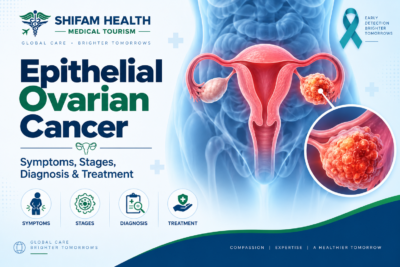
Epithelial Ovarian Cancer: Symptoms, Stages, Diagnosis & Treatment
Filters & Insights
Learn about epithelial ovarian cancer, including symptoms, stages, diagnosis, treatment options, surgery, chemotherapy, targeted therapy & prognosis.

Epithelial ovarian cancer is the most common broad category of ovarian cancer, arising from the cells covering the surface of the ovary or, in many cases, the fallopian tube. It’s often grouped clinically with fallopian tube and primary peritoneal cancers because they behave and are treated similarly. Symptoms are frequently subtle — bloating, pelvic discomfort, early fullness — which is why many cases are diagnosed at a more advanced stage.
Treatment typically combines surgery (cytoreductive/debulking surgery) with platinum-based chemotherapy, and increasingly, maintenance therapy with PARP inhibitors for eligible patients based on BRCA and HRD testing. Prognosis varies significantly by stage, histologic subtype, and molecular profile — there is no single number that applies to every patient.
If you or a family member has just heard the words “epithelial ovarian cancer,” this guide walks through what the diagnosis means, how staging and molecular testing shape treatment, what the current treatment landscape actually looks like in 2026, and what international patients should know about pursuing treatment in India.
Table of Contents
ToggleWhat Is Epithelial Ovarian Cancer?
Epithelial ovarian cancer develops from the epithelial cells that line the surface of the ovary. It is the most common category of ovarian cancer by far, though it is not the only one — germ cell tumors and sex cord-stromal tumors are separate, less common categories with different biology and treatment approaches, not covered in depth here.
An important clinical nuance: research over the past two decades has shown that a substantial share of what looks like ovarian cancer — particularly the high-grade serous subtype — actually originates in the fallopian tube rather than the ovary itself. Because of this, and because these cancers are treated the same way, oncologists frequently group epithelial ovarian cancer, fallopian tube cancer, and primary peritoneal cancer together under shared diagnostic and treatment guidelines. You may see all three terms used in your own records interchangeably by your care team — that’s expected, not a contradiction.
Types of Epithelial Ovarian Cancer
Epithelial ovarian cancer isn’t one disease — it’s a group of histologic subtypes that differ in biology, typical behavior, and treatment approach:
| Subtype | Relative Frequency | Notable Features |
|---|---|---|
| High-Grade Serous Carcinoma | Most common subtype, especially in advanced disease | Often linked to BRCA mutations; usually the subtype studied in PARP inhibitor trials |
| Low-Grade Serous Carcinoma | Less common | Tends to behave differently from high-grade; often less responsive to standard chemotherapy |
| Endometrioid Carcinoma | Moderate | Sometimes associated with endometriosis |
| Clear Cell Carcinoma | Less common | Often associated with endometriosis; can behave differently in response to chemotherapy |
| Mucinous Carcinoma | Less common | Distinct molecular profile; treatment approach can differ from serous subtypes |
This distinction matters clinically — a treatment plan appropriate for high-grade serous carcinoma isn’t automatically appropriate for clear cell or mucinous disease. Your pathology report identifying your specific subtype is one of the most important documents in your treatment planning.
Symptoms of Epithelial Ovarian Cancer
Early-stage epithelial ovarian cancer often causes vague, easy-to-dismiss symptoms, which is a major reason many cases are diagnosed at a more advanced stage.
Possible symptoms include:
- Persistent bloating
- Pelvic or abdominal pain
- Feeling full quickly when eating
- Difficulty eating or appetite changes
- Changes in bowel habits
- Urinary frequency or urgency
- Fatigue
- Unexplained weight change
- Abdominal swelling (sometimes related to fluid buildup, or ascites)
These symptoms are common and usually have benign explanations — this list should not cause alarm on its own. What matters clinically is persistence: symptoms that are new, occur frequently (guidelines often reference more than 12 times a month), and don’t resolve should prompt medical evaluation, particularly in combination.
Causes and Risk Factors
No single cause explains an individual diagnosis. Recognized risk factors include:
- Increasing age
- Family history of ovarian, breast, or related cancers
- BRCA1/BRCA2 pathogenic mutations
- Lynch syndrome and certain other hereditary cancer syndromes
- Endometriosis, particularly linked to clear cell and endometrioid subtypes
- Certain reproductive factors
A risk factor is not a cause. Many women diagnosed with epithelial ovarian cancer have no identifiable risk factor, and many women with strong risk factors never develop the disease.
Genetic and Hereditary Testing
This is one of the most clinically important sections of a modern ovarian cancer workup — testing results can directly change your treatment plan, not just your family’s future risk awareness.
Why testing matters:
- BRCA1/BRCA2 mutations (germline — inherited, or somatic — found only in the tumor) are strongly linked to epithelial ovarian cancer, particularly high-grade serous carcinoma, and directly influence eligibility for PARP inhibitor therapy.
- Lynch syndrome and other hereditary cancer genes are also tested for in appropriate cases.
- Germline testing looks at inherited mutations present in every cell of your body (relevant to your family’s risk).
- Somatic tumor testing looks specifically at mutations present in the tumor itself, which may or may not be inherited.
Current guidelines generally recommend genetic counseling and testing be offered to essentially all patients newly diagnosed with epithelial ovarian cancer, given how directly the results can affect treatment selection — not only patients with an obvious family history. Your oncology team or a genetic counselor can walk you through what testing is being recommended and why.
How Epithelial Ovarian Cancer Is Diagnosed
Diagnosis requires a combination of clinical evaluation, imaging, tumor marker testing, and ultimately tissue examination — no single test, including a blood test, can diagnose ovarian cancer on its own.
The typical pathway includes:
- Medical history and pelvic examination
- Transvaginal ultrasound — often the first imaging test
- CT scan of the abdomen and pelvis to assess disease extent
- MRI in selected cases where additional characterization is needed
- PET/CT in specific situations, such as assessing suspected recurrence
- CA-125 blood test — a tumor marker that can be elevated in ovarian cancer, but is not a standalone diagnostic test (see below)
- Surgical evaluation and biopsy — tissue examination remains the only way to confirm the diagnosis and subtype
Is CA-125 Enough to Diagnose Ovarian Cancer?
No. CA-125 can be elevated in numerous non-cancerous conditions — including endometriosis, fibroids, pelvic infection, and even menstruation — and it can be normal in some patients who do have ovarian cancer, particularly certain subtypes like mucinous carcinoma. CA-125 is a useful piece of the overall clinical picture and a helpful tool for monitoring response to treatment later, but it cannot confirm or rule out ovarian cancer by itself. Diagnosis always requires the fuller clinical and pathological picture.
Pathology and Molecular Testing
Once tissue is obtained — through biopsy or surgery — a pathologist examines it to determine:
- Histologic subtype (high-grade serous, endometrioid, clear cell, mucinous, low-grade serous)
- Grade — how abnormal the cancer cells look and how aggressively they tend to behave
- Extent of invasion and spread within the specimen
- Molecular/biomarker findings, including BRCA and HRD status where tested
This pathology report, combined with imaging and surgical findings, forms the foundation for staging and treatment planning.
Epithelial Ovarian Cancer Stages (FIGO Staging)
Staging follows the FIGO (International Federation of Gynecology and Obstetrics) system, and reflects how far the cancer has spread at the time of diagnosis and surgical assessment.
| Stage | General Meaning |
|---|---|
| Stage I | Cancer confined to one or both ovaries or fallopian tubes |
| Stage II | Cancer has spread to other pelvic organs, such as the uterus or nearby structures |
| Stage III | Cancer has spread to the peritoneum (abdominal lining) beyond the pelvis, and/or to nearby lymph nodes |
| Stage IV | Cancer has spread to distant sites outside the abdomen — for example, the liver interior, lungs, or distant lymph nodes; malignant cells in pleural fluid also indicate Stage IV |
This is a general framework, not a substitute for your actual staging report. Each stage has clinically important sub-classifications (for example, IA vs. IB vs. IC) determined by your surgical and pathological findings, and your specific stage is what your oncology team uses — not a simplified summary.
Stage Is Not the Same as Grade
These two terms are frequently confused:
- Stage describes how far the cancer has spread.
- Grade describes how abnormal the cancer cells look under the microscope and how aggressively the tumor tends to behave.
A patient can have early-stage but high-grade disease, or more advanced-stage but lower-grade disease. Both pieces of information — stage and grade — are used together in treatment planning, not interchangeably.
Treatment Overview
Epithelial ovarian cancer treatment is built around two core pillars — surgery and systemic therapy (chemotherapy and, increasingly, maintenance therapy) — with the sequence and specifics tailored to stage, subtype, molecular findings, and individual fitness for surgery.
Surgery and Cytoreductive Surgery
Surgery plays a central role in both diagnosis (confirming the extent of disease) and treatment (removing as much cancer as possible).
Cytoreductive (debulking) surgery aims to remove all visible tumor, or as much as can be safely removed. This typically involves removing the ovaries, fallopian tubes, uterus, omentum, and any visible tumor deposits in the abdomen and pelvis, along with lymph node assessment where indicated.
- Complete cytoreduction — no visible residual disease remaining — is associated with better outcomes, but it is not achievable in every patient, and your surgical team cannot promise this outcome before surgery.
- Residual disease — any tumor left behind — is described in your operative report and factors into further treatment planning.
- Fertility-sparing surgery may be considered in carefully selected, typically early-stage cases in younger patients who wish to preserve fertility — this is a specific conversation with your gynecologic oncologist, not a routine option.
Primary Surgery vs. Neoadjuvant Chemotherapy
Not every patient undergoes surgery first. Two general sequences are used:
Primary surgery first, followed by chemotherapy — more common when the disease appears operable with a realistic chance of complete or near-complete cytoreduction.
Neoadjuvant chemotherapy first (chemotherapy → interval surgery → additional chemotherapy) — considered when disease is extensive, when achieving meaningful cytoreduction upfront seems unlikely, or when a patient’s overall fitness makes immediate major surgery higher risk.
The decision between these two paths depends on disease distribution on imaging, expected operability, surgical complexity, and overall patient fitness — assessed by a multidisciplinary team. This is not a choice a patient makes alone or one this article can make for you — it requires direct evaluation of your imaging and clinical status.
Chemotherapy
Platinum-based chemotherapy remains the backbone of systemic treatment for epithelial ovarian cancer. The most commonly used combination is carboplatin plus paclitaxel, typically given intravenously over multiple cycles (often 6, though this varies by clinical scenario).
Chemotherapy may be given:
- After surgery (adjuvant) in the primary-surgery-first pathway
- Before surgery (neoadjuvant), followed by interval surgery, then further chemotherapy
- Intraperitoneally (directly into the abdominal cavity) in select cases, in addition to or instead of purely intravenous dosing
Common side effects include fatigue, nausea, hair loss, low blood counts, and increased infection risk — all generally manageable with supportive care, though your oncology team will discuss what to expect for your specific regimen.
Your exact chemotherapy plan depends on histologic subtype, stage, prior treatment, and overall health — there is no single universal regimen for every patient.
Maintenance Therapy
Maintenance therapy — treatment continued after initial chemotherapy response to delay recurrence — has become a major part of modern epithelial ovarian cancer care, and this is an area where guidelines have continued to evolve through 2025 and into 2026.
Current guideline-supported maintenance options generally include:
- PARP inhibitors (see below) for eligible patients based on BRCA/HRD status
- Bevacizumab, an anti-angiogenic agent, for select patients — often used in combination with or as an alternative to PARP inhibitor maintenance depending on individual risk factors and prior treatment
- Combination approaches in specific higher-risk scenarios
Eligibility is not universal. It depends on BRCA mutation status, HRD (homologous recombination deficiency) test results, response to initial platinum-based chemotherapy, whether bevacizumab was used earlier in treatment, and disease characteristics. As of the most recent NCCN guideline update, recommendations have been further refined for specific patient subgroups — for example, patients who are BRCA wild-type or of unknown status, did not receive bevacizumab during primary therapy, and test HRD-positive now have an updated maintenance recommendation. This kind of refinement happens regularly, which is exactly why maintenance therapy decisions should be made with your current treating oncologist rather than a general guide like this one.
PARP Inhibitors and BRCA/HRD Testing
PARP inhibitors work by exploiting a vulnerability in cancer cells that already have difficulty repairing DNA damage — a state called homologous recombination deficiency (HRD).
The relationship, simplified but not oversimplified:
BRCA1/BRCA2 mutation → one common cause of homologous recombination deficiency → PARP inhibitors are particularly effective in cells with this deficiency, because blocking the PARP repair pathway on top of an already-impaired repair system is especially damaging to the cancer cell.
BRCA and HRD are related but not identical. A patient can be HRD-positive without carrying a BRCA mutation — HRD testing captures a broader group of patients who may benefit from PARP inhibitor maintenance than BRCA testing alone would identify. This is why both tests are frequently ordered together in current practice, not just BRCA testing on its own.
Not every patient qualifies for PARP inhibitor maintenance. Eligibility depends on stage, histologic subtype (data most strongly support high-grade serous and higher-grade endometrioid disease), BRCA/HRD status, and treatment response. PARP inhibitors also carry their own side-effect profile, including fatigue, nausea, blood count changes, and a small but recognized long-term risk of secondary blood cancers (such as myelodysplastic syndrome), which is why oncologists monitor patients on extended maintenance therapy carefully — a genuine trade-off your oncologist will discuss, not a decision to take lightly.
Targeted Therapy
Beyond PARP inhibitors, targeted therapy in epithelial ovarian cancer is generally biomarker-driven rather than a broad category of interchangeable drugs. Bevacizumab, which targets tumor blood vessel formation, is the most established example, used both in combination with chemotherapy and as maintenance therapy in appropriate patients.
Newer targeted approaches continue to be studied in clinical trials. Because indications and approvals in this space change relatively quickly, ask your oncology team which targeted options — if any — apply to your specific molecular profile, rather than relying on any general resource, including this one, for a current drug list.
Immunotherapy
Immunotherapy is not a standard, universal treatment for epithelial ovarian cancer at this time. Unlike some other cancer types, large trials of immune checkpoint inhibitors in the frontline setting for ovarian cancer (for example, the JAVELIN trial evaluating avelumab) have generally not shown the benefit hoped for in unselected patients.
Immunotherapy may be relevant in more specific, biomarker-selected situations — for example, in tumors with MSI-H (microsatellite instability-high) or dMMR (mismatch repair deficient) status, which occur in a minority of ovarian cancers. Discuss with your oncology team whether biomarker testing relevant to immunotherapy eligibility applies to your case — it is not an automatic part of every treatment plan.
Radiation Therapy
Radiation plays a more limited, selective role in epithelial ovarian cancer compared with surgery and systemic therapy. It may be considered for:
- Symptom control or palliation in specific situations
- Selected cases of localized recurrence
- Certain specific clinical circumstances your radiation oncologist would identify
Radiation is not a routine, standard component of frontline epithelial ovarian cancer treatment for most patients.
Recurrent Epithelial Ovarian Cancer
Recurrence is unfortunately common in advanced-stage epithelial ovarian cancer, and treatment approach depends heavily on how the disease responds when it returns.
- Platinum-sensitive recurrence — disease that returns a meaningful interval (commonly cited as more than 6 months) after completing platinum-based chemotherapy — generally responds well to platinum-based treatment again, and may be a candidate for further surgery, chemotherapy, and PARP inhibitor maintenance/rechallenge in appropriate cases.
- Platinum-resistant or platinum-refractory disease — recurrence within a shorter interval, or disease that doesn’t respond to platinum at all — is managed differently, typically with non-platinum chemotherapy options, targeted therapy where applicable, and often stronger consideration of clinical trial enrollment.
- Surgery for recurrence is considered selectively, not routinely, based on disease pattern and prior response.
Recurrent disease management is highly individualized. This overview is meant to help you understand the terminology your oncologist may use — not to suggest a specific treatment path for your situation.
Prognosis and Survival
Prognosis in epithelial ovarian cancer depends on multiple factors together, not any single one:
- Stage at diagnosis
- Histologic subtype
- Grade
- BRCA/HRD status
- Completeness of surgical cytoreduction
- Response to initial chemotherapy
- Overall health and fitness
- Pattern of recurrence, if it occurs
Be cautious of any source, including this one, presenting a single confident survival percentage without this context. Published statistics describe outcomes for groups of patients studied under specific conditions — they do not predict any individual’s outcome. Your oncologist, who has your complete clinical picture, is the right person to discuss what the data means specifically for you.
Follow-Up and Monitoring
After completing initial treatment, follow-up generally includes:
- Regular clinical visits and symptom review
- CA-125 monitoring where it was informative at diagnosis (not useful in every patient, depending on subtype)
- Imaging when clinically indicated, rather than on a fixed universal schedule
- Ongoing management of treatment-related side effects
Your specific follow-up schedule is individualized by your oncology team based on your stage, treatment received, and risk of recurrence — there is no single protocol that applies to everyone.
Epithelial Ovarian Cancer Treatment Cost in India
Published cost estimates for ovarian cancer treatment in India vary enormously — from roughly ₹50,000 for a single component up to ₹30,00,000+ for extensive, multi-line advanced disease treatment — which reflects real differences in disease stage and treatment complexity, not inconsistent pricing. Rather than quoting one number, it’s more useful to understand what actually drives the total:
- Diagnostic work-up — imaging, CA-125 and other tumor markers, biopsy
- Pathology and molecular testing — including BRCA and HRD testing, which typically add a meaningful, separate cost
- Surgery — cytoreductive/debulking surgery cost varies significantly with complexity and length of procedure; commonly cited in the range of roughly ₹2,00,000–₹4,00,000 for the surgical component alone in published sources, though complex cases with extensive disease cost more
- Hospitalization and ICU care, if needed, particularly after extensive surgery
- Chemotherapy — commonly cited per-cycle costs range widely (roughly ₹40,000–₹1,50,000+ per cycle depending on drugs and hospital), typically across 6 cycles
- Maintenance therapy — PARP inhibitors are oral targeted drugs taken over an extended period (often 2 years or more) and represent a significant additional cost that is frequently not included in advertised “package” prices — confirm explicitly whether maintenance therapy is included in any quote you receive
- Targeted therapy or immunotherapy, where indicated
- Follow-up imaging and monitoring
Why International Patients Consider India
India has become a significant destination for international gynecologic cancer patients, driven by a combination of specialist availability, advanced surgical and diagnostic infrastructure, and treatment costs substantially lower than the US, UK, or Gulf region for comparable care.
Rather than claiming India is universally “the best,” the more useful question is: what should you actually compare before choosing a center for epithelial ovarian cancer treatment?
- Does the hospital have a dedicated gynecologic oncologist experienced specifically in cytoreductive surgery — not a general oncologic surgeon operating outside their primary focus?
- Is there in-house or closely partnered molecular testing for BRCA and HRD, with reasonable turnaround time?
- Does the center have a functioning multidisciplinary tumor board discussing gynecologic cancer cases specifically?
- What is the hospital’s ICU capacity and post-operative care infrastructure for major abdominal surgery?
- Does the center have genuine clinical trial access, relevant for patients with recurrent or difficult-to-treat disease?
- Is there a dedicated international patient department that can coordinate report review, itemized cost estimates, and remote follow-up after you return home?
Choosing an Ovarian Cancer Hospital
Rather than a superficial “Top 10” ranking, use this as an evaluation checklist:
- Fellowship-trained gynecologic oncologist with a demonstrated cytoreductive surgery caseload
- Medical oncologist experienced in ovarian cancer systemic therapy, including maintenance therapy management
- Pathology and molecular diagnostics, including BRCA/HRD testing
- Experienced surgical and ICU team for extensive abdominal surgery
- Chemotherapy day-care/infusion services
- Multidisciplinary tumor board specific to gynecologic cancer
- Clinical trial access, where relevant to your case
- International patient coordination team
Verify accreditation (JCI/NABH) and each specialist’s actual credentials, training, and case experience directly with the hospital before committing.
International Patient Treatment Journey
- Share your reports — imaging, pathology, CA-125 and other test results, and any prior treatment history.
- Specialist and pathology review by a gynecologic oncology team, occasionally requesting additional slides or repeat imaging.
- Treatment recommendation and itemized cost estimate, including whether maintenance therapy is factored in.
- Hospital selection and medical visa documentation support.
- Travel planning and arrival coordination.
- In-person consultation and, where needed, further workup on arrival.
- Surgery and/or chemotherapy, per your treatment plan.
- Recovery and discharge planning.
- Remote follow-up — pathology results, side-effect monitoring, and maintenance therapy coordination once you’re back home.
No responsible facilitator can guarantee visa approval, treatment acceptance, or treatment outcomes — and any source that does should raise concern.
How Shifam Health Supports International Ovarian Cancer Patients
Shifam Health is a medical tourism facilitator — not a hospital, oncology clinic, or diagnostic center, and not a substitute for your treating physician. What we help coordinate:
- Sharing your imaging, pathology, and molecular testing reports with a partner hospital’s gynecologic oncology team
- Requesting an itemized treatment and cost estimate — including clarifying whether maintenance therapy is factored in
- Hospital and specialist shortlisting based on your specific diagnosis and stage
- Medical visa documentation support
- Airport pickup, accommodation guidance, and local coordination during treatment
- Interpreter support where needed
- Remote follow-up communication, including maintenance therapy coordination, once you’re back home
We don’t diagnose ovarian cancer, recommend a specific treatment, or guarantee outcomes — those decisions belong to you and your treating oncology team. Our role is to remove the logistical burden so you can focus on the medical decision itself.
If you or a family member has an epithelial ovarian cancer diagnosis and are exploring treatment options in India, share your reports with our team on WhatsApp or through a short inquiry form. There’s no obligation, and most patients hear back with an initial specialist review within 24–48 hours.
Frequently Asked Questions
What is epithelial ovarian cancer?
It is the most common category of ovarian cancer. Many high-grade serous cancers originate in the fallopian tube and are treated similarly.
What are the main types?
The major subtypes include high-grade serous, low-grade serous, endometrioid, clear cell, and mucinous carcinoma.
What are the symptoms?
Persistent bloating, pelvic or abdominal pain, early fullness, urinary changes, and fatigue may occur.
What are the stages?
FIGO stages range from Stage I, limited to the ovaries or fallopian tubes, to Stage IV, involving distant spread.
How is it diagnosed?
Evaluation may include pelvic examination, ultrasound, CT or MRI, CA-125 testing, and tissue examination. No single test confirms the diagnosis.
Is CA-125 enough to diagnose ovarian cancer?
No. CA-125 can rise from noncancerous conditions and may remain normal in some patients with ovarian cancer.
What is cytoreductive surgery?
Also called debulking surgery, it aims to remove all visible cancer when safely possible and may involve the ovaries, fallopian tubes, uterus, omentum, and affected tissues.
What is neoadjuvant chemotherapy?
Chemotherapy given before surgery to reduce tumor burden, followed by interval surgery and additional chemotherapy in selected patients.
What are PARP inhibitors?
These targeted medicines interfere with DNA repair and can be particularly effective in cancers with BRCA mutations or homologous recombination deficiency (HRD).
What is the prognosis?
Prognosis varies according to stage, subtype, molecular features, overall health, and treatment response.
How much does treatment cost in India?
Surgery plus initial chemotherapy may cost approximately $4,000–$12,000+, while maintenance or recurrent treatment can add substantially to costs. A personalized quote is essential.
Sources & Further Reading
- NCCN Clinical Practice Guidelines in Oncology — Ovarian Cancer/Fallopian Tube Cancer/Primary Peritoneal Cancer, Version 3.2025
- Renz, et al. Cancer of the ovary, fallopian tube, and peritoneum: 2025 update. International Journal of Gynecology & Obstetrics, 2025.
- JAMA Network Open — PARP Inhibitor Maintenance After First-Line Chemotherapy in Advanced-Stage Epithelial Ovarian Cancer: Systematic Review and Meta-Analysis, 2025
- American Cancer Society — Ovarian Cancer
- FIGO Cancer Report / Staging Guidelines
This article is for general educational purposes and does not constitute individualized medical advice. Treatment decisions for epithelial ovarian cancer should always be made in consultation with your own gynecologic oncologist and multidisciplinary care team, based on your complete pathology, staging, and molecular testing results.




Popular Posts From Last Week
- September 10, 2026
- shifamhealth
Medically reviewed content · Published 2026 · Last reviewed August 2026 Blount’s disease, also called tibia vara, is…
- September 15, 2026
- shifamhealth
Medically reviewed content · Published 2026 · Last reviewed September 2026 Bow legs medically called genu varum —…
- September 14, 2026
- shifamhealth
Medically reviewed content · Published 2026 · Last reviewed September 2026 A “broken ankle” is the common term…
- September 15, 2026
- shifamhealth
Medically reviewed content · Published 2026 · Last reviewed August 2026 A burst fracture is a spinal vertebra…
- September 13, 2026
- shifamhealth
Carpal tunnel syndrome (CTS) is compression of the median nerve as it passes through the carpal tunnel —…
- September 13, 2026
- shifamhealth
If a lumbar MRI report mentions “kissing spinous processes” or “Baastrup’s disease,” it’s worth pausing before assuming this…
- September 10, 2026
- shifamhealth
Chronic back pain is one of the most common reasons people seek medical care, and also one of…
- September 11, 2026
- shifamhealth
Myelopathy means dysfunction of the spinal cord itself — not a single disease, but a syndrome that can…
- September 14, 2026
- shifamhealth
Scoliosis is a three-dimensional spinal deformity — sideways curvature combined with rotation — and it is genuinely not…
- September 12, 2026
- shifamhealth
Medically reviewed content · Published 2026 · Last reviewed September 2026 Discitis is inflammation or infection involving an…
- September 12, 2026
- shifamhealth
A femoral hernia occurs when tissue often part of the bowel or fatty tissue — pushes through the…
- September 11, 2026
- shifamhealth
Kümmell’s disease refers to a delayed collapse of a vertebra — a nonunion or failure to heal properly…