



Home > Blog > Bunion Surgery Cost in India (2026): Procedure, Recovery Time, Best Hospitals & Cost Breakdown
Bunion Surgery Cost in India (2026): Procedure, Recovery Time, Best Hospitals & Cost Breakdown
Filters & Insights
Explore cartilage repair surgery cost in India, treatment options, recovery time, leading hospitals, and factors affecting the overall cost for international patients.

How Much Does Bunion Surgery Cost in India?
Bunion surgery in India typically costs between $2,000 and $6,500 USD for international patients, depending on the surgical technique, severity of the deformity, implants required, hospital tier, and rehabilitation program. Standard Chevron osteotomy for a mild-to-moderate bunion sits toward the lower end. Complex reconstruction using the Lapidus procedure, or revision surgery after a previous failed correction, costs significantly more. These are planning estimates — your actual quote requires an X-ray or clinical photograph reviewed by a foot and ankle surgeon.
Quick Cost Reference: What to Expect
| Procedure | Estimated Cost (USD) | Hospital Stay | Weight-Bearing |
|---|---|---|---|
| Chevron Osteotomy (Mild–Moderate) | $2,000–$3,500 | Day surgery–1 night | Protected weight-bearing in a boot from day 1. |
| Scarf Osteotomy (Moderate) | $2,500–$4,000 | 1–2 nights | Protected weight-bearing; full weight-bearing at 6–8 weeks. |
| Lapidus Procedure (Severe / Hypermobile) | $3,500–$5,500 | 1–2 nights | Non-weight-bearing for 6 weeks, then boot until about 12 weeks. |
| Minimally Invasive Surgery (MIS) | $2,500–$4,500 | Day surgery | Protected weight-bearing from day 1. |
| Akin Osteotomy (Adjunct) | +$300–$600 | Same as primary procedure | Same as primary procedure. |
| Revision Bunion Surgery | $4,000–$6,500 | 2–3 nights | Non-weight-bearing for 6–8 weeks. |
| Physiotherapy Program (4 Weeks) | $300–$900 | Outpatient | Progressive rehabilitation. |
What’s typically included: Surgeon fee, anesthesiologist, operating theatre, implants (screws/plates), standard diagnostics, medicines during admission, initial physiotherapy. Typically not included: International flights, extended accommodation, outpatient physiotherapy beyond discharge, medical visa fees. Always request an itemized written quote against your specific X-ray findings before booking travel.
Table of Contents
ToggleWhat Is a Bunion and Why Does It Develop?
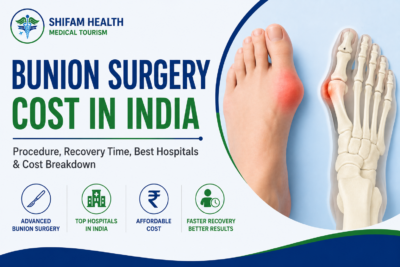
A bunion medically called hallux valgus, is a progressive deformity of the first metatarsophalangeal (MTP) joint at the base of your big toe. The big toe angles toward the second toe, the first metatarsal bone drifts in the opposite direction, and the joint prominence on the inner side of the foot enlarges, becomes inflamed, and eventually causes significant pain.
What most patients do not realise is that a bunion is not simply a bony lump that grows on the foot. It is a structural collapse of the alignment between the first metatarsal and the big toe — the lump is the visible consequence of that malalignment, not the primary problem. This matters for treatment, because removing only the bump without correcting the underlying bone alignment produces poor results and a high recurrence rate.
Why bunions develop is usually a combination of factors rather than a single cause:
- Genetics is the dominant factor in most cases. If your mother or grandmother had bunions, you have a significantly elevated risk regardless of footwear choices.
- Foot mechanics — flat feet, ligament laxity, and hypermobile first ray (excessive movement at the first metatarsocuneiform joint) all contribute to progressive deformity.
- Footwear — narrow, pointed toe boxes and high heels accelerate deformity progression in genetically susceptible feet. They do not cause bunions in feet without underlying predisposition.
- Inflammatory arthritis — rheumatoid arthritis in particular can drive rapid bunion development and requires specific consideration before surgery.
Understanding why your bunion developed matters for surgical planning. A patient with a hypermobile first ray needs a different procedure than a patient with a rigid moderate deformity. A surgeon who offers the same operation to every bunion patient is not individualising treatment.
Symptoms: When a Bunion Is Affecting Your Life
Bunions progress at different rates and cause different degrees of disability. Not all bunions need surgery. What typically drives patients to seek surgical consultation:
Pain at the bunion prominence — initially with tight shoes, later with any footwear, eventually even at rest in severe cases. The pain is caused by pressure on the inflamed bursa over the joint and, in advanced cases, by arthritis within the MTP joint itself.
Difficulty finding shoes that fit without pressure on the prominence. This is one of the most consistently reported functional complaints, particularly among working patients and those who need professional footwear.
Second toe problems — as the big toe angulates, it pushes under or over the second toe, causing hammer toe deformity, corns, and ulceration. Left untreated, these secondary deformities may require their own correction at the time of bunion surgery.
Walking and balance problems — in severe deformity, the altered foot biomechanics affect gait, cause forefoot pain under the lesser metatarsals (metatarsalgia), and reduce walking distance.
Cosmetic concern — particularly among younger patients. This alone is generally not considered sufficient indication for surgery, but it frequently accompanies the functional complaints above.
When Is Surgery Actually Recommended?
Bunion surgery is recommended when conservative (non-surgical) measures have failed to provide adequate relief and the deformity is causing meaningful functional limitation. It is not routinely recommended for asymptomatic bunions, however large they appear.
Conservative management first: Before surgery is considered, most guidelines recommend a trial of conservative measures including wide toe box footwear, custom orthotics to offload the joint, padding of the prominence, physiotherapy, and anti-inflammatory medication. These approaches do not correct the deformity they manage symptoms. For many patients, particularly those with mild deformity and manageable pain, conservative management is appropriate and indefinitely sustainable.
When surgery becomes appropriate:
- Pain that significantly limits daily activity despite footwear modification and orthotics
- Progressive deformity causing secondary toe problems
- Failed conservative management over a reasonable trial period (typically 3–6 months minimum)
- Occupational requirements that cannot be met with conservative measures
- Associated second toe deformity requiring concurrent correction
When surgery should be approached cautiously or delayed:
- Patients with peripheral vascular disease or poor foot circulation
- Uncontrolled diabetes with neuropathy
- Active inflammatory arthritis requiring medical optimisation first
- Patients unwilling to comply with the post-operative non-weight-bearing or restricted-weight-bearing protocol — non-compliance is the single biggest predictor of poor outcome and recurrence
Types of Bunion Surgery: Procedures Explained Honestly
Chevron Osteotomy
The Chevron (or Austin) osteotomy is the most commonly performed bunion correction for mild-to-moderate deformity. The surgeon makes a V-shaped cut in the head of the first metatarsal, shifts the bone laterally to reduce the angular deformity, and fixes it with one or two small screws.
Who it suits: Intermetatarsal angle (IMA) typically under 13–15 degrees, first MTP joint with reasonable cartilage, patients without hypermobility of the first ray.
Honest limitations: Chevron osteotomy can only correct a limited degree of deformity. Attempting it in moderate-to-severe deformity produces inadequate correction and high recurrence. The surgery is technically straightforward relative to other osteotomies, which means it is widely offered — including by surgeons without subspecialty foot and ankle training. For straightforward cases, this is fine. For anything beyond mild-moderate, it is not the right choice.
Scarf Osteotomy
The Scarf osteotomy makes a Z-shaped cut along the length of the first metatarsal shaft, allowing the bone to be shifted laterally and rotated to correct both angular and rotational deformity. It can achieve greater correction than Chevron and is the workhorse procedure for moderate bunion deformity in many European and Indian foot and ankle centres.
Who it suits: Moderate deformity (IMA roughly 13–18 degrees), cases requiring rotational correction, cases where the metatarsal shaft length needs to be maintained.
Honest limitations: More technically demanding than Chevron. The longer bone cut means a slightly longer healing time. Not ideal for very severe deformity with a hypermobile first ray.
Lapidus Procedure (First Tarsometatarsal Arthrodesis)
The Lapidus procedure fuses the joint at the base of the first metatarsal (the first tarsometatarsal joint) rather than cutting the metatarsal itself. By stabilising the root cause of the deformity — the hypermobile first ray — it addresses the fundamental biomechanical problem rather than just its angular consequence.
Who it suits: Severe deformity (IMA above 18 degrees), patients with demonstrable first ray hypermobility, patients with flatfoot contributing to the deformity, revision cases after failed osteotomy.
Honest limitations: Requires strict non-weight-bearing for typically 6 weeks, compared to protected weight-bearing from day one for Chevron. Recovery is longer. The fusion eliminates motion at the first TMT joint — most patients do not notice functional loss from this, but it is a permanent structural change. This is the right procedure for the right patient, but it is not appropriate for mild-moderate bunions.
Minimally Invasive Bunion Surgery (MIS)
Minimally invasive bunion surgery sometimes called percutaneous bunion surgery uses small stab incisions and a burr to perform the bone correction without the open exposure of traditional osteotomy. It has gained significant traction in the last decade and is now offered at specialist foot and ankle centers in India.
What the evidence shows: MIS can produce equivalent correction to open osteotomy for mild-to-moderate deformity with smaller scars, less soft tissue disruption, and potentially faster early recovery. The technique requires specific training and a learning curve — outcomes in experienced hands are comparable; outcomes in inexperienced hands are not.
The “laser bunion surgery” question: You will encounter this term in searches and in marketing. There is no laser involved in bunion correction — the bone is cut with a burr or saw regardless of incision size. “Laser bunion surgery” is a marketing term, not a medical one. If a centre is advertising laser bunion surgery, ask them specifically what they mean. Be appropriately sceptical.
Honest limitations: MIS is not suitable for severe deformity, cases requiring a Lapidus procedure, or revision surgery. Confirm that your chosen surgeon performs MIS regularly — not just occasionally.
Akin Osteotomy
The Akin osteotomy is a small corrective cut at the base of the proximal phalanx of the big toe. It is almost always performed in addition to a primary metatarsal osteotomy rather than alone, addressing residual toe angulation after the main correction. Most patients undergoing Chevron or Scarf will have an Akin added if needed — it is not a separate decision but part of the surgical plan.
First MTP Arthrodesis (Fusion)
When the first MTP joint itself has significant arthritis alongside the bunion deformity, or in cases of very severe deformity with joint destruction, fusion of the first MTP joint addresses both problems simultaneously. This eliminates the joint entirely. The toe is fixed in a functional position and no longer bends.
Who it suits: Severe bunion with concurrent first MTP joint arthritis, patients who have failed previous correction, rheumatoid arthritis patients with joint destruction, older patients where durability outweighs the need for joint motion.
Honest limitations: The toe does not move. Most patients adapt well and walk normally, but high-heeled shoes requiring significant MTP joint extension are not possible post-fusion. Clarify this before consenting.
Understanding Your Bunion Surgery Cost in India
What a Complete International Patient Package Should Include
When your medical coordinator sends a cost estimate, this is what a properly structured international patient quote should cover:
Included in the surgical package:
- Surgeon’s fee
- Anaesthesiologist fee
- Operating theatre
- Hospital room (day surgery or overnight admission as required)
- Pre-operative blood tests, ECG, and weight-bearing foot X-rays (if done in India)
- Implants — screws, plates, or fixation devices as required by the procedure
- Medicines during hospital stay
- Surgical boot or post-operative shoe provided at discharge
- Nursing care and dressings
- Initial physiotherapy assessment and discharge exercises
What you need to confirm is included:
- The specific implant brand (generic vs branded implants have different costs — ask)
- Akin osteotomy if likely needed (sometimes charged additionally)
- Post-operative outpatient physiotherapy sessions
- Follow-up appointments
Not typically included:
- International flights
- Hotel or serviced apartment between surgery and return home
- Outpatient physiotherapy beyond the inpatient program
- Medical visa fees
- Travel insurance
- Management of complications requiring additional procedures
Factors That Determine Your Final Cost
Deformity severity is the primary driver. A mild bunion corrected with a Chevron under local anaesthesia as a day case costs significantly less than a severe deformity requiring Lapidus reconstruction with plating, an extended non-weight-bearing period, and complex rehabilitation.
Associated deformities — if your second toe has developed a hammer toe deformity secondary to the bunion, both require correction simultaneously. Each additional procedure adds to the total. This is not upselling — leaving secondary toe deformities uncorrected during bunion surgery often causes persistent forefoot pain.
Bilateral surgery — operating on both feet simultaneously is occasionally appropriate (under the same anaesthetic, recovery is combined rather than sequential) but more commonly they are staged 3–6 months apart. Sequential surgery doubles accommodation and visa costs but is often the safer surgical approach. Discuss this explicitly.
Hospital tier — NABH-accredited hospitals in Delhi, Mumbai, Bangalore, and Chennai with dedicated foot and ankle surgery programs charge more than smaller regional centres. For complex reconstruction, the expertise at a subspecialty centre justifies the additional cost.
Surgeon subspecialty experience — India has fellowship-trained foot and ankle surgeons, but they are not evenly distributed across all hospitals that market bunion surgery. Verify that your surgeon has specific foot and ankle subspecialty training, not just general orthopaedic qualifications. For Lapidus procedures and revision surgery, this distinction matters significantly.
Rehabilitation — four weeks of outpatient physiotherapy in India after surgery typically costs $300–$900 total. For international patients returning to countries where equivalent physiotherapy costs $80–$150 per session, completing rehabilitation in India can make strong financial sense.
India vs Other Countries: Cost Comparison
| Country | Estimated Cost (USD) | NHS / Public Wait | Notes |
|---|---|---|---|
| India | $2,000–$6,500 | N/A | Comprehensive bunion procedures with a significant cost advantage. |
| USA | $8,000–$25,000+ | N/A (Private) | High costs; insurance is often essential for local patients. |
| UK | £5,000–£15,000 (Private) | 18+ months (NHS) | Elective foot surgery often has long NHS waiting lists. |
| Germany | €6,000–€18,000 | 4–8 weeks | High-quality orthopedic care; language may be a consideration. |
| Turkey | $2,500–$7,000 | 1–2 weeks | Growing expertise in foot and ankle surgery. |
| Thailand | $4,000–$10,000 | 1–2 weeks | Available at leading hospitals, particularly in Bangkok. |
| UAE | $6,000–$16,000 | 1–2 weeks | Modern facilities with convenient access for Gulf-region patients. |
India’s cost advantage is real and consistent — typically 70–80% below USA pricing and 60–70% below UK private rates. The quality differential at India’s top foot and ankle centres is far smaller than the price differential suggests. The caveat that applies across all medical tourism decisions applies here too: the quality is at the best centres, not uniformly across every facility marketing bunion surgery.
Risks and Complications: What Patients Are Rarely Told Clearly
Bunion surgery has a generally good safety profile, but it is not without meaningful risks. Understanding them honestly is part of making an informed decision — and most competitor content in this space glosses over them.
Recurrence is the most important risk to understand. Bunions can recur after surgical correction, and the recurrence rate is not trivial. Reported long-term recurrence rates in the literature vary widely by technique, patient factors, and follow-up duration — but figures of 10–30% over 10+ years are not unusual, particularly for osteotomy techniques in patients who have underlying hypermobility or flatfoot deformity that was not simultaneously addressed. The Lapidus procedure, which addresses root-cause hypermobility, generally shows lower recurrence rates in appropriate candidates than isolated metatarsal osteotomy. If you are considering bunion surgery, ask your surgeon specifically about recurrence risk for your deformity pattern and chosen procedure.
Under-correction or over-correction — the bone is not moved quite enough, or is moved too far, leading to persistent deformity or a crossover toe where the big toe angles away from the second toe. This requires revision surgery to address.
Stiffness of the first MTP joint — post-operative stiffness is common and usually resolves with physiotherapy. Permanent stiffness (hallux rigidus developing after surgery) occurs in a minority but is a recognised complication, particularly after procedures that involve the joint surface.
Nerve irritation (neuritis) — the dorsomedial cutaneous nerve runs across the surgical field. Retraction or minor injury to this nerve during surgery causes numbness or tingling along the inner border of the big toe. In most cases this resolves over weeks to months. Permanent numbness is uncommon but possible.
Delayed healing or non-union — the bone cut takes longer to heal than expected, or fails to heal properly. Risk is increased in smokers, diabetic patients, patients on certain medications (particularly methotrexate), and those who load the foot prematurely.
Infection — superficial wound infection occurs in a small percentage of cases and responds to antibiotics. Deep infection involving the bone (osteomyelitis) is rare but serious and may require removal of implants and prolonged treatment.
Transfer metatarsalgia — pain under the lesser metatarsal heads (the balls of the foot) that develops or worsens after bunion surgery. When the first metatarsal is shortened or elevated during correction, load transfers to the second and third metatarsal heads. Careful surgical planning minimises this risk.
Need for revision surgery — a combination of the above complications may require further surgery. Revision bunion surgery is more complex and more expensive than primary surgery, with a lower probability of achieving a perfect result.
The honest overall picture: Most patients who undergo bunion surgery by an experienced foot and ankle surgeon achieve meaningful improvement in pain and function. But bunion surgery is not cosmetic surgery with a universally high satisfaction rate — it involves bone cutting, hardware implantation, and a recovery measured in months, not weeks. The decision to proceed should be based on meaningful functional limitation that has not responded to conservative management, not on cosmetic dissatisfaction alone.
Recovery Timeline: What Actually Happens, Month by Month
Recovery from bunion surgery is consistently underestimated by patients, and this is the most common source of post-operative dissatisfaction. Set your expectations accurately before surgery.
Week 1: You will be in a surgical boot or post-operative shoe with your foot elevated as much as possible. Swelling and pain are significant. Most Chevron and MIS patients can walk short distances in a flat surgical shoe from day one, but walking is slow and uncomfortable. Lapidus patients are strictly non-weight-bearing on crutches. Focus is on swelling management — foot elevation above heart level when resting.
Weeks 2–6: Chevron and Scarf patients typically progress from a surgical shoe toward a wide trainer around week 4–6. Lapidus patients remain non-weight-bearing until approximately week 6, then transition through a boot. Driving is not possible in a right-foot surgical boot — if your surgery is on the right foot, factor this into your travel planning. Physiotherapy begins with gentle range-of-motion exercises and progresses as healing allows.
Month 2–3: Most patients are walking in wide, comfortable shoes (trainers/sneakers) by 6–8 weeks for simpler procedures. Swelling is present but decreasing. The foot looks and feels significantly better than at one month. Return to office or sedentary work is usually possible by 6–8 weeks. Physical or standing work takes longer.
Month 4–6: Progressive return to normal footwear. Residual swelling — particularly around the surgical site — is still common and can persist for up to 12 months. This is normal and does not indicate a complication. Most patients can begin low-impact sport (swimming, cycling) around 3–4 months. Running and high-impact activity typically from month 4–6 depending on healing.
Important for international patients: For a Chevron or MIS procedure, plan for a minimum 2–3 week stay in India (surgery plus initial recovery and physiotherapy). For Lapidus, plan for 4–6 weeks or consider returning home and completing rehabilitation with home-country physiotherapists following the Indian surgeon’s protocol.
Bilateral Bunion Surgery: One Operation or Two?
Many patients have bunions on both feet. A common question is whether to operate on both simultaneously or stage them 3–6 months apart.
Simultaneous bilateral surgery means one anaesthetic, one recovery period, and one trip to India. The trade-off is that you are non-weight-bearing or restricted on both feet simultaneously — requiring full assistance for daily activities for several weeks, which is genuinely difficult unless you have significant care support.
Staged bilateral surgery means two separate trips, two recovery periods, but each recovery is on one foot — you can use the operated foot in a surgical shoe or boot while the other foot is normal, which dramatically improves your independence.
Most experienced foot and ankle surgeons recommend staging bilateral bunion surgery unless there are compelling reasons (patient lives very far away, cost of two trips is prohibitive, patient preference with realistic understanding of the challenges). Discuss this specifically with your surgeon — the right answer depends on your home support situation, occupation, and deformity severity.
Planning Your Treatment in India: A Practical Patient Guide
Before you book anything: Send weight-bearing X-rays of both feet (even if only one is being treated) and a brief description of your symptoms and failed conservative measures to your Shifam Health coordinator. A written surgical opinion should come back to you before you make any travel plans. Do not travel based on a verbal estimate.
Getting your cost estimate right: A proper quote specifies: which procedure, which implants, what hospital, how many nights, whether Akin osteotomy is included, and what physiotherapy is included. A quote that just says “$3,000 for bunion surgery” is not adequate — push for itemisation.
Medical visa: India’s e-Medical Visa is available online, requires an appointment letter from an Indian hospital, is typically processed within 3–7 business days, and permits one accompanying attendant (who receives an Attendant Visa). For staged bilateral surgery, your second trip may use the same visa if within its validity period — confirm this with your coordinator.
Accommodation: Post-operatively you need ground-floor or elevator-accessible accommodation within close proximity to the hospital for physiotherapy appointments. Most major Indian hospitals with international patient programs have accommodation partners — ask specifically for post-surgical accommodation recommendations, not general hotel suggestions.
What to bring: Your most recent foot X-rays (weight-bearing), details of any previous foot surgery, a list of current medications (including blood thinners and anti-inflammatories — these need to be managed around surgery), and comfortable slip-on shoes that are one to two sizes larger than normal (your operated foot will swell into them).
After you return home: Leave India with a written discharge summary, post-operative X-rays showing the correction achieved, your physiotherapy protocol in English, implant details (for airport security metal detectors), and your surgeon’s contact for remote follow-up. Good Indian centres accustomed to international patients provide WhatsApp or telemedicine follow-up as standard.


Popular Posts From Last Week
- July 13, 2026
- shifamhealth
Written by: Shifam Health Content Team | Medically reviewed by: Endocrine Surgery Advisory Panel, Shifam Health | Published:…
- July 13, 2026
- shifamhealth
Stapedectomy surgery in India typically costs $900 to $3,500 (roughly ₹75,000 to ₹2,90,000) for international patients, depending on…
- July 14, 2026
- shifamhealth
Parotid gland tumor surgery (parotidectomy) in India typically costs $1,500 to $5,000 for international patients, depending on whether…
- July 15, 2026
- shifamhealth
How can patients from Kazakhstan get a Medical Visa for India? Citizens of Kazakhstan can apply for an…
- July 10, 2026
- shifamhealth
Kidney stones can cause severe pain, blood in the urine, recurrent infections, and even kidney damage if left…
- July 11, 2026
- Areen Fatima
HIPEC surgery cost in India typically ranges from USD 8,000 to 18,000 for a complete international-patient package —…
- July 10, 2026
- shifamhealth
If you or a family member has just been told there’s a bulge, an aneurysm in the aorta,…
- July 14, 2026
- shifamhealth
A few days after birth, a doctor points to your baby’s foot and says the word “clubfoot.” In…
- July 14, 2026
- shifamhealth
How much does an IVC filter cost in India? Published pricing from Indian hospitals ranges widely — roughly…
- July 10, 2026
- shifamhealth
Recovery is one of the biggest concerns for anyone considering weight loss surgery. Questions like “How long will…
- July 16, 2026
- shifamhealth
How Much Does Bunion Surgery Cost in India? Bunion surgery in India typically costs between $2,000 and $6,500…
- July 9, 2026
- shifamhealth
Hearing that a knee replacement has failed can be frustrating, especially after expecting years of pain-free movement. Whether…